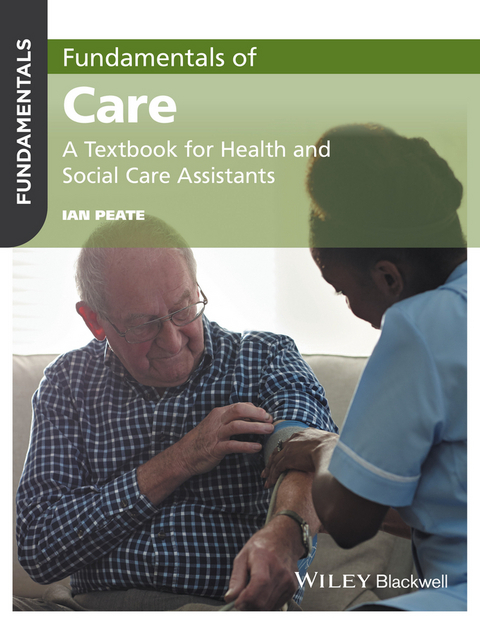
Fundamentals of Care (eBook)
John Wiley & Sons (Verlag)
978-1-119-21222-5 (ISBN)
Fundamentals of Care is an accessible introductory textbook for all health care assistants; assistant practitioners and social care support workers who are undertaking the newly introduced, mandatory Care Certificate, as well as offering a resource for providing care and support.
Practically focused, each chapter begins with the outcomes associated with each standard, which helps contextualise and focus the reader on the content and relevance to the Care Certificate. The book also includes exercises to encourage the reader to stop, look, listen and act, thinking cap activity promotes further thinking and application to care and support provision along with case studies and resource files.
Written to help the reader come to terms with the role and function of the heath and care assistants, Fundamentals of Care offers support to those undertaking the Care Certificate and to assist those who already work as health and care assistants, helping them in their quest to enhance safe and effective care.
Ian Peate OBE is Editor-in-Chief of the British Journal of Nursing, and Head of the School of Health Studies, Gibraltar.
Fundamentals of Care is an accessible introductory textbook for all health care assistants; assistant practitioners and social care support workers who are undertaking the newly introduced, mandatory Care Certificate, as well as offering a resource for providing care and support. Practically focused, each chapter begins with the outcomes associated with each standard, which helps contextualise and focus the reader on the content and relevance to the Care Certificate. The book also includes exercises to encourage the reader to stop, look, listen and act, thinking cap activity promotes further thinking and application to care and support provision along with case studies and resource files. Written to help the reader come to terms with the role and function of the heath and care assistants, Fundamentals of Care offers support to those undertaking the Care Certificate and to assist those who already work as health and care assistants, helping them in their quest to enhance safe and effective care.
Ian Peate OBE is Editor-in-Chief of the British Journal of Nursing, and Head of the School of Health Studies, Gibraltar.
"This book is easy to read and navigate. The structure of the book leads the reader
to be challenged into finding out more
information and thinking about how
this information can be used in practice.
The chapters are presented in a clear
way with a similar layout throughout all
sections that enables the readers to find
areas of interest quickly. While most of
the subject matter is not new, this book
pulls it together into a handy textbook
that is very informative and will benefit
those undertaking their Care Certificate
and any health and social care assistant to
really explore the fundamentals of their
role and constantly improve their practice
to ensure high-quality care is given." (BJHCA March 2017)
Chapter 1
Health and social care provision in the UK
Care certificate outcomes
There are no care certificate outcomes for this chapter. This chapter aims to:
- Introduce the reader to health and care provision across the UK.
- Emphasise the fact that the four different countries of the UK adopt different approaches to care provision whilst still being a part of the wider National Health Service.
- Offer the reader some insight into past and present issues surrounding health and social care.
Take stock
Rate your current knowledge and skills prior to reading this chapter. Put a tick in the box that you think applies to you with regards to the standard being discussed.
| Key: |
| I know this I have a good level of knowledge or skills regarding this aspect of the standard. I make use of the knowledge and skills identified on a regular basis, feeling confident in my ability and performance. I do not need a refresher. |
| Satisfactory My level of knowledge and standard of skills meet the criteria associated with the standard. I use the skills and knowledge from time to time. I might not always feel confident in my capability, I would benefit from a refresher. |
| I require a review I do not feel that I have the skills and/or the knowledge that would enable me to meet the standard in a confident and competent way. The knowledge and skills I used to have are no longer valid. I will require a refresher. |
| This is new to me I have never worked in a caring role before or I have never covered this topic before. I will need further training and development in this area. |
| Standard | Self‐assessment |
| Understand health and social care provision in the UK | I know this | Satisfactory | I should review this | This is new to me |
| Discuss the role and function of the NHS nationally and locally | I know this | Satisfactory | I should review this | This is new to me |
| Describe how health and social care services are regulated and monitored | I know this | Satisfactory | I should review this | This is new to me |
| Highlight aspects of health and social care offered and provided by the NHS, the private and voluntary sectors | I know this | Satisfactory | I should review this | This is new to me |
| Differentiate between primary, secondary and tertiary services | I know this | Satisfactory | I should review this | This is new to me |
| Develop an insight into the assessment of health and social care needs for individuals and communities | I know this | Satisfactory | I should review this | This is new to me |
Introduction
The ways in which health and social care provision are provided have changed over the years and it is very likely that they will continue to change. The four countries of the United Kingdom (UK) – Northern Ireland, Wales, England and Scotland – each have devolved responsibilities for the provision of health and social care service within their borders. This means that each country sets its own priorities for care provision. Often, because of these transferred responsibilities (transferred from central government), discussing the issue in a general manner can become complex. The focus of this chapter will be predominantly on the provision of health and social care service in England.
An historical view
Care, being cared for, providing care is an essential human need in order for the full development, maintenance and sustaining of human beings. The tradition of caring has often been associated with women – a female activity that focuses on the individual, the family and groups of people. Care and cure are two very different entities and it could be implied that throughout history care has not been awarded the same importance as cure. Cure it could be suggested has gained more attention because of the public recognition of a range of supposedly lifesaving and life‐sustaining new technologies and, tentatively, because it is very often associated with males, whereas care is seen as a traditional female activity. However, there cannot be any curing without caring, and the notion of care has been rooted in our history through examples such as religious (or spiritual), social, political, educational and economic contexts.
Health and disease are ever‐present factors of the human state, and throughout history the need for some kind of support and care of individuals and populations has varied. People have always helped other people during times of need (there is also evidence where people have failed to respond to the needs of others), paving the way for the development of systems of care and the fundamental beginnings of health and social care as we know it today. We are all likely to be recipients of care.
The National Health Service
On 5 July 1948, the National Health Service (NHS) was established with the aim of healthcare being free at the point of delivery. Figure 1.1 provides a timeline concerning the NHS since its inception in 1948.
Figure 1.1 Some key dates and events since the inception of the NHS.
Source: http://www.nhs.uk/Tools/Pages/NHSTimeline.aspx
The NHS in the four countries
There are several differences between NHS services in England and the other three home countries:
- Northern Ireland has a fully integrated health and social care service and Scotland has passed legislation to achieve this goal.
- Scotland and Wales have integrated boards (as opposed to trusts) that commission services at a local level.
- Scotland has the Scottish Intercollegiate Guidelines Network (SIGN) for their clinical guidance as opposed to the National Institute for Health and Care Excellence (NICE).
Scotland
In Scotland health and social care policy and funding are the responsibility of the Health and Social Care Directorates of the Scottish Government. There are over 160,000 staff who work across 14 regional NHS Boards, seven Special NHS Boards and one public health body. Around 12,000 of these healthcare staff are engaged under independent contractor arrangements.
The NHS in Scotland is completely devolved and responsibility for it lies wholly with the Scottish Government. The Cabinet Secretary for Health and Wellbeing and Scottish Government set out their national objectives and priorities for the NHS that should be delivered and monitored via NHS Boards and Special NHS Boards.
In 2004 the 14 NHS Boards were replaced by trusts, which cover all of Scotland. These are all‐purpose organisations that plan, commission and deliver NHS services for their respective area. They take overall responsibility for the health of their communities and commission all services including GP, dental, community care and hospital care. These boards are also required to work together on a regional and national basis ensuring that specialist healthcare – such as neurosurgery – is commissioned in an effective manner. Locally the boards have representation or partnerships with community health and social care teams, and there is also a close involvement of local authorities, patients and the public.
The population of Scotland is estimated to be in the region of 5.3 million, with a healthcare budget of around £13 billion.
Northern Ireland
The healthcare service in Northern Ireland offers health and social care to its population and is administered by the Department of Health, Social Services and Public Safety.
The Health and Social Care Board carries overall responsibility for the commissioning of services and it does this through five Local Commissioning Groups. The five Local Commissioning Groups have a responsibility for commissioning health and social care and do this by addressing the needs of their local population.
There are five Health and Social Care Trusts that have responsibility for providing an integrated health and social care service in their regions. The Northern Ireland Ambulance Service is seen as a sixth trust.
There is a Patient and Client Council that exists to provide an independent voice for patients, carers and communities. An independent organisation, the Regulation and Quality Improvement Authority, encourages continuous improvement through a programme of inspections.
The Public Health Agency is charged with the responsibility to improve health and wellbeing, provide health protection and input directly into commissioning, and does this through the Health and Social Care Board.
The population of Northern Ireland is estimated to be in the region of 1.8 million, with a healthcare budget of around £4.3 billion.
Wales
In Wales the NHS is devolved, and the...
| Erscheint lt. Verlag | 14.3.2017 |
|---|---|
| Reihe/Serie | Fundamentals |
| Fundamentals | Fundamentals |
| Sprache | englisch |
| Themenwelt | Medizin / Pharmazie ► Pflege ► Ausbildung / Prüfung |
| Schlagworte | Einführungen in die Krankenpflege • Gesundheits- u. Sozialwesen • Health & Social Care • healthcare assistant, assisstant practitioner, support worker, health, social care, safety, team work, communication, introduction, fundamental care • Introductions to Nursing • Krankenpflege • nursing • Sozialarbeit |
| ISBN-10 | 1-119-21222-7 / 1119212227 |
| ISBN-13 | 978-1-119-21222-5 / 9781119212225 |
| Informationen gemäß Produktsicherheitsverordnung (GPSR) | |
| Haben Sie eine Frage zum Produkt? |
 EPUB (Adobe DRM)
Kopierschutz: Adobe-DRM
Adobe-DRM ist ein Kopierschutz, der das eBook vor Mißbrauch schützen soll. Dabei wird das eBook bereits beim Download auf Ihre persönliche Adobe-ID autorisiert. Lesen können Sie das eBook dann nur auf den Geräten, welche ebenfalls auf Ihre Adobe-ID registriert sind.
Details zum Adobe-DRM
Dateiformat: EPUB (Electronic Publication)
EPUB ist ein offener Standard für eBooks und eignet sich besonders zur Darstellung von Belletristik und Sachbüchern. Der Fließtext wird dynamisch an die Display- und Schriftgröße angepasst. Auch für mobile Lesegeräte ist EPUB daher gut geeignet.
Systemvoraussetzungen:
PC/Mac: Mit einem PC oder Mac können Sie dieses eBook lesen. Sie benötigen eine
eReader: Dieses eBook kann mit (fast) allen eBook-Readern gelesen werden. Mit dem amazon-Kindle ist es aber nicht kompatibel.
Smartphone/Tablet: Egal ob Apple oder Android, dieses eBook können Sie lesen. Sie benötigen eine
Geräteliste und zusätzliche Hinweise
Buying eBooks from abroad
For tax law reasons we can sell eBooks just within Germany and Switzerland. Regrettably we cannot fulfill eBook-orders from other countries.
aus dem Bereich