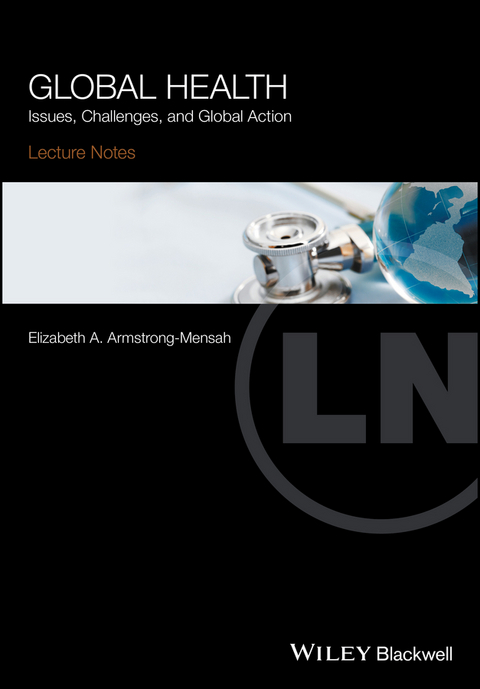
Global Health (eBook)
John Wiley & Sons (Verlag)
978-1-119-11022-4 (ISBN)

Global Health Lecture Notes: Issues, Challenges and Global Action provides a thorough introduction to a wide range of important global health issues and explores the resources and skills needed for this rapidly expanding area.
Global Health is a growing area that reflects the increasing interconnectedness of health and its determinants. Major socio-economic, environmental and technological changes have produced new challenges, and exacerbated existing health inequalities experienced in both developed and developing countries. This textbook focuses on managing and preventing these challenges, as well as analysing critical links between health, disease, and socio-economic development through a multi-disciplinary approach.
Featuring learning objectives and discussion points, Global Health Lecture Notes is an indispensable resource for global health students, faculty and practitioners who are looking to build on their understanding of global health issues.
Elizabeth A. Armstrong-Mensah, PhD, Adjunct/Affiliate Assistant Professor, Morehouse School of Medicine and Georgia State University, Atlanta, Georgia, USA.
Preface ix
Acknowledgments xi
1 Essentials of global health 1
2 Globalization, infectious diseases, and global health 13
3 Noncommunicable diseases 25
4 Global burden of disease and measurement 47
5 Culture, behavior, and global health 59
6 Water, sanitation, and global health 69
7 Global hunger, nutrition, and food security 85
8 Global health and human rights 97
9 Natural disasters and complex humanitarian emergencies 107
10 Gender and global sexual and reproductive health 119
11 Health systems and global health 131
12 Financing global health 139
13 Ethics in global health research, design, and practice 153
14 Health-related Millennium Development Goals and global health 161
15 Global health partnerships and governance 173
16 Evaluating global health projects 185
Index 197
1
Essentials of global health
Learning Objectives
By the end of this chapter, you will be able to:
- Define global health;
- List and explain at least two key global health concepts;
- Discuss at least two defining features of global health;
- Explain the difference between international health and global health;
- Explain the significance of global health in today’s world.
Summary of key points
Global health is an emerging interdisciplinary field of study, research, and practice whose scope, objectives, and training requirements remain unclear to many around the world. Preceded by three other health‐related fields, it is at present, the main health focus of the world. This notwithstanding, there are ongoing debates about what global health is and whether it is different from its predecessor, international health. Although a few similarities exist between global health and international health, they are different on several domains. This chapter traces the evolution of global health. It discusses the concept of global health and explains some key terms associated with it. It further highlights the difference between global health and international health, and draws attention to the significance of global health in the twenty‐first century and beyond.
Evolution and concept of global health
Prior to the evolution of global health, the world experienced and focused on three health‐related fields: tropical medicine (also known as colonial medicine), public health, and international health. These fields emerged at various points in time in response to environmental, political, and economic factors (see Figure 1.1).
Figure 1.1 Health‐related fields prior to global health.
Tropical medicine
The first health‐related field the world experienced and focused on was tropical medicine.
Tropical medicine is a branch of medicine that focuses on identifying, diagnosing, preventing, and treating diseases most prominent in tropical regions of the world. Specifically, it focuses on infectious and parasitic infestations including yellow fever, dysentery, and malaria, and utilizes an individual clinical approach towards population disease prevention and management. Entomology, parasitology, clinical medicine, epidemiology, and community health are the major disciplines associated with early tropical medicine (Giles & Lucas, 1998).
In the mid‐fifteenth century, during the Age of Discovery, Portuguese and Spanish explorers made successful voyages to the Americas and to the coasts of Africa, East Asia, India, and the Middle East. Their success spurred other European nations to embark on similar voyages. Thus, by the sixteenth century, European nations had begun to scramble for, partition, and colonize many regions around the world including Africa among themselves (see Figure 1.2). Many of the countries they colonized were located in the tropics. The hot climate and environmental conditions of the tropics negatively affected the health of the European colonists. They experienced many infectious diseases including malaria, yellow fever, dengue fever, and diarrheal diseases not prevalent in their home countries.
Figure 1.2 Map showing European colonization of Africa.
Source: de Blij H. J., and Muller, P. O. (n.d.).
European colonists coined the term “tropical medicine” to describe the host of unfamiliar diseases they experienced in the tropics (MacFarlane et al., 2008; Warwick, 1998). They challenged scientists in their home countries to research and tackle those diseases. This effort culminated in the establishment of the first two schools of tropical medicine in 1898: the Liverpool School of Tropical Medicine and later, the London School of Hygiene and Tropical Medicine. The establishment of these two institutions was groundbreaking and pivotal in that, it led to a greater acceptance of the germ theory, which postulated that diseases in the tropics were caused by germs and not by climate, or poison in the air as some scientists at the time believed.
The development of the germ theory increased European momentum towards colonialism. European colonists came to realize that they could continue to colonize countries in the tropics if they could find a way to prevent and treat the germs that caused diseases in that area. Thus, the goal of the newly established schools of tropical medicine was to train colonial medical officers to treat tropical diseases inorder to make the colonies more habitable for economic exploitation and expansion (Baronov, 2008).
Following the establishment of the first two schools of tropical medicine, other schools of tropical medicine were established around the world. Today, there are several schools, institutions, and departments devoted to the study of tropical medicine. Some of these include the Institute of Tropical Medicine and International Health in Berlin, the Institute of Tropical Medicine in Antwerp, the Institute of Tropical Medicine in Nagasaki, and the Department of Tropical Medicine at Tulane University in the United States of America. In the mid‐twentieth century, many doctors and scientists from the tropical and subtropical regions of Africa, Asia, and Latin America went to Europe for training in tropical medicine. Upon returning to their home countries, they incorporated portions of tropical medicine into their educational curricula and founded research institutions devoted to tropical medicine.
Tropical medicine developed as a necessary part of the colonial system (Tropical Medicine, 2001). In order to sustain the territorial expansion of their empires in the tropics, it was necessary for European colonists to have the ability to diagnose and successfully treat the dozens of diseases and infections unique to the tropics that plagued them. Coining the term “tropical medicine” symbolized colonist recognition of the differences in disease and risk factors between the indigenous populations of the tropics and populations from Europe. The postulation and acceptance of the germ theory following the establishment of the first schools of tropical medicine in England and Liverpool, triggered and validated European perceptions that they were superior intellectually, technologically, and socially to the people in the tropics, especially those in Africa, whom they saw as suffering from various tropical diseases (Farley, 1991). It was this outlook that caused Europeans to believe that they could address the health problems of people in the developing world without their involvement, hence the emergence of international health in the late nineteenth and early twentieth century (Crozier, 2007).
Public health
The second health‐related field the world experienced and focused on following tropical medicine is public health: a science that focuses on preventing disease, promoting health, and prolonging life among populations as a whole. Public health first emerged in Britain in response to the health and unsanitary conditions presented by the Industrial Revolution. It later spread to other parts of the world.
With the emergence of the Industrial Revolution in the late eighteenth century, many people mass migrated from rural areas to urban centers in search of well paying industrialized jobs in factories. By the early nineteenth century, the impetus created by the Industrial Revolution led to the overcrowding of cities, lodging houses, shelters, and homes, and in the process, created unforeseen sanitary and public health problems including the outbreak of cholera, tuberculosis, and diphtheria. Until John Snow, a British doctor, traced the cholera epidemic in London to a contaminated water pump on Broad Street in 1885, and until Edwin Chadwick learned that removing the pump handle would bring about a drastic reduction in the incidence and prevalence of cholera, no one knew exactly why people in the cities of London were getting sick. The discoveries of Snow and Chadwick, coupled with Chadwick’s 1842 landmark Report on the Inquiry into Sanitary Conditions of the Laboring Population of Great Britain, contributed to revealing the public health challenges facing England and strengthened the debate on the need for government involvement in the preservation of the health of its people. Thus, in the mid‐nineteenth century, the British government took steps to reform health and to improve upon the health of its citizens. This effort culminated in the passing of the first Public Health Act in 1848, and the coining of the term “public health” to distinguish government effort to preserve and protect the health of its citizens or the public from private actions.
The invention of the steam engine, the spinning jenny, and the power loom were at the heart of the Industrial Revolution. These inventions mechanized the factory system and created a shift from the manual production of goods in cottage industries, to the mass production of goods in factories powered by steam engines. Although the Industrial Revolution improved upon systems of transportation, production, communication, banking, and the standard of living for many in England, it also resulted in harsh employment and living conditions for the poor and working classes.
International health
International health is the third health‐related field the world experienced and focused on following public...
| Erscheint lt. Verlag | 28.2.2017 |
|---|---|
| Reihe/Serie | Lecture Notes |
| Lecture Notes | Lecture Notes |
| Sprache | englisch |
| Themenwelt | Medizin / Pharmazie ► Medizinische Fachgebiete |
| Studium ► Querschnittsbereiche ► Prävention / Gesundheitsförderung | |
| Schlagworte | disaster management • Disease • Epidemic • Gender • Gesundheits- u. Sozialwesen • Global Health • Globalization • Health & Social Care • health, ethics • Humanitarian emergency • Human Rights • Infection • International Public Health • Life Expectancy • medical education • Medical Science • Medizin • Medizinstudium • Nutrition • Public Health / International • Reise- u. Tropenmedizin • Sanitation • Travel / Tropical Medicine |
| ISBN-10 | 1-119-11022-X / 111911022X |
| ISBN-13 | 978-1-119-11022-4 / 9781119110224 |
| Informationen gemäß Produktsicherheitsverordnung (GPSR) | |
| Haben Sie eine Frage zum Produkt? |
 EPUB (Adobe DRM)
Kopierschutz: Adobe-DRM
Adobe-DRM ist ein Kopierschutz, der das eBook vor Mißbrauch schützen soll. Dabei wird das eBook bereits beim Download auf Ihre persönliche Adobe-ID autorisiert. Lesen können Sie das eBook dann nur auf den Geräten, welche ebenfalls auf Ihre Adobe-ID registriert sind.
Details zum Adobe-DRM
Dateiformat: EPUB (Electronic Publication)
EPUB ist ein offener Standard für eBooks und eignet sich besonders zur Darstellung von Belletristik und Sachbüchern. Der Fließtext wird dynamisch an die Display- und Schriftgröße angepasst. Auch für mobile Lesegeräte ist EPUB daher gut geeignet.
Systemvoraussetzungen:
PC/Mac: Mit einem PC oder Mac können Sie dieses eBook lesen. Sie benötigen eine
eReader: Dieses eBook kann mit (fast) allen eBook-Readern gelesen werden. Mit dem amazon-Kindle ist es aber nicht kompatibel.
Smartphone/Tablet: Egal ob Apple oder Android, dieses eBook können Sie lesen. Sie benötigen eine
Geräteliste und zusätzliche Hinweise
Buying eBooks from abroad
For tax law reasons we can sell eBooks just within Germany and Switzerland. Regrettably we cannot fulfill eBook-orders from other countries.
aus dem Bereich