Still Moving (eBook)
John Wiley & Sons (Verlag)
978-1-119-16490-6 (ISBN)
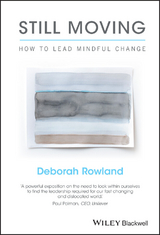
Still Moving: How to Lead Mindful Change sets out an innovative approach for guiding organisations and indeed entire systems through ongoing, disruptive change. It combines Deborah Rowland's own rigorous research into change and its leadership with insights from her extensive field experience helping major global corporations including GlaxoSmithKline, RWE and Shell achieve lasting change with increased productivity, employee engagement and responsible societal impact. It is filled with helpful inspiring stories of leadership and change from the real world and, bravely, the author's own personal journey.
Challenging leaders to cultivate both their inner and outer skills necessary for success, Still Moving weaves together the 'being' and 'doing' states of leading change and emphasises the importance of a mindful stance and deep systemic perception within a leader. With the goal of collaborative, sustainable change, the book delves into a variety of important topics, including present-moment awareness, intentional response, edge and tension and emergent change. Compelling and provocative, Still Moving questions the conventional wisdom of much change theory and asks that leaders first work on their inner source in order to more effortlessly change the world around them.
Deborah Rowland brings a unique combination of practical experience, original insight and ground-breaking research to the leadership of change. She has personally led change in global organisations such as BBC Worldwide, Gucci Group, PepsiCo and Shell. Across her consulting career she has pioneered two major inquiries into leading change sustainably, which have been extensively published and whose insights inform the reality of organisational transformation around the world. The story of this book now inspires the Still Moving change consulting practice. Deborah acts as a change coach to CEOs and major institutional leaders in all walks of life and is a sought after speaker, teacher, and writer in the field. She is co-author of Sustaining Change: Leadership That Works (Wiley, 2008). Deborah tends to her own inner source via regular yoga, meditation, art gazing, painting and walks in nature, in particular along the spectacular coastal paths of Southern Cornwall.
STILL MOVING Still Moving: How to Lead Mindful Change sets out an innovative approach for guiding organisations and indeed entire systems through ongoing, disruptive change. It combines Deborah Rowland s own rigorous research into change and its leadership with insights from her extensive field experience helping major global corporations including GlaxoSmithKline, RWE and Shell achieve lasting change with increased productivity, employee engagement and responsible societal impact. It is filled with helpful inspiring stories of leadership and change from the real world and, bravely, the author s own personal journey. Challenging leaders to cultivate both their inner and outer skills necessary for success, Still Moving weaves together the being and doing states of leading change and emphasises the importance of a mindful stance and deep systemic perception within a leader. With the goal of collaborative, sustainable change, the book delves into a variety of important topics, including present-moment awareness, intentional response, edge and tension and emergent change. Compelling and provocative, Still Moving questions the conventional wisdom of much change theory and asks that leaders first work on their inner source in order to more effortlessly change the world around them.
Deborah Rowland brings a unique combination of practical experience, original insight and ground-breaking research to the leadership of change. She has personally led change in global organisations such as BBC Worldwide, Gucci Group, PepsiCo and Shell. Across her consulting career she has pioneered two major inquiries into leading change sustainably, which have been extensively published and whose insights inform the reality of organisational transformation around the world. The story of this book now inspires the Still Moving change consulting practice. Deborah acts as a change coach to CEOs and major institutional leaders in all walks of life and is a sought after speaker, teacher, and writer in the field. She is co-author of Sustaining Change: Leadership That Works (Wiley, 2008). Deborah tends to her own inner source via regular yoga, meditation, art gazing, painting and walks in nature, in particular along the spectacular coastal paths of Southern Cornwall.
Foreword ix
Acknowledgements xiii
Moved by Stillness xvii
1 Introduction 1
2 Is Change Changing? 11
3 Still Moving - The Inner and Outer Skills 29
4 It All Starts in Mindfulness 57
5 The Power of the Systemic 79
6 Make Disturbance Your Friend 103
7 Holding the Fire 125
8 The Time for Emergence 149
9 A Tale of Still Moving and Business Transformation 173
10 Still Moving and Your Leadership 199
11 The Sense of an Ending 215
Appendix 1 Detailed Still Moving Research Methodology from Chapter 3 227
Appendix 2 Detailed Leadership Development Programme Description from Chapter 9 229
Notes 233
Bibliography and General Recommended Reading 239
Index 241
"Still Moving is an inspiring, practical and provocative take on the power of mindful leadership to reshape our world."--Otto Scharmer, Senior Lecturer, MIT
"What makes a successful change agent in a world of exponential change? I have long argued that learning to live with ambiguity will be one of the keys to success. Still Moving will show you how."--Paul Polman, CEO, Unilever
"A compelling and practical guide to the leadership of change. By sharing her self-reflection and brave journey into her past, Deborah inspires us all to become more conscious and embracing of our own life narratives."--Ann Sarnoff, President, BBC Worldwide North America
"Still Moving is a must read for any senior leader or consultant who is responsible for leading large, complex change. Let the book speak to you, consume the wisdom, and put that wisdom into practice."--Bill Adams, CEO, The Leadership Circle and Full Circle Group
"How strange that it has taken so long for us to wake up to the fact that the inner states and capacities of leaders really matter. Still Moving changes the game, and not too soon."--Michael Chaskalson, Professor of Practice, Ashridge Business School
"Still Moving is an exciting breakthrough in thinking on leading change and a must read for any serious change leadership practitioner. It challenges us to consider how change needs to be different in today's fast paced world."--Mike White, Former Chairman and CEO, DirecTV
"Still Moving will permanently alter the way you think about leading change. Thoughtful, honest, compelling."--Kevin Cox, Chief Human Resources Officer, American Express Company
1
Introduction
Stillness is what creates love,
Movement is what creates life,
To be still,
Yet still moving –
That is everything!
Do Hyun Choe, Japanese Master
My life began in change, the ultimate change, when I was handed over at 6 weeks old and adopted into the welcome and hugely loving embrace of the Rowland family. I had experienced an ending, with my biological mother, at the very start of life. An in‐between time, floating without family, in a Lancashire mother‐and‐babies home. And then here was a new beginning with my adopted family. Born Wendy Juliet, I was renamed Deborah Anne. Since that cataclysmic time, no change has ever seemed insurmountable.
It meant that I learned to live life on a boundary. As an adopted child I grew up with detached curiosity, an outsider in my own life. Seeking to belong yet hard‐wired not to trust, I cautiously put one foot into my new family, and, at the same time, carefully kept one foot out, just in case I had to leave – or be left – again. Perhaps I was always on the look out for a bond, for intimacy. However, it seemed I both tumbled into it and ran away from it almost at the same time. The edge, for me, felt the safest place.
Yet this detachment, this instinct to be alongside rather than inside gave me a helpful vantage point to observe and notice. I was intensely curious about people, in particular how they related to each other and formed systems. I could make good use of my fate.
My earliest companion – detached curiosity – set my life on its course. Holding Mum and Dad’s hands as a wondrous wide‐eyed 10‐year‐old, I was transfixed by the blockbuster Tutankhamun exhibition in London in 1972, the treasure trove of royal Egyptian artefacts unearthed by the archaeologist Howard Carter. And when in 1977 Desmond Morris published Manwatching: A Field Guide to Human Behaviour, I knew I had found my field.
And so I read archaeology and anthropology at university. From the Trobrianders of New Guinea to the Nuer of the Nile, their ethnographies provided many hours of absorbing reading and reflection in the university library. The anthropological discipline of acute unbiased observation enhanced my sensitivity to diversity and to context. All thought and action, however seemingly strange, make perfect sense when you can see the system within which they are situated. I also spent many hours on my hands and knees in deep Neolithic trenches, using a tiny trowel to gently scrape away and reveal history’s previously unearthed layers. I felt both strengthened and humbled when I stood in that deep messy line of time.
As compelling as the experience was, I put down my trowel and continued my personal line out of those trenches. And I did so because a single memory from just one anthropology lecture had already awakened my purpose. A purpose that has guided the intervening 30 years I have spent in business – and that still guides me today. Indeed, it is the reason why I write this book.
The memory came from a grainy black and white film shown in that fateful lecture. Shot at the turn of the last century, it falteringly documented how a group of British Christian missionaries entered a native tribe in Africa with the aim of ‘civilising’ its seemingly primitive culture. This was the change goal. As a result of inter‐village warfare, this native culture was thought to be on the verge of extinction. What caught my attention, beyond the misguided arrogance of the change goal, was the change approach.
The missionaries decided to introduce the villagers to the game of cricket. Believing they would channel their aggression into this edifying game, the missionaries looked on aghast as the African warriors picked up the cricket stumps as javelins, and the cricket balls as missiles. Far from reducing the inter‐village warfare, the change approach amplified it. On entering a strange landscape the missionaries had sought new results by importing old routines. Big mistake.
Worryingly those lessons of over a century ago still need heeding today. There remain plenty of well‐intended missionaries with antique approaches to change. History repeats.
But the lessons from the missionaries pointed me to my (professional) fate. I have spent 30 years exploring what it truly takes to lead change in new and uncertain environments, where past solutions no longer work and in fact become a dangerous liability.
I believe I have found some of the answers, and offer them to you in Still Moving.
Leading Change Starts Inside Yourself
Here’s my primary insight – start by becoming still and examining the source of your thinking and action.
The missionaries leapt into their habitual routines without first questioning the deeper beliefs shaping them. Unaware of these biased lenses they could not clearly see the system they were seeking to change. Blind to their own impulses and ignorant of context, all they could do was reactively shape – and not resourcefully respond – to the escalating fray.
Now, I can hear you thinking, ‘I would never have done anything like that!’ Really?
We all grow up in our stories, our personal histories. Like my adoption story, the narratives of our lives lay down deep deposits in the layers of our being – deposits of emotional instinct, felt security or insecurity, self‐identity, adaptive coping behaviour. And we take those deposits and we import those routines into our adult life: our relationships and our leadership. They are the source of our repeating patterns and impulses in the present – particularly in stressful and challenging situations. In these circumstances we naturally get anxious, and can resort to primitive self‐limiting patterns of thinking and acting that lead to the very opposite of the results we are trying to create.
The dual capacity to be aware of, and able to regulate our response to, experience guides the entire quality of our thinking, action and results. What’s more, my new research has shown that this ability to tune into and regulate the self, within an evolving system, is the number one inner skill in being able to lead change well. If senior leaders stay stuck in habitual response, so do their organisations.
Once you are able to come off autopilot and hold your default impulses lightly, you are freed of their attachment and can intentionally and less habitually respond. You see what shows up in experience with systemic perception not just personal projection. Easy to say, much harder to do!
I am grateful for how my instinctive preference to be on the observational edge of human systems has enabled me to have a rewarding career in the field of leadership and change. Yet, even today when guiding leadership groups, and the two seats on either side of me remain empty, I can easily tip into my default story: ‘Here we go again, I am left alone, abandoned!’ Rather than hold the systemic insight: ‘My distance from others has given me the necessary detachment for leadership’.
It’s a wafer‐thin line between impulsive, anxious reaction, and mindful, perceptive response, especially when the world feels threatening and disruptive.
Aha, the ‘M word’ has made its first appearance. Let’s go there now.
The Mindfulness Explosion
In my first book with Malcolm Higgs, Sustaining Change: Leadership That Works (2008), we set out the four leadership practices, or exhibited behaviours, that our research showed in combination were highly correlated with successful change outcomes.
These were: Attractor – creating an emotional pull in your organisation towards shared purpose; Edge and Tension – naming reality and amplifying disturbance in order to innovate; Container – channelling anxiety and uncertainty into productive energy by being calm, confident and affirming; and Transforming Space – taking actions that create deep change in the here‐and‐now experience.
At that time we also drew attention to what we surmised were two critical inner conditions behind these practices: self‐awareness and ego‐less intention.1
Yet in that round of research we did not empirically test the relationship between this inner state and a leader’s successful practice. It remained a hypothesis. We focused on what leaders did, the four practices above. And this was largely because we had not found a single coherent framework that could describe this inner state.
In the decade since we wrote Sustaining Change there has been an explosion of interest in so‐called ‘mindfulness’.2,3 While newly arrived on the public scene mindfulness has in fact been in existence for almost 2,500 years. Originally derived from ancient Buddhist contemplative tradition, and more recently adopted into western settings through the fields of medicine, social psychology, education and general work place productivity, the practice of mindfulness – classically trained via meditation – has now found its way into leadership.
Mindfulness is, in essence, the cultivation of a deeper awareness of the self, others and the world through focused, non‐judgemental and intentional attention on the present moment.4 This is a radical shift in how we show up in our lives, where research shows that...
| Erscheint lt. Verlag | 21.2.2017 |
|---|---|
| Sprache | englisch |
| Themenwelt | Geisteswissenschaften ► Psychologie ► Arbeits- und Organisationspsychologie |
| Medizin / Pharmazie ► Medizinische Fachgebiete ► Psychiatrie / Psychotherapie | |
| Wirtschaft ► Betriebswirtschaft / Management ► Unternehmensführung / Management | |
| Schlagworte | Business & Management • Business psychology • CEO leadership • Change Leadership • Change Management • change practitioner • change theory • Corporate Change • Corporate Leadership • Cultural Change • disrupted industry • Disruptive Change • Führung • Führung • hr leadership • Human Resources • Leading Change • Lean Leadership • lean organization • Management f. Führungskräfte • Management f. Führungskräfte • Management / Leadership • manager leadership • Mindful Leadership • Mindfulness • Mindfulness in Business • mindfulness practice • mindfulness theory • nimble organization • Organisationsentwicklung • Organizational & Industrial Psychology • Organizational change • Organizational Development • organizational disruption • Organizational Mindfulness • organizational psychology • Psychologie • Psychologie i. d. Arbeitswelt • Psychology • reorganization • Wirtschaft u. Management |
| ISBN-10 | 1-119-16490-7 / 1119164907 |
| ISBN-13 | 978-1-119-16490-6 / 9781119164906 |
| Informationen gemäß Produktsicherheitsverordnung (GPSR) | |
| Haben Sie eine Frage zum Produkt? |
 EPUB (Adobe DRM)
Kopierschutz: Adobe-DRM
Adobe-DRM ist ein Kopierschutz, der das eBook vor Mißbrauch schützen soll. Dabei wird das eBook bereits beim Download auf Ihre persönliche Adobe-ID autorisiert. Lesen können Sie das eBook dann nur auf den Geräten, welche ebenfalls auf Ihre Adobe-ID registriert sind.
Details zum Adobe-DRM
Dateiformat: EPUB (Electronic Publication)
EPUB ist ein offener Standard für eBooks und eignet sich besonders zur Darstellung von Belletristik und Sachbüchern. Der Fließtext wird dynamisch an die Display- und Schriftgröße angepasst. Auch für mobile Lesegeräte ist EPUB daher gut geeignet.
Systemvoraussetzungen:
PC/Mac: Mit einem PC oder Mac können Sie dieses eBook lesen. Sie benötigen eine
eReader: Dieses eBook kann mit (fast) allen eBook-Readern gelesen werden. Mit dem amazon-Kindle ist es aber nicht kompatibel.
Smartphone/Tablet: Egal ob Apple oder Android, dieses eBook können Sie lesen. Sie benötigen eine
Geräteliste und zusätzliche Hinweise
Buying eBooks from abroad
For tax law reasons we can sell eBooks just within Germany and Switzerland. Regrettably we cannot fulfill eBook-orders from other countries.
aus dem Bereich