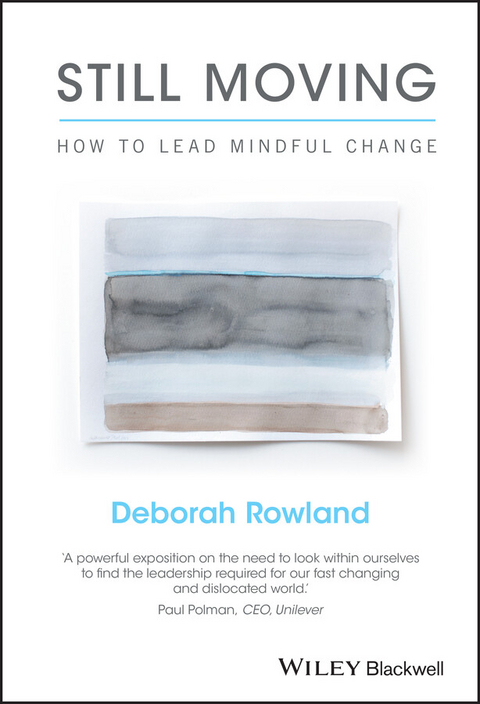
Still Moving (eBook)
John Wiley & Sons (Verlag)
978-1-119-16489-0 (ISBN)
Still Moving: How to Lead Mindful Change sets out an innovative approach for guiding organisations and indeed entire systems through ongoing, disruptive change. It combines Deborah Rowland's own rigorous research into change and its leadership with insights from her extensive field experience helping major global corporations including GlaxoSmithKline, RWE and Shell achieve lasting change with increased productivity, employee engagement and responsible societal impact. It is filled with helpful inspiring stories of leadership and change from the real world and, bravely, the author's own personal journey.
Challenging leaders to cultivate both their inner and outer skills necessary for success, Still Moving weaves together the 'being' and 'doing' states of leading change and emphasises the importance of a mindful stance and deep systemic perception within a leader. With the goal of collaborative, sustainable change, the book delves into a variety of important topics, including present-moment awareness, intentional response, edge and tension and emergent change. Compelling and provocative, Still Moving questions the conventional wisdom of much change theory and asks that leaders first work on their inner source in order to more effortlessly change the world around them.
Deborah Rowland brings a unique combination of practical experience, original insight and ground-breaking research to the leadership of change. She has personally led change in global organisations such as BBC Worldwide, Gucci Group, PepsiCo and Shell. Across her consulting career she has pioneered two major inquiries into leading change sustainably, which have been extensively published and whose insights inform the reality of organisational transformation around the world. The story of this book now inspires the Still Moving change consulting practice. Deborah acts as a change coach to CEOs and major institutional leaders in all walks of life and is a sought after speaker, teacher, and writer in the field. She is co-author of Sustaining Change: Leadership That Works (Wiley, 2008). Deborah tends to her own inner source via regular yoga, meditation, art gazing, painting and walks in nature, in particular along the spectacular coastal paths of Southern Cornwall.
STILL MOVING Still Moving: How to Lead Mindful Change sets out an innovative approach for guiding organisations and indeed entire systems through ongoing, disruptive change. It combines Deborah Rowland s own rigorous research into change and its leadership with insights from her extensive field experience helping major global corporations including GlaxoSmithKline, RWE and Shell achieve lasting change with increased productivity, employee engagement and responsible societal impact. It is filled with helpful inspiring stories of leadership and change from the real world and, bravely, the author s own personal journey. Challenging leaders to cultivate both their inner and outer skills necessary for success, Still Moving weaves together the being and doing states of leading change and emphasises the importance of a mindful stance and deep systemic perception within a leader. With the goal of collaborative, sustainable change, the book delves into a variety of important topics, including present-moment awareness, intentional response, edge and tension and emergent change. Compelling and provocative, Still Moving questions the conventional wisdom of much change theory and asks that leaders first work on their inner source in order to more effortlessly change the world around them.
Deborah Rowland brings a unique combination of practical experience, original insight and ground-breaking research to the leadership of change. She has personally led change in global organisations such as BBC Worldwide, Gucci Group, PepsiCo and Shell. Across her consulting career she has pioneered two major inquiries into leading change sustainably, which have been extensively published and whose insights inform the reality of organisational transformation around the world. The story of this book now inspires the Still Moving change consulting practice. Deborah acts as a change coach to CEOs and major institutional leaders in all walks of life and is a sought after speaker, teacher, and writer in the field. She is co-author of Sustaining Change: Leadership That Works (Wiley, 2008). Deborah tends to her own inner source via regular yoga, meditation, art gazing, painting and walks in nature, in particular along the spectacular coastal paths of Southern Cornwall.
Title Page 5
Copyright Page 6
Contents 9
Foreword 11
Acknowledgements 15
Moved by Stillness 19
Chapter 1 Introduction 21
Leading Change Starts Inside Yourself 23
The Mindfulness Explosion 24
Does Mindfulness Matter? 25
Still Moving – a Call to Leadership 27
Who is This Book For? 27
Chapter 2: Is Change Changing? 28
Chapter 3: Still Moving – the Inner and Outer Skills 28
Chapter 4: It All Starts in Mindfulness 28
Chapter 5: The Power of the Systemic 29
Chapter 6: Make Disturbance Your Friend 29
Chapter 7: Holding the Fire 29
Chapter 8: The Time for Emergence 29
Chapter 9: A Tale of Still Moving and Business Transformation 30
Chapter 10: Still Moving and Your Leadership 30
Chapter 11: The Sense of an Ending 30
Chapter 2 Is Change Changing? 31
Change is Changing 32
The Context For Leading Change Today 33
The Collapse of the Vertical, Low Trust in Our Institutions 33
The Power of the Ground 36
A Distracted and Divided Attention 38
Leadership in Changing Times 40
CEO, Personal Banking Division – Taking People Through a Digital Revolution 41
Chief Human Resources Officer – Transforming his HR Organisation and also Healthcare for his Peer Group of Large Employers 42
CEO, International Children’s Charity – Transforming and Uniting a Country Organisation into a Global One 42
CEO, Major US Cable TV Operator – Improving the Customer Experience Journey 43
CEO, European Utility – Major Transformation of a 100-Year-Old Stable Company 44
Summary – Implications of Today’s World for Change and its Leadership 45
Chapter 3 Still Moving – The Inner and Outer Skills 49
The Fine Line Between Movement and Action 50
The Change Leadership Research – Context and Big Messages 51
Big Message One – We Created a Change Leadership Construct, Still Moving, That Accounts for Over Half the Reason why Leaders can Lead Change Well 52
Big Message Two – The Inner Capacities Come First 52
Big Message Three – The Key Element of a Leader’s External Practice is to Bring Purposeful Edge and Tension to Their System 52
Big Message Four – Top Leaders in Particular need to be able to Attend to Whole System Dynamics 52
Big Message Five – In Today’s Uncertain and Disruptive World You can only Adopt an Emergent Step-by-Step Approach to Change 53
Big Message Six – Still Moving Skills can be Cultivated, But Not How We’ve Done it in the Past 54
Big Message Seven – Low Success in Change is Driven by a Leadership Style that is Non-Mindful (with Low Self-Awareness), Ego-Centric and Characterised by a Change Approach that is Top?Down and Directive 54
Moving Well: The External Practices – What Great Change Leaders Do 54
Attractor: A Pull Towards Purpose – Meaning Matters 55
The Power of Purpose 56
Meaning Makes Sense 56
What is Your Presence Signifying? 57
Attractor Leadership in Action 57
Edge and Tension: The Amplification of Disturbance – Truth is a Turn On 58
Acknowledge Reality 59
Challenge Assumptions 59
Stretch What’s Possible 59
Edge and Tension Leadership in Action 60
Container: The Channelling of Anxiety into Purposeful Energy – Safety Strengthens 60
A Clear Contract 61
A Well-Held Process 61
Non-Anxious Leadership in a Sea of Anxiety 62
Container Leadership in Action 62
Transforming Space: Creating Movement in the Here-and-Now – We Only Ever Have the Now 63
Change the Now 63
Put together Diverse Groups 64
Attend to the Physical Quality of Space 64
Transforming Space Leadership in Action 64
Standing Still: The Inner Capacities – How to Be as a Change Leader 65
Staying Present: Notices What is Here, Now 65
Are, We, Here? 66
Allow What is the Case, to Be the Case 67
Staying Present in Action 68
Curious and Intentional Responding: Chooses the Nature of Experience 68
Respond Not React 69
Set Clear Intention 69
Curious and Intentional Responding in Action 70
From Mindfulness to the Systemic 70
Tuning into the System: Accurately Perceives Reality 71
Visible Signs as System Intelligence 71
Tune into the Emotional Climate 72
Relate Systemic Interpretation to Others 72
Tuning into the System in Action 72
Acknowledging the Whole: Integrates All That Happens 73
Uncover the Intention of the System 74
Give Every Element its Place – Especially Difficulty 74
Acknowledging the Whole in Action 75
Still Moving: Summary 76
Chapter 4 It All Starts in Mindfulness 77
Change is All in the Mind 78
Mindfulness in a Nutshell 79
Paying Attention 79
In the Present Moment 80
With Intention 81
Non-Judgementally 81
Mindfulness and the Leadership of Change 82
Mindful Leaders Approach, Not Avoid Difficulty 82
Mindful Leaders Create Psychological Safety 83
Mindful Leaders Don’t Shirk the Big Calls 84
Mindfulness and Still Moving 85
Staying Present (see Table 4.1) 85
Uses Language to Describe Experience and Doesn’t Get Caught Up in the Response to the Experience Itself 85
Focuses on What is Happening in the Present Moment and Consciously Avoids Distraction for a Sustained Period of Time 86
Pays Attention to What is Happening in the Present Moment with a Positive, Appreciative and Generous Attitude of Mind 86
Consciously Makes Time and Space During Disturbing Situations to Process What is Going On 86
Remains Calmly Curious and Objective in Novel, Disturbing and Difficult Situations 87
Curious and Intentional Responding (see Table 4.2) 88
Notices and Processes One’s Feelings and Emotions as Observable Data and Does Not Impulsively React with Them 88
At Any Moment is Conscious of Both One’s Options on How to Respond to What is Being Experienced and also the Choices that One Takes in Response 89
Approaches What Arises in Any Situation with Curiosity Rather than Judgement, Including Interactions with Others Where You Seek to Understand Before You Evaluate 89
Uses Personal Intention as an Inner Compass to Guide How One is, and What One Does, in Any Situation 90
Is Not Afraid of Uncertainty and Trying Out New Things in Order to Bring About Positive Change and Move Beyond Autopilot 90
Mindfulness in Action: Bold Transformation of a Global Human Resources (HR) Function 91
Building the Future HR Model 92
Securing the Business Case and the Vendor 94
Empowering Others to Own Big Change with You 95
Implementing with Poise 97
Summary – When You Lose Touch With Inner Stillness You Lose Touch With Yourself 98
Chapter 5 The Power of the Systemic 99
Systemic Thinking is Not the Same as Systemic Perceiving 100
The Potency of Systemic Leadership 102
Discern that What is Here, Is also There 103
Monitor and Regulate Your Response to Organisational Projection 104
Approach Difficulty and Disturbance as a Resource 106
Create Strong and Flourishing Whole Systems 107
Tuning into the System (see Table 5.1) 110
Pays Attention in any Given Situation to the Visible Signs that Give the Leader Intelligence About the Organisational System 110
Puts into Words Current Experience in Ways that Other People can Relate to 111
Even When Feeling Upset, Finds a Way to Put their Experience into Words 111
Notices and Tunes into (Changes In) the Emotions and Feelings of those Around them and in the Wider System, So can Bring Awkward Facts to Light 112
Consciously Anticipates and Empathises with the Impact of Actions and Events on Others and the Wider System 112
Acknowledging the Whole (see Table 5.2) 113
Notices and Uses Data About One’s Own Feelings, Impulses and Physical Sensations as Visible Signs as to What is Being Felt and Experienced in their Team, Organisation or Wider Society 114
Views All Experience as What, In Some Way, Is Meant to Happen – Giving Everything that Arises a Place, and a Purpose (Senses the System’s Intentionality) 115
Has an Open?Minded, Expansive and Inclusive Mindset that is Able to Use Multiple Interpretations of What is Being Experienced in Order to Build Up an Accurate Picture of Reality 115
Views Difficulty and Disturbance Not as Obstacles or Barriers but Rather as Important Resources to Learn from and be Acknowledged so that the Whole System Gains Strength 116
Is Conscious of How their Systemic Leadership can Model to Others Non?Reactivity, Wider Perspective Taking and the Facing of Difficulty so that they Build the Capacity for Greater Mindfulness in Others 116
Systemic Leadership in Action – Building a Global Networked Enterprise 117
Letting the Opportunity Emerge 117
Stepping Up to the Leadership Plate 118
Nudging the Organisation to its Destiny 119
Breaking through the Dark Days 120
Systemic Change Leadership Can Be Done, Yet It Starts in Emotional Contact 121
Chapter 6 Make Disturbance Your Friend 123
What is Edge and Tension Leadership? (See Table 6.1) 125
Tells It As It Is Describes Reality with Respect Yet Without Compromise
Stays Constant When the Going Gets Tough Does Not Withdraw From Difficulty, Holds People’s Hands ‘In the Fire’
Spots and Challenges Assumptions Creates Discomfort by Challenging Existing Paradigms and Disrupts Habitual Ways of Doing Things
Sets and Holds High Standards for Others Using Differentiating Consequence Management Stretches the Goals and Limits of What’s Possible
Does Not Compromise on Talent Pays Attention to Getting and Keeping ‘A Players’
Focuses on a Few Big Priorities, Not Lots of Small Distractions 130
The Challenge of Edge and Tension 131
It’s Easy to Lose It 131
Overcoming My Story 132
Not Having a Systemic Interpretation of the Difficulty 133
Edge and Tension – How to Do This Well 134
Edge and Tension with Staying Present and Curious and Intentional Responding 135
Edge and Tension with Tuning into the System 135
Edge and Tension with Acknowledging the Whole 135
Edge and Tension Leadership in a Transforming Space 136
Edge and Tension in Action – A Leader Who Could Face Her Fear 138
Edge with Empathy 139
Staying Present While Under Fire 141
With No Fear You are Just Stupid 142
Edge and Tension Summary: It Must Come from a Still Place 143
Chapter 7 Holding the Fire 145
Going to the Edge Requires Container Leadership 146
What is ‘Containment’? 147
The Consequences of No Containment 148
Containment Does Require Managing Your Own Inner State First 149
Too Much Containment Constricts 149
Too Little Containment Creates Unsafe Places 150
Organisational Containment, Big Change and Top Leadership 151
Latest Research Findings on Container Leadership 151
The Power of Container to Channel Edge and Tension Towards Big Change 152
Containment and Restructuring 153
Building Networks to Reduce Anxiety and Liberate Creativity 153
Containment that Transforms Conflicting Relationships and the Insecurity of Not Knowing 155
Containment Allows Tough Transitions 156
Container Leadership – Combining the Internal (Being) and the External (Doing) 156
Top Level Container Leadership in Action – Successfully Moving an Entire Organisation Through Extreme Difficulty and Transition 158
Trust as the Foundation for Container 159
Authorisation Around Real Work Builds Energetic Action 160
The Fierceness of Authenticity 162
Changing Meetings to Change Culture 163
The Art of Fierce Conversations 165
Container Summary: Arriving Where You Want to Be and Having People Know They Are Seen 165
Chapter 8 The Time for Emergence 169
What is ‘Emergence’? 170
Local Interactions Create Higher-Level Patterns 170
The Self-Organising Power of Networks 171
Change is Always Here – You Don’t Have To ‘Bring’ It 172
How You Do Change Determines Where You End Up 173
We Try to Get to New Places Using Old Approaches 174
What is Emergent Change? 175
Emergent Change Practice 1: Set an Overall Intention and Direction, Establish a Few Hard Rules to Guide Behaviour and then Allow Self-Organisation 175
Emergent Change Practice 2: Start in a Small Way Around Ripe Issues or Hot Topics that Have Large Consequences 177
Emergent Change Practice 3: Work Step-By-Step, Adjusting Plans As You Go, Using Trials and Experiments 178
Emergent Change Practice 4: Build Skills in Changing the Here?and?Now Moment, for, E.g., Effective Dialogue, How to Run Meetings, The Art of Storytelling 179
Emergent Change Practice 5: Use Informal Volunteer Networks to Build Change Understanding, Energy and Novel Connections – In Particular Tune into the Periphery 180
Emergent Change Practice 6: At all Times, Cultivate the Emergent Conditions of Connectivity, Diversity and Rapid Feedback Loops 181
Emergent Change in Action – Much Comes from Little 182
Amplify Positive Deviance 183
Ignorance is Useful 184
Tap into Purpose 185
This is your Problem 186
Hard Rules that can Liberate 187
Nudging the System and Staying Out of the Way 188
Leading Emergent Change: Helping the System ‘See’ 190
Chapter 9 A Tale of Still Moving and Business Transformation 193
A Fateful Opening to a Story of Business Transformation 195
Facing the Conundrum 196
A Visionary and Courageous Leader 197
Investing in the How When You Don’t (Yet) Know the What 198
Building a Living Laboratory for Change 199
A Development Programme That Changes, Not a Programme About Change 200
A Container to Help People Move Through Change 201
An Attractor Frame for ‘Leading From the Future’ 201
The Systemic Consequences of a Counter-Cultural Design 203
The Light Side – It Made the Business Change More Able to Be Faced 204
The Dark Side – Working With and Integrating the Shadow 205
Give Difficulty a Place 205
The Design Elements That Created Most Movement 206
Peer Groups and Origin Stories 207
Cultivating Mindfulness 210
Developing Systemic Skill 212
Foraging Groups and Prototyping 214
Still Moving and Business Transformation – Final Reflections 215
Chapter 10 Still Moving and Your Leadership 219
How Can Still Moving Leadership Be Cultivated? 221
Don’t Be Prepared to Go Past Go, Unless… 222
How to Cultivate Still Moving Leadership – Overall Principles 223
Principle Number Two: Make It Experience Based 224
Principle Number Three: Impact Being Before Doing 225
Principle Number Four: Don’t Go It Alone 228
Principle Number Five: Pick a Regular Practice 229
Developing Still Moving – Summary of Principles 231
Still Moving Leadership – Do Individual Personality Differences Count? 232
Still Moving Leadership – Does Culture Eat It for Breakfast? 233
Chapter 11 The Sense of an Ending 235
Overall, Adopt a More Emergent Approach to Change 236
For Yourself, Cultivate the Skills of Still Moving Leadership 237
The Still Inner Capacities – How to ‘Be’ as a Change Leader 238
The Moving External Practices – What to ‘Do’ as a Change Leader 240
How to Develop Still Moving Skills 241
The Contextual Requirements for Still Moving 242
First, a Preparedness to Uncover the Deep Sources that Create Today’s Reality 242
Second, a Genuine Desire to Find Collaborative Solutions 243
Third, The Courage to Run Towards, and not Away from Difficulty 244
Appendix 1 Detailed Still Moving Research Methodology from Chapter 3 247
Appendix 2 Detailed Leadership Development Programme Description from Chapter 9 249
Notes 253
Bibliography and General Recommended Reading 259
Index 261
EULA 271
"Still Moving is an inspiring, practical and provocative take on the power of mindful leadership to reshape our world."--Otto Scharmer, Senior Lecturer, MIT
"What makes a successful change agent in a world of exponential change? I have long argued that learning to live with ambiguity will be one of the keys to success. Still Moving will show you how."--Paul Polman, CEO, Unilever
"A compelling and practical guide to the leadership of change. By sharing her self-reflection and brave journey into her past, Deborah inspires us all to become more conscious and embracing of our own life narratives."--Ann Sarnoff, President, BBC Worldwide North America
"Still Moving is a must read for any senior leader or consultant who is responsible for leading large, complex change. Let the book speak to you, consume the wisdom, and put that wisdom into practice."--Bill Adams, CEO, The Leadership Circle and Full Circle Group
"How strange that it has taken so long for us to wake up to the fact that the inner states and capacities of leaders really matter. Still Moving changes the game, and not too soon."--Michael Chaskalson, Professor of Practice, Ashridge Business School
"Still Moving is an exciting breakthrough in thinking on leading change and a must read for any serious change leadership practitioner. It challenges us to consider how change needs to be different in today's fast paced world."--Mike White, Former Chairman and CEO, DirecTV
"Still Moving will permanently alter the way you think about leading change. Thoughtful, honest, compelling."--Kevin Cox, Chief Human Resources Officer, American Express Company
| Erscheint lt. Verlag | 31.1.2017 |
|---|---|
| Sprache | englisch |
| Themenwelt | Geisteswissenschaften ► Psychologie ► Arbeits- und Organisationspsychologie |
| Medizin / Pharmazie ► Medizinische Fachgebiete ► Psychiatrie / Psychotherapie | |
| Wirtschaft ► Betriebswirtschaft / Management ► Unternehmensführung / Management | |
| Schlagworte | Business & Management • Business psychology • CEO leadership • Change Leadership • Change Management • change practitioner • change theory • Corporate Change • Corporate Leadership • Cultural Change • disrupted industry • Disruptive Change • Führung • Führung • hr leadership • Human Resources • Leading Change • Lean Leadership • lean organization • Management f. Führungskräfte • Management f. Führungskräfte • Management / Leadership • manager leadership • Mindful Leadership • Mindfulness • Mindfulness in Business • mindfulness practice • mindfulness theory • nimble organization • Organisationsentwicklung • Organizational & Industrial Psychology • Organizational change • Organizational Development • organizational disruption • Organizational Mindfulness • organizational psychology • Psychologie • Psychologie i. d. Arbeitswelt • Psychology • reorganization • Wirtschaft u. Management |
| ISBN-10 | 1-119-16489-3 / 1119164893 |
| ISBN-13 | 978-1-119-16489-0 / 9781119164890 |
| Informationen gemäß Produktsicherheitsverordnung (GPSR) | |
| Haben Sie eine Frage zum Produkt? |
 PDF (Adobe DRM)
Kopierschutz: Adobe-DRM
Adobe-DRM ist ein Kopierschutz, der das eBook vor Mißbrauch schützen soll. Dabei wird das eBook bereits beim Download auf Ihre persönliche Adobe-ID autorisiert. Lesen können Sie das eBook dann nur auf den Geräten, welche ebenfalls auf Ihre Adobe-ID registriert sind.
Details zum Adobe-DRM
Dateiformat: PDF (Portable Document Format)
Mit einem festen Seitenlayout eignet sich die PDF besonders für Fachbücher mit Spalten, Tabellen und Abbildungen. Eine PDF kann auf fast allen Geräten angezeigt werden, ist aber für kleine Displays (Smartphone, eReader) nur eingeschränkt geeignet.
Systemvoraussetzungen:
PC/Mac: Mit einem PC oder Mac können Sie dieses eBook lesen. Sie benötigen eine
eReader: Dieses eBook kann mit (fast) allen eBook-Readern gelesen werden. Mit dem amazon-Kindle ist es aber nicht kompatibel.
Smartphone/Tablet: Egal ob Apple oder Android, dieses eBook können Sie lesen. Sie benötigen eine
Geräteliste und zusätzliche Hinweise
Buying eBooks from abroad
For tax law reasons we can sell eBooks just within Germany and Switzerland. Regrettably we cannot fulfill eBook-orders from other countries.
aus dem Bereich