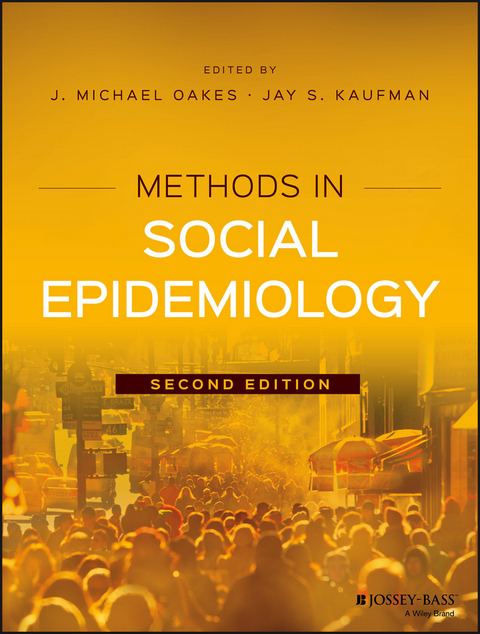
Methods in Social Epidemiology (eBook)
John Wiley & Sons (Verlag)
978-1-118-60373-4 (ISBN)
Methods in Social Epidemiology provides students and professionals with a comprehensive reference for studying the social distribution and social determinants of health. Covering the theory, models, and methods used to measure and analyze these phenomena, this book serves as both an introduction to the field and a practical manual for data collection and analysis. This new second edition has been updated to reflect the field's tremendous growth in recent years, including advancements in statistical modeling and study designs. New chapters delve into genetic methods, structural cofounding, selection bias, network methods, and more, including new discussion on qualitative data collection with disadvantaged populations.
Social epidemiology studies the way society's innumerable social interactions, both past and present, yields different exposures and health outcomes between individuals within populations. This book provides a thorough, detailed overview of the field, with expert guidance toward the real-world methods that fuel the latest advances.
- Identify, measure, and track health patterns in the population
- Discover how poverty, race, and socioeconomic factors become risk factors for disease
- Learn qualitative data collection techniques and methods of statistical analysis
- Examine up-to-date models, theory, and frameworks in the social epidemiology sphere
As the field continues to evolve, researchers continue to identify new disease-specific risk factors and learn more about how the social system promotes and maintains well-known exposure disparities. New technology in data science and genomics allows for more rigorous investigation and analysis, while the general thinking in the field has become more targeted and attentive to causal inference and core assumptions behind effect identification. It's an exciting time to be a part of the field, and Methods in Social Epidemiology provides a solid reference for any student, researcher, or faculty in public health.
Michael Oakes, PhD, is Associate Professor and Co-Director, US Census Data Research Center. Division of Epidemiology & Community Health, School of Public Health, University of Minnesota. In 2007 he was a named a McKnight Presidential Fellow, an award given to a select group of the University's most promising new associate professors. In 2010 he was awarded the Schuman award for excellence in graduate teaching, the School of Public Health's highest teaching honor. Among other things, he is currently Co-Chair of UMN's Institutional Review Board (IRB) for the protection of human research subjects and Vice-Chair of UMN's conflict of interest (COI) committee.
Jay S. Kaufman, PhD,is Professor and Canada Research Chair in Health Disparities in the Department of Epidemiology, Biostatistics and Occupational Health at McGill University, and Visiting Professor in the School of Public Health of the University of Chile. He is an editor at the journal 'Epidemiology' and an associate editor at 'American Journal of Epidemiology', and has been awarded the Rothman Epidemiology Prize (1998), a Robert Wood Johnson Foundation Investigator Award in Health Policy Research (2006-2008), a Fulbright Fellowship (2007) and the Wade Hampton Frost Lectureship (2014).
A thorough, practical reference on the social patterns behind health outcomes Methods in Social Epidemiology provides students and professionals with a comprehensive reference for studying the social distribution and social determinants of health. Covering the theory, models, and methods used to measure and analyze these phenomena, this book serves as both an introduction to the field and a practical manual for data collection and analysis. This new second edition has been updated to reflect the field's tremendous growth in recent years, including advancements in statistical modeling and study designs. New chapters delve into genetic methods, structural cofounding, selection bias, network methods, and more, including new discussion on qualitative data collection with disadvantaged populations. Social epidemiology studies the way society's innumerable social interactions, both past and present, yields different exposures and health outcomes between individuals within populations. This book provides a thorough, detailed overview of the field, with expert guidance toward the real-world methods that fuel the latest advances. Identify, measure, and track health patterns in the population Discover how poverty, race, and socioeconomic factors become risk factors for disease Learn qualitative data collection techniques and methods of statistical analysis Examine up-to-date models, theory, and frameworks in the social epidemiology sphere As the field continues to evolve, researchers continue to identify new disease-specific risk factors and learn more about how the social system promotes and maintains well-known exposure disparities. New technology in data science and genomics allows for more rigorous investigation and analysis, while the general thinking in the field has become more targeted and attentive to causal inference and core assumptions behind effect identification. It's an exciting time to be a part of the field, and Methods in Social Epidemiology provides a solid reference for any student, researcher, or faculty in public health.
Michael Oakes, PhD, is Associate Professor and Co-Director, US Census Data Research Center. Division of Epidemiology & Community Health, School of Public Health, University of Minnesota. In 2007 he was a named a McKnight Presidential Fellow, an award given to a select group of the University's most promising new associate professors. In 2010 he was awarded the Schuman award for excellence in graduate teaching, the School of Public Health's highest teaching honor. Among other things, he is currently Co-Chair of UMN's Institutional Review Board (IRB) for the protection of human research subjects and Vice-Chair of UMN's conflict of interest (COI) committee. Jay S. Kaufman, PhD,is Professor and Canada Research Chair in Health Disparities in the Department of Epidemiology, Biostatistics and Occupational Health at McGill University, and Visiting Professor in the School of Public Health of the University of Chile. He is an editor at the journal "Epidemiology" and an associate editor at "American Journal of Epidemiology", and has been awarded the Rothman Epidemiology Prize (1998), a Robert Wood Johnson Foundation Investigator Award in Health Policy Research (2006-2008), a Fulbright Fellowship (2007) and the Wade Hampton Frost Lectureship (2014).
Tables and Figures xi
About the Editors xvii
About the Authors xix
Preface xxvii
1 Introduction: Advancing Methods in Social Epidemiology 1
Jay S. Kaufman and J. Michael Oakes
Part One: Measures and Measurement 21
2 The Measurement of Socioeconomic Status 23
J. Michael Oakes and Kate E. Andrade
3 Measuring and Analyzing "Race," Racism, and Racial Discrimination 43
Saffron Karlsen and James Yzet Nazroo
4 Measuring Poverty 69
David M. Betson and Jennifer L. Warlick
5 Health Inequalities: Measurement and Decomposition 91
Sam Harper and John Lynch
6 A Conceptual Framework for Measuring Segregation and Its Association with Population Outcomes 132
Sean F. Reardon
7 Measures of Residential Community Contexts 158
Patricia O'Campo and Margaret O'Brien Caughy
Part Two: Design and Analysis 177
8 Community-Based Participatory Research: Rationale and Relevance for Social Epidemiology 179
Paula M. Lantz, Barbara A. Israel, Amy J. Schulz, and Angela G. Reyes
9 Social Network Analysis for Epidemiology 212
David A. Shoham and Lynne C. Messer
10 Fieldwork with In-Depth Interviews: How to Get Strangers in the City to Tell You Their Stories 239
Melody L. Boyd and Stefanie DeLuca
11 Experimental Social Epidemiology: Controlled Community Trials 254
Peter J. Hannan
12 Propensity Score Matching for Social Epidemiology 283
J. Michael Oakes and Pamela Jo Johnson
13 Longitudinal Approaches to Social Epidemiologic Research 308
Magdalena Cerdá and Katherine M. Keyes
14 Fixed Effects and Difference-in-Differences 341
Erin C. Strumpf, Sam Harper, and Jay S. Kaufman
15 Fixed Versus Random Effects Models for Multilevel and Longitudinal Data 369
Ashley Schempf Hirai and Jay S. Kaufman
16 Mediation Analysis in Social Epidemiology 398
Arijit Nandi and Tyler J. VanderWeele
17 A Roadmap for Estimating and Interpreting Population Intervention Parameters 432
Jennifer Ahern and Alan E. Hubbard
18 Using Causal Diagrams to Understand Common Problems in Social Epidemiology 458
M. Maria Glymour
19 Natural Experiments and Instrumental Variables Analyses in Social Epidemiology 493
M. Maria Glymour, Stefan Walter, and Eric J. Tchetgen Tchetgen
Index 539
About the Authors
Jennifer Ahern, Ph.D., M.P.H., is the Associate Dean for Research and Associate Professor of Epidemiology at University of California, Berkeley, School of Public Health. She examines the effects of the social and physical environment, and programs and policies that alter the social and physical environment, on many aspects of health (e.g., violence, substance use, mental health, and gestational health). Dr. Ahern has a methodological focus to her work, including application of causal inference methods and semi-parametric estimation approaches, aimed at improving the rigor of observational research and optimizing public health intervention planning. Her research is supported by a New Innovator Award from the National Institutes of Health (NIH), Office of the Director.
Kate E. Andrade, M.P.H., is a doctoral candidate in the Division of Epidemiology and Community Health, University of Minnesota. Her interests include applied research methods for social epidemiology, causal inference, and consequential epidemiology. Her dissertation work is exploring different analytic techniques in neighborhood effect studies.
David M. Betson, Ph.D., Associate Professor of Economics and Public Policy, College of Arts and Letters, University of Notre Dame. His research examines the impact of government on the distribution of income and wealth in the United States with a particular focus on the measurement of poverty. He was a member of the NRC Panel on Poverty Measurement that in 1995 issued a series of recommendations that has led to the new Supplemental Poverty Measure.
Melody L. Boyd, Ph.D., is an Assistant Professor of Sociology at The College at Brockport, State University of New York. Her research focuses on urban poverty, housing, neighborhoods, race, and social policy.
Magdalena Cerdá, Ph.D., is an Associate Professor of emergency medicine at the University of California at Davis School of Medicine. In her research, Magdalena integrates approaches from social and psychiatric epidemiology to examine how social contexts shape violent behavior, substance use, and common forms of mental illness. Her research focuses primarily on two areas: (1) the causes, consequences, and prevention of violence and (2) the social and policy determinants of substance use from childhood to adulthood.
Stefanie DeLuca, Ph.D., is an Associate Professor of Sociology at the Johns Hopkins University. Her research uses sociological perspectives to inform education and housing policy. She has carried out mixed-methods studies that incorporate qualitative research into experimental or quasi-experimental designs. Her new book address the children of the Moving to Opportunity Study as they transition to adulthood in Baltimore: Coming of Age in the Other America.
M. Maria Glymour, Ph.D., is an Associate Professor at the University of California, San Francisco, Department of Epidemiology and Biostatistics. Dr. Glymour's work focuses on evaluating social determinants of healthy aging, emphasizing methods to overcome causal inference challenges in observational data.
Peter J. Hannan, M.Stat., was a Senior Research Fellow in the Division of Epidemiology and Community Health in the School of Public Health at the University of Minnesota. Mr. Hannan's research interests included methodological issues with clustering in community trials, multiple imputations, Bayesian statistical analysis, and correspondence analysis. He was involved with the Minnesota Heart Health Program, was a statistical consultant to David Murray's classic text “Design and Analysis of Group Randomized Trials,” and has done statistical analysis and power calculation sections for many group randomized trials implemented in the Division, and collaborated on a number of methodological papers in his research interest areas. He is widely recognized as a leader in the design and analysis of community trials. Mr. Hannan died from natural causes on September 28, 2015.
Sam Harper, Ph.D., is trained in epidemiology at the University of South Carolina, the US National Center for Health Statistics, and the University of Michigan. His research focuses on measurement and analysis of social and economic determinants of health using routinely collected data and the use of quasi-experimental and experimental study designs to inform policy. He is currently an Associate Professor in the Department of Epidemiology, Biostatistics & Occupational Health at McGill University.
Ashley Hirai (Schempf), Ph.D., is a Senior Scientist at the Maternal and Child Health Bureau. In this role, she applies technical expertise in perinatal epidemiology, GIS, and advanced research and evaluation methods to inform and improve various programs and initiatives. Her research focuses on perinatal disparities and policy-relevant strategies to reduce inequality.
Alan E. Hubbard, Ph.D., is the Head of Biostatistics at University of California, Berkeley, School of Public Health. Dr. Hubbard is the Principal Investigator of a study of statistical methods related to patient-centered outcomes research among acute trauma patients (PCORI), head of the computational biology Core D of the SuperFund Center at UC Berkeley (NIH/EPA), as well a consulting statistician on several federally and foundation projects, including a study to measure the impacts of sanitation, water quality, hand washing, and nutrition on child growth and development. He has published over 200 articles and worked on projects ranging from molecular biology of aging, wildlife biology, epidemiology, and infectious disease modeling, but most of his work has focused on semi-parametric estimation in high-dimensional data. His current methods-research focuses on statistical inference for data-adaptive parameters.
Barbara A. Israel, Dr.P.H., M.P.H., is Professor of Health Behavior and Health Education in the School of Public Health at the University of Michigan. Dr. Israel has extensive experience conducting, evaluating, disseminating, and translating findings from community-based participatory research (CBPR) projects in collaboration with partners in diverse communities. Her research interests and publications are in the areas of: the conduct of CBPR; the evaluation of CBPR partnerships; the social and physical environmental determinants of health and health inequities; the relationship among stress, social support, control, and physical and mental health; and evaluation research methodologies.
Pamela Jo Johnson, M.P.H., Ph.D., is Associate Professor, Center for Spirituality and Healing, with graduate faculty appointments in the Divisions of Epidemiology and Community Health and Health Policy and Management, School of Public Health, University of Minnesota. She is a health services epidemiologist who focuses on social disparities in health and healthcare; access to healthcare; and complementary and alternative medicine (CAM). Her current work is focused on CAM use in diverse populations, well-being promotion in midlife, and integrative health services research. She is particularly interested in the measurement and methodological issues inherent in each of these areas.
Saffron Karlsen, Ph.D., is Senior Lecturer in Social Research at the Centre for the Study of Ethnicity and Citizenship at the University of Bristol. Her work examines the processes by which ethnicity becomes meaningful in people's lives: as aspects of personal identity and in relation to particular social outcomes, such as health and socioeconomic position. This work has examined, in particular, the influence of power imbalances on ethnic inequalities, evidenced in different forms of racist victimization and social inclusion/exclusion.
Katherine M. Keyes, Ph.D., is an associate professor of epidemiology at the Columbia University Mailman School of Public Health. Katherine's research focuses on life course epidemiology with particular attention to psychiatric disorders and injury, including early origins of child and adult health and cross-generational cohort effects on substance use, mental health, and chronic disease.
Paula M. Lantz, Ph.D., M.S., is Professor of Public Policy and Associate Dean for Research and Policy Engagement in the Gerald R. Ford School of Public Policy at the University of Michigan, where she is also Professor of Health Management and Policy in the School of Public Health. Professor Lantz is an elected member of the National Academy of Medicine. As a social demographer/epidemiologist, her research focuses on public policies and other interventions aimed at improving population health and that address social inequalities in health over the life course. She is currently conducting research regarding the potential of social impact bonds/pay for success strategies in addressing the social determinants of health in low-income communities.
John Lynch, Ph.D., is a Professor of Epidemiology and Public Health, University of Adelaide, Australia. John's research focuses on improving health and development outcomes for disadvantaged children through conducting pragmatic randomized control trials, analyses of large cohort studies, and whole-of-population linked government and non-government administrative and service data.
Lynne C. Messer, Ph.D., is a social, environmental, and reproductive/perinatal epidemiologist whose substantive work focuses on the social-structural determinants of maternal and child health disparities within the Developmental Origins of Health and Disease framework. Methodologically, her work entails better-defining neighborhood environments, developing environmental exposure measures for a variety...
| Erscheint lt. Verlag | 21.2.2017 |
|---|---|
| Reihe/Serie | Public Health / Epidemiology and Biostatistics |
| Public Health / Epidemiology and Biostatistics | Public Health/Epidemiology and Biostatistics |
| Sprache | englisch |
| Themenwelt | Mathematik / Informatik ► Mathematik ► Statistik |
| Mathematik / Informatik ► Mathematik ► Wahrscheinlichkeit / Kombinatorik | |
| Studium ► Querschnittsbereiche ► Epidemiologie / Med. Biometrie | |
| Technik | |
| Schlagworte | Epidemiologie • Health Sociology • Jay S. Kaufman • J. Michael Oakes • Medical Statistics & Epidemiology • Medizinische Statistik u. Epidemiologie • Methods in Social Epidemiology, 2nd Edition • Public Health • social epidemiology analysis • social epidemiology data collection • social epidemiology genomics • social epidemiology measurement • social epidemiology methods • social epidemiology models • social epidemiology patterns • social epidemiology reference • social epidemiology risk factors • social epidemiology statistics • social epidemiology textbook • social epidemiology theory • social epidemiology visualization • social factors in health • social patterns in health • Statistics • Statistik |
| ISBN-10 | 1-118-60373-7 / 1118603737 |
| ISBN-13 | 978-1-118-60373-4 / 9781118603734 |
| Informationen gemäß Produktsicherheitsverordnung (GPSR) | |
| Haben Sie eine Frage zum Produkt? |
 EPUB (Adobe DRM)
Kopierschutz: Adobe-DRM
Adobe-DRM ist ein Kopierschutz, der das eBook vor Mißbrauch schützen soll. Dabei wird das eBook bereits beim Download auf Ihre persönliche Adobe-ID autorisiert. Lesen können Sie das eBook dann nur auf den Geräten, welche ebenfalls auf Ihre Adobe-ID registriert sind.
Details zum Adobe-DRM
Dateiformat: EPUB (Electronic Publication)
EPUB ist ein offener Standard für eBooks und eignet sich besonders zur Darstellung von Belletristik und Sachbüchern. Der Fließtext wird dynamisch an die Display- und Schriftgröße angepasst. Auch für mobile Lesegeräte ist EPUB daher gut geeignet.
Systemvoraussetzungen:
PC/Mac: Mit einem PC oder Mac können Sie dieses eBook lesen. Sie benötigen eine
eReader: Dieses eBook kann mit (fast) allen eBook-Readern gelesen werden. Mit dem amazon-Kindle ist es aber nicht kompatibel.
Smartphone/Tablet: Egal ob Apple oder Android, dieses eBook können Sie lesen. Sie benötigen eine
Geräteliste und zusätzliche Hinweise
Buying eBooks from abroad
For tax law reasons we can sell eBooks just within Germany and Switzerland. Regrettably we cannot fulfill eBook-orders from other countries.
aus dem Bereich