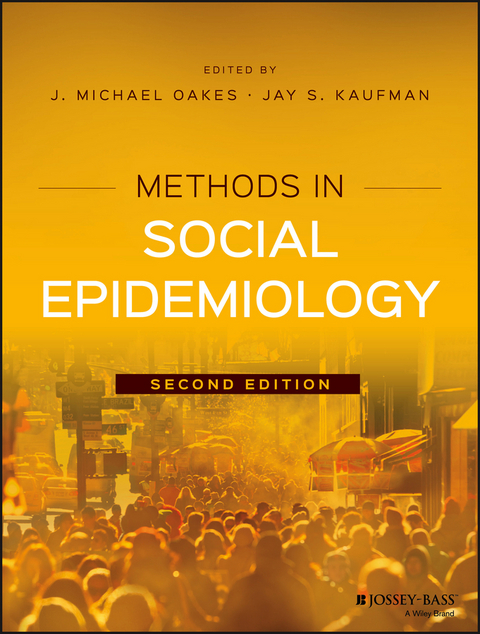
Methods in Social Epidemiology (eBook)
608 Seiten
Jossey-Bass (Verlag)
978-1-118-60372-7 (ISBN)
Methods in Social Epidemiology provides students and professionals with a comprehensive reference for studying the social distribution and social determinants of health. Covering the theory, models, and methods used to measure and analyze these phenomena, this book serves as both an introduction to the field and a practical manual for data collection and analysis. This new second edition has been updated to reflect the field's tremendous growth in recent years, including advancements in statistical modeling and study designs. New chapters delve into genetic methods, structural cofounding, selection bias, network methods, and more, including new discussion on qualitative data collection with disadvantaged populations.
Social epidemiology studies the way society's innumerable social interactions, both past and present, yields different exposures and health outcomes between individuals within populations. This book provides a thorough, detailed overview of the field, with expert guidance toward the real-world methods that fuel the latest advances.
- Identify, measure, and track health patterns in the population
- Discover how poverty, race, and socioeconomic factors become risk factors for disease
- Learn qualitative data collection techniques and methods of statistical analysis
- Examine up-to-date models, theory, and frameworks in the social epidemiology sphere
As the field continues to evolve, researchers continue to identify new disease-specific risk factors and learn more about how the social system promotes and maintains well-known exposure disparities. New technology in data science and genomics allows for more rigorous investigation and analysis, while the general thinking in the field has become more targeted and attentive to causal inference and core assumptions behind effect identification. It's an exciting time to be a part of the field, and Methods in Social Epidemiology provides a solid reference for any student, researcher, or faculty in public health.
Michael Oakes, PhD, is Associate Professor and Co-Director, US Census Data Research Center. Division of Epidemiology & Community Health, School of Public Health, University of Minnesota. In 2007 he was a named a McKnight Presidential Fellow, an award given to a select group of the University's most promising new associate professors. In 2010 he was awarded the Schuman award for excellence in graduate teaching, the School of Public Health's highest teaching honor. Among other things, he is currently Co-Chair of UMN's Institutional Review Board (IRB) for the protection of human research subjects and Vice-Chair of UMN's conflict of interest (COI) committee.
Jay S. Kaufman, PhD,is Professor and Canada Research Chair in Health Disparities in the Department of Epidemiology, Biostatistics and Occupational Health at McGill University, and Visiting Professor in the School of Public Health of the University of Chile. He is an editor at the journal 'Epidemiology' and an associate editor at 'American Journal of Epidemiology', and has been awarded the Rothman Epidemiology Prize (1998), a Robert Wood Johnson Foundation Investigator Award in Health Policy Research (2006-2008), a Fulbright Fellowship (2007) and the Wade Hampton Frost Lectureship (2014).
Michael Oakes, PhD, is Associate Professor and Co-Director, US Census Data Research Center. Division of Epidemiology & Community Health, School of Public Health, University of Minnesota. In 2007 he was a named a McKnight Presidential Fellow, an award given to a select group of the University's most promising new associate professors. In 2010 he was awarded the Schuman award for excellence in graduate teaching, the School of Public Health's highest teaching honor. Among other things, he is currently Co-Chair of UMN's Institutional Review Board (IRB) for the protection of human research subjects and Vice-Chair of UMN's conflict of interest (COI) committee. Jay S. Kaufman, PhD,is Professor and Canada Research Chair in Health Disparities in the Department of Epidemiology, Biostatistics and Occupational Health at McGill University, and Visiting Professor in the School of Public Health of the University of Chile. He is an editor at the journal "Epidemiology" and an associate editor at "American Journal of Epidemiology", and has been awarded the Rothman Epidemiology Prize (1998), a Robert Wood Johnson Foundation Investigator Award in Health Policy Research (2006-2008), a Fulbright Fellowship (2007) and the Wade Hampton Frost Lectureship (2014).
Cover 1
Title Page 5
Copyright 6
Contents 9
Tables and Figures 13
About the Editors 19
About the Authors 21
Preface 29
Chapter 1: Introduction: Advancing Methods in Social Epidemiology 35
What Is Social Epidemiology? 35
What Is Social Epidemiologic Methodology? 37
Three Fundamental Issues 38
Advancing Further Still 46
References 50
Part One: Measures and Measurement 55
Chapter 2: The Measurement of Socioeconomic Status 57
What Is Socioeconomic Status? 59
Why Does it Matter? 61
How Is SES Measured? 63
How Should SES Be Measured? 70
Recommendations and Conclusions 73
References 75
Chapter 3: Measuring and Analyzing "Race," Racism, and Racial Discrimination 77
Concepts 79
Measurement 85
Conclusions 96
References 96
Chapter 4: Measuring Poverty 103
What Does It Mean to be Poor? 104
Early Attempts at Constructing Poverty Budgets (Thresholds) 106
Current Methods of Poverty Measurement 108
NRC Panel Recommendations 109
Impact on Elderly and Child Poverty 114
Progress Toward Adoption of a New Poverty Measure 118
Conclusions 122
References 123
Chapter 5: Health Inequalities: Measurement and Decomposition 125
Issues 126
Measures 135
Decomposition of Inequalities 151
Conclusions 159
References 159
Appendix 164
Chapter 6: A Conceptual Framework for Measuring Segregation and Its Association with Population Outcomes 166
What Is Segregation? 167
Why Does Segregation Matter? 168
Conceptual and Methodological Issues in the Measurement of Segregation 169
Measures of Residential Segregation 174
The Association of Segregation with Population Outcomes 184
Summary 188
References 189
Chapter 7: Measures of Residential Community Contexts 192
Measurement Strategies for Residential Neighborhoods 193
Observational Measures of Neighborhoods 195
Measures on Perceptions of Neighborhoods 198
Bringing in the Community Perspective 201
Future Directions on Measuring Neighborhood Environments 206
References 206
Part Two: Design and Analysis 211
Chapter 8: Community-Based Participatory Research: Rationale and Relevance for Social Epidemiology 213
Definition and Principles of CBPR 214
CBPR and Social Epidemiology 218
Deciding Whether or Not to Use a CBPR Approach 223
The Process of CBPR 224
Common Pitfalls/Challenges and Facilitating Factors in CBPR 228
Discussion 233
Conclusion: “Push Beyond the Research” 236
Acknowledgments 237
References 237
Chapter 9: Social Network Analysis for Epidemiology 246
Introduction to Network Concepts 250
Study Design and Data Collection Methods 253
Analytic Approaches 256
Future Directions for SNA 265
Conclusions 267
Acknowledgments 267
References 267
Chapter 10: Fieldwork with In-Depth Interviews: How to Get Strangers in the City to Tell You Their Stories 273
Logistics 277
How to Talk to Strangers So It Does Not Feel Strange 283
Conclusion: One Size Does Not Fit All, and Try, Try, Again 285
Acknowledgments 286
References 286
Chapter 11: Experimental Social Epidemiology: Controlled Community Trials 288
Randomization and Dependence 291
Implications of Clustering—Proper Inference in Community Trials 295
Efficient Allocation of Resources Subject to Constraints 297
Example of Designing a GRT and Some Further Issues 299
Implementation of Randomized Community Trials 310
Summary 311
References 312
Chapter 12: Propensity Score Matching for Social Epidemiology 317
The Counterfactual Framework 318
Propensity Score Matching Methods 324
Worked Example 330
Conclusions 336
References 338
Chapter 13: Longitudinal Approaches to Social Epidemiologic Research 342
Analytic Approaches to Describe Longitudinal Patterns 343
Analytic Approaches to Address Sources of Bias in Longitudinal Research 356
Conclusion 368
References 369
Appendix 1. MPLUS Code for Unconditional Growth Model 371
Appendix 2. MPLUS Code for Growth Model with Covariates 371
Appendix 3. SAS Code for Hierarchical Age–Period–Cohort Model Described in Figure 13.5 372
Appendix 4. SAS Code to Estimate Inverse Probability of Treatment Weights 373
Appendix 5. SAS Code to Estimate Marginal Structural Models 374
Chapter 14: Fixed Effects and Difference-in-Differences 375
Methods 377
Applications 394
Conclusion 396
Key Readings and Resources 397
Acknowledgments 397
References 397
Chapter 15: Fixed Versus Random Effects Models for Multilevel and Longitudinal Data 403
Between Versus Within Cluster Variables 404
Fixed Effects 411
Random Effects 416
Hybrid Effects 417
Marginal Models 420
An Applied Multilevel Example and Comparison of Results from Different Models 421
Multilevel and Longitudinal Literature Examples 424
Summary and Recommendations for Further Reading 427
References 428
Chapter 16: Mediation Analysis in Social Epidemiology 432
The Product Method for Mediation Analysis 434
Counterfactual Approach to Mediation Analysis 435
Controlled or Natural Effects? 441
Decomposition of Racial Inequalities in Health 442
Exposure-Induced Mediator-Outcome Confounding 445
Mediation Analysis with Multiple Mediators 449
Sensitivity Analyses 452
Other Topics 459
Conclusions 460
References 460
Chapter 17: A Roadmap for Estimating and Interpreting Population Intervention Parameters 466
Roadmap 468
Other Parameters and Future Directions 486
Conclusions 487
Acknowledgments 487
References 488
Chapter 18: Using Causal Diagrams to Understand Common Problems in Social Epidemiology 492
Some Background Definitions 493
Graphical Models 500
Applying DAGs to Guide Analyses in Social Epidemiology 507
Caveats and Conclusion 521
Acknowledgments 522
References 522
Chapter 19: Natural Experiments and Instrumental Variables Analyses in Social Epidemiology 527
Motivations for Using Instrumental Variables in Social Epidemiology Research 528
Assumptions and Estimation in IV Analyses 532
Framing Natural Experiments and IVs Causally 543
A Good Instrument Is Hard to Find 553
Limitations of IV Analyses 563
Conclusion 565
References 566
Index 573
EULA 603
| Erscheint lt. Verlag | 22.2.2017 |
|---|---|
| Reihe/Serie | Public Health / Epidemiology and Biostatistics |
| Public Health / Epidemiology and Biostatistics | Public Health/Epidemiology and Biostatistics |
| Sprache | englisch |
| Themenwelt | Mathematik / Informatik ► Mathematik ► Statistik |
| Mathematik / Informatik ► Mathematik ► Wahrscheinlichkeit / Kombinatorik | |
| Studium ► Querschnittsbereiche ► Epidemiologie / Med. Biometrie | |
| Technik | |
| Schlagworte | Epidemiologie • Health Sociology • Jay S. Kaufman • J. Michael Oakes • Medical Statistics & Epidemiology • Medizinische Statistik u. Epidemiologie • Methods in Social Epidemiology, 2nd Edition • Public Health • social epidemiology analysis • social epidemiology data collection • social epidemiology genomics • social epidemiology measurement • social epidemiology methods • social epidemiology models • social epidemiology patterns • social epidemiology reference • social epidemiology risk factors • social epidemiology statistics • social epidemiology textbook • social epidemiology theory • social epidemiology visualization • social factors in health • social patterns in health • Statistics • Statistik |
| ISBN-10 | 1-118-60372-9 / 1118603729 |
| ISBN-13 | 978-1-118-60372-7 / 9781118603727 |
| Informationen gemäß Produktsicherheitsverordnung (GPSR) | |
| Haben Sie eine Frage zum Produkt? |
 PDF (Adobe DRM)
Kopierschutz: Adobe-DRM
Adobe-DRM ist ein Kopierschutz, der das eBook vor Mißbrauch schützen soll. Dabei wird das eBook bereits beim Download auf Ihre persönliche Adobe-ID autorisiert. Lesen können Sie das eBook dann nur auf den Geräten, welche ebenfalls auf Ihre Adobe-ID registriert sind.
Details zum Adobe-DRM
Dateiformat: PDF (Portable Document Format)
Mit einem festen Seitenlayout eignet sich die PDF besonders für Fachbücher mit Spalten, Tabellen und Abbildungen. Eine PDF kann auf fast allen Geräten angezeigt werden, ist aber für kleine Displays (Smartphone, eReader) nur eingeschränkt geeignet.
Systemvoraussetzungen:
PC/Mac: Mit einem PC oder Mac können Sie dieses eBook lesen. Sie benötigen eine
eReader: Dieses eBook kann mit (fast) allen eBook-Readern gelesen werden. Mit dem amazon-Kindle ist es aber nicht kompatibel.
Smartphone/Tablet: Egal ob Apple oder Android, dieses eBook können Sie lesen. Sie benötigen eine
Geräteliste und zusätzliche Hinweise
Buying eBooks from abroad
For tax law reasons we can sell eBooks just within Germany and Switzerland. Regrettably we cannot fulfill eBook-orders from other countries.
aus dem Bereich