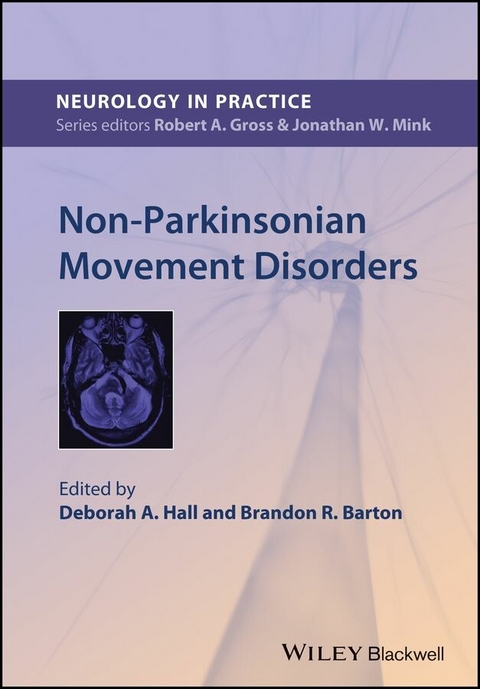
Non-Parkinsonian Movement Disorders (eBook)
John Wiley & Sons (Verlag)
978-1-118-47405-1 (ISBN)
- Each presentation includes practical descriptions of phenomenology, and key clinical information from the history and neurological examination that guide the physician to the correct diagnosis, and treatment options
- Throughout the book Science Revisited highlights remind clinicians of the scientific anchors related to each disorder, and Evidence at a Glance boxes summarise clinical trial evidence-based review information
- Numerous video clips in every chapter demonstrate different movement disorders to aid diagnosis
- Unique learning tools, Tips and Tricks and Caution Warning boxes, give useful hints on improving outcomes and preventing errors
Deborah Hall, MD, PhD
Department of Neurological Sciences, Section of Movement Disorders at Rush University Medical Center, Chicago
Dr Hall was awarded her MD at Indiana University and completed her internship, neurology residency and movement disorders fellowship at University of Colorado. She is the recipient of an NIH K23 career development award to investigate the prevalence of FMR1 repeat expansions in various movement disorders. Her research interests are in Fragile X tremor ataxia syndrome and in clinical aspects of movement disorders.
Brandon Barton, MD
Department of Neurological sciences, Rush University Medical Center, Chicago
Dr Barton splits his time between the Movement Disorders section at Rush University Medical Center and the Veterans Administration. Barton's research interests are in clinical trials in movement disorders, and in behavioral changes in Parkinson disease, particularly impulse control disorders.
A clinical in the office or at the bedside guide to effective patient care for neurologists in practice and in training Each presentation includes practical descriptions of phenomenology, and key clinical information from the history and neurological examination that guide the physician to the correct diagnosis, and treatment options Throughout the book Science Revisited highlights remind clinicians of the scientific anchors related to each disorder, and Evidence at a Glance boxes summarise clinical trial evidence-based review information Numerous video clips in every chapter demonstrate different movement disorders to aid diagnosis Unique learning tools, Tips and Tricks and Caution Warning boxes, give useful hints on improving outcomes and preventing errors
Deborah Hall, MD, PhD Department of Neurological Sciences, Section of Movement Disorders at Rush University Medical Center, Chicago Dr Hall was awarded her MD at Indiana University and completed her internship, neurology residency and movement disorders fellowship at University of Colorado. She is the recipient of an NIH K23 career development award to investigate the prevalence of FMR1 repeat expansions in various movement disorders. Her research interests are in Fragile X tremor ataxia syndrome and in clinical aspects of movement disorders. Brandon Barton, MD Department of Neurological sciences, Rush University Medical Center, Chicago Dr Barton splits his time between the Movement Disorders section at Rush University Medical Center and the Veterans Administration. Barton's research interests are in clinical trials in movement disorders, and in behavioral changes in Parkinson disease, particularly impulse control disorders.
List of Contributors vii
Series Foreword ix
Foreword x
About the Companion Website xi
1 Approach to Movement Disorders 1
Deborah A. Hall and Brandon R. Barton
part 1: hypokinetic
2 Hypokinetic (Non?]Parkinsonian) Movement Disorders 7
Shyamal H. Mehta and Alberto J. Espay
part 2: hyperkinetic
3 Common Types of Tremor 17
Jeff Kraakevik and Bernadette Schoneburg
4 Myoclonus 26
Daniel Burdick and Pinky Agarwal
5 Tics and Tourette Syndrome 35
David Shprecher
6 Chorea, Athetosis, and Ballism 43
Rohit Dhall
7 Dystonia 57
Lauren Schrock, Tao Xie and Brandon R. Barton
8 Ataxia 68
Samantha Holden and Deborah A. Hall
9 Restless Leg Syndrome 79
Olga Klepitskaya
10 Hemifacial Spasm and Other Facial Movement Disorders 89
Tao Xie, Ifeoma Nwaneri and Un Jung Kang
11 Periodic Limb Movements of Sleep and REM Sleep Behavior Disorder 99
Aleksandar Videnovic
12 Stereotypies 106
Michael Rotstein
13 Paroxysmal Movement Disorders 114
Christina L. Vaughan
14 Uncommon Movement Disorders and Movement Disorder Mimics 121
Nina Browner
part 3: other disease syndromes
15 Tardive Syndromes 133
Stephanie Lessig
16 Heavy Metal Accumulation Diseases 139
Khashayar Dashtipour and Janice Fuentes
17 ICU Intensive Care Unit Movement Disorder Emergencies 150
Florence C. F. Chang and Steven J. Frucht
18 Functional or Psychogenic Movement Disorders 161
S. Elizabeth Zauber
part 4: additional resources
19 Genetics of Movement Disorders 171
Deborah A. Hall
20 Neuroimaging Finding in Movement Disorders 175
Kathleen L. Poston
21 Clinical Rating Scales in Movement Disorders 185
Padmaja Vittal and Brandon R. Barton
22 Videotaping Suggestions for Movement Disorders 190
Gian Pal and Deborah A. Hall
Index 195
1
Approach to Movement Disorders
Deborah A. Hall, MD, PhD1 and Brandon R. Barton, MD, MS1,2
1Department of Neurological Sciences, Section of Movement Disorders, Rush University Medical Center, Chicago, Illinois, USA
2Department of Neurological Sciences, Rush University Medical Center; Neurology Section, Jesse Brown VA Medical Center, Chicago, Illinois, USA
Introduction
Patients with movement disorders typically present with a change in their overall pattern of movements: this may represent an increase of movement (hyperkinetic), decrease (hypo‐ or akinetic), uncoordinated movement (ataxia), or a combination of the aforementioned. The initial task is to properly categorize the appearance or “phenomenology” of the movement disorder, as this is the essential step to guide the clinician in developing a differential diagnosis and treatment plan. Given recent advances in neurology, the majority of movement disorder patients are candidates for treatment, such as medication, physical therapy, or surgical interventions.
The first part of this book provides a short chapter on non‐parkinsonian hypokinetic movement disorders; parkinsonian disorders are covered in another volume in this series. The second part includes hyperkinetic disorders. Part three includes various syndromes that do not fit into the other categories or that overlap between categories. Broader chapters in part four, on genetics, neuroimaging, rating scales, and videotaping suggestions, are intended to serve as clinician resources.
This introductory chapter provides an approach that will facilitate the evaluation of a movement disorder patient. The phenomenological categorization of the most common movement disorders falls into seven major categories: parkinsonism, tremor, dystonia, myoclonus, chorea, ataxia, and tics. Most of the commonly encountered disorders can be classified into one of these categories, but given the breadth of the diseases in the field, there are many unusual or rare types of movement that may not be easily categorized or may be consistent with more than one phenomenological category. A thorough history and examination are essential to defining the phenomenology. Home videotapes of the patient may also be useful if the movements are intermittent, variable, or not seen clearly in the office. Laboratory testing and imaging are necessary in some movement disorders, but are less helpful in many circumstances given that the disorders are diagnosed mainly on history and examination.
History
Start by asking six questions in the history.
1. Can you describe the movements?
Patients will usually be able to describe a decrease or increase (or both) in their overall movement from baseline, although often hyperkinetic aspects of abnormal movements can overshadow the hypokinetic movements from the patient’s perspective. Hypokinetic movement disorders, also termed bradykinesia (slowed movement) or akinesia (loss of movement) are characterized by an overall decrease in the speed or amplitude of movement in any area of the body. Signs and symptoms could include decreased facial expression, slowed speech, reduced dexterity of the extremities, decreased arm swing, and slowed walking speed. Hyperkinetic movement disorders, also generally termed dyskinesia (abnormal movements), are characterized by an increase in baseline movements. Hyperkinetic movement disorders have highly variable manifestations, ranging from increased eye closure to arm flailing to jerking of the legs. Lastly, patients may complain of a change in the character of voluntary movements, such as becoming clumsy or unsteady with walking, which may be seen in ataxic disorders.
Certain features of abnormal movements are very important to elicit in the patient’s description. Defining the conditions under which the movement occurs, such as with rest or with action, is necessary for accurate diagnosis and categorization of tremor. An ability to suppress the movement or an increase in the movement with suggestion are features common to tics. Specific triggers of the movements, especially with certain tasks, may be reported in dystonic disorders or paroxysmal movement disorders. Myoclonus can be triggered by startle. Asking about worsening of the disorder or improvement with certain foods or alcohol can narrow the differential diagnosis in forms of dystonia, myoclonus, or tremor disorders. A history of falls, especially the temporal course, is helpful in disorders that affect gait and balance, as falls are seen earlier or more frequently in some disorders as opposed to others.
2. When did the movements start and how have they changed over time?
Most movement disorders are subacute or chronic in nature. An acute onset is less common and may signify a secondary movement disorder related to an underlying inciting event, such as a stroke or medication change. Acute onset of movement disorders at maximal severity is also commonly seen in functional movement disorders, where patients will often present to emergency departments from the start. Most hypokinetic, hyperkinetic, and ataxic movement disorders will slowly worsen over time. Disorders that improve over time are less common; for example, tic disorders will typically improve from childhood into adolescence and adulthood. Static movement disorders may occur with birth injury or some dystonic disorders.
3. Are the movements continuous or intermittent?
Although many movement disorders start out as intermittent or suppressible, they tend to become more continuous or constant when they progress over time. The rest tremor seen in parkinsonian disorders is a classic example, where the tremor starts intermittently in a limb before becoming more regular and spreading to other limbs. Early on, this type of tremor can be sometimes voluntarily suppressed or decreased with movement, but later the tremor is continuous. Episodic movement disorders are much less common. Paroxysmal disorders, which are typically choreic or dystonic in nature, can many times be diagnosed by history alone if specific triggers such as sudden movements cause the disorder to occur. Functional (psychogenic) movement disorders are also frequently episodic. The circumstances under which the movement occurs can be particularly helpful. For example, restless legs syndrome worsens at night when the patient is laying down.
4. Is there a family history?
All modes of inheritance patterns are seen in movement disorders and the genetic basis of these disorders is rapidly being discovered. It is not sufficient to inquire only about the particular movement disorder seen in the patient, since broadening the questioning to other biological family members may yield additional important clues. For example, patients with grandchildren with intellectual disabilities may be at risk for fragile X‐associated disorders. Tic patients may have associated diagnoses in the family, such as attention deficit hyperactivity disorder.
5. Are there other medical illnesses?
The majority of movement disorders are restricted to the nervous system, but systemic organ involvement may provide diagnostic clues. For example, patients with underlying cancers may be at risk for paraneoplastic disorders and iron deficiency anemia or diabetes may predispose to restless legs syndrome. The presence of cardiomyopathy is associated with Friedreich ataxia or mitochondrial disorders. Enlargement of visceral organs (spleen, liver) may suggest a lysosomal storage disease.
6. Have the movements been treated in the past and what was the response to treatment?
A response to dopamine medications may facilitate diagnosis of dopa‐response dystonia. Paroxysmal movement disorders may be exquisitely responsive to antiepileptic medications. Other substances may improve movements, such as the improvement of essential tremor, essential myoclonus, and myoclonus‐dystonia with alcohol.
Examination
Depending on the movement disorder, abnormal movements may be present in focal or contiguous areas of the body or may be generalized. By determining the location and phenomenology of the movement, most patients can be placed into one of seven distinct patterns of abnormal movement.
Parkinsonism
The main features of parkinsonism are tremor at rest, bradykinesia or akinesia, rigidity, loss of postural reflexes, flexed posture, and freezing. Parkinsonism, in particular, Parkinson disease, is the most common disorder seen in movement disorder clinics and is covered by another volume of this series.
Tremor
This pattern is typically rhythmical and oscillatory and may affect more than one body part. Tremor should be classified on examination by the conditions under which it is activated: at rest, with posture, or with action. Tremor may be present in multiple conditions, for example, essential tremor, which is frequently seen with posture and action or intention. Tremors may also be task specific, such as the dystonic tremor of writer’s cramp.
Chorea
Choreic movement is random in nature and is purposeless, non‐rhythmic, and unsustained. It may appear to flow from one body part to another. Huntington disease is a frequent cause of chorea and manifests with brief, irregular movements. Chorea can be suppressed or camouflaged. It can be accompanied by “negative chorea” or motor impersistence.
Dystonia
In dystonia, agonist and...
| Erscheint lt. Verlag | 9.2.2017 |
|---|---|
| Reihe/Serie | NIP- Neurology in Practice |
| NIP- Neurology in Practice | NIP- Neurology in Practice |
| Sprache | englisch |
| Themenwelt | Medizin / Pharmazie ► Medizinische Fachgebiete ► Neurologie |
| Schlagworte | Bewegungsstörung • Bewegungsstörung • Medical Science • Medizin • Neurologie • Neurology • Non-Parkinsonian Movement DisordersDeborah HallBrandon BartonNeurology in PracticeRobert GrossJon MinkHypokineticHyperkineticTremorMyoclonusTics/Tourette'sChoreaAthetosisBallismDystoniaAtaxiaRestless Legs SyndromeHemifacial SpasmOther Facial DisordersPeriodic Limb Movements of Sleep/RBDStereotypical MannerismsParoxysmal Movement DisordersMimics of Hyperkinetic DisordersTardive SyndromesHeavy Metal Accumulation DiseasesICU Movement Disorder EmergenciesFunctionalPsychogenicGenetics of Movement DisordersNeuroi |
| ISBN-10 | 1-118-47405-8 / 1118474058 |
| ISBN-13 | 978-1-118-47405-1 / 9781118474051 |
| Informationen gemäß Produktsicherheitsverordnung (GPSR) | |
| Haben Sie eine Frage zum Produkt? |
 EPUB (Adobe DRM)
Kopierschutz: Adobe-DRM
Adobe-DRM ist ein Kopierschutz, der das eBook vor Mißbrauch schützen soll. Dabei wird das eBook bereits beim Download auf Ihre persönliche Adobe-ID autorisiert. Lesen können Sie das eBook dann nur auf den Geräten, welche ebenfalls auf Ihre Adobe-ID registriert sind.
Details zum Adobe-DRM
Dateiformat: EPUB (Electronic Publication)
EPUB ist ein offener Standard für eBooks und eignet sich besonders zur Darstellung von Belletristik und Sachbüchern. Der Fließtext wird dynamisch an die Display- und Schriftgröße angepasst. Auch für mobile Lesegeräte ist EPUB daher gut geeignet.
Systemvoraussetzungen:
PC/Mac: Mit einem PC oder Mac können Sie dieses eBook lesen. Sie benötigen eine
eReader: Dieses eBook kann mit (fast) allen eBook-Readern gelesen werden. Mit dem amazon-Kindle ist es aber nicht kompatibel.
Smartphone/Tablet: Egal ob Apple oder Android, dieses eBook können Sie lesen. Sie benötigen eine
Geräteliste und zusätzliche Hinweise
Buying eBooks from abroad
For tax law reasons we can sell eBooks just within Germany and Switzerland. Regrettably we cannot fulfill eBook-orders from other countries.
aus dem Bereich