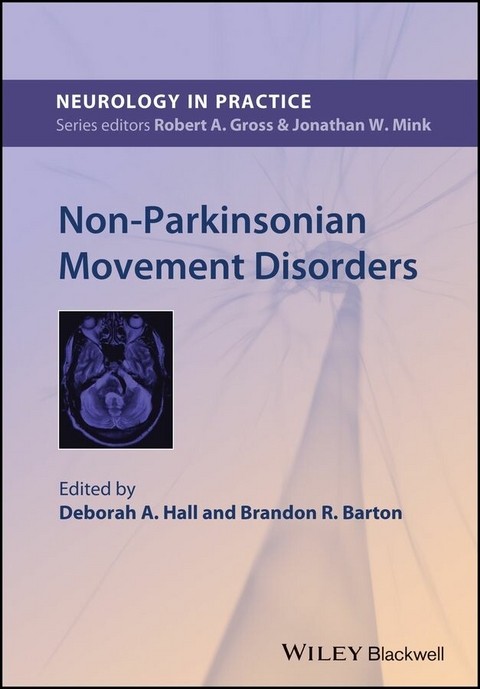
Non-Parkinsonian Movement Disorders (eBook)
John Wiley & Sons (Verlag)
978-1-118-47406-8 (ISBN)
- Each presentation includes practical descriptions of phenomenology, and key clinical information from the history and neurological examination that guide the physician to the correct diagnosis, and treatment options
- Throughout the book Science Revisited highlights remind clinicians of the scientific anchors related to each disorder, and Evidence at a Glance boxes summarise clinical trial evidence-based review information
- Numerous video clips in every chapter demonstrate different movement disorders to aid diagnosis
- Unique learning tools, Tips and Tricks and Caution Warning boxes, give useful hints on improving outcomes and preventing errors
Deborah Hall, MD, PhD
Department of Neurological Sciences, Section of Movement Disorders at Rush University Medical Center, Chicago
Dr Hall was awarded her MD at Indiana University and completed her internship, neurology residency and movement disorders fellowship at University of Colorado. She is the recipient of an NIH K23 career development award to investigate the prevalence of FMR1 repeat expansions in various movement disorders. Her research interests are in Fragile X tremor ataxia syndrome and in clinical aspects of movement disorders.
Brandon Barton, MD
Department of Neurological sciences, Rush University Medical Center, Chicago
Dr Barton splits his time between the Movement Disorders section at Rush University Medical Center and the Veterans Administration. Barton's research interests are in clinical trials in movement disorders, and in behavioral changes in Parkinson disease, particularly impulse control disorders.
A clinical in the office or at the bedside guide to effective patient care for neurologists in practice and in training Each presentation includes practical descriptions of phenomenology, and key clinical information from the history and neurological examination that guide the physician to the correct diagnosis, and treatment options Throughout the book Science Revisited highlights remind clinicians of the scientific anchors related to each disorder, and Evidence at a Glance boxes summarise clinical trial evidence-based review information Numerous video clips in every chapter demonstrate different movement disorders to aid diagnosis Unique learning tools, Tips and Tricks and Caution Warning boxes, give useful hints on improving outcomes and preventing errors
Deborah Hall, MD, PhD Department of Neurological Sciences, Section of Movement Disorders at Rush University Medical Center, Chicago Dr Hall was awarded her MD at Indiana University and completed her internship, neurology residency and movement disorders fellowship at University of Colorado. She is the recipient of an NIH K23 career development award to investigate the prevalence of FMR1 repeat expansions in various movement disorders. Her research interests are in Fragile X tremor ataxia syndrome and in clinical aspects of movement disorders. Brandon Barton, MD Department of Neurological sciences, Rush University Medical Center, Chicago Dr Barton splits his time between the Movement Disorders section at Rush University Medical Center and the Veterans Administration. Barton's research interests are in clinical trials in movement disorders, and in behavioral changes in Parkinson disease, particularly impulse control disorders.
Title Page 5
Copyright Page 6
Contents 7
List of Contributors 9
Series Foreword 11
Foreword 12
About the Companion Website 13
Chapter 1 Approach to Movement Disorders 15
Introduction 15
History 15
Examination 17
Diagnostic testing 17
Treatment 18
Further Readings 18
Part 1 Hypokinetic 19
Chapter 2 Hypokinetic (Non-Parkinsonian) Movement Disorders 21
Introduction 21
Stiff-person syndrome (SPS) 21
Primary lateral sclerosis 24
Catatonia 24
Neuromuscular causes of hypokinesia 25
Functional slowness 27
Akinetic mutism 27
Further Readings 28
Part 2 Hyperkinetic 29
Chapter 3 Common Types of Tremor 31
Introduction 31
Essential tremor (ET) 32
Drug-induced tremor 35
Parkinsonian tremor 36
Functional tremor 37
Brainstem/cerebellar tremor 38
Dystonic tremor 38
Orthostatic tremor 39
Conclusion 39
Further Readings 39
Chapter 4 Myoclonus 40
Introduction 40
Definition 40
Clinical Localization 41
Diagnostic approach and etiology 42
Treatment 46
Conclusion 47
Further Readings 47
Chapter 5 Tics and Tourette Syndrome 49
Introduction 49
Phenomenology and definitions 49
History and diagnosis 49
Primary versus secondary tic disorders 50
Tic subtypes 50
Comorbidities and heredity 52
Prognosis 52
Management 52
Education 52
Treatment of OCD 52
Treatment ADD/ADHD 53
Treatment of tics 53
Individualized therapy and the art of medicine 55
Further Readings 56
Chapter 6 Chorea, Athetosis, and Ballism 57
Introduction 57
Chorea 57
Huntington disease 59
Other inherited choreas 63
Ballism 69
Athetosis 69
Further Readings 70
Chapter 7 Dystonia 71
Introduction 71
Definition 71
Classification of dystonia 71
Common dystonia syndromes 76
Diagnostic evaluation 77
Evaluation 77
Treatment 78
Further Readings 81
Chapter 8 Ataxia 82
Introduction 82
Clinical features 83
Diagnosis 85
Treatment 91
Further Readings 92
Chapter 9 Restless Leg Syndrome 93
Introduction 93
Clinical features 93
Mimics of RLS 94
Epidemiology of RLS 95
Etiology of RLS 95
Pathophysiology 97
Treatment 97
Prognosis 102
Further Readings 102
Chapter 10 Hemifacial Spasm and Other Facial Movement Disorders 103
Hemifacial spasm 103
Blepharospasm 106
Facial tics and Tourette syndrome 110
Further Readings 112
Chapter 11 Periodic Limb Movements of Sleep and REM Sleep Behavior Disorder 113
Introduction 113
REM sleep behavior disorder (RBD) 115
Further Readings 119
Chapter 12 Stereotypies 120
Introduction 120
Definitions 120
Clinical presentation 121
Epidemiology 124
Differential diagnosis 124
Prognosis 126
Management 126
Further Readings 126
Chapter 13 Paroxysmal Movement Disorders 128
Introduction 128
Paroxysmal dyskinesias 128
Secondary causes of paroxysmal dyskinesias 132
Episodic ataxias 132
Myoclonus 132
Startle syndromes 132
Oculogyric crisis 134
Functional syndromes 134
Further Readings 134
Chapter 14 Uncommon Movement Disorders and Movement Disorder Mimics 135
Introduction 135
Alien hand/limb syndrome 135
Belly dancer dyskinesia 137
Jumpy stumps 137
Painful legs and moving toes 138
Myokymia 139
Startle/hyperekplexia 140
Further Readings 144
Part 3 Other Disease Syndromes 145
Chapter 15 Tardive Syndromes 147
Introduction 147
Definition 147
Pathophysiology 147
Clinical features 148
Risk factors 148
Tardive syndromes 148
Differential diagnosis of tardive syndromes 150
Summary 152
Further Readings 152
Chapter 16 Heavy Metal Accumulation Diseases 153
Introduction 153
Arsenic 153
Bismuth 154
Copper 155
Iron 155
Lead 156
Manganese 160
Mercury 161
Thallium 161
Zinc 162
Further Readings 162
Chapter 17 ICU Intensive Care Unit Movement Disorder Emergencies 164
Introduction 164
NMDA receptor encephalitis 165
Neuroleptic malignant syndrome 167
Serotonin syndrome 167
Status dystonicus (dystonic storm) 169
Airway emergencies 169
Tic status 170
Drug-induced akathisia 171
Non-epileptic myoclonus 172
Acute chorea and hemiballism 172
Further Readings 173
Chapter 18 Functional or Psychogenic Movement Disorders 175
Introduction 175
Terminology 175
Diagnosis 175
Pathophysiology 176
Types of functional movement disorders 176
Tremor 176
Functional dystonia 177
Parkinsonism 178
Gait disorders 179
Jerks/myoclonus 179
Paroxysmal disorders 179
Psychiatric diagnoses 179
Conclusions 181
Further Readings 181
Part 4 Additional Resources 183
Chapter 19 Genetics of Movement Disorders 185
Introduction 185
Essential tremor 185
Myoclonus 185
Tics 186
Chorea 186
Dystonia 187
Ataxia 187
Hemifacial spasm 187
Restless legs syndrome, periodic limb movements of sleep, and REM sleep behavior disorder 187
Stereotypy 188
Paroxysmal disorders 188
Conclusions 188
Further Readings 188
Chapter 20 Neuroimaging Finding in Movement Disorders 189
Introduction 189
Imaging findings in movement disorders by phenomenology 189
Tremor 189
Myoclonus 192
Chorea and Ballism 194
Dystonia 194
Ataxia 194
Further Readings 197
Chapter 21 Clinical Rating Scales in Movement Disorders 199
Introduction 199
Dyskinetic/abnormal involuntary movements 200
Dystonia 200
Chorea 200
Tremor 201
Gilles de la Tourette syndrome 201
Myoclonus 202
Ataxia 202
Further Readings 202
Chapter 22 Videotaping Suggestions for Movement Disorders 204
Introduction 204
Environment 204
Equipment 204
Instructions for the Videographer 206
Further Readings 207
Index 209
Supplemental Images 222
EULA 226
| Erscheint lt. Verlag | 27.12.2016 |
|---|---|
| Reihe/Serie | NIP- Neurology in Practice | NIP- Neurology in Practice |
| Sprache | englisch |
| Themenwelt | Medizin / Pharmazie ► Medizinische Fachgebiete ► Neurologie |
| Schlagworte | Bewegungsstörung • Bewegungsstörung • Medical Science • Medizin • Neurologie • Neurology • Non-Parkinsonian Movement DisordersDeborah HallBrandon BartonNeurology in PracticeRobert GrossJon MinkHypokineticHyperkineticTremorMyoclonusTics/Tourette'sChoreaAthetosisBallismDystoniaAtaxiaRestless Legs SyndromeHemifacial SpasmOther Facial DisordersPeriodic Limb Movements of Sleep/RBDStereotypical MannerismsParoxysmal Movement DisordersMimics of Hyperkinetic DisordersTardive SyndromesHeavy Metal Accumulation DiseasesICU Movement Disorder EmergenciesFunctionalPsychogenicGenetics of Movement DisordersNeuroi |
| ISBN-10 | 1-118-47406-6 / 1118474066 |
| ISBN-13 | 978-1-118-47406-8 / 9781118474068 |
| Informationen gemäß Produktsicherheitsverordnung (GPSR) | |
| Haben Sie eine Frage zum Produkt? |
 PDF (Adobe DRM)
Kopierschutz: Adobe-DRM
Adobe-DRM ist ein Kopierschutz, der das eBook vor Mißbrauch schützen soll. Dabei wird das eBook bereits beim Download auf Ihre persönliche Adobe-ID autorisiert. Lesen können Sie das eBook dann nur auf den Geräten, welche ebenfalls auf Ihre Adobe-ID registriert sind.
Details zum Adobe-DRM
Dateiformat: PDF (Portable Document Format)
Mit einem festen Seitenlayout eignet sich die PDF besonders für Fachbücher mit Spalten, Tabellen und Abbildungen. Eine PDF kann auf fast allen Geräten angezeigt werden, ist aber für kleine Displays (Smartphone, eReader) nur eingeschränkt geeignet.
Systemvoraussetzungen:
PC/Mac: Mit einem PC oder Mac können Sie dieses eBook lesen. Sie benötigen eine
eReader: Dieses eBook kann mit (fast) allen eBook-Readern gelesen werden. Mit dem amazon-Kindle ist es aber nicht kompatibel.
Smartphone/Tablet: Egal ob Apple oder Android, dieses eBook können Sie lesen. Sie benötigen eine
Geräteliste und zusätzliche Hinweise
Buying eBooks from abroad
For tax law reasons we can sell eBooks just within Germany and Switzerland. Regrettably we cannot fulfill eBook-orders from other countries.
aus dem Bereich