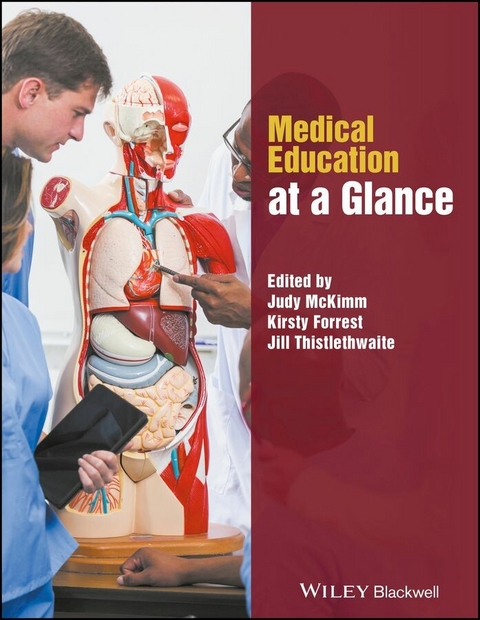
Medical Education at a Glance (eBook)
John Wiley & Sons (Verlag)
978-1-118-72382-1 (ISBN)
Covering the core concepts, activities and approaches involved in medical education, Medical Education at a Glance provides a concise, accessible introduction to this rapidly expanding area of study and practice.
This brand new title from the best-selling at a Glance series covers the range of essential medical education topics which students, trainees, new lecturers and clinical teachers need to know. Written by an experienced author team, Medical Education at a Glance is structured under the major themes of the discipline including teaching skills, learning theory,and assessment, making it an easy-to-digest guide to the practical skills and theory of medical education, teaching and learning.
Medical Education at a Glance:
- Presents core information in a highly visual way, with key concepts and terminology explained.
- Is a useful companion to the Association for the Study of Medical Education's (ASME) book Understanding Medical Education.
- Covers a wide range of topics and themes.
- Is a perfect guide for teaching and learning in both the classroom and clinical setting.
Judy McKimm, Professor of Medical Education, Swansea University Medical School, Swansea University, UK.
Kirsty Forrest, Deputy Head of Medicine, Faculty of Health Sciences and Medicine, Bond University, Australia.
Jill Thistlethwaite, Adjunct Professor, University Technology Sydney, NPS MedicineWise Sydney, University of Queensland, Australia.
Covering the core concepts, activities and approaches involved in medical education, Medical Education at a Glance provides a concise, accessible introduction to this rapidly expanding area of study and practice. This brand new title from the best-selling at a Glance series covers the range of essential medical education topics which students, trainees, new lecturers and clinical teachers need to know. Written by an experienced author team, Medical Education at a Glance is structured under the major themes of the discipline including teaching skills, learning theory,and assessment, making it an easy-to-digest guide to the practical skills and theory of medical education, teaching and learning. Medical Education at a Glance: Presents core information in a highly visual way, with key concepts and terminology explained. Is a useful companion to the Association for the Study of Medical Education s (ASME) book Understanding Medical Education. Covers a wide range of topics and themes. Is a perfect guide for teaching and learning in both the classroom and clinical setting.
Judy McKimm, Swansea University Medical School, Swansea University, UK. Kirsty Forrest, Faculty of Health Sciences and Medicine, Bond University, Australia. Jill Thistlethwaite, University Technology Sydney, NPS MedicineWise Sydney, University of Queensland, Australia.
Preface vii
Acknowledgements viii
About the editors ix
Contributors x
Part 1 Overview and broad concepts 1
1 What is medical education? 2
2 Stages of medical education 4
3 Evidence-guided education 6
4 Learning theories: paradigms and orientations 8
5 Learning theories and clinical practice 10
6 The curriculum 12
7 Planning and design 14
8 Equality, diversity and inclusivity 16
9 Principles of selection 18
10 Evaluation 20
11 Educational leadership 22
12 International perspectives 24
Part 2 Medical education in practice 27
13 Large group teaching: planning and design 28
14 Large group teaching: delivery 30
15 Small group teaching: planning and design 32
16 Small group teaching: delivery 34
17 Clinical teaching: planning and design 36
18 Clinical teaching: delivery 38
19 Simulation: planning and design 40
20 Simulation: delivery 42
21 Patient involvement in education 44
22 Ward-based and bedside teaching 46
23 Learning and teaching in ambulatory settings 48
24 Teaching in the operating theatre 50
25 Interprofessional education 52
26 Reflective practice 54
27 Teaching clinical reasoning 56
28 Professionalism 58
29 Peer learning and teaching 60
30 Communication 62
31 Problem-based and case-based learning 64
32 Learner support 66
33 Supporting professional development activities 68
34 Mentoring and supervision 70
35 e-Learning 72
36 Social media 74
Part 3 Assessment and feedback 77
37 Feedback 78
38 Principles of assessment 80
39 Written assessments 82
40 Assessment of clinical skills 84
41 Work-based assessment 86
42 Assessing professionalism 88
43 Portfolios 90
44 Setting pass marks 92
45 Developing yourself as a medical educator 94
Further reading/resources 96
References 101
Index 107
2 Stages of medical education
Practice points
Broadly, four distinct stages exist in medical education and training:
- Basic medical education – delivered by universities in collaboration with health providers
- Early postgraduate or internship, where the newly qualified doctor works under close supervision
- Specialist postgraduate training, where the doctor trains for a particular specialty or career
- Continuing professional development and updating
Table 2.1 The four stages of medical education
| Stage | Who is involved | Key features | Years (approx.) |
| Basic medical education | Medical students | This is a university-based ‘medical degree' Students enter after secondary school (undergraduates) or after another degree (graduate entry) | 4–7 |
| Early postgraduate | Doctors in training e.g. Junior Doctor, Foundation Doctor, Intern | Early career doctors, retain generalist roles Under direct supervision Geared towards achieving defined competencies | 1–2 |
| Postgraduate specialty | Doctors in training, e.g. Resident, Registrar | Training for a particular specialty/career, e.g. a ‘surgeon' or a ‘psychiatrist' and/or on academic/teaching/research pathways Working under supervision to a defined curriculum and competencies Involved in training juniors and students | 4+ |
| Continuing Professional Development (CPD) Continuing Medical Education (CME) | All practising, registered doctors | Maintaining, updating, diversifying, subspecialising Often linked to formal appraisal, relicensing and revalidating processes | Ongoing – the rest of your career |
Source: adapted from McKimm et al., 2013.
The stages of medical education comprise basic (undergraduate) medical education, postgraduate medical education (including vocational training, specialist training, and research doctoral education), continuing medical education (CME) and the continuing professional development (CPD) of medical doctors (WFME, 2016).
Basic medical education
Basic or undergraduate medical education refers to the period that begins when a student enters medical school and ends with the final examination for basic medical qualification. In some countries, however, undergraduate education refers to pre-medical college education, which results in a Bachelor's degree and is the training students receive before entering medical school.
Basic medical education is usually provided by universities, whose programmes are accredited by a regulatory body (such as a medical council). Accreditation is a quality assurance process that aims to evaluate educational and training institutions, programmes and practices to determine whether applicable (i.e. national and/or international) standards are met. Increasingly, undergraduate programme accreditation is tied to the regulation and licensing of health professionals, most commonly to initial licensing and registration.
Successful completion of medical programmes leads graduates to professional registration and entry into postgraduate training. Many programmes also include opportunities for additional full-time study leading to an intercalated degree, such as a BSc, Masters or PhD in a related science or social science.
Worldwide, two main curriculum models for basic medical education exist, although within these a variety of educational offerings are provided:
- traditional undergraduate programme, lasting 5–7 years, primarily for school leavers;
- graduate entry programmes, lasting 4–5 years for graduates with a prior university degree or qualified health professionals. Students on these programmes are also referred to as medical students and can leave with further Bachelors', or more frequently Masters' qualifications. The Masters' degrees often include a strong element of research training.
The latter, most notably in Australia, North America and Europe, are new professional degrees based on the broad-based undergraduate degrees. The rationale behind such shifts was in response to international changes, such as the Bologna Agreement (European Commission, 2015), which aims to streamline and align all higher education programmes and levels in the EU. See Chapter 6 for further description of curriculum models.
Postgraduate training
Internationally, effective postgraduate education is highly structured with clear definition of standards, outcomes and competencies delivered by trained supervisors and measured by a wide range of assessments, as described in Chapters 38–44.
In many low and middle income countries (LMICs), however, whilst basic medical education may be offered, it is at postgraduate level, and in particular in speciality training, that more development is needed. In some areas this has been addressed at regional level through defining standards and sharing resources. Reciprocal agreements exist between councils of some countries to facilitate the movement of individual doctors, whereas between others additional examinations or evidence has to be provided. Most countries have provision for employing doctors who are non-specialists
Academic training
Many countries offer specific programmes for doctors who wish to combine their medical training with research, education or leadership/management development. The most common programmes focus on clinical or laboratory-based research, typically giving opportunities for doctors in training to step out of clinical training for a period of time or to extend their training whilst studying for a doctorate or master's degree alongside clinical practice.
Internship
While differences exist between countries as to the structure and length of medical education, most require new medical graduates to undertake a period of supervised practice (typically 1 or 2 years) often with a limited scope of registration. This period of internship is typically structured around clinical placements in a small range of core clinical specialties: medicine, surgery and primary care. Because doctors also need skills in assessing and managing patients with acute, undifferentiated presentation, many internship programmes also include an emergency medicine rotation. Other rotations are highly variable between programmes and jurisdictions, and may include paediatrics, reproductive health, mental health and community placements. Progression from internship normally requires satisfactory completion of formal assessments, often with a strong emphasis on workplace-based assessment, but some include written assessment.
In the US however, the majority of graduates from medical school progress into residency speciality training programmes. This initially reflected that American students were graduate entrants in medical school and therefore already more mature, and traditionally the students had a higher level of patient contact and management exposure prior to graduation.
Speciality training
Specialty training is where doctors become a specific ‘type' of doctor, such as surgeon, psychiatrist or ‘general practitioner' (GP, family doctor). The length of speciality training ranges from 3 to 10 years depending on the specialty and country/region. In high income countries (e.g. Canada, UK, US) around 60 specialities and subspecialties exist. In LMICs, the number of subspecialties tends to be much lower because health services are less specialised, there are fewer qualified specialists and subsequently a lack of training posts. In order to address this, agreements with other countries have been established to train doctors in required specialties (e.g. surgery, family medicine), who then return to their home country to practise. As in undergraduate education, specialty training may also have a focus on acquiring knowledge and skills that will enable the practitioner to function at an advanced level in rural, remote or relatively under-resourced settings.
Each specialty generally has its own set of national educational standards and assessments, administered by a professional body that is distinct from the overall medical regulator (and may also be distinct from providers of undergraduate education, e.g. professional boards or medical colleges). Specialty training posts are often strictly controlled at national level, tied to workforce planning and the future needs of the healthcare system. Once a doctor has undergone the relevant clinical experience and passed examinations, they become eligible for the specialist register and can gain a post as a consultant or specialist. Hodges and others have critiqued the ‘time-served' apprenticeship model of training, suggesting that moving towards competency-based and more tailored personalised training may be more appropriate to address individuals' different rates of learning and experience (Hodges and Lingard, 2012).
Continuing professional development
Once qualified and registered in their field, most countries require doctors to engage in (and be able to evidence) a commitment to education throughout their career in the form of continuing professional development (CPD) or medical education (CME). The main purpose of CPD is...
| Erscheint lt. Verlag | 14.2.2017 |
|---|---|
| Reihe/Serie | At a Glance |
| At a Glance | At a Glance |
| Sprache | englisch |
| Themenwelt | Medizin / Pharmazie ► Allgemeines / Lexika |
| Medizin / Pharmazie ► Medizinische Fachgebiete | |
| Medizin / Pharmazie ► Studium | |
| Schlagworte | Assessing • Assessment • Case-Based • Communication • Curriculum • Delivery • Design • Development • Education • Educational • Educator • eLearning • Evaluation • Feedback • Group • interprofessional • Leadership • Learner • learning • Marking • Medical • medical education • Medical Professional Development • Medical Science • Medizin • Medizinstudium • Mentor • Mentoring • Patient • PEER • Perspektiven in medizinischen Berufen • Planning • Portfolio • Practice • Problem-based • Professional • Professionalism • Reasoning • reflective • selection • Simulation • Social Media • Supervision • Supervisor • Support |
| ISBN-10 | 1-118-72382-1 / 1118723821 |
| ISBN-13 | 978-1-118-72382-1 / 9781118723821 |
| Informationen gemäß Produktsicherheitsverordnung (GPSR) | |
| Haben Sie eine Frage zum Produkt? |
 EPUB (Adobe DRM)
Kopierschutz: Adobe-DRM
Adobe-DRM ist ein Kopierschutz, der das eBook vor Mißbrauch schützen soll. Dabei wird das eBook bereits beim Download auf Ihre persönliche Adobe-ID autorisiert. Lesen können Sie das eBook dann nur auf den Geräten, welche ebenfalls auf Ihre Adobe-ID registriert sind.
Details zum Adobe-DRM
Dateiformat: EPUB (Electronic Publication)
EPUB ist ein offener Standard für eBooks und eignet sich besonders zur Darstellung von Belletristik und Sachbüchern. Der Fließtext wird dynamisch an die Display- und Schriftgröße angepasst. Auch für mobile Lesegeräte ist EPUB daher gut geeignet.
Systemvoraussetzungen:
PC/Mac: Mit einem PC oder Mac können Sie dieses eBook lesen. Sie benötigen eine
eReader: Dieses eBook kann mit (fast) allen eBook-Readern gelesen werden. Mit dem amazon-Kindle ist es aber nicht kompatibel.
Smartphone/Tablet: Egal ob Apple oder Android, dieses eBook können Sie lesen. Sie benötigen eine
Geräteliste und zusätzliche Hinweise
Buying eBooks from abroad
For tax law reasons we can sell eBooks just within Germany and Switzerland. Regrettably we cannot fulfill eBook-orders from other countries.
aus dem Bereich