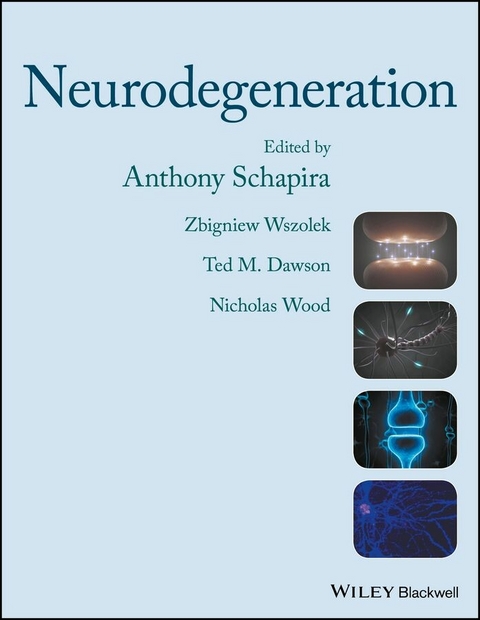
Neurodegeneration (eBook)
John Wiley & Sons (Verlag)
978-1-118-66192-5 (ISBN)
- Presents a clinically oriented guide to the diseases caused by neurodegeneration
- Templated chapters combine clinical and research information on neurodegenerative diseases beginning with the common elements before treating each disease individually
- Diseases are grouped by anatomical regions of degeneration and include common disorders such as Parkinson's Disease, Alzheimer's Disease, Amyotrophic Lateral Sclerosis/Motor Neuron Disease, and Multiple Sclerosis as well as less common diseases
- Edited by globally leading authorities on the subject, and written by expert contributing authors
About the Editors
Professor Anthony Schapira is Professor of Neurological Science and Head of the Department of Clinical Neuroscience at the UCL Institute of Neurology, London, UK and Chairman of Clinical Neurosciences Specialties.
Zbigniew Wszolek, MD, is Professor of Neurology in the Department of Neurology, Mayo Clinic, Jacksonville, Florida, USA.
Ted M.Dawson, MD, PhD, is Leonard and Madlyn Abramson Professor of Neurodegenerative Diseases and Scientific Director in the Institute for Cell Engineering, Johns Hopkins University, Baltimore, Maryland, USA.
Professor Nicholas Wood is Research Director of the UCL Institute of Genetics and Galton Professor of Genetics at UCL National Hospital for Neurology and Neurosurgery, Institute of Neurology, London, UK.
About the Editors Professor Anthony Schapira is Professor of Neurological Science and Head of the Department of Clinical Neuroscience at the UCL Institute of Neurology, London, UK and Chairman of Clinical Neurosciences Specialties. Zbigniew Wszolek, MD, is Professor of Neurology in the Department of Neurology, Mayo Clinic, Jacksonville, Florida, USA. Ted M.Dawson, MD, PhD, is Leonard and Madlyn Abramson Professor of Neurodegenerative Diseases and Scientific Director in the Institute for Cell Engineering, Johns Hopkins University, Baltimore, Maryland, USA. Professor Nicholas Wood is Research Director of the UCL Institute of Genetics and Galton Professor of Genetics at UCL National Hospital for Neurology and Neurosurgery, Institute of Neurology, London, UK.
Neurodegeneration 3
Contents 7
List of Contributors 8
Preface 11
Dedication 12
CHAPTER 1 Pathology of Brain Aging 13
Introduction 13
The need for better understanding of the aging process and human brain pathologies: clinical and epidemiological aspects 13
Brain pathologies in aging 13
Nonspecific and non-diagnostic pathologies in aging brain 14
AD neuropathologic changes: neurofibrillary tangles 14
AD neuropathologic changes: A? plaques 14
Notes on AD pathology in persons past 90 years of age 14
Dementia with Lewy bodies (DLB) 16
HS-aging and pathological TDP-43 inclusions 16
Cerebrovascular disease (CVD) pathology 17
Genetics and the environment: risk factors and potential therapeutic targets 18
Summary 20
References 20
CHAPTER 2 Protein Aggregation and Neurodegeneration: Tauopathies and Synucleinopathies 24
Introduction 24
Amyloids 24
Tauopathies 26
Tau isoforms in human brain and their interactions with microtubules 26
Tau aggregation 26
Tau phosphorylation 26
Isoform composition of tau filaments 27
Genetics 27
Animal models of human tauopathies 27
Synucleinopathies 28
Three human synucleins 28
Synucleins are lipid-binding proteins 28
SNCA mutations cause familial PD 28
Lewy body filaments are made of ?-synuclein 28
Multiple system atrophy 29
Synthetic ?-synuclein filaments 29
Animal models of human synucleinopathies 29
Experimental transmission of tauopathy and synucleinopathy 30
Additional therapeutic implications 31
Acknowledgments 32
References 32
CHAPTER 3 Prion Degeneration 37
Clinical definition and epidemiology 37
Spectrum of clinical phenotype 37
Sporadic Creutzfeldt–Jakob disease (sCJD) 37
Familial Creutzfeldt–Jakob disease (fCJD) 38
Iatrogenic Creutzfeldt–Jakob disease (iCJD) 39
Variant Creutzfeldt–Jakob disease (vCJD) 39
Gerstmann–Sträussler–Scheinker disease (GSS) 39
Fatal insomnia (FI) 39
Variably protease-sensitive prion disease (VPSPr) 39
Pathology/pathophysiology of prion diseases 39
Prion-related histopathologies 39
Protease-resistant PrPSc and PrPSc typing 40
Prion propagation 41
Prion pathogenesis 41
Genetics 42
Environment 43
Clinical prodrome and biomarkers 43
Examination and investigations (including imaging) 44
Magnetic resonance imaging (MRI) 44
Electroencephalogram (EEG) 44
Cerebrospinal fluid (CSF) 44
Positron emission tomography (PET) 44
Other tests 44
Additional studies 44
Diagnosis and prognosis 44
Treatment options (including comorbid conditions) 45
Medical 45
Surgical 46
Social 46
Future developments 46
References 46
CHAPTER 4 Excitotoxicity 49
Clinical definition and epidemiology 49
Spectrum of clinical phenotype 49
Pathology/pathophysiology specific to the disease 51
Genetics 53
Environment 53
Diagnostic considerations in excitotoxicity 54
Treatment approaches 54
Future developments 54
Acknowledgment 55
References 55
CHAPTER 5 Etiology and Pathogenesis of Parkinson Disease 58
Introduction 58
Experimental models for studying PD 58
Genetics and the development of PD 59
Mitochondria 60
Neuroinflammation, immunity, and the widespread Lewy body pathology in PD 60
Prion-like mechanism of ?-synuclein spread 61
Environmental risk factors 62
Recurrent themes 62
References 62
CHAPTER 6 Parkinson Disease: Treatment Options – Surgical Therapy 65
Introduction 65
Standard surgical targets for Parkinson disease: the pallidum and subthalamic nucleus 65
Patient selection 66
Emerging targets for Parkinson disease: the pedunculopontine area 66
Experimental surgery for Parkinson disease: some potential future directions 66
Summary 67
References 67
CHAPTER 7 Multiple System Atrophy: Clinical, Genetics, and Neuropathology 70
History and definition 70
Epidemiology 70
Spectrum of clinical phenotype 70
Motor disturbances 71
Non-motor symptoms 72
Pathology/pathophysiology specific to the disease 72
Pathology 72
Environmental risk factors 75
Genetics 75
Investigations 76
Diagnosis and prognosis 77
Diagnosis 77
Differential diagnosis 77
Prognosis 78
Treatment options 78
Non-medical treatment 78
Medical and surgical treatment 78
Future and experimental developments 78
Anti-inflammatory approaches 78
Neurotransplantation 78
Mesenchymal autologous stem cell therapy 78
Conclusions 79
References 80
CHAPTER 8 Progressive Supranuclear Palsy 84
Introduction 84
Clinical definition and epidemiology 84
Spectrum of the clinical phenotype 86
Pathology 86
Histopathology 86
Molecular pathology 86
Tau and neurodegeneration in PSP 88
Genetics 88
Environment 89
Clinical prodrome and biomarkers 89
Examination and investigations 89
Diagnosis and prognosis 90
Treatments 90
Future developments 90
Conclusions 91
Acknowledgement 91
References 91
CHAPTER 9 Dementia with Lewy Bodies 95
Clinical definition 95
Epidemiology 95
Spectrum of clinical phenotypes of DLB 96
Pathology and pathophysiology 97
Genetics 98
Environmental factors 98
Biomarkers 98
Diagnosis 100
Prognosis 101
Treatment options and management 101
Future development 102
References 102
CHAPTER 10 Corticobasal Degeneration 105
Clinical definition and epidemiology 105
Epidemiology 105
Spectrum of clinical phenotype 105
Clinical signs and symptoms associated with CBD 105
Clinical syndromes associated with CBD 106
Pathology/pathophysiology of CBD 107
Pathology 107
Genetics 107
Biomarkers 109
Neuroimaging 109
Cerebrospinal fluid 109
Examination and investigations 109
Laboratory testing 109
Magnetic resonance imaging 109
Molecular imaging 110
Diagnosis and prognosis 110
Treatment 111
Future developments 111
Identification of biomarkers 111
Tau-directed therapies 111
References 111
CHAPTER 11 Alzheimer’s Disease 114
Clinical definition 114
Epidemiology 114
AD Criteria 114
Historical background 114
Preclinical stage of AD 114
MCI due to AD 114
Dementia phase of AD 115
Atypical phenotype 116
Visual variant of AD 116
Logopenic aphasia 116
Frontotemporal dementia 116
Pathophysiology of AD 116
Neuropathology of AD 117
Microcopic findings 117
Histological findings 117
Atypical pathology 118
Genetics of AD 118
Genetic risk factors 118
Early-onset familial AD 118
Late-onset AD 119
Environment 119
Risk factors 119
Protective factors 119
Diagnosis 119
History 119
Examination 121
Investigation 121
Management 122
Pharmacological treatment 122
Safety issues 122
Management of agitation in dementia 124
The future in Alzheimer’s disease 124
References 124
CHAPTER 12 Frontotemporal Dementia 127
Introduction 127
Clinical definition and epidemiology 127
Spectrum of clinical phenotype 127
Behavioral variant (bvFTD) 128
Primary non-fluent aphasia (PNFA) 128
Semantic dementia (SD) 128
Logopenic progressive aphasia (LPA) 128
Frontotemporal dementia with parkinsonism linked to chromosome 17 (FTDP-17) 128
Frontotemporal dementia with motor neuron disease (FTD-MND) 129
Pathology/pathophysiology 130
Genetics 130
Pathology 131
Clinical prodrome and biomarkers 132
Morphologic and functional imaging 132
Diagnosis and prognosis 133
Treatment options 133
Future developments 133
References 134
CHAPTER 13 Prion Diseases and Other Rapidly Progressive Dementias 138
Prion diseases 138
Clinical definition and epidemiology 138
Spectrum of clinical phenotype 138
Pathology/pathophysiology specific to the disease 139
Genetics 139
Environmental 139
Clinical prodrome and biomarkers 140
Examination and investigations including imaging 140
Diagnosis and prognosis 140
Treatment options 141
Social, family, or third-party care 141
Future developments 141
Non-prion, rapidly progressive dementias 141
Clinical definition and epidemiology 141
Spectrum of clinical phenotype 141
Pathophysiology of specific causes of RPD 142
Examinations and investigations 143
Diagnosis and prognosis 146
Treatment options 146
Future developments 147
References 147
CHAPTER 14 Amyotrophic Lateral Sclerosis and Primary Lateral Sclerosis 149
Clinical definition and epidemiology 149
Clinical definition 149
Epidemiology 149
Spectrum of the clinical phenotype 150
ALS 150
PLS 151
Pathophysiology 151
Environmental factors 152
Genetics 152
Pathology 154
Clinical prodrome and biomarkers 157
Examination and investigations 162
Diagnosis and prognosis 164
Diagnosis 164
Prognosis 164
Treatment 164
Medical management 164
Surgical treatment of ALS and PLS 166
Family-based and third-party care of ALS and PLS patients 166
References 167
CHAPTER 15 Hereditary Spastic Paraplegia 173
Introduction 173
Neuropathology 173
Hereditary spastic paraplegia syndromes 175
Common cellular pathogenic themes 180
Conclusions 186
Acknowledgments 186
References 186
CHAPTER 16 Spinal Muscular Atrophy 191
Introduction 191
Genetic basis of disease 191
Epidemiology 191
Clinical characteristics 192
Type 0 SMA 192
Type 1 SMA 192
Type 2 SMA 193
Type 3 SMA 193
Type 4 SMA 193
Disease course 193
Pathology 194
Diagnosis 194
Clinical investigation and findings 194
Genetic testing 196
Medical care and treatment 197
Respiratory 197
Gastrointestinal and nutritional 197
Orthopedic 198
Palliative care 198
Disease pathophysiology 198
The SMN gene 198
SMN splicing 198
SMN expression 199
Genetic modifiers 199
The SMN protein 199
Animal models 201
Drosophila 201
Zebrafish 202
Mouse 202
Pig 203
Disease mechanisms 203
Therapeutics development 204
SMN2 gene activation 205
Promoting exon 7 inclusion in SMN2-derived transcripts 206
SMN protein stabilization 206
Gene therapy 207
Stem cell therapy 207
Neuroprotection 207
Clinical trial development 207
Outcome measures 207
Biomarkers 208
Concluding remarks 208
References 208
CHAPTER 17 Spinal and Bulbar Muscular Atrophy (Kennedy Disease) 214
Clinical definition and epidemiology 214
Clinical phenotype 214
Genotype–phenotype correlations 214
Pathology and pathogenesis 215
Examination and laboratory investigations 216
Laboratory investigations 218
Diagnosis and prognosis 219
Prognosis 219
Treatment 220
Anti-androgen treatment 220
Future developments 221
References 221
CHAPTER 18 Optic Neuropathies 223
Introduction 223
Leber’s hereditary optic neuropathy (LHON) 223
Clinical features 223
Investigations 224
Clinical course and prognosis 224
Other neurological features 225
Genetics and pathogenesis 225
Treatment 225
Dominant optic atrophy 225
Clinical features 226
Investigations 227
Genetics and pathogenesis 227
Other neurological features 227
Treatment 227
Optic neuropathy and hereditary neuropathy 227
Optic neuropathy and other central nervous system degenerative disorders 227
Friedreich’s ataxia 227
The spinocerebellar ataxias 227
Hereditary spastic paraplegia (HSP) 228
DIDMOAD (Wolfram) syndrome 228
Other neurodegenerative disorders 228
Deafness, dystonia, optic neuropathy (Mohr–Tranebjaerg) syndrome 228
References 228
CHAPTER 19 Peripheral Nerve Neuropathies Including Charcot–Marie–Tooth Disease 230
Clinical definition, epidemiology, and causes of peripheral neuropathies 230
The peripheral nervous system 230
Types and prevalence of peripheral neuropathies 230
Causes of peripheral neuropathy 230
Spectrum of peripheral neuropathy phenotypes 231
CMT disease 231
Other inherited peripheral neuropathies: HNPP, dHMN, HSAN, HNA, and GAN 231
Molecular genetics of inherited peripheral neuropathies 234
CMT disease and HNPP 234
Distal hereditary motor neuropathy 239
Hereditary sensory and autonomic neuropathy 240
Hereditary neuralgic amyotrophy 241
Giant axonal neuropathy 241
Chronic inflammatory demyelinating polyradiculoneuropathy and Guillain–Barré syndrome: acquired inflammatory demyelinating neuropathies 241
Identification of biomarkers in peripheral neuropathies 242
Investigation of peripheral neuropathies 242
Diagnosis of peripheral neuropathies 242
Treatment options in peripheral neuropathies 243
Future developments in peripheral neuropathies 244
Next-generation sequencing 244
Experimental therapeutic treatments 244
References 245
CHAPTER 20 Axonal Loss and Neurodegeneration in Multiple Sclerosis 250
Clinical definition and epidemiology 250
Spectrum of clinical phenotype 250
Genetic and environmental influences in MS 251
Neurodegeneration in MS 251
Axonal transection during inflammatory demyelination 251
Mechanisms of axonal transection in acute MS lesions 252
Degeneration of chronically demyelinated axons 252
Mechanisms of chronically demyelinated axonal degeneration 253
Cortical and deep gray matter demyelination in MS 254
Diagnosis and disease progression 256
Treatment options 256
Future developments 257
Acknowledgments 257
References 257
CHAPTER 21 Huntington’s Disease and Other Choreas 260
Huntington’s disease 260
Introduction 260
Clinical features of Huntington’s disease 260
Genetics of Huntington’s disease 271
Pathology 274
Models of Huntington’s disease 278
Development of disease-modifying therapies for Huntington’s disease 279
Other degenerative choreas 285
Huntington’s disease phenocopy syndromes 285
Major syndromes 285
Neuroacanthocytosis 287
Wilson disease 287
Benign hereditary chorea 287
Other causes of chorea 287
Management 287
Conclusions and the future 288
References 289
CHAPTER 22 Spinocerebellar Ataxias 296
Clinical definition and epidemiology 296
Spectrum of clinical and pathological phenotypes 296
Clinical features 296
Overview of the neuropathology of spinocerebellar ataxias 298
Pathological features 299
Diagnostic examination and investigations 299
Neuroimaging 299
SCA genetics and pathogenesis 300
SCA3 302
SCA2 302
SCA1 303
SCA7 303
SCA6 304
Approaches to therapy 304
References 304
CHAPTER 23 Ataxia Telangiectasia 308
Clinical definition and epidemiology 308
Spectrum of clinical phenotype and genetics 308
(i) Childhood onset – young age of onset (~2 years), typical/classical 308
(ii) Childhood onset – atypical, slower rate of progress 309
(iii) Adult onset – early, slow rate of progress 309
(iv) Adult onset – later age 310
(v) Disparity of cellular and clinical phenotypes 310
(vi) Ataxia telangiectasia caused by mutation of the MRE11 gene 310
Other related disorders – RIDDLE syndrome 310
Cerebellar versus extrapyramidal symptoms in ataxia telangiectasia 310
Pathology/pathophysiology specific to the disease 311
Clinical biomarkers 311
Examination and investigations (including imaging) 311
Diagnosis and prognosis 311
Prognosis for ataxia telangiectasia 312
Treatment options 312
References 313
CHAPTER 24 Niemann–Pick Disease 315
Introduction 315
Primary acid sphingomyelinase deficiencies–Niemann–Pick diseases type A and B 315
Clinical definition and epidemiology 315
Spectrum of clinical phenotypes 315
Pathology, pathophysiology specific to the disease 315
Clinical prodrome and biomarkers 316
Examination and investigations 316
Diagnosis 316
Treatment options 316
Future developments 316
Endosomal/lysosomal trafficking deficiency – Niemann–Pick disease, type C 316
Clinical definition and epidemiology 316
Spectrum of clinical phenotype 316
Pathology, pathophysiology specific to the disease 317
Clinical prodrome and biomarkers 317
Examination 317
Investigations 317
Prognosis 318
Treatment options 318
Future developments 318
References 318
CHAPTER 25 X-linked Adrenoleukodystrophy 321
Clinical definition and epidemiology 321
Spectrum of clinical phenotype (Table 25.1) 321
Childhood cerebral adrenoleukodystrophy (CCALD) 321
Adolescent cerebral adrenoleukodystrophy 321
Adult cerebral adrenoleukodystrophy 321
Adrenomyeloneuropathy 321
Addison’s disease only 321
Spinocerebellar variant 321
Asymptomatic boys and men 322
Symptomatic female heterozygote 322
Pathology/pathophysiology specific to the disease 322
Neuropathology 322
Genetics 322
Pathophysiology 323
Environment 323
Clinical prodrome and biomarkers 323
Examination, investigations (including imaging) 323
Neurological examination 323
Endocrine evaluation 323
Neuropsychological testing 323
Neuroimaging 324
Diagnosis and prognosis 325
Diagnosis 325
Prognosis 325
Treatment options (including comorbid conditions) 325
Medical 325
Surgical 326
“Social” – family-based or third-party care 326
Future developments 326
References 326
CHAPTER 26 Neurodegeneration with Brain Iron Accumulation, Wilson Disease, and Manganism 329
Neurodegenerative disorders with brain iron accumulation (NBIA) 329
Clinical definition and epidemiology 329
Neuroferritinopathy 329
Aceruloplasminemia 330
Pantothenate kinase associated neurodegeneration (PKAN) 331
Phospholipase A2 (PLA2G6) mutation associated neurodegeneration (PLAN) 332
Mitochondrial membrane protein associated neurodegeneration (MPAN) 333
Kufor Rakeb syndrome (KRS, ATP13A2 mutations) 334
Woodhouse–Sakati syndrome (WSS) 334
FA2H associated NBIA 334
Beta-propeller protein associated neurodegeneration (BPAN) 335
CoA synthase protein-associated neurodegeneration (CoPAN) 335
Manganism 335
Spectrum of clinical phenotype 335
Pathophysiology 335
Investigations 335
Diagnosis and prognosis 335
Treatment 336
Wilson disease 336
Spectrum of clinical phenotype 336
Pathophysiology 336
Investigations 336
Diagnosis and prognosis 336
Treatment 336
References 336
Index 339
EULA 347
| Erscheint lt. Verlag | 8.2.2017 |
|---|---|
| Sprache | englisch |
| Themenwelt | Medizin / Pharmazie ► Medizinische Fachgebiete ► Neurologie |
| Schlagworte | ALS/MND • Alzheimer's • Anthony Schapira • Ataxias • Autoimmune neurodegeneration • Biowissenschaften • cerebellum • CJD • Cognitive Examinations • dementias • dementia with lewy bodies • Focal plaques • frontal lobe • Frontotemporal dementia • Huntington's • Life Sciences • Mechanisms of neurodegeneration • Medical Science • Medizin • Movement Examinations • MS • Myelin breakdown • Neurodegeneration • Neurodegenerative Erkrankung • Neurologie • Neurology • Neuroprotection • Neuroscience • Neurovascular Disease • Neurovaskuläre Krankheiten • Neurovaskuläre Krankheiten • Neurowissenschaften • Nicholas Wood • Non-focal plaques • Parkinson's • pharmacology • Plaque formation • prion disease • prion diseases • Ted M Dawson • Zbigniew Wszolek |
| ISBN-10 | 1-118-66192-3 / 1118661923 |
| ISBN-13 | 978-1-118-66192-5 / 9781118661925 |
| Informationen gemäß Produktsicherheitsverordnung (GPSR) | |
| Haben Sie eine Frage zum Produkt? |
 PDF (Adobe DRM)
Kopierschutz: Adobe-DRM
Adobe-DRM ist ein Kopierschutz, der das eBook vor Mißbrauch schützen soll. Dabei wird das eBook bereits beim Download auf Ihre persönliche Adobe-ID autorisiert. Lesen können Sie das eBook dann nur auf den Geräten, welche ebenfalls auf Ihre Adobe-ID registriert sind.
Details zum Adobe-DRM
Dateiformat: PDF (Portable Document Format)
Mit einem festen Seitenlayout eignet sich die PDF besonders für Fachbücher mit Spalten, Tabellen und Abbildungen. Eine PDF kann auf fast allen Geräten angezeigt werden, ist aber für kleine Displays (Smartphone, eReader) nur eingeschränkt geeignet.
Systemvoraussetzungen:
PC/Mac: Mit einem PC oder Mac können Sie dieses eBook lesen. Sie benötigen eine
eReader: Dieses eBook kann mit (fast) allen eBook-Readern gelesen werden. Mit dem amazon-Kindle ist es aber nicht kompatibel.
Smartphone/Tablet: Egal ob Apple oder Android, dieses eBook können Sie lesen. Sie benötigen eine
Geräteliste und zusätzliche Hinweise
Buying eBooks from abroad
For tax law reasons we can sell eBooks just within Germany and Switzerland. Regrettably we cannot fulfill eBook-orders from other countries.
aus dem Bereich