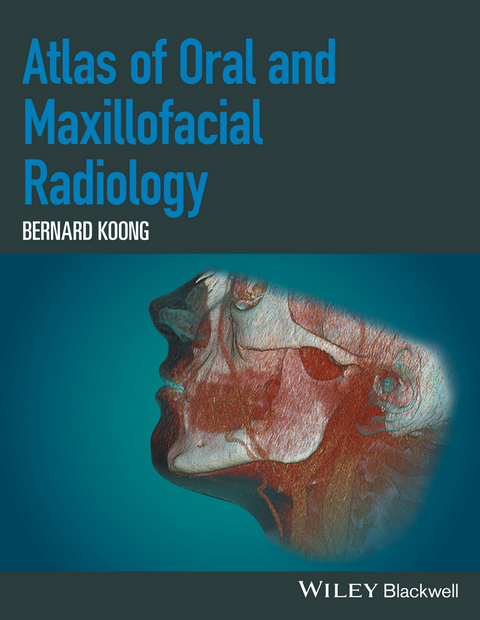
Atlas of Oral and Maxillofacial Radiology (eBook)
368 Seiten
Wiley-Blackwell (Verlag)
978-1-118-93962-8 (ISBN)
- Unique lesion-based problem solving chapter makes this an easy-to-use reference in a clinical setting
- Includes 2D intraoral radiography, the panoramic radiograph, cone beam CT, multidetector CT and MRI
- Multiple cases are presented in order to demonstrate the variation in the radiological appearances of conditions affecting the jaws and teeth
- Special focus on conditions where diagnostic imaging may substantially contribute to diagnosis
- Features a useful chapter covering the temporomandibular joint
Bernard Koong is a highly experienced oral and maxillofacial radiologist practicing full time multimodality clinical radiology. He is a founding partner of Envision Medical Imaging, a multidisciplinary fully comprehensive private radiology group in Australia and also consults internationally. He has personally reported over 200,000 radiological studies involving a wide variety of imaging techniques.
Having completed his specialist training in oral and maxillofacial radiology at the University of Toronto, Bernard now holds the position of Clinical Professor at the University of Western Australia, where he coordinates and delivers the oral and maxillofacial radiology lectures for the undergraduate and postgraduate courses. He also has a long history of providing oral and maxillofacial radiology courses for other universities as well as surgery and radiology programmes across Australasia. As an invited speaker, Bernard has presented more than 100 lectures to the dental and medical professions internationally, and is a member of the Editorial Board of Clinical Oral Implant Research.
Bernard Koong is a highly experienced oral and maxillofacial radiologist practicing full time multimodality clinical radiology. He is a founding partner of Envision Medical Imaging, a multidisciplinary fully comprehensive private radiology group in Australia and also consults internationally. He has personally reported over 200,000 radiological studies involving a wide variety of imaging techniques. Having completed his specialist training in oral and maxillofacial radiology at the University of Toronto, Bernard now holds the position of Clinical Professor at the University of Western Australia, where he coordinates and delivers the oral and maxillofacial radiology lectures for the undergraduate and postgraduate courses. He also has a long history of providing oral and maxillofacial radiology courses for other universities as well as surgery and radiology programmes across Australasia. As an invited speaker, Bernard has presented more than 100 lectures to the dental and medical professions internationally, and is a member of the Editorial Board of Clinical Oral Implant Research.
CHAPTER 3
Anomalies Related to the Teeth
3.1 Supernumerary teeth (Figures 3.1–3.5)
Figure 3.1 Supernumerary tooth left premaxilla: surface‐rendered CBCT (a), cropped panoramic radiograph (b) and corrected sagittal CBCT (c) images.
Figure 3.2 Supernumerary tooth: cropped panoramic radiograph.
Figure 3.3 Supernumerary teeth: cropped panoramic radiograph.
Figure 3.4 Supernumerary teeth: cropped panoramic radiograph.
Figure 3.5 Supernumerary tooth left maxilla: coronal CBCT image.
- Synonyms: hyperdontia, supplemental teeth, mesiodens, paramolars.
- Teeth developing in addition to the normal 32 permanent and 20 deciduous teeth.
- 1–4% of population.
- More common in the permanent dentition. The anterior maxilla and mandibular premolar regions are quite common locations.
- Multiple supernumerary teeth may be associated with some syndromes.
- May affect the normal dentition. For example, crowding, impaction and, less commonly, resorption of the normal teeth.
- Ultra‐low‐dose cone beam computed tomography (CBCT) or multidetector computed tomography (MDCT) may be required to accurately locate these teeth for removal and also to assess the effects on the adjacent teeth.
Radiological features
- Resemble teeth but the size and morphology may or may not resemble the normal dentition.
Differential diagnosis
| Key radiological differences |
| Compound odontoma | Dental tissue arrangements are not as close to normal tooth architecture, often demonstrating a clump of multiple tooth‐like structures. |
3.2 Congenital absence (Figures 3.6 and 3.7)
Figure 3.6 Congenital absence: cropped panoramic radiograph.
Figure 3.7 Partial anodontia: panoramic radiograph.
- Synonyms: hypodontia, partial or complete anodontia, oligodontia.
- Third molars are most commonly affected, followed by second premolars, maxillary lateral incisors and mandibular central incisors.
- May be seen in ectodermal dysplasia.
- Occasionally, ultra‐low‐dose CBCT or MDCT may be required to confirm absence where there is suspicion that the tooth is ectopic and may not be visualised within the field of view of the intraoral radiograph or is outside of the focal trough of the panoramic radiograph.
Radiological features
- Absence of normal dentition.
Differential diagnosis
| Key radiological differences |
| Delayed development | This is occasionally challenging as there is a large variation in the chronology of tooth development and contralateral teeth may also be absent. |
| Ectopic teeth | Present but not located in the normal position. |
3.3 Delayed and early development/eruption
- Many tables identifying the mean development/eruption times of teeth in relation to chronological age are widely available. However, the wide variation in the chronology of tooth development and eruption is noted.
- Eruption is when a tooth is seen in the oral cavity.
- Several local conditions, including impactions, presence of supernumerary teeth and pathology, can delay tooth eruption and alter development. Ultra‐low‐dose CBCT or MDCT may be useful for these cases.
Radiological features
- Radiological investigations are often performed to evaluate whether all the teeth are present, and whether entities are present that may interfere with the development and eruption of the teeth.
3.4 Ectopic development and eruption (Figures 3.8–3.16)
Figure 3.8 Impacted 13 and 23: cropped panoramic radiograph (a) and axial MDCT image (b).
Figure 3.9 Impacted 13 and 23: axial MDCT image (a) and cropped panoramic radiograph (b).
Figure 3.10 Impacted 13: surface‐rendered (a,b) and cross‐sectional (para‐axial) (c) CBCT images.
Figure 3.11 Impacted tooth: corrected sagittal and cross‐sectional (para‐axial) CBCT images (a,b).
Figure 3.12 Ectopic 43: cropped panoramic radiograph.
Figure 3.13 Ectopic 33: cropped panoramic radiograph (a) and axial CBCT image (b).
Figure 3.14 Transposition 23 and 24: reconstructed panoramic (a), surface‐rendered (b) and axial CBCT (c) images.
Figure 3.15 Ectopic 28: axial MDCT image (a) and cropped panoramic radiograph (b).
Figure 3.16 Two ectopic mandibular premolars: panoramic radiograph.
- When a tooth develops and erupts away from its expected native location.
- Transposition is where two adjacent teeth have exchanged positions, most commonly involving the maxillary canines and first premolars.
- It is noted that pathological entities, such as cysts and tumours, can displace teeth.
Radiological features
- A key radiological role in the evaluation of ectopic teeth is to ensure that the ectopic position is developmental in nature and not related to tooth displacement by a pathological entity.
- Ultra‐low‐dose CBCT or MDCT should be considered, especially if the precise location is required or if there is concern for possible associated abnormality which is not clearly depicted on intraoral and/or panoramic radiography.
3.5 Impaction (Figures 3.17–3.23)
Figure 3.17 Impacted third molars of several cases: cropped panoramic radiographs (a–g).
Figure 3.18 Impacted 38: cropped panoramic radiograph (a) and axial MDCT image (b).
Figure 3.19 Impacted 38: corrected sagittal CBCT image.
Figure 3.20 Impacted 48: corrected coronal (a) and axial (b) MDCT images.
Figure 3.21 Impacted 38: corrected sagittal (a) and axial (b) CBCT images.
Figure 3.22 Impacted 38: cropped panoramic radiograph (a) and corrected coronal MDCT image (b).
Figure 3.23 Impacted 26: cropped panoramic radiograph.
- Usually refers to failure of eruption of a tooth where there is a physical obstruction, such as another tooth, dense bone or occasionally soft tissue.
- The term non‐eruption is sometimes used to refer to teeth which do not erupt but do not demonstrate any particular dense physical barrier or pathology obstructing the eruption pathway.
- Most commonly affecting the third molars (especially the mandibular), followed by the maxillary canines. Impacted teeth may be ectopic and/or abnormal in morphology. Supernumerary teeth are often impacted.
- May be associated with:
- Pericoronitis (refer to Chapter 5.
- Periodontal bone loss of the adjacent teeth (refer to Chapter 5).Caries (refer to Chapter 4).
- Root resorption.Cystic and odontogenic tumours (refer to Chapters 8 and 10).
- Like any surgical procedure, extraction of the impacted teeth is associated with potential complications. A particular potential risk associated with the removal of mandibular third molars is damage to the inferior alveolar nerve.
Radiological features
- Ultra‐low‐dose CBCT and MDCT are the imaging techniques of choice for:
- Precise location and orientation of the impacted tooth and when the relationship with adjacent anatomical structures is required. Useful features demonstrated by these techniques include the number of roots, root morphology, mandibular and incisive canals, mental foramen, preservation of jaw cortices over the roots and relationship with the maxillary sinus.
- Evaluation of associated pathology, such as root resorption of the adjacent teeth.
- Third molars:
- Panoramic radiograph is often employed initially. While it does not depict these impacted teeth as accurately and with as much detail as CBCT and MDCT, it may provide sufficient information. Based upon the appearances in this view, ultra‐low‐dose CBCT and MDCT are sometimes indicated. Indications include:
- Mandibular canal appears projected over the third molar roots in the panoramic view.
- There are radiological criteria (on panoramic radiographs) which have been used. Examples include darkening,...
- Mandibular canal appears projected over the third molar roots in the panoramic view.
- Panoramic radiograph is often employed initially. While it does not depict these impacted teeth as accurately and with as much detail as CBCT and MDCT, it may provide sufficient information. Based upon the appearances in this view, ultra‐low‐dose CBCT and MDCT are sometimes indicated. Indications include:
| Erscheint lt. Verlag | 27.1.2017 |
|---|---|
| Sprache | englisch |
| Themenwelt | Medizin / Pharmazie ► Gesundheitsfachberufe |
| Medizinische Fachgebiete ► Radiologie / Bildgebende Verfahren ► Radiologie | |
| Medizin / Pharmazie ► Zahnmedizin | |
| Schlagworte | 2D intraoral radiography • cone beam CT • Dental radiology • dentistry • Dentistry Special Topics • diagnostic imaging • intraoral imaging • Medical Science • Medizin • MRI • Multidetector CT • OMFR • OMR • oral and maxillofacial imaging • Oral and Maxillofacial Radiology • Oralpathologie • Oral Pathology • Panoramic radiograph • Radiologie • Radiologie u. Bildgebende Verfahren • Radiology & Imaging • Spezialthemen Zahnmedizin • temporo-mandibular joint • Zahnmedizin |
| ISBN-10 | 1-118-93962-X / 111893962X |
| ISBN-13 | 978-1-118-93962-8 / 9781118939628 |
| Informationen gemäß Produktsicherheitsverordnung (GPSR) | |
| Haben Sie eine Frage zum Produkt? |
 EPUB (Adobe DRM)
Kopierschutz: Adobe-DRM
Adobe-DRM ist ein Kopierschutz, der das eBook vor Mißbrauch schützen soll. Dabei wird das eBook bereits beim Download auf Ihre persönliche Adobe-ID autorisiert. Lesen können Sie das eBook dann nur auf den Geräten, welche ebenfalls auf Ihre Adobe-ID registriert sind.
Details zum Adobe-DRM
Dateiformat: EPUB (Electronic Publication)
EPUB ist ein offener Standard für eBooks und eignet sich besonders zur Darstellung von Belletristik und Sachbüchern. Der Fließtext wird dynamisch an die Display- und Schriftgröße angepasst. Auch für mobile Lesegeräte ist EPUB daher gut geeignet.
Systemvoraussetzungen:
PC/Mac: Mit einem PC oder Mac können Sie dieses eBook lesen. Sie benötigen eine
eReader: Dieses eBook kann mit (fast) allen eBook-Readern gelesen werden. Mit dem amazon-Kindle ist es aber nicht kompatibel.
Smartphone/Tablet: Egal ob Apple oder Android, dieses eBook können Sie lesen. Sie benötigen eine
Geräteliste und zusätzliche Hinweise
Buying eBooks from abroad
For tax law reasons we can sell eBooks just within Germany and Switzerland. Regrettably we cannot fulfill eBook-orders from other countries.
aus dem Bereich