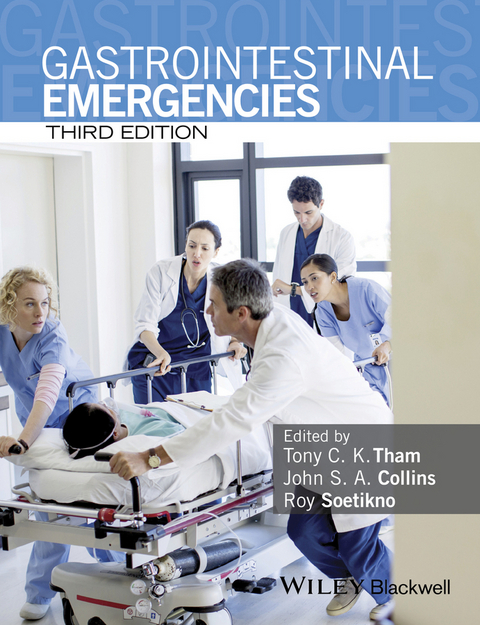
Gastrointestinal Emergencies (eBook)
John Wiley & Sons (Verlag)
978-1-118-63838-5 (ISBN)
Tony Tham, Consultant Physician and Gastroenterologist,?Ulster Hospital, Dundonald, Belfast. He is on various GI boards/committees, including the Specialist Advisory Committee for internal medicine for the Joint Royal College of Physicians Training Board, and the British Society of Gastroenterology committee for clinical standards. Dr Tham is an assessor for doctors applying for direct entry into the specialist register in the UK, and an examiner for the Royal College of Physicians and Queen's University of Belfast medical school. John Collins, Consultant Gastroenterologist,?Royal Victoria Hospital, Belfast.?He is a Past President of the Irish Society of Gastroenterology and is currently Secretary of the Royal College of Physicians of Edinburgh. Roy Soetikno, Associate Professor of Medicine,?and Associate Chief of GI?sectin, Veterans Affairs Palo Alto Health Care System. Specializing in endoscopic surgery for early gastrointestinal cancer.
Notes on contributors, vii
Section 1: Approach to specific presentations
1 Approach to dysphagia, 3
John S. A. Collins
2 Approach to vomiting, 8
Bee Chan Lee and John S. A. Collins
3 Approach to upper gastrointestinal bleeding, 12
Patrick B. Allen and Tony C. K. Tham
4 Approach to acute abdominal pain, 19
Tony C. K. Tham
5 Approach to jaundice, 25
Tony C. K. Tham
6 Acute severe lower gastrointestinal hemorrhage, 34
Jennifer M. Kolb and Tonya Kaltenbach
7 Approach to diarrhea, 39
John S. A. Collins
Section 2: Complications of gastrointestinal procedures and therapy
8 Complications of upper gastrointestinal endoscopy, 45
Daniel J. Stein and Reza Shaker
9 Complications of percutaneous endoscopic gastrostomy, 51
Barbara Willandt and Jo Vandervoort
10 Complications of endoscopic variceal ligation, sclerotherapy, and balloon tamponade, 57
Aarti K. Rao and Roy Soetikno
11 ERCP complications, 61
Constantinos P. Anastassiades and Richard C. K. Wong
12 Complications of laparoscopic surgery, 70
Stephen Attwood and Khalid Osman
13 Complications of liver biopsy, 77
Robert J. Wong and Aijaz Ahmed
14 Complications of colonoscopy, 81
Matthias Steverlynck and Jo Vandervoort
15 Complications of capsule endoscopy, 86
Roy Soetikno and Andres Sanchez?]Yague
16 Complications of endoscopic ultrasound, 91
Maria Cecilia M. Sison?]Oh, Andres Sanchez?]Yague, and Roy Soetikno
17 Complications of Endoscopic Mucosal Resection (EMR) and Endoscopic Submucosal Dissection (ESD), 99
Ichiro Oda, Haruhisa Suzuki, and Seiichiro Abe
18 Complications of bariatric surgery, 105
Allison R. Schulman, Michele B. Ryan, and Christopher C. Thompson
19 Complications of drugs used in gastroenterology, 117
Paul Kevin Hamilton and Philip Toner
Section 3: Specific conditions
20 Foreign body impaction in the esophagus, 135
George Triadafilopoulos
21 Esophageal perforation, 142
Ioannis S. Papanikolaou and Peter D. Siersema
22 Acute upper non?]variceal gastrointestinal hemorrhage, 151
Kelvin Palmer
23 Acute pancreatitis, 158
David R. Lichtenstein
24 Biliary tract emergencies, 172
Joseph K. N. Kim and David L. Carr?]Locke
25 Variceal hemorrhage, 177
Roy Soetikno and Andres Sanchez?]Yague
26 Acute liver failure, 183
Philip S. J. Hall and W. Johnny Cash
27 Ascites and spontaneous bacterial peritonitis, 193
Andrés Cárdenas, Isabel Graupera, and Pere Ginès
28 Alcoholic hepatitis, 204
Brian J. Hogan and David William Michael Patch
29 Perforation of the gastrointestinal tract, 211
Ian McAllister
30 Intestinal obstruction, 220
Kevin McCallion
31 Acute appendicitis, 225
Ian McAllister
32 Middle gastrointestinal bleeding, 230
Andres Sanchez?]Yague
33 Ischemic bowel, 239
Ryan B. Perumpail and Shai Friedland
34 Acute severe ulcerative colitis, 242
Subrata Ghosh and Marietta Iacucci
35 Gastrointestinal infections, 251
Graham Morrison and John S. A. Collins
36 Diverticular disease, 263
Jennifer M. Kolb and Tonya Kaltenbach
37 Gastrointestinal complications of HIV disease, 269
Emma McCarty and Wallace Dinsmore
38 Gastrointestinal complications in the intensive care unit, 276
James J. McNamee and Daniel F. McAuley
Index, 282
CHAPTER 1
Approach to dysphagia
John S. A. Collins
Northern Ireland Medical and Dental Training Agency, Royal Victoria Hospital, Belfast, UK
Definitions
Dysphagia refers to a subjective sensation of the obstruction of swallowed solids or liquids from mouth to stomach. Patients most frequently complain that food “sticks” in the retrosternal area or simply will “not go down.” Patients may complain of a feeling of choking and chest discomfort. In some cases food material is rapidly regurgitated to relieve symptoms.
Dysphagia can be divided into two types:
- oropharyngeal dysphagia, where there is an inability to initiate the swallowing process and may involve disorders of striated muscle. There may be a sensation of solids or liquids left in the pharynx.
- esophageal dysphagia, which involves disorders of the smooth muscle of the esophagus and results in symptoms within seconds of the Initiation of swallowing.
Odynophagia is the sensation of pain on swallowing which is usually felt in the chest or throat. Globus is the sensation of a lump, fullness or tightness in the throat.
Differential diagnosis
The causes of the above types of dysphagia are shown in Tables 1.1 and 1.2.
Table 1.1 Etiology of oropharyngeal dysphagia.
|
Table 1.2 Etiology of esophageal dyphagia.
|
History and examination
Acute dysphagia is a relatively uncommon, but dramatic, presenting symptom and constitutes a gastrointestinal emergency. The patient will complain of difficulty initiating swallowing or state that food is readily swallowed but results in the rapid onset of chest discomfort or pain, which is only relieved by passage or regurgitation of the swallowed food bolus. The latter sensation can result after swallowing a mouthful of liquid. In the acute case it is important to ask the patient about the presence of other neurological symptoms.
If oropharyngeal dysphagia is suspected, the following points are important:
- The patient may complain of nasal regurgitation of liquid, coughing or choking during swallowing or a change in voice character which may indicate nasal speech due to palatal weakness.
- Patients may describe repeated attempts at the initiation of swallowing.
- Symptoms are noticed within a second of swallowing.
- Patients with cerebrovascular disease may give a history of symptoms of transient ischemic attacks (TIA) – these would include visual disturbance, dysphasia, or transient facial or limb weakness.
- There may be progressive muscular weakness and dysphagia is only part of the symptom complex, in contrast to esophageal dysphagia where swallowing disorder is the most prominent symptom.
- Patients should have a careful neurological examination and evaluation of the pharynx and larynx including direct laryngoscopy.
- In cases of esophageal dysphagia, the following points are important:
- Is the sensation of dysphagia worse with liquids or solids? If a progressive obstructive lesion is the cause of symptoms, the patient will notice difficulty swallowing solids initially and liquids later. Difficulty with both solids and liquids suggests dysmotility.
- Is the dysphagia intermittent or progressive? Intermittent dysphagia may indicate a motility disorder such as diffuse esophageal spasm whereas a progressive course is more characteristic of an esophageal tumor.
- How long have symptoms been present? A long history usually greater than 12 months suggests a benign cause, whereas a short history less than 4 weeks suggests a malignant etiology.
- Has the patient a history of heartburn suggesting gastroesophageal reflux disease (GERD)? While a history of heartburn does not rule out gastroesophageal cancer as a cause of dysphagia, a long history in the presence of slow onset, non-progressive symptoms may point to a benign peptic stricture as the cause.
A diagnostic algorithm for the symptomatic assessment of the patient with dysphagia is shown in Fig. 1.1.
Fig. 1.1 Diagnostic algorithm for the symptomatic assessment of the patient with dysphagia.
Source: Yamada 1995. Reproduced with permission of Wiley.
The etiology of esophageal dysphagia is summarized in Table 1.2.
While acute dysphagia may be painful, especially in relation to foreign body or food bolus impaction above an existing stricture, a history of odynophagia usually suggests an inflammatory condition or disruption of the esophageal mucosa leading to the irritation of pain receptors. The causes of odynophagia are:
- Candida
- herpes simplex
- cytomegalovirus
- pill-induced ulceration
- reflux disease/stricture
- radiation esophagitis
- caustic injury
- motility disorders stimulated by swallowing
- cancer
- graft-versus-host disease
- foreign body.
Clinical signs in patients who present with dysphagia are uncommon. On examination, the following signs should be noted:
- loss of weight
- signs of anemia
- cervical lymphadenopathy
- hoarseness
- concomitant neurological especially bulbar signs
- respiratory signs if history of cough/choking
- hepatomegaly
- oral ulcers or signs of Candida
- goiter.
Investigation
Dysphagia is considered to be an “alarm symptom” and should be investigated as a matter of urgency in all cases. Upper gastrointestinal endoscopy is a safe investigation in experienced hands provided the intubation is carried out under direct visualization of the oropharynx and upper esophageal sphincter. The endoscopist should be alert to the possibility of a high obstruction and the likelihood of retained food debris or saliva if dysphagia has been present for some time. If there is a history of choking, the patient should have a liquid-only diet for 24 hours followed by a 12-hour fast prior to the procedure. In some cases, the careful passage of a nasoesophageal tube to aspirate retained luminal contents may be necessary. At endoscopy, obstructing lesions can be biopsied and peptic strictures can be dilated with a balloon or bougie.
The presence of a dilated food and saliva-filled esophagus in the absence of a stricture raises the possibility of achalasia.
Barium studies are not a prerequisite for endoscopy but should be considered complementary in dysphagia. Barium swallow may give additional information in the following situations:
- in cases of suspected oropharyngeal dysphagia, especially if videofluoroscopy is employed;
- where a high esophageal obstruction is suspected prior to endoscopy;
- where a motility disorder is suspected as a method to assess lower esophageal relaxation.
In some cases, a barium swallow may be a useful investigation in certain circumstances:
- Where there is suspected proximal obstruction, e.g. laryngeal cancer, Zenker's diverticulum;
- Following a negative endoscopy or obstructive symptoms as lower esophageal rings may be more easily detected at fluoroscopy.
Esophageal manometry is indicated if both endoscopy and barium studies are inconclusive in the presence of persistent symptoms. Manometry requires intubation of the esophagus with a multilumen recording...
| Erscheint lt. Verlag | 28.10.2016 |
|---|---|
| Sprache | englisch |
| Themenwelt | Medizin / Pharmazie ► Allgemeines / Lexika |
| Medizinische Fachgebiete ► Chirurgie ► Viszeralchirurgie | |
| Medizinische Fachgebiete ► Innere Medizin ► Gastroenterologie | |
| Medizin / Pharmazie ► Medizinische Fachgebiete ► Notfallmedizin | |
| Schlagworte | appendicitis • Chirurgie u. chirurgische Spezialgebiete • dysphagia • Emergency Medicine & Trauma • Endoscopic Gastrostomy • Endoscopy • Gastroenterologie • gastroenterology • GI emergency • jaundice • Laparoscopic surgery • Liver failure • Medical Science • Medizin • Notfallmedizin u. Traumatologie • Surgery & Surgical Specialities |
| ISBN-10 | 1-118-63838-7 / 1118638387 |
| ISBN-13 | 978-1-118-63838-5 / 9781118638385 |
| Informationen gemäß Produktsicherheitsverordnung (GPSR) | |
| Haben Sie eine Frage zum Produkt? |
 EPUB (Adobe DRM)
Kopierschutz: Adobe-DRM
Adobe-DRM ist ein Kopierschutz, der das eBook vor Mißbrauch schützen soll. Dabei wird das eBook bereits beim Download auf Ihre persönliche Adobe-ID autorisiert. Lesen können Sie das eBook dann nur auf den Geräten, welche ebenfalls auf Ihre Adobe-ID registriert sind.
Details zum Adobe-DRM
Dateiformat: EPUB (Electronic Publication)
EPUB ist ein offener Standard für eBooks und eignet sich besonders zur Darstellung von Belletristik und Sachbüchern. Der Fließtext wird dynamisch an die Display- und Schriftgröße angepasst. Auch für mobile Lesegeräte ist EPUB daher gut geeignet.
Systemvoraussetzungen:
PC/Mac: Mit einem PC oder Mac können Sie dieses eBook lesen. Sie benötigen eine
eReader: Dieses eBook kann mit (fast) allen eBook-Readern gelesen werden. Mit dem amazon-Kindle ist es aber nicht kompatibel.
Smartphone/Tablet: Egal ob Apple oder Android, dieses eBook können Sie lesen. Sie benötigen eine
Geräteliste und zusätzliche Hinweise
Buying eBooks from abroad
For tax law reasons we can sell eBooks just within Germany and Switzerland. Regrettably we cannot fulfill eBook-orders from other countries.
aus dem Bereich