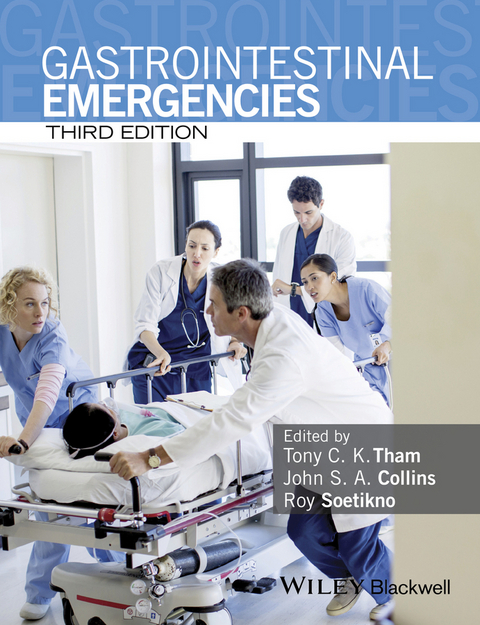
Gastrointestinal Emergencies (eBook)
John Wiley & Sons (Verlag)
978-1-118-63840-8 (ISBN)
Gastrointestinal Emergencies 3E provides practical, up-to-date guidance for gastroenterologists, endoscopists, surgeons, emergency and acute physicians, medical students and trainees managing patients presenting with GI complications and/or emergencies.
Combining a symptom section, a specific conditions section and a section that examines complications (and solutions) of GI procedures, focus throughout is on clear, specific how-to guidance, for use before a procedure or immediately after emergency stabilization. An evidence-based approach to presentation, diagnosis and investigation is utilized throughout.
New to this third edition are several brand new chapters covering various complications of procedures and specific conditions not previously featured, as well as a thorough look at the many diagnostic and therapeutic advances in recent years. In addition, every chapter from the current edition has undergone wholesale revision to ensure it is updated with the very latest in management guidelines and clinical practice. Once again, full range of emergencies encountered in daily clinical practice will be examined, such as acute pancreatitis, esophageal perforation, capsule endoscopy complications, acute appendicitis, and the difficulties after gastrointestinal procedures. International guidelines from the world's key gastroenterology societies will be included in relevant chapters.
Gastrointestinal Emergencies 3E is the definitive reference guide for the management of gastrointestinal emergencies and endoscopic complications, and the perfect accompaniment for the modern-day gastroenterologist, surgeon, emergency and acute physicians.
Every Emergency Department, GI/endoscopy unit, medical/surgical admission unit should keep a copy close at hand for quick reference.
Tony Tham, Consultant Physician and Gastroenterologist,?Ulster Hospital, Dundonald, Belfast. He is on various GI boards/committees, including the Specialist Advisory Committee for internal medicine for the Joint Royal College of Physicians Training Board, and the British Society of Gastroenterology committee for clinical standards. Dr Tham is an assessor for doctors applying for direct entry into the specialist register in the UK, and an examiner for the Royal College of Physicians and Queen's University of Belfast medical school.
John Collins, Consultant Gastroenterologist,?Royal Victoria Hospital, Belfast.?He is a Past President of the Irish Society of Gastroenterology and is currently Secretary of the Royal College of Physicians of Edinburgh.
Roy Soetikno, Associate Professor of Medicine,?and Associate Chief of GI?sectin, Veterans Affairs Palo Alto Health Care System. Specializing in endoscopic surgery for early gastrointestinal cancer.
Gastrointestinal Emergencies 3E provides practical, up-to-date guidance for gastroenterologists, endoscopists, surgeons, emergency and acute physicians, medical students and trainees managing patients presenting with GI complications and/or emergencies. Combining a symptom section, a specific conditions section and a section that examines complications (and solutions) of GI procedures, focus throughout is on clear, specific how-to guidance, for use before a procedure or immediately after emergency stabilization. An evidence-based approach to presentation, diagnosis and investigation is utilized throughout. New to this third edition are several brand new chapters covering various complications of procedures and specific conditions not previously featured, as well as a thorough look at the many diagnostic and therapeutic advances in recent years. In addition, every chapter from the current edition has undergone wholesale revision to ensure it is updated with the very latest in management guidelines and clinical practice. Once again, full range of emergencies encountered in daily clinical practice will be examined, such as acute pancreatitis, esophageal perforation, capsule endoscopy complications, acute appendicitis, and the difficulties after gastrointestinal procedures. International guidelines from the world s key gastroenterology societies will be included in relevant chapters. Gastrointestinal Emergencies 3E is the definitive reference guide for the management of gastrointestinal emergencies and endoscopic complications, and the perfect accompaniment for the modern-day gastroenterologist, surgeon, emergency and acute physicians. Every Emergency Department, GI/endoscopy unit, medical/surgical admission unit should keep a copy close at hand for quick reference.
Tony Tham, Consultant Physician and Gastroenterologist,?Ulster Hospital, Dundonald, Belfast. He is on various GI boards/committees, including the Specialist Advisory Committee for internal medicine for the Joint Royal College of Physicians Training Board, and the British Society of Gastroenterology committee for clinical standards. Dr Tham is an assessor for doctors applying for direct entry into the specialist register in the UK, and an examiner for the Royal College of Physicians and Queen's University of Belfast medical school. John Collins, Consultant Gastroenterologist,?Royal Victoria Hospital, Belfast.?He is a Past President of the Irish Society of Gastroenterology and is currently Secretary of the Royal College of Physicians of Edinburgh. Roy Soetikno, Associate Professor of Medicine,?and Associate Chief of GI?sectin, Veterans Affairs Palo Alto Health Care System. Specializing in endoscopic surgery for early gastrointestinal cancer.
Title Page 5
Copyright Page 6
Contents 7
Notes on contributors 9
Section 1 Approach to specific presentations 13
Chapter 1 Approach to dysphagia 15
Definitions 15
Differential diagnosis 15
History and examination 15
Investigation 17
Management of dysphagia 18
Further reading 19
Chapter 2 Approach to vomiting 20
Definition 20
Etiology 20
History 21
Examination 21
Investigations 21
Management of acute nausea and vomiting 22
Further reading 23
Chapter 3 Approach to upper gastrointestinal bleeding 24
Introduction 24
History 24
Causes of upper gastrointestinal bleeding 24
Past medical history 24
Examination and assessment 25
Management of UGIB 26
Summary 29
References 29
Chapter 4 Approach to acute abdominal pain 31
Introduction 31
History 32
Examination 34
Investigation 35
Management 36
References 36
Chapter 5 Approach to jaundice 37
Definition 37
Differential diagnosis 37
History and examination 37
History 37
Investigations 41
Management 43
References 45
Chapter 6 Acute severe lower gastrointestinal hemorrhage 46
Introduction 46
Definition 46
Presentation and differential diagnosis 46
Evaluation 46
Independent correlates of severe bleeding 46
Management 47
Outcomes 49
Further reading and viewing 50
Chapter 7 Approach to diarrhea 51
Definition 51
Differential diagnosis 51
History 52
Examination 52
Investigation 53
Management 53
Further reading 53
Section 2 Complications of gastrointestinal procedures and therapy 55
Chapter 8 Complications of upper gastrointestinal endoscopy 57
Introduction 57
Complications of sedation 57
Cardiopulmonary complications 58
Management of sedation-related complications 58
Infectious complications 58
Perforation 58
Bleeding 59
Complications of common endoscopic procedures 59
Summary 60
References 60
Chapter 9 Complications of percutaneous endoscopic gastrostomy 63
Introduction 63
Minor complications 63
Major complications 64
References 66
Chapter 10 Complications of endoscopic variceal ligation, sclerotherapy, and balloon tamponade 69
Acknowledgements 71
References 71
Chapter 11 ERCP complications 73
Introduction 73
Post-ERCP pancreatitis 73
Post-sphincterotomy bleeding (PSB) 74
Infectious complications 76
Perforation 77
Cardiopulmonary complications 78
Contrast media-related reactions 79
Conclusions 79
References 79
Chapter 12 Complications of laparoscopic surgery 82
Introduction 82
Assessment, investigation, and management of laparoscopic complications 82
Types of complication 83
Complications of operative injury during laparoscopy 84
Conversion to open surgery 85
Complications specific to procedures 85
References 88
Chapter 13 Complications of liver biopsy 89
Introduction 89
Complications 89
Acknowledgments 92
Further reading 92
Chapter 14 Complications of colonoscopy 93
Introduction 93
Complications 93
Rare complications of colonoscopy 96
References 96
Chapter 15 Complications of capsule endoscopy 98
Introduction 98
Contraindications 98
Limitations 99
References 101
Chapter 16 Complications of endoscopic ultrasound 103
Introduction 103
Complications 104
Summary 109
References 109
Chapter 17 Complications of Endoscopic Mucosal Resection (EMR) and Endoscopic Submucosal Dissection (ESD) 111
Introduction 111
Stomach 111
Colon 113
Esophagus 114
References 114
Chapter 18 Complications of bariatric surgery 117
Introduction 117
Roux-en-Y gastric bypass 117
Gastric banding 122
Sleeve gastrectomy 123
Vertical banded gastroplasty 124
Biliopancreatic-diversion with or without duodenal switch 124
Conclusion 124
References 124
Chapter 19 Complications of drugs used in gastroenterology 129
The nature of drug complications 129
An overview of ADRs for gastroenterology drugs 129
Principles of prescribing 141
References 142
Section 3 Specific conditions 145
Chapter 20 Foreign body impaction in the esophagus 147
Introduction 147
History and examination 147
Treatment 147
References 153
Chapter 21 Esophageal perforation 154
Introduction 154
Etiology 154
Clinical presentation 154
Examination 155
Investigations 155
Diagnosis 155
Management 155
Summary 160
Future developments 160
References 160
Chapter 22 Acute upper non-variceal gastrointestinal hemorrhage 163
Introduction 163
Risk assessment 163
Diagnosis and etiology 165
Management 165
References 169
Chapter 23 Acute pancreatitis 170
Introduction 170
Clinical presentation (Table 23.1) 170
Diagnosis: clinical and imaging 170
Etiology of acute pancreatitis 172
Assessment of severity and outcome 175
Treatment of acute pancreatitis 178
Definition and management of local complications 179
Management of sterile pancreatic necrosis 181
References 182
Chapter 24 Biliary tract emergencies 184
Introduction 184
Gallstone pancreatitis 184
Cholangitis 185
Bile leak 186
Acute cholecystitis 186
References 187
Chapter 25 Variceal hemorrhage 189
Introduction 189
Clinical presentation 189
Prevention of variceal hemorrhage 189
Secondary prevention of variceal hemorrhage 191
Initial emergency management of bleeding varices 191
Acknowledgments 193
References 194
Chapter 26 Acute liver failure 195
Introduction 195
Definitions 195
Epidemiology 196
Etiology 196
Clinical manifestations 199
Treatment 200
Prognostication and transplantation 202
Acknowledgment 203
References 204
Chapter 27 Ascites and spontaneous bacterial peritonitis 205
Introduction 205
Pathophysiology of ascites in cirrhosis 205
Clinical presentation of ascites and diagnosis 205
Treatment of ascites 208
Treatment and prophylaxis of SBP 211
References 213
Chapter 28 Alcoholic hepatitis 216
Introduction 216
Pathogenesis 216
Clinical features 216
Biochemical features 217
Investigations and diagnosis 217
Prognostic factors 217
Management 218
Conclusion 220
References 221
Chapter 29 Perforation of the gastrointestinal tract 223
Introduction 223
Clinical presentation 223
Prognosis 224
Management 224
Colonic perforation 226
References 229
Chapter 30 Intestinal obstruction 232
Introduction 232
Etiology 232
Examination 234
Investigations 234
Management 235
Acknowledgment 236
Chapter 31 Acute appendicitis 237
Introduction 237
Etiology 237
History 237
Examination 237
Unusual presentations 238
Investigation 238
Management 239
Management of complicated appendicitis 240
Postoperative complications 241
References 241
Chapter 32 Middle gastrointestinal bleeding 242
Introduction 242
Evaluation 242
Management 247
References 249
Chapter 33 Ischemic bowel 251
Introduction 251
Acute mesenteric ischemia 251
Ischemic colitis 252
Chronic mesenteric ischemia 252
References 253
Chapter 34 Acute severe ulcerative colitis 254
Introduction 254
Acute severe crohn’s colitis 254
Principles of management 255
Conclusion 260
References 261
Chapter 35 Gastrointestinal infections 263
Introduction 263
Gastroenteritis 263
General management 265
Specific infections 265
Other important gastrointestinal conditions 271
References 272
Useful links 274
Chapter 36 Diverticular disease 275
Introduction 275
Acute diverticulitis 275
Complicated diverticular disease 276
Diverticular hemorrhage 278
Further reading 279
Chapter 37 Gastrointestinal complications of HIV disease 281
Overview of HIV/AIDS 281
HIV testing in the gastrointestinal setting 281
Upper gastrointestinal diseases associated with HIV 282
Gastric diseases associated with HIV 283
Hepatobiliary diseases associated with HIV 284
Lower gastrointestinal diseases associated with HIV 284
Investigation of lower gastrointestinal symptoms 285
Anorectal diseases associated with HIV 285
Gastrointestinal complications of antiretroviral therapy 286
Conclusion 287
References 287
Chapter 38 Gastrointestinal complications in the intensive care unit 288
Introduction 288
Specific gastrointestinal conditions 288
References 292
Index 294
Supplemental Images 309
EULA 319
| Erscheint lt. Verlag | 20.1.2016 |
|---|---|
| Sprache | englisch |
| Themenwelt | Medizin / Pharmazie ► Allgemeines / Lexika |
| Medizinische Fachgebiete ► Chirurgie ► Viszeralchirurgie | |
| Medizinische Fachgebiete ► Innere Medizin ► Gastroenterologie | |
| Medizin / Pharmazie ► Medizinische Fachgebiete ► Notfallmedizin | |
| Schlagworte | appendicitis • Chirurgie u. chirurgische Spezialgebiete • dysphagia • Emergency Medicine & Trauma • Endoscopic Gastrostomy • Endoscopy • Gastroenterologie • gastroenterology • GI emergency • jaundice • Laparoscopic surgery • Liver failure • Medical Science • Medizin • Notfallmedizin u. Traumatologie • Surgery & Surgical Specialities |
| ISBN-10 | 1-118-63840-9 / 1118638409 |
| ISBN-13 | 978-1-118-63840-8 / 9781118638408 |
| Informationen gemäß Produktsicherheitsverordnung (GPSR) | |
| Haben Sie eine Frage zum Produkt? |
 PDF (Adobe DRM)
Kopierschutz: Adobe-DRM
Adobe-DRM ist ein Kopierschutz, der das eBook vor Mißbrauch schützen soll. Dabei wird das eBook bereits beim Download auf Ihre persönliche Adobe-ID autorisiert. Lesen können Sie das eBook dann nur auf den Geräten, welche ebenfalls auf Ihre Adobe-ID registriert sind.
Details zum Adobe-DRM
Dateiformat: PDF (Portable Document Format)
Mit einem festen Seitenlayout eignet sich die PDF besonders für Fachbücher mit Spalten, Tabellen und Abbildungen. Eine PDF kann auf fast allen Geräten angezeigt werden, ist aber für kleine Displays (Smartphone, eReader) nur eingeschränkt geeignet.
Systemvoraussetzungen:
PC/Mac: Mit einem PC oder Mac können Sie dieses eBook lesen. Sie benötigen eine
eReader: Dieses eBook kann mit (fast) allen eBook-Readern gelesen werden. Mit dem amazon-Kindle ist es aber nicht kompatibel.
Smartphone/Tablet: Egal ob Apple oder Android, dieses eBook können Sie lesen. Sie benötigen eine
Geräteliste und zusätzliche Hinweise
Buying eBooks from abroad
For tax law reasons we can sell eBooks just within Germany and Switzerland. Regrettably we cannot fulfill eBook-orders from other countries.
aus dem Bereich