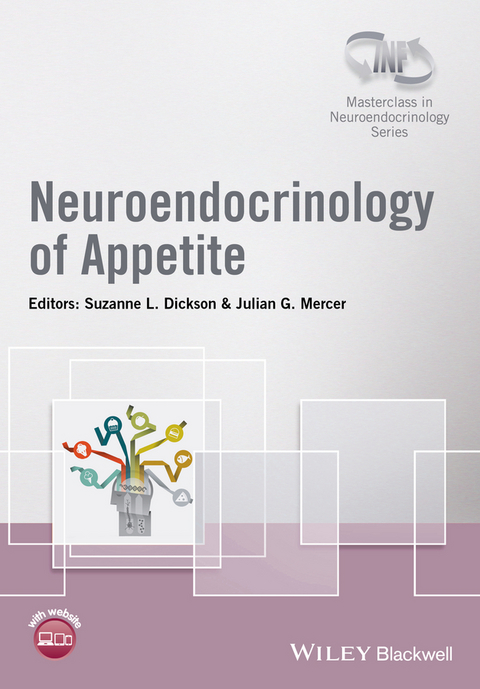
Neuroendocrinology of Appetite (eBook)
John Wiley & Sons (Verlag)
978-1-118-83930-0 (ISBN)
Professor Suzanne L Dickson, The Sahlgrenska Academy of the University of Gothenberg, Sweden
Professor Julian G. Mercer, Rowett Institute of Nutrition and Health, University of Aberdeen, UK
This cutting-edge, interdisciplinary volume describes established and state of the art approaches for exploring the pathways that influence and control appetite, including: behavioural, electrophysiological, neuroanatomical, gene knockout and pharmacological techniques. The book presents key peptide and neurotransmitter systems, together with newly emerging concepts of metabolic signalling and hypothalamic inflammation. The impact of early life experience on neuroendocrine appetite circuits is also looked at, including early programming of these circuits by circulating hormones. Finally, new emerging therapeutic approaches to appetite suppression are discussed, including those linked to bariatric (weight loss) surgery. Neuroendocrinology of Appetite is especially focused on established and emerging technologies and approaches for investigating appetite control. It is written so as to provide an overview of sufficient depth for an undergraduate or new scientist in the field to come up to speed in the complementary approaches used by researchers in this field. Taking an interdisciplinary approach, the book aims to appeal to all those with a basic, clinical or therapeutic interest in research into obesity and eating disorders.
Professor Suzanne L Dickson, The Sahlgrenska Academy of the University of Gothenberg, Sweden Professor Julian G. Mercer, Rowett Institute of Nutrition and Health, University of Aberdeen, UK
Foreword vii
List of Contributors ix
Series Preface xi
About the Companion Website xiii
1 Neuroanatomy of Feeding Pathways 1
Brian J. Oldfield, Paul N. Mirabella, and Aneta Stefanidis
2 Afferent Endocrine Control of Eating 24
Wolfgang Langhans and Jens Juul Holst
3 Ontogeny of Neuroendocrine Feeding Circuits 55
Sophie Croizier and Sebastien G. Bouret
4 Hypothalamic Peptides and Meal Patterns 76
Yada Treesukosol and Timothy H. Moran
5 Food Hedonics: Insight from Animal Models 90
Karolina P. Skibicka and Scott E. Kanoski
6 Functional and Anatomical Dissection of Feeding Circuits 112
Deniz Atasoy and Scott M. Sternson
7 Exploring Appetite and Hypothalamic Circuitry through Manipulating Gene Expression 134
Tara Jois and Mark W. Sleeman
8 Electrophysiology of the Appetite-Regulating Circuits of the Hypothalamus 151
Nancy Sabatier, John Menzies, and Gareth Leng
9 Functional Neuroimaging of Appetite and Gut-Brain Interactions 174
Paul A.M. Smeets and Hubert Preissl
10 Appetite Disorders: From Binge Eating to Anorexia Nervosa 201
Mathieu Méquinion, Susanne la Fleur, and Odile Viltart
11 Future Prospects of the Management of Appetite Disorders Bariatric Surgery 224
Carel le Roux and Karl Neff
12 Discovery of New Drugs for Weight Loss and Prevention of Weight Regain 247
Anders Lehmann, Udo Bauer, Stephan Hjorth, Rudolph L. Leibel and Michael Rosenbaum
Index 000
CHAPTER 1
Neuroanatomy of Feeding Pathways
Brian J. Oldfield, Paul N. Mirabella, and Aneta Stefanidis
Department of Physiology, Monash University, Melbourne, Victoria, Australia
Introduction
It is widely recognized that body weight is determined by the balance between energy intake and energy expenditure with a positive energy balance driving overweight and obesity. This self-evident truth and its extension into the simplistic view that body weight loss is reliant on ‘just eating less and exercising more’ overlooks the almost overwhelming genetically driven regulatory mechanisms that have been honed through millennia to defend against reduced body weight, or more particularly, the loss of body fat mass.
Of the two sides of the energy balance equation, energy intake has been considered the most tractable and has been the subject of most weight loss therapies to date. Pharmacotherapies, recently accepted and under consideration by regulatory agencies, have targeted neurotransmitter systems within central neural pathways that have long been established as pivotal in the control of ingestion of food. These have not been without their problems given, that a central neural focus necessarily leaves open the possibility of an adverse impact on mood. In this respect, drugs such as rimonabant, which act on central reward pathways, have been removed from the market given what are deemed to be unacceptable risks of depressive side effects. Rather than derailing attempts to develop therapies based on an understanding of central neural mediators of appetite, recent experiences have driven a push toward combination therapies. These may have complementary actions to reduce intake or enable approaches involving reduced doses of individual polymodal components, below those which will risk adverse side effects. These and other possible pharmacotherapeutic approaches are discussed in Chapter 12.
An understanding of the neuroanatomy of feeding pathways has been a cornerstone of neuroscience and behavioral neuroscience research since the middle of the 1900s and remains fundamental not only to advances in the biology of ingestive behavior but to the elucidation of therapeutic directions to combat obesity. This sort of understanding may have been hampered to date by schools of thought that have tended to draw attention to specific areas of the brain deemed to be critically important, whether these be the brainstem, ventromedial hypothalamus or midbrain mesolimbic pathways. However, the current trend, reviewed here, to consider the interrelationships of distributed neural networks extending across brainstem, hypothalamic, midbrain, and cortical regions, coordinating reflex, homeostatic, hedonic, and executive control of feeding, augers well for a more complete understanding of the central neural control of feeding related processes.
1.1 Historical background and perspectives
The regions of the brain associated with feeding were established in the mid-1950s in the pivotal commentary (Teitelbaum and Stellar, 1954) where, based on earlier observations of the impact of electrolytic lesions in rats (Hetherington and Ranson, 1940), Stellar proposed a ‘dual center model’ for the regulation of feeding (Figure 1.1). Essentially, this view of the neuroanatomy of feeding pathways ascribed a predominantly ‘satiety’ function to the mediobasal hypothalamus and a ‘feeding’ role to the more lateral hypothalamus. While parcellation of the brain into centers by early psychologists to define motivated behaviors has not always been helpful or enduring, the dual center view of feeding is at least fundamentally consistent with more contemporary ‘cellular’ insights into the central neural control of ingestive behavior. There is still support for broad regional divisions into feeding and satiety; however, as will be defined later, the division is by no means simple or complete. For example, peptides that are powerfully orexigenic, such as neuropeptide Y (NPY) and agouti related peptide (AgRP), are contained within neurons in the arcuate nucleus (see the recent review by Morton et al. (2014)), which is a nucleus at the heart of the traditional ventromedial ‘satiety’ center, and, conversely, anorexigenic peptides including cocaine- and amphetamine-regulated transcript (CART) and corticotrophin releasing factor (CRF) are expressed in neurons in the predominantly ‘feeding related’ lateral hypothalamus.
Figure 1.1 Diagrammatic representation of lesions centered in the ventromedial and lateral hypothalamus causing overeating and overweight or starvation and emaciation, respectively. These lesions provided the basis for what became known as the ‘dual center hypothesis’ of body weight control.
The landmark identification of the adipocyte-derived hormone leptin (Zhang et al., 1994), the cloning of its receptor (Tartaglia et al., 1995), and the localization of the long form (ObRb) of this receptor within the arcuate (ARC) nucleus contributed to the ‘arcuate-centric’ view of central feeding related pathways that was pervasive for at least the following decade. This was further underscored by the fact that insulin, the other major factor circulating in proportion to fat mass, was identified as acting on neurons within the ARC (Baskin et al., 1999). These adipostatic hormones, along with ghrelin, were quickly accepted as the major long-term determinants of appetite and body weight via the recruitment of integrated central circuits mediating appetite through a hub in the ARC. More recently, a more balanced view has emerged, which integrates the mediobasal hypothalamus, other hypothalamic sites that receive projections from the ARC, the brainstem nucleus of the solitary tract (NTS), mesolimbic pathways, and executive control sites in the cerebral cortex. While this list of key brain regions contributing to the distributed neural networks acting in concert to define appetite, feeding, and body weight is not meant to be exhaustive, it will serve as the basis for the description of central feeding pathways described in this chapter.
1.2 The arcuate nucleus, an important hub but not the last word in hypothalamic feeding-related pathways
Within four years of the discovery of leptin and the realization that its receptor was localized in the ventromedial hypothalamus, the ARC had been described as the epicenter of a ‘web of hypothalamic pathways’, drawing together the paraventricular nucleus (PVN) and the lateral hypothalamus (LatH). This schema, described in the pivotal review by J.K. Elmquist and colleagues (Elmquist et al., 1999), linked the rich history of lesion based behavioral studies with the burgeoning tracing and Fos reliant studies, which provided valuable new insight into functional neural pathways.
Such studies established the centrality of the ARC in the modern schematic of feeding related pathways. In particular they identified the two major neuronal subgroups within this nucleus that, despite their close proximity, direct very different effects on feeding and metabolism. The often described opposing actions of these two cell populations in the ARC is based in their neurochemical content, on one hand a medially-positioned group of neurons containing AgRP/NPY/gamma amino butyric acid (GABA) and on the other, more laterally-placed neurons characterized by their content of pro-opiomelanocortin (POMC)/CART. The attractiveness of this arrangement is that the former is orexigenic and the latter anorexigenic, and as such they constitute a sort of ‘yin and yang’ of the control of energy balance. ‘AgRP/NPY/GABA’ neurons are inhibited by leptin and insulin and activated by ghrelin, whereas ‘POMC/CART’ neurons are generally stimulated by leptin and inhibited in conditions of negative energy balance where ghrelin levels are elevated. Therefore, the prevailing peripheral metabolic milieu determines a net output from the ARC based on the recruitment, in concert, of cell groups with opposing actions. POMC neurons exert their anorectic actions via one of its cleavage products, α-melanocyte stimulating hormone (α-MSH), on melanocortin MC4 receptors (MC4R) in other hypothalamic regions primarily concentrated in the PVN and LatH. NPY acts on Y1 and Y5 receptors in the PVN, while AgRP exerts inverse agonist actions on MC4R, thereby augmenting the orexigenic effects of NPY. It is noteworthy that until recently the neurochemical ‘phenotype’ of neurons in the PVN and LatH expressing MC4R was not known and even now the distribution of the receptors is better characterized by the neurons that do not express it. For example, in the PVN, SIM1+ (single-minded 1) neurons predominantly express the MC4R and these are glutamatergic but not GABAergic (Xu et al., 2013). Moreover, they do not express oxytocin, corticotropin releasing hormone or vasopressin (Shah et al., 2014); however, they do contain thyrotropin releasing hormone (Decherf et al., 2010). The MC4Rs in the lateral hypothalamus coexist with neurotensin but not other prominent lateral hypothalamic peptides such as melanin-concentrating hormone (MCH) and orexin (Cui et al., 2012).
The simplicity of this schema is only slightly complicated by the fact that NPY/AgRP neurons...
| Erscheint lt. Verlag | 25.10.2016 |
|---|---|
| Reihe/Serie | Wiley-INF Masterclass in Neuroendocrinology Series |
| Wiley-INF Neuroendocrinology Series | Wiley-INF Neuroendocrinology Series |
| Sprache | englisch |
| Themenwelt | Medizinische Fachgebiete ► Innere Medizin ► Endokrinologie |
| Medizin / Pharmazie ► Medizinische Fachgebiete ► Psychosomatik | |
| Studium ► 1. Studienabschnitt (Vorklinik) ► Biochemie / Molekularbiologie | |
| Naturwissenschaften ► Biologie ► Humanbiologie | |
| Naturwissenschaften ► Biologie ► Zoologie | |
| Technik | |
| Schlagworte | Appetite • appetite suppression • Bariatric Surgery • behavioural • Biowissenschaften • Electrophysiological • Ernährungslehre • Ernährungslehre • Gene Knockout • Gesundheits- u. Sozialwesen • Health & Social Care • hormones • hypothalamic inflammation • Life Sciences • metabolic signalling • Metabolism & Biochemistry of Nutrition • neuroanatomical • neuroendocrine appetite circuits • Neuroendocrinology • Neuroendokrinologie • neurotransmitter systems • Nutrition • Peptide Systems • pharmacological • Stoffwechsel • Stoffwechsel u. Biochemie der Ernährung • Stoffwechsel u. Biochemie der Ernährung • Therapeutic • weight loss |
| ISBN-10 | 1-118-83930-7 / 1118839307 |
| ISBN-13 | 978-1-118-83930-0 / 9781118839300 |
| Informationen gemäß Produktsicherheitsverordnung (GPSR) | |
| Haben Sie eine Frage zum Produkt? |
 EPUB (Adobe DRM)
Kopierschutz: Adobe-DRM
Adobe-DRM ist ein Kopierschutz, der das eBook vor Mißbrauch schützen soll. Dabei wird das eBook bereits beim Download auf Ihre persönliche Adobe-ID autorisiert. Lesen können Sie das eBook dann nur auf den Geräten, welche ebenfalls auf Ihre Adobe-ID registriert sind.
Details zum Adobe-DRM
Dateiformat: EPUB (Electronic Publication)
EPUB ist ein offener Standard für eBooks und eignet sich besonders zur Darstellung von Belletristik und Sachbüchern. Der Fließtext wird dynamisch an die Display- und Schriftgröße angepasst. Auch für mobile Lesegeräte ist EPUB daher gut geeignet.
Systemvoraussetzungen:
PC/Mac: Mit einem PC oder Mac können Sie dieses eBook lesen. Sie benötigen eine
eReader: Dieses eBook kann mit (fast) allen eBook-Readern gelesen werden. Mit dem amazon-Kindle ist es aber nicht kompatibel.
Smartphone/Tablet: Egal ob Apple oder Android, dieses eBook können Sie lesen. Sie benötigen eine
Geräteliste und zusätzliche Hinweise
Buying eBooks from abroad
For tax law reasons we can sell eBooks just within Germany and Switzerland. Regrettably we cannot fulfill eBook-orders from other countries.
aus dem Bereich