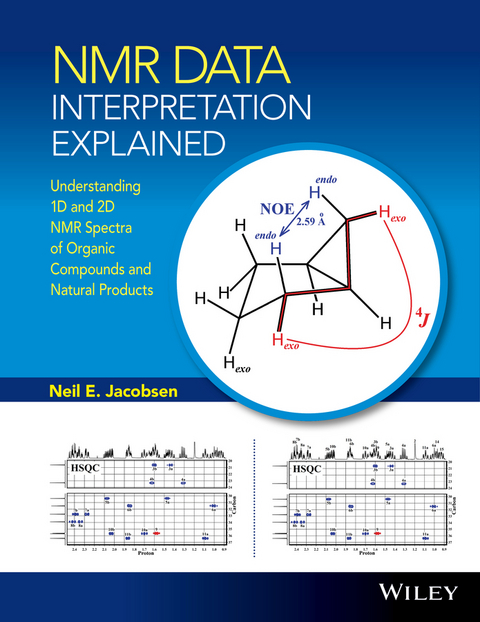
NMR Data Interpretation Explained (eBook)
John Wiley & Sons (Verlag)
978-1-119-04714-8 (ISBN)
Through numerous examples, the principles of the relationship between chemical structure and the NMR spectrum are developed in a logical, step-by-step fashion
- Includes examples and exercises based on real NMR data including full 600 MHz one- and two-dimensional datasets of sugars, peptides, steroids and natural products
- Includes detailed solutions and explanations in the text for the numerous examples and problems and also provides large, very detailed and annotated sets of NMR data for use in understanding the material
- Describes both simple aspects of solution-state NMR of small molecules as well as more complex topics not usually covered in NMR books such as complex splitting patterns, weak long-range couplings, spreadsheet analysis of strong coupling patterns and resonance structure analysis for prediction of chemical shifts
- Advanced topics include all of the common two-dimensional experiments (COSY, ROESY, NOESY, TOCSY, HSQC, HMBC) covered strictly from the point of view of data interpretation, along with tips for parameter settings
Neil E. Jacobsen has been the NMR Facility Manager in the Department of Chemistry and Biochemistry at the University of Arizona for the last 20 years. He teaches an undergraduate course in NMR Spectroscopy (Organic Qualitative Analysis) using a series of unknowns including monoterpenes and steroids, with students acquiring their own 400 MHz 1D and 2D NMR data. He also teaches a graduate course in Organic Synthesis and NMR Spectroscopy that is focused on using the spectrometers and interpreting complex NMR data. He has 30 years of experience working in the field of NMR spectroscopy, and during that time he has authored 46 publications in peer-reviewed journals as well as the 2007 Wiley book NMR Spectroscopy Explained.
Through numerous examples, the principles of the relationship between chemical structure and the NMR spectrum are developed in a logical, step-by-step fashion Includes examples and exercises based on real NMR data including full 600 MHz one- and two-dimensional datasets of sugars, peptides, steroids and natural products Includes detailed solutions and explanations in the text for the numerous examples and problems and also provides large, very detailed and annotated sets of NMR data for use in understanding the material Describes both simple aspects of solution-state NMR of small molecules as well as more complex topics not usually covered in NMR books such as complex splitting patterns, weak long-range couplings, spreadsheet analysis of strong coupling patterns and resonance structure analysis for prediction of chemical shifts Advanced topics include all of the common two-dimensional experiments (COSY, ROESY, NOESY, TOCSY, HSQC, HMBC) covered strictly from the point of view of data interpretation, along with tips for parameter settings
Neil E. Jacobsen has been the NMR Facility Manager in the Department of Chemistry and Biochemistry at the University of Arizona for the last 20 years. He teaches an undergraduate course in NMR Spectroscopy (Organic Qualitative Analysis) using a series of unknowns including monoterpenes and steroids, with students acquiring their own 400 MHz 1D and 2D NMR data. He also teaches a graduate course in Organic Synthesis and NMR Spectroscopy that is focused on using the spectrometers and interpreting complex NMR data. He has 30 years of experience working in the field of NMR spectroscopy, and during that time he has authored 46 publications in peer-reviewed journals as well as the 2007 Wiley book NMR Spectroscopy Explained.
NMR Data Interpretation Explained: Understanding 1D and 2D NMR Spectra of Organic Compounds and Natural Products 1
Contents 7
Examples 13
Preface 15
Acknowledgments 17
About the Companion Website 19
Chapter 1: Spectroscopy and the Proton NMR Experiment 21
1 What is the Structure of a Molecule? 21
2 Mass Spectrometry 23
2.1 Ionization Methods and Molecular Ions 24
2.1.1 Electron Impact (EI) 24
2.1.2 Soft Ionization 25
2.2 High-Resolution Mass Spectrometry and Exact Mass 25
2.3 Isotope Patterns and the Halogens Br and Cl 27
3 Infrared (IR) Spectroscopy 29
4 Ultraviolet (UV) and Visible Spectroscopy 30
5 A Highly Simplified View of the NMR Experiment 33
Chapter 2: Chemical Shifts and Splitting Patterns 37
1 Chemical Shifts in the Proton Spectrum 37
2 Splitting: The Effect of One Neighbor: A Doublet 41
3 Splitting: The Effect of Two Neighbors: A Triplet 43
4 Splitting: The Effect of Three Neighbors: A Quartet 45
5 Splitting: The Effect of "n" Neighbors: A Multiplet 50
6 Using Splitting Patterns to Choose from a Group of Isomers 54
7 Peak Intensities (Peak Areas) and the Number of Protons in a Peak 57
8 Publication Format for Proton NMR Data 59
9 Recognizing Common Structure Fragments 61
10 Overlap in Proton NMR Spectra. Example: 1-Methoxyhexane 65
11 Protons Bound to Oxygen: OH Groups. Example: 2-Ethyl-1-Butanol 68
12 Summary of Chemical Shifts and Splitting Patterns 70
Chapter 3: Proton (1H) NMR of Aromatic Compounds 71
1 Benzene: The Aromatic Ring Current and the Shielding Cone 71
2 Monsubstituted Benzene: X-C6H5 72
2.1 Toluene 72
2.2 Aromatic Chemical Shifts: Resonance Structures 74
2.3 Nitrobenzene 75
2.4 Anisole 76
2.5 Substituent Effects on Aromatic Chemical Shifts 78
2.6 Long-Range J Couplings in Aromatic Rings: Protons 4 Bonds Apart 79
3 Disubstituted Benzene: X—C6H4—Y 82
3.1 Symmetrical Disubstituted Benzene: X-C6H4-X 82
3.2 Unsymmetrical Disubstituted Benzene, X-C6H4-Y 92
3.2.1 para (1,4) Disubstituted Benzene: p-X-C6H4-Y 93
3.2.2 meta (1,3) Disubstituted Benzene: m-X-C6H4-Y 98
3.2.3 ortho (1,2) Disubstituted Benzene: o-X-C6H4-Y 107
4 Coupling Between Aromatic Ring Protons and Substitutent Protons Homonuclear Decoupling
4.1 The Methyl Group (CH3) 120
4.2 The Methoxy Substituent (OCH3) 122
4.3 The Formyl (H-C=O) Substituent 123
5 Trisubstituted Aromatic Rings: The AB2 System 126
6 Other Aromatic Ring Systems: Heteroaromatics, Five-Membered Rings and Fused Rings 130
6.1 Pyridine (C5H5N) 131
6.2 Pyrrole (C4H5N) 132
6.3 Furan (C4H4O) 133
6.4 Naphthalene (C10H8) 135
6.5 Indole (C8H7N) 137
6.6 Quinoline and Isoquinoline (C9H7N) 138
7 Summary of New Concepts: Proton NMR of Aromatic Compounds 140
Chapter 4: Carbon-13 (13C) NMR 145
1 Natural Abundance and Sensitivity of 13C 145
2 Proton Decoupling—Removing the Splitting Effect of Nearby Protons 146
3 Intensity of 13C Peaks—Symmetry and Relaxation 146
4 Chemical Shifts of Carbon-13 (13C) Nuclei 149
4.1 13C Frequency and Chemical Shift Reference 149
4.2 General Regions of the 13C Chemical Shift Scale 150
4.3 Correlations between 1H and 13C Chemical Shift for a C-H Pair 152
4.4 Quantitation of the Steric Effect for 13C Chemical Shifts 155
4.5 Example of Steric Effects on 13C Chemical Shifts: The "Crowded CH" in Steroids 161
4.6 The ?-gauche Effect: Steric Shifts That Give Stereochemical Information 163
4.7 Inductive Effects in 13C Chemical Shifts: Electronegative Atoms 167
4.8 The Effect of Ring Strain on 13C Chemical Shift of sp3-Hybridized Carbons 170
5 Quaternary Carbons: The Carbonyl Group 171
6 Simple Aromatic Compounds: Substituent Effects on 13C Chemical Shifts 176
7 Highly Oxygenated Benzene Rings and Coumarin 181
8 Fused Rings and Heteroaromatic Compounds 185
8.1 Pyridine (C5H5N) 185
8.2 Pyrrole (C4H5N) 187
8.3 Furan (C4H4O) 188
8.4 Naphthalene (C10H8) 188
8.5 Indole (C8H7N) 190
8.6 Quinoline and Isoquinoline (C9H7N) 193
9 Edited 13C Spectra: DEPT 194
9.1 Non-decoupled 13C Spectra 195
9.2 Edited 13C Spectra 196
9.3 Practical Details of the DEPT Experiment 201
9.3.1 Sensitivity 201
9.3.2 Pulse Calibration 201
9.3.3 J Value Setting 202
9.3.4 Phase Correction 205
10 The Effect of Other Magnetic Nuclei on the 13C Spectrum: 31P, 19F, 2H and 14N 205
10.1 Splitting of 13C Peaks By Deuterium (2H) 205
10.2 Splitting of 13C Peaks by Phosphorus (31P) 206
10.3 Splitting of 13C Peaks by Fluorine (19F) 208
10.4 Splitting and Broadening of 13C Peaks by Nitrogen (14N) 209
11 Direct Observation of Nuclei Other Than Proton (1H) and Carbon (13C) 210
11.1 Phosphorus-31 (31P) NMR 212
11.2 Fluorine-19 (19F) NMR 214
Chapter 5: Alkenes (Olefins) 218
1 Proton Chemical Shifts of Simple Olefins 219
2 Short-Range (Two and Three Bond) Coupling Constants (J Values) in Olefins 222
3 The Allylic Coupling: A Long-Range (Four-Bond) J Coupling 225
4 Long-Range Olefin Couplings in Cholesterol: The bis-Allylic Coupling (J) 229
5 Carbon-13 Chemical Shifts of Hydrocarbon Olefins (Alkenes) 230
6 Resonance Effects on Olefinic 13C Chemical Shifts 234
13C and DEPT Spectra 241
Proton Spectrum 241
Vinyl Group Spin System: Peaks x, y and z 242
Second Olefin Spin System: Peaks t, u, v and w 243
7 Alkynes 245
Chapter 6: Chirality and Stereochemistry: Natural Products 247
1 The Molecules of Nature 247
2 Chirality, Chiral Centers, Chiral Molecules, and the Chiral Environment 250
3 The AB System 252
4 Detailed Analysis of the AB Spectrum: Calculating the Chemical Shifts 254
5 The ABX System 257
6 Variations on the ABX Theme: ABX3, ABX2 and ABXY 265
7 The Effect of Chirality on 13C Spectra. Diastereotopic Carbons 269
8 A Closer Look at Chemical Shift Equivalence in an Asymmetric Environment 271
8.1 Chemical Shift Equivalence of CH3 Group Protons 271
8.2 Non-Equivalence of CH2 Group Protons 272
8.3 Chemical Shift Equivalence by Symmetry 272
9 J Couplings and Chemical Shifts in the Rigid Cyclohexane Chair System 275
6.9.1 Cyclohexene and Cyclohexenone 282
10 A Detailed Look at the Dependence of 3JHH on Dihedral Angle: The Karplus Relation 286
11 Magnetic Non-Equivalence. The X-CH2-CH2-Y Spin System: A2B2 and AA'BB' Patterns 296
12 Bicyclic Compounds and Small Rings (Three- and Four-Membered) 306
12.1 The Bicyclo[2.2.1] Ring System 306
12.2 The Bicyclo[3.1.0] Ring System 311
12.3 The Bicyclo[3.1.1] Ring System 314
Reference 318
Chapter 7: Selective Proton Experiments: Biological Molecules 319
1 Sugars: Monosaccharides and Oligosaccharides 319
2 Slowing of OH Exchange in Polar Aprotic Solvents Like DMSO 325
3 Selective TOCSY Applied to the Assignment of the 1H Spectra of Sugars 327
4 The Selective NOE (Nuclear Overhauser Effect) Experiment 339
4.1 Recognizing Artifacts in Selective NOE Spectra 340
4.2 The Relationship Between NOE Intensity and Distance 340
4.3 Magnetization Transfer in the Selective TOCSY and Selective NOE Experiments 341
5 Amino Acids and Peptides 351
6 Nucleic Acids 368
7 Parameter Settings for NMR Experiment Setup and NMR Data Processing 377
Bibliography 378
Chapter 8: Homonuclear Two-Dimensional NMR: Correlation of One Hydrogen (1H) to Another 379
1 Selective TOCSY Experiments Displayed as a Stacked Plot 379
2 The Two-Dimensional COSY Experiment 385
3 Shape and Fine Structure of COSY Crosspeaks Contour Plots
4 2D-COSY Spectra of Sugars 396
Exercises 8.2–8.7: COSY Cartoons 400
5 2D-COSY Spectra of Aromatic Compounds 411
6 Parameter Settings in the 2D COSY Experiment the DQF-COSY Experiment
7 COSY Spectra of Peptides 419
8 COSY Spectra of Natural Products 425
9 Two-Dimensional (2D) TOCSY (Total Correlation Spectroscopy) 432
10 Two-Dimensional (2D) NOESY (Nuclear Overhauser Effect Spectroscopy) 443
Parameter Settings Used for 2D Spectra in this Chapter 449
Chapter 9: Heteronuclear Two-Dimensional NMR: Correlation of One Hydrogen (1H) to One Carbon (13C) 450
1 3-Heptanone: A Thought Experiment 450
2 Edited HSQC: Making the CH2 Protons Stand Out 456
3 The 2D-HSQC Spectrum of Cholesterol 463
4 A Detailed Look at the HSQC Experiment 475
5 Parameters and Settings for the 2D-HSQC Experiment 478
5.1 Spectral Window 478
5.2 Acquisition Time 478
5.3 One-Bond J Coupling Value 479
5.4 Number of 1D Spectra Acquired: F1 Resolution 480
5.5 Number of Scans: Sensitivity 480
6 Data Processing: Phase Correction in Two Dimensions 480
7 Long-Range Couplings Between 1H and 13C 483
8 2D-HMBC (Heteronuclear Multiple-Bond Correlation) 485
8.1 2D-HMBC Spectra of Aromatic Compounds 487
8.2 HMBC Spectra of Natural Products: Using the Methyl Correlations 495
8.3 HMBC Spectra of Sugars 511
9 Parameters and Settings for the 2D-HMBC Experiment 515
9.1 Spectral Window 515
9.2 Acquisition Time 516
9.3 One-Bond and Long-Range JCH Coupling Values 516
9.4 Number of Scans 516
10 Comparison of HSQC and HMBC 516
11 HMBC Variants 517
Parameter Settings Used for 2D Spectra in this Chapter 517
References 518
Chapter 10: Structure Elucidation Using 2D NMR 519
1 Literature Structure Problems 520
2 Sesquiterpenoids 521
3 Steroids 542
4 Oligosaccharides 572
5 Alkaloids 594
6 Triterpenes 617
Reference 635
Index 637
End User License Agreement 651
| Erscheint lt. Verlag | 21.10.2016 |
|---|---|
| Sprache | englisch |
| Themenwelt | Medizin / Pharmazie ► Gesundheitsfachberufe |
| Medizinische Fachgebiete ► Radiologie / Bildgebende Verfahren ► Kernspintomographie (MRT) | |
| Naturwissenschaften ► Chemie ► Analytische Chemie | |
| Naturwissenschaften ► Physik / Astronomie ► Elektrodynamik | |
| Technik | |
| Schlagworte | 2D NMR • carbohydrates • carbon-13 NMR • chemical shift • Chemie • Chemistry • COSY • hmbc • HSQC • J coupling • Long-Range Coupling • <p>NMR Spectroscopy • Natural Products • NMR Spectroscopy / MRI / Imaging • NMR-Spektroskopie • NMR-Spektroskopie / MRT / Bildgebende Verfahren • Noe • NOESY • Nucleic Acids</p> • Organic Chemistry • Organische Chemie • Peptides • Pharmaceutical & Medicinal Chemistry • Pharmazeutische u. Medizinische Chemie • Proton NMR • ROESY • Spektroskopie • stereochemistry • Structure Elucidation |
| ISBN-10 | 1-119-04714-5 / 1119047145 |
| ISBN-13 | 978-1-119-04714-8 / 9781119047148 |
| Informationen gemäß Produktsicherheitsverordnung (GPSR) | |
| Haben Sie eine Frage zum Produkt? |
 PDF (Adobe DRM)
Kopierschutz: Adobe-DRM
Adobe-DRM ist ein Kopierschutz, der das eBook vor Mißbrauch schützen soll. Dabei wird das eBook bereits beim Download auf Ihre persönliche Adobe-ID autorisiert. Lesen können Sie das eBook dann nur auf den Geräten, welche ebenfalls auf Ihre Adobe-ID registriert sind.
Details zum Adobe-DRM
Dateiformat: PDF (Portable Document Format)
Mit einem festen Seitenlayout eignet sich die PDF besonders für Fachbücher mit Spalten, Tabellen und Abbildungen. Eine PDF kann auf fast allen Geräten angezeigt werden, ist aber für kleine Displays (Smartphone, eReader) nur eingeschränkt geeignet.
Systemvoraussetzungen:
PC/Mac: Mit einem PC oder Mac können Sie dieses eBook lesen. Sie benötigen eine
eReader: Dieses eBook kann mit (fast) allen eBook-Readern gelesen werden. Mit dem amazon-Kindle ist es aber nicht kompatibel.
Smartphone/Tablet: Egal ob Apple oder Android, dieses eBook können Sie lesen. Sie benötigen eine
Geräteliste und zusätzliche Hinweise
Buying eBooks from abroad
For tax law reasons we can sell eBooks just within Germany and Switzerland. Regrettably we cannot fulfill eBook-orders from other countries.
aus dem Bereich