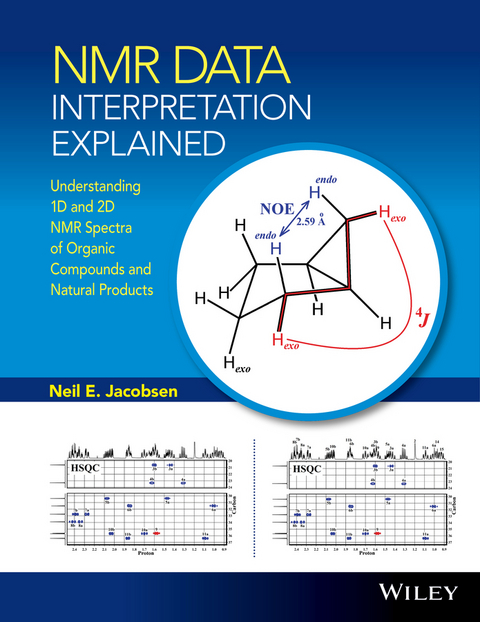
NMR Data Interpretation Explained (eBook)
John Wiley & Sons (Verlag)
978-1-119-17688-6 (ISBN)
Through numerous examples, the principles of the relationship between chemical structure and the NMR spectrum are developed in a logical, step-by-step fashion
- Includes examples and exercises based on real NMR data including full 600 MHz one- and two-dimensional datasets of sugars, peptides, steroids and natural products
- Includes detailed solutions and explanations in the text for the numerous examples and problems and also provides large, very detailed and annotated sets of NMR data for use in understanding the material
- Describes both simple aspects of solution-state NMR of small molecules as well as more complex topics not usually covered in NMR books such as complex splitting patterns, weak long-range couplings, spreadsheet analysis of strong coupling patterns and resonance structure analysis for prediction of chemical shifts
- Advanced topics include all of the common two-dimensional experiments (COSY, ROESY, NOESY, TOCSY, HSQC, HMBC) covered strictly from the point of view of data interpretation, along with tips for parameter settings
Neil E. Jacobsen has been the NMR Facility Manager in the Department of Chemistry and Biochemistry at the University of Arizona for the last 20 years. He teaches an undergraduate course in NMR Spectroscopy (Organic Qualitative Analysis) using a series of unknowns including monoterpenes and steroids, with students acquiring their own 400 MHz 1D and 2D NMR data. He also teaches a graduate course in Organic Synthesis and NMR Spectroscopy that is focused on using the spectrometers and interpreting complex NMR data. He has 30 years of experience working in the field of NMR spectroscopy, and during that time he has authored 46 publications in peer-reviewed journals as well as the 2007 Wiley book NMR Spectroscopy Explained.
Neil E. Jacobsen has been the NMR Facility Manager in the Department of Chemistry and Biochemistry at the University of Arizona for the last 20 years. He teaches an undergraduate course in NMR Spectroscopy (Organic Qualitative Analysis) using a series of unknowns including monoterpenes and steroids, with students acquiring their own 400 MHz 1D and 2D NMR data. He also teaches a graduate course in Organic Synthesis and NMR Spectroscopy that is focused on using the spectrometers and interpreting complex NMR data. He has 30 years of experience working in the field of NMR spectroscopy, and during that time he has authored 46 publications in peer-reviewed journals as well as the 2007 Wiley book NMR Spectroscopy Explained.
Chapter 1
Spectroscopy and the Proton NMR Experiment
1 What is the Structure of a Molecule?
There are several levels of understanding what a molecule “looks like” on the scale of individual atoms. The first step is to understand how many of each type of atom make up the collection of atoms that are bonded together to form a molecule. The molecular formula is an accounting of the types of atoms in a molecule and the number of each type of atom (e.g., C6H8N2O4). Mass spectrometry is used to “weigh” molecules and obtain their exact mass, in atomic mass units (amu). Because atoms have masses that can differ slightly from integer values (e.g., , , , ), a very precise measurement of the mass of a molecule allows us to determine the molecular formula. With a molecular formula, we can start to think about how this group of atoms is connected together. For example, for C4H6O (Figure 1.1) we can think of many ways to connect the atoms, while satisfying the valence rules (four bonds to C, two to O, one to H).
Note that all of the C4H6O structures in Figure 1.1 have one thing in common: the total of the number of π bonds plus the number of rings is two in each case. These two “unsaturations” can be determined from the molecular formula by a simple calculation:
- Discard the oxygen(s): C4H6O → C4H6.
- Any halogens (F, Cl, Br, I) are converted to hydrogens.
- Any nitrogens (N) are converted to CH (one C and one H for each N). You now have the modified molecular formula: C4H6.
- If n is the number of carbon atoms in the modified molecular formula (Cn), calculate the number of hydrogens expected in a saturated hydrocarbon with this number of carbons: m = (n × 2) + 2 = (4 × 2) + 2 = 10.
- Subtract the number of hydrogens in the modified molecular formula (6) from this saturated hydrocarbon value and divide the result by 2: m − 6 = 10 − 6 = 4; u = 4/2 = 2.
This result (u) is equal to the number of π bonds in the molecule plus the number of rings. Note that a triple bond (CC) is really one σ bond and two π bonds, so it counts as two “unsaturations”.
For larger molecules the number of isomers (structures with the same molecular formula) increases very rapidly with the number of atoms. For the formula C8H11NO3 there are 383 different commercially available compounds! NMR is especially useful for distinguishing between these many possibilities.
In the NMR instrument, each atom (actually the nucleus of each atom) has a precise resonant frequency in the radio frequency spectrum. We can “tune in to the radio channel” of each of these atoms in turn and gather information about the immediate surroundings of that atom in the molecule. There are several kinds of information we can get from each atom:
- Nearby functional groups change the resonant frequency in predictable ways, so the exact resonant frequency can be used to determine the “chemical environment” of that atom. There are two types of these frequency-shifting effects:
- Nearby electronegative atoms (O, N, Br, etc.). This effect acts through σ bonds and dies off quickly after 2 or 3 bonds. This is similar to the well-known inductive effect that modifies reactivity in organic chemistry reactions.
- Nearby double bonds (C=C or olefin/aromatic, C=O or carbonyl, CN or nitrile, etc.). This effect acts directly through space and dies off after about 5 Ångstroms (one Ångstrom or Å is approximately the length of a C–H bond). The orientation of the plane of the double bond relative to the atom being observed is also important.
- Hydrogen atoms are affected by the proximity of other hydrogen atoms in the molecule. So we can look around the immediate vicinity of our hydrogen (the one whose radio channel we are tuned to) and see the number and proximity of other hydrogens or groups of hydrogens. This effect manifests itself in two ways:
- “Splitting” of the resonant frequency of our hydrogen (the one being observed) by a nearby hydrogen into two resonant frequencies very close to each other. The stronger the effect, the wider is the separation of the two frequencies. This effect travels through the bonds and dies off quickly as the number of bonds separating the two hydrogens increases: 2 bonds ≥ 3 bonds > 4 bonds. This effect is sensitive to the angles formed by the bonds connecting the two hydrogens, so we can get information about the relative orientation of groups connected by single bonds. These can either be fixed orientations determined by rigid bonding in rings (stereochemistry) or preferred orientations in a flexible molecule (conformation).
- Enhancement of the NMR radio signal received from one hydrogen when we hit the other hydrogen with a radio signal at its precise radio frequency. This enhancement is called an NOE and it operates directly through space between hydrogens. The effect dies off quickly with increasing separation and is not seen at all for distances greater than 5 Å. The NOE gives us a molecular ruler for measuring distances between specific pairs of hydrogens in the molecule.
Note that the NMR experiment gives us lots of specific information from the point of view of one atom in the molecule: nearby functional groups and nearby hydrogens, through bonds or directly through space. We can get the same type of information from each of the atoms in the molecule in turn, especially from the hydrogens. Adding up all of this information (chemical environments, distances, and angles) can give us a covalent structure (which atoms are connected to which by covalent bonds) and a conformation (shape of the molecule in three dimensions).
Determining the structure of a molecule by NMR is a puzzle-solving exercise, and to date it still requires a lot of human judgment and intuition; you don't just feed it into a computer and out pops a structure. The exercise can be exciting and challenging, and it gives the rare human experience of looking straight into the molecular world and getting unambiguous answers to our questions. But it must be emphasized that NMR does not give a picture of the molecule. In spite of its close relationship to MRI (magnetic resonance imaging), NMR spectroscopy is not an imaging experiment and it does not give any kind of image or picture of the molecule. You, the person interpreting the NMR data, must put all of these simple pieces of evidence together, along with whatever other information you have, to propose a structure of the molecule. Then you have to go over the evidence to make sure all of it is consistent with your proposed structure. As in all science, we can gather more and more evidence and be more and more sure of our conclusion, but we can never be absolutely sure. One of the advantages of NMR is that the sheer volume of complimentary information that can be gathered from multiple vantage points (the different atoms in the molecule) makes it a technique with a very high degree of confidence in the conclusions. For small molecules (molecular weight below 500 Da), this confidence comes very close to certainty for experienced users willing to do a number of NMR experiments.
There is another technique for molecular structure determination that does generate a picture or image of the molecule. X-ray crystallography measures the pattern of scattering of X-rays from a solid crystal of the molecule. By analyzing the intensities of thousands of spots from the scattered X-rays, a computer can create a three-dimensional map of the electron density of the molecule. Since atoms are basically dense clouds of electrons, the atoms can be accurately located and you get a three-dimensional structure of the molecule. The main drawback of this technique is that you need a crystal, and even then the crystal may not have the right properties to give good X-ray diffraction. Once you have a good crystal, the process is time consuming and requires a great deal of calculation and refinement of the data by an expert. In contrast, an NMR spectrum can be acquired in a few minutes if a pure sample can be dissolved in a solvent. The analysis of NMR data, as we shall see, is straightforward and can be learned by anyone with a basic understanding of organic chemistry.
Before we look at the NMR experiment in more detail, some of the other tools for organic structure determination will be briefly explained. These give information which is complementary to the NMR data and help to provide the complete picture of the molecule.
2 Mass Spectrometry
Mass spectrometry is essentially a method for weighing individual molecules to determine their mass. Knowing the masses of individual atoms that make up the molecule (H = 1, C = 12, N = 14, O = 16, etc.), we can narrow down the possibilities to a small number of possible molecular formulae. For example, for an integer mass of 120 units, we can have the following molecular formulae:
Exercise 1.1: Calculate the number of unsaturations (number of π bonds + number of rings) for each of the above molecular formulae. Explain why C6H16O2 is not a possible molecular formula for a molecular mass of 120.
We will see shortly that with a more accurate...
| Erscheint lt. Verlag | 21.10.2016 |
|---|---|
| Sprache | englisch |
| Themenwelt | Medizin / Pharmazie ► Gesundheitsfachberufe |
| Medizinische Fachgebiete ► Radiologie / Bildgebende Verfahren ► Kernspintomographie (MRT) | |
| Naturwissenschaften ► Chemie ► Analytische Chemie | |
| Naturwissenschaften ► Physik / Astronomie ► Elektrodynamik | |
| Technik | |
| Schlagworte | 2D NMR • carbohydrates • carbon-13 NMR • chemical shift • Chemie • Chemistry • COSY • hmbc • HSQC • J coupling • Long-Range Coupling • <p>NMR Spectroscopy • Natural Products • NMR Spectroscopy / MRI / Imaging • NMR-Spektroskopie • NMR-Spektroskopie / MRT / Bildgebende Verfahren • Noe • NOESY • Nucleic Acids</p> • Organic Chemistry • Organische Chemie • Peptides • Pharmaceutical & Medicinal Chemistry • Pharmazeutische u. Medizinische Chemie • Proton NMR • ROESY • Spektroskopie • stereochemistry • Structure Elucidation |
| ISBN-10 | 1-119-17688-3 / 1119176883 |
| ISBN-13 | 978-1-119-17688-6 / 9781119176886 |
| Informationen gemäß Produktsicherheitsverordnung (GPSR) | |
| Haben Sie eine Frage zum Produkt? |
 EPUB (Adobe DRM)
Kopierschutz: Adobe-DRM
Adobe-DRM ist ein Kopierschutz, der das eBook vor Mißbrauch schützen soll. Dabei wird das eBook bereits beim Download auf Ihre persönliche Adobe-ID autorisiert. Lesen können Sie das eBook dann nur auf den Geräten, welche ebenfalls auf Ihre Adobe-ID registriert sind.
Details zum Adobe-DRM
Dateiformat: EPUB (Electronic Publication)
EPUB ist ein offener Standard für eBooks und eignet sich besonders zur Darstellung von Belletristik und Sachbüchern. Der Fließtext wird dynamisch an die Display- und Schriftgröße angepasst. Auch für mobile Lesegeräte ist EPUB daher gut geeignet.
Systemvoraussetzungen:
PC/Mac: Mit einem PC oder Mac können Sie dieses eBook lesen. Sie benötigen eine
eReader: Dieses eBook kann mit (fast) allen eBook-Readern gelesen werden. Mit dem amazon-Kindle ist es aber nicht kompatibel.
Smartphone/Tablet: Egal ob Apple oder Android, dieses eBook können Sie lesen. Sie benötigen eine
Geräteliste und zusätzliche Hinweise
Buying eBooks from abroad
For tax law reasons we can sell eBooks just within Germany and Switzerland. Regrettably we cannot fulfill eBook-orders from other countries.
aus dem Bereich