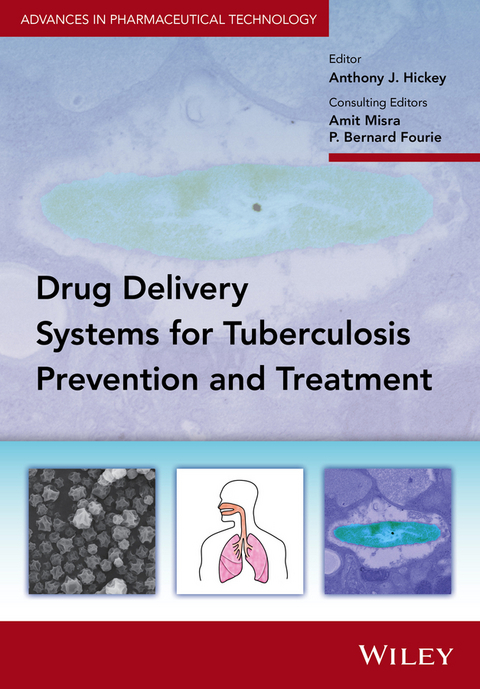
Delivery Systems for Tuberculosis Prevention and Treatment (eBook)
456 Seiten
Wiley (Verlag)
978-1-118-94319-9 (ISBN)
Provides a review of novel pharmaceutical approaches for Tuberculosis drugs
- Presents a novel perspective on tuberculosis prevention and treatment
- Considers the nature of disease, immunological responses, vaccine and drug delivery, disposition and response
- Multidisciplinary appeal, with contributions from microbiology, immunology, molecular biology, pharmaceutics, pharmacokinetics, chemical and mechanical engineering
Anthony J. Hickey, Distinguished Fellow (appointed June 2012), is a Program Director in Inhaled Therapeutics in the Center for Aerosol and Nanomaterials Engineering at the Research Triangle Institute, North Carolina, USA. Dr Hickey has more than 30 years of academic and research experience in pulmonary biology, aerosol physics, powder dynamics, pharmacokinetics and drug disposition, formulation design, and device development. Since joining RTI in 2011, he has conducted research related to pulmonary drug and vaccine delivery for tuberculosis treatment and therapy. Additionally, Dr. Hickey is an adjunct professor of biomedical engineering at the University of North Carolina at Chapel Hill School of Medicine, emeritus professor of molecular pharmaceutics at the University of North Carolina at Chapel Hill Eshelman School of Pharmacy, and founder and president of Cirrus Pharmaceuticals, Inc.
1
Introduction: A Guide to Treatment and Prevention of Tuberculosis Based on Principles of Dosage Form Design and Delivery
A.J. Hickey
RTI International, RTP, NC, USA
1.1 Background
Tuberculosis has been a scourge of mankind for millennia. The discovery by Koch of the causative organism Mycobacterium tuberculosis at the end of the nineteenth century was hailed as the discovery that would rapidly lead to its eradication [1]. Despite the speed of development of a vaccine, attenuated Mycobacterium bovis (bacille Calmette Guerin), and the discovery of a therapeutic drug within only a few decades, circumstances that could not have been foreseen with respect to new strains, multiple-drug resistance and co-infection with human immunodeficiency virus, have rendered the disease a more complicated challenge than originally envisaged.
As the twentieth century progressed physicians were horrified to discover that the vaccine was not universally protective and that resistance to the drug of choice, streptomycin, was increasing rapidly [2]. These observations led to further activities in both the realm of vaccine and drug development, the latter being the more clinically successful but the former yielding much need information on the pathogen, the host immunity and pathogenesis of disease.
During this period pharmacy and pharmaceutical dosage form design were also entering a golden age. Manufacturing of drug products or compounding, which was traditionally an activity that took place in a pharmacy, was transferred to an industrial setting. Commercial products involving a variety of dosage form were being standardized to allow production on a scale previously unknown. The introduction of legislation regulating the quality of products, particularly to address adulteration and ensure safety, commenced most notably in the 1930s with the Food Drug and Cosmetics Act of the United States [3]. In the latter half of the twentieth century the underlying physical chemistry and chemical engineering required to manufacture under rigorously controlled conditions that ensured the quality, uniformity, efficacy and safety of the product were developed.
With this background it is noteworthy that the parallel developments in dosage form and tuberculosis (TB) treatment led to their convergence in the early part of the twentieth century when reproducible drug delivery could only be achieved by oral administration (tablets and capsules) or parenteral administration (injection). As a consequence, other routes and means of delivery were rarely, if ever, considered for the delivery of drugs or vaccines. This can be contrasted with the products of biotechnology developed in the late twentieth century for which both oral and parenteral administration were rarely feasible. Of course, the ease of delivery and the required dose were the leading reasons for the selection of these routes of administration.
There was a brief period in the middle of the twentieth century when the absence of new drugs and the increase in drug resistance led to studies of inhaled therapy for tuberculosis but the development of new drugs resulted in this approach being abandoned and only revisited during times when there were no apparent oral and parenteral dosage forms to meet the immediate challenge. Figure 1.1 presents the number of publications that can be found in the accessible literature for the period since the initial rise in drug-resistant tuberculosis in the 1940s. A subsequent peak appears following the rise in human immunodeficiency virus co-infected patients and multiple-drug-resistant tuberculosis requiring alternative therapeutic strategies.
Figure 1.1 Reports of Aerosol Delivery Extracted from PubMed from the earliest citations in the modern literature
1.2 Dosage Form Classification
The route of administration by which drugs are delivered dictates the dosage form employed. The United States Pharmacopeia has classified therapeutic products in terms of three tiers: route of administration, dosage forms and performance test which captures all conventional and most novel strategies for disease treatment as shown in Figure 1.2 [4]. The performance measure of significance for the majority of dosage forms is the dissolution rate which, together with the biological parameter of permeability for those drugs presented at mucosal sites, dictates the appearance of the drug in the systemic circulation and ultimately its therapeutic effect.
Figure 1.2 United States Pharmacopeia Taxonomy of Dosage Forms structured from: Tier 1 – Route of Administration; through Tier 2 – Dosage Form to; Tier 3 – Performance (not shown).
(Modified from ref. [4] Courtesy of Margareth Marques and the USP)
1.2.1 Dosage Forms
It would not be possible to do justice to the science and technology underpinning the wide range of dosage forms available for drug delivery. However, to put those used in the treatment and prevention of tuberculosis in context a brief review of the key components and processes involved may be helpful to the reader.
1.2.1.1 Solid Oral Dosage Forms
These consist of a mixture of powders each of which is intended to confer a desirable property on the dosage form that leads to effective manufacture, drug delivery and therapeutic effect [5, 6].
In addition to the drug substance which must be well characterized, glidants help the powder flow which aids in filling, surfactants enhance dissolution and diluents are considered inert bulking agents that assist in metering small quantities of drug during filling and may help in compaction. Binding agents, as the name suggests, help in binding all components into a granule or tablet to preserve the integrity of the dosage form on storage and prior to administration. The common dosage forms are capsules and tablets that differ in that the former consists of a powder or granulated loose fill while the latter requires compaction [5, 6]. The most common capsule is prepared with gelatin and filled with the optimized formulation of drug in excipients to allow for stability on storage and reproducible and efficacious dose delivery. Tablets also contain the drug and excipient compacted into a single solid dosage form that has desired performance properties in terms of stability, dissolution, dose delivery and efficacy. Biopharmaceutical considerations are of great significance to the disposition of drugs from solid oral dosage forms. Their behavior under the wide range of pH conditions (1–8) in the gastro-intestinal tract and an understanding of the influence of anatomy and physiology on local residence time and regions of absorption are significant considerations in optimization of the dosage form. Relatively recently the publication of Lipinski’s rules [7] and the biopharmaceutical classification system [8] have been an enormous help in the selection of drugs and requirements of formulations that correlate with successful drug delivery by the oral route of administration.
1.2.1.2 Parenteral Dosage Forms
These are intended for injection either directly into the blood circulation [intravenous (IV)] or at a site from which the drug can readily be transported to the vasculature as would occur following subcutaneous or intramuscular administration [9]. There are other infrequently employed (intraperitoneal) or specialized (intrathecal or intratumoral) sites of injection that are not relevant to tuberculosis therapy. The key elements of a parenteral dosage form are the requirement for a formulation suitable for delivery from a syringe through a needle to the intended site. The formulation can range from simple solutions to a variety of dispersed systems (emulsions, micelles, liposomes and solid suspensions). Important physico-chemical properties must be considered to avoid local tissue damage on injection. Primarily these relate to the requirement to approximate physiological pH and ionic strength (tonicity) [10]. However, there are other safety considerations for injectable dispersed systems that relate to physical obstruction of capillaries (embolism), as well as uptake by the reticulo-endothelial system (inflammation, irritation or immune responses) [11]. The composition of any excipients, carrier systems and the nature of the injected active ingredient will dictate expectations of any of these responses.
1.2.1.3 Inhaled Dosage Forms
These deliver droplets or particles to the pulmonary mucosa that are then distributed locally and transported to the systemic circulation by absorption. The most important criteria for the efficacy of inhaled therapeutics are the aerodynamic particle size distribution and the dose delivered. The particle size range that is targeted for efficient delivery of drug to the lungs is 1–5 μm [12]. The United States Pharmacopeia has described types of inhaled drug product. Of those shown in Figure 1.3 the most important aerosol products for the treatment of pulmonary disease fall into three categories: metered dose inhalers (MDIs), dry powder inhalers (DPIs), and nebulizer systems. MDIs employ high-vapor-pressure propellant to deliver rapidly evaporating droplets containing the active ingredient; dry powder inhalers deliver particles of drug alone or by the use of a carrier particle; and nebulizers deliver aqueous solutions or suspensions of the active ingredient [12]. It is important to note that the...
| Erscheint lt. Verlag | 25.8.2016 |
|---|---|
| Reihe/Serie | Advances in Pharmaceutical Technology |
| Advances in Pharmaceutical Technology | Advances in Pharmaceutical Technology |
| Mitarbeit |
Berater: Amit Misra, P. Bernard Fourie |
| Sprache | englisch |
| Themenwelt | Medizinische Fachgebiete ► Innere Medizin ► Pneumologie |
| Studium ► Querschnittsbereiche ► Infektiologie / Immunologie | |
| Naturwissenschaften ► Chemie ► Technische Chemie | |
| Technik | |
| Schlagworte | Aerosol • Biowissenschaften • Chemie • Chemistry • Clinical Trials • Delivery • Dosage form • Drug • Drug Formulation & Delivery • Efficacy Testing • Life Sciences • Medical Science • Medizin • Microbiology & Virology • Mikrobiologie • Mikrobiologie u. Virologie • mycobacterium tuberculosis • Pharmacokinetics • Pharmacology & Pharmaceutical Medicine • Pharmakologie • Pharmakologie u. Pharmazeutische Medizin • Tuberculosis • Tuberkulose • Vaccine • Wirkstoffformulierung, Wirkstofftransport |
| ISBN-10 | 1-118-94319-8 / 1118943198 |
| ISBN-13 | 978-1-118-94319-9 / 9781118943199 |
| Informationen gemäß Produktsicherheitsverordnung (GPSR) | |
| Haben Sie eine Frage zum Produkt? |
 EPUB (Adobe DRM)
Kopierschutz: Adobe-DRM
Adobe-DRM ist ein Kopierschutz, der das eBook vor Mißbrauch schützen soll. Dabei wird das eBook bereits beim Download auf Ihre persönliche Adobe-ID autorisiert. Lesen können Sie das eBook dann nur auf den Geräten, welche ebenfalls auf Ihre Adobe-ID registriert sind.
Details zum Adobe-DRM
Dateiformat: EPUB (Electronic Publication)
EPUB ist ein offener Standard für eBooks und eignet sich besonders zur Darstellung von Belletristik und Sachbüchern. Der Fließtext wird dynamisch an die Display- und Schriftgröße angepasst. Auch für mobile Lesegeräte ist EPUB daher gut geeignet.
Systemvoraussetzungen:
PC/Mac: Mit einem PC oder Mac können Sie dieses eBook lesen. Sie benötigen eine
eReader: Dieses eBook kann mit (fast) allen eBook-Readern gelesen werden. Mit dem amazon-Kindle ist es aber nicht kompatibel.
Smartphone/Tablet: Egal ob Apple oder Android, dieses eBook können Sie lesen. Sie benötigen eine
Geräteliste und zusätzliche Hinweise
Buying eBooks from abroad
For tax law reasons we can sell eBooks just within Germany and Switzerland. Regrettably we cannot fulfill eBook-orders from other countries.
aus dem Bereich