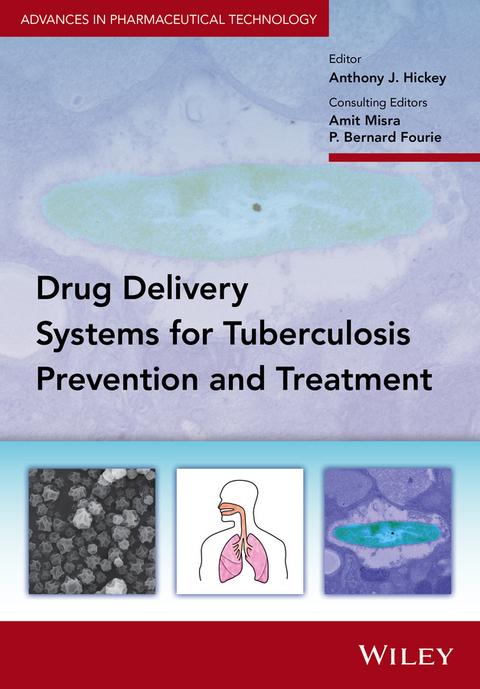
Delivery Systems for Tuberculosis Prevention and Treatment (eBook)
456 Seiten
Wiley (Verlag)
978-1-118-94320-5 (ISBN)
Provides a review of novel pharmaceutical approaches for Tuberculosis drugs
- Presents a novel perspective on tuberculosis prevention and treatment
- Considers the nature of disease, immunological responses, vaccine and drug delivery, disposition and response
- Multidisciplinary appeal, with contributions from microbiology, immunology, molecular biology, pharmaceutics, pharmacokinetics, chemical and mechanical engineering
Anthony J. Hickey, Distinguished Fellow (appointed June 2012), is a Program Director in Inhaled Therapeutics in the Center for Aerosol and Nanomaterials Engineering at the Research Triangle Institute, North Carolina, USA.
Dr Hickey has more than 30 years of academic and research experience in pulmonary biology, aerosol physics, powder dynamics, pharmacokinetics and drug disposition, formulation design, and device development. Since joining RTI in 2011, he has conducted research related to pulmonary drug and vaccine delivery for tuberculosis treatment and therapy.
Additionally, Dr. Hickey is an adjunct professor of biomedical engineering at the University of North Carolina at Chapel Hill School of Medicine, emeritus professor of molecular pharmaceutics at the University of North Carolina at Chapel Hill Eshelman School of Pharmacy, and founder and president of Cirrus Pharmaceuticals, Inc.
Anthony J. Hickey, Distinguished Fellow (appointed June 2012), is a Program Director in Inhaled Therapeutics in the Center for Aerosol and Nanomaterials Engineering at the Research Triangle Institute, North Carolina, USA. Dr Hickey has more than 30 years of academic and research experience in pulmonary biology, aerosol physics, powder dynamics, pharmacokinetics and drug disposition, formulation design, and device development. Since joining RTI in 2011, he has conducted research related to pulmonary drug and vaccine delivery for tuberculosis treatment and therapy. Additionally, Dr. Hickey is an adjunct professor of biomedical engineering at the University of North Carolina at Chapel Hill School of Medicine, emeritus professor of molecular pharmaceutics at the University of North Carolina at Chapel Hill Eshelman School of Pharmacy, and founder and president of Cirrus Pharmaceuticals, Inc.
Title Page 5
Copyright Page 6
Contents 7
List of Contributors 17
Foreword 20
Advances in Pharmaceutical Technology: Series Preface 23
Preface 25
Chapter 1 Introduction: A Guide to Treatment and Prevention of Tuberculosis Based on Principles of Dosage Form Design and Delivery 27
1.1 Background 27
1.2 Dosage Form Classification 29
1.2.1 Dosage Forms 29
1.3 Controlled and Targeted Delivery 31
1.4 Physiological and Disease Considerations 32
1.5 Therapeutic Considerations 33
1.6 Conclusion 34
References 34
Section 1 Pathogen and Host 37
Chapter 2 Host Pathogen Biology for Airborne Mycobacterium tuberculosis: Cellular and Molecular Events in the Lung 39
2.1 Introduction 39
2.2 Lung 40
2.2.1 Alveoli 42
2.2.2 The Different Lung Macrophages 43
2.2.3 Other Immune Cells in the Lung 43
2.3 General Aspects of Mucus and Surfactant 43
2.4 General M. tuberculosis 44
2.5 M. tuberculosis Interaction with the Lung Macrophage 45
2.5.1 Initial Interactions Following Inhalation 45
2.5.2 Interactions with the Macrophage 45
2.6 M. tuberculosis Interaction with other Respiratory Immune Cells 49
2.6.1 Neutrophils 49
2.6.2 Dendritic Cells 50
2.6.3 NK Cells 51
2.6.4 B Cells 52
2.6.5 T Cells 53
2.7 TB Granuloma 55
2.8 Conclusion 56
References 56
Chapter 3 Animal Models of Tuberculosis 74
3.1 Introduction 74
3.2 What is an Animal Model of TB? 75
3.3 How are Animal Models of TB Used? 76
3.4 TB Animal Models Currently Used for TB Drug and Vaccine Evaluation 77
3.4.1 Guinea Pig 79
3.4.2 Mouse 80
3.4.3 Non-human Primate 81
3.4.4 Rabbit 82
3.4.5 Zebrafish 83
3.4.6 Rat 83
3.4.7 Domestic Animals and Wildlife Reservoirs 84
3.5 Summary 84
References 85
Section 2 Immunological Intervention 93
Chapter 4 Vaccine Preparation: Past, Present, and Future 95
4.1 Introduction 95
4.2 Early Efforts in TB Vaccine Development 97
4.2.1 Early BCG Formulation and Manufacturing 97
4.2.2 History of the BCG Vaccine and Routes of Administration 98
4.2.3 Quality Control Issues 98
4.3 Current BCG Vaccine Formulation 99
4.3.1 BCG Vaccine Strain Variability 99
4.3.2 BCG Lyophilization for Stability 99
4.3.3 Manufacturing Process 100
4.3.4 Packing and Storage 101
4.3.5 Transportation 101
4.3.6 Needle-stick Issues 102
4.4 Novel TB Vaccination Strategies 102
4.4.1 Formulation and Stabilization Techniques 104
4.4.2 Manufacturing of TB Vaccines 107
4.4.3 Whole-Cell Vaccine 108
4.4.4 Subunit Vaccines 109
4.4.5 Regulatory Approval Process 109
4.4.6 Vaccine Packaging 110
4.5 Future Perspective 110
4.6 Conclusions 111
References 111
Chapter 5 TB Vaccine Assessment 117
5.1 Introduction 117
5.2 Preclinical Vaccine Assessment 118
5.2.1 Murine Model 119
5.2.2 Guinea Pig Model 120
5.2.3 Cattle Model 120
5.2.4 Non-human Primate Model 121
5.3 Clinical Assessment of Vaccines 123
5.3.1 Human Clinical Trials and Phases of Testing 123
5.3.2 Live Attenuated Vaccine Candidates 123
5.3.3 Viral Vectored Subunit Vaccines 125
5.3.4 Adjuvanted Subunit Vaccines 126
5.3.5 Therapeutic Vaccines 127
5.3.6 Route of Immunization 127
5.4 Laboratory Immunological Analysis and Assessment of Vaccine Trials 128
5.4.1 Decision on Population of Interest 128
5.4.2 Detection of Infection 128
5.4.3 Detection of Protective Immunity 128
5.5 How well do the Available Preclinical Models Predict Vaccine Success in Humans? 129
References 131
Section 3 Drug Treatment 137
Chapter 6 Testing Inhaled Drug Therapies for Treating Tuberculosis 139
6.1 Introduction 139
6.2 The Need for New Drug Treatments for Tuberculosis 140
6.3 Inhaled Drug Therapy for Tuberculosis 140
6.4 Published Studies of Inhalation Therapy for TB 141
6.5 The Guinea Pig Model for Testing Inhaled Therapies for TB 142
6.6 Guinea Pig Study Design 143
6.7 Purchase and Grouping Animals 144
6.8 Infecting Guinea Pigs with Virulent Mycobacterium tuberculosis 144
6.9 Dosing Groups of Guinea Pigs with TB Drugs 145
6.10 Collecting Data 147
6.11 Aerosol Dosing Chambers and Practice 148
6.11.1 Study Timing with Regard to Scale of Manufacturing 148
6.11.2 Animal Model Selection 149
6.11.3 Dose and Dosing Regimen 149
6.12 Nebulizer Aerosol Delivery Systems for Liquids 149
6.13 Dry-Powder Aerosol Delivery Systems for Solids 151
6.14 Summary 153
Acknowledgments 153
References 153
Chapter 7 Preclinical Pharmacokinetics of Antitubercular Drugs 157
7.1 Introduction 157
7.2 Factors Influencing the Pharmacokinetic Behavior of Drugs 158
7.2.1 Physicochemical Properties of the Drug 158
7.2.2 Formulation and Routes of Administration 163
7.2.3 Disease State 164
7.3 Pulmonary Delivery of Anti-TB Drugs 164
7.4 Pharmacokinetic Study Design 166
7.4.1 Animal Models 166
7.4.2 Biological Samples 167
7.4.3 Analytical Method 168
7.4.4 Calculation of PK Parameters 168
7.5 Implications of PK Parameters on Efficacy 170
7.5.1 Tissue Samples 170
7.5.2 Pharmacokinetics of Anti-TB Drug in Granulomas 171
7.5.3 PK/PD Correlations 172
7.6 Case Studies (Drugs Administered by Conventional and Pulmonary Routes) 172
7.6.1 Rifampicin 172
7.6.2 Capreomycin 177
References 178
Chapter 8 Drug Particle Manufacture –Supercritical Fluid, High-Pressure Homogenization 182
8.1 Introduction 182
8.2 Preparation of Nano- and Micro-particles 183
8.2.1 Microparticles Prepared by a Supercritical Antisolvent–Drug Excipient Mixing (SAS–DEM) Technique 183
8.2.2 Nanoparticles Prepared by a Supercritical Fluid (SCF) Technique 183
8.2.3 Nanosuspension 184
8.2.4 Liposomes 185
References 185
Chapter 9 Spray Drying Strategies to Stop Tuberculosis 187
9.1 Introduction 187
9.2 Overview of Spray Drying 188
9.2.1 Advantages of Spray Drying 189
9.2.2 Hardware 189
9.2.3 Spray Dryer Classifications 194
9.2.4 Process Parameters 196
9.2.5 Particle Formation Mechanism 198
9.3 Advances in Spray Drying Technology 200
9.3.1 The ‘Quality by Design’ Approach 200
9.3.2 The Nano Spray Dryer B-90 201
9.3.3 Novel Multi-Channel Nozzles 203
9.4 Anti-Tuberculosis Therapeutics Produced by Spray Drying 205
9.4.1 Controlled-Release Microparticles 205
9.4.2 Maximal Drug-loaded Microparticles 210
9.4.3 Vaccines 212
9.5 Conclusion 213
9.6 Acknowledgements 213
References 213
Chapter 10 Formulation Strategies for Antitubercular Drugs by Inhalation 223
10.1 Introduction 223
10.2 Lung Delivery of TB Drugs 224
10.3 Powders for Inhalation and Liquids for Nebulization 226
10.4 Antibacterial Powders for Inhalation: Manufacturing of Respirable Microparticles 228
10.5 Antibacterial Powders for Inhalation: Devices and Delivery Strategies 234
10.6 Conclusions and Perspectives 237
References 237
Chapter 11 Inhaled Drug Combinations 239
11.1 Introduction 239
11.2 Standard Combinations in Oral and Parenteral Regimens 240
11.2.1 Combinations for the Directly Observed Treatment Short-Course (DOTS) Regimen 240
11.3 The Rationale for Inhaled Therapies of TB 242
11.3.1 Single Drug, Supplementing Other Orally Administered Drugs 244
11.3.2 Single Drug Replacing Injectable First- or Second-Line Agents 245
11.3.3 Multiple Inhaled Drugs, Adjunct or Stand-alone Therapy 246
11.3.4 “Stimulate the Phagocyte” 246
11.4 Combinations of Anti-TB Drugs with Other Agents 248
11.4.1 Drugs that Primarily Affect the Pathogen 248
11.4.2 Drugs that Affect Host Responses 249
11.4.3 Drugs that Affect both Host and Pathogen 250
11.5 Formulation of Inhaled Drug Combinations 250
11.5.1 Excipient-free Formulations 250
11.5.2 Applications of Excipients 251
11.5.3 Preparing Multi-Component Particles and Vesicles 253
11.5.4 Shelf Stability 253
11.5.5 Drug Release and Pharmacokinetics 254
11.5.6 Inhalation Dosimetry 255
11.6 Conclusions 256
References 256
Chapter 12 Ion Pairing for Controlling Drug Delivery 265
12.1 Introduction 265
12.2 Ion Pairing Definitions and Concepts 266
12.2.1 Ion Pairing as Physicochemical Tuning Tool 267
12.2.2 Metal Ion Complexation 268
12.2.3 Some Considerations on Ion Pair and Metal Complex Stability 270
12.3 Ion Pairs, Complexes and Drug Delivery 271
12.3.1 Oral Route 271
12.3.2 Transdermal/Dermal and Mucosal Route 272
12.3.3 Parenteral Route 273
12.3.4 The Pulmonary Route and Infectious Diseases 273
12.3.5 Toxicity Considerations 274
12.4 Remarks 278
References 280
Chapter 13 Understanding the Respiratory Delivery of High Dose Anti-Tubercular Drugs 284
13.1 Introduction 284
13.2 Tuberculosis 285
13.3 Drugs Used to Treat Tuberculosis, Doses, Challenges and Requirements for Therapy in Lungs 286
13.3.1 Current TB Treatment Regimen 286
13.3.2 Challenges of Conventional Oral and Parenteral Therapy 287
13.3.3 Rationale for Respiratory Delivery 287
13.4 Approaches for Respiratory Delivery of Drugs 288
13.5 Current DPI Formulations and Their Mechanisms of Aerosolization 288
13.6 DPI Formulations for Tuberculosis and Requirements 290
13.7 Issues to Consider in Respiratory Delivery of Powders for Tuberculosis 290
13.8 Relationship between De-agglomeration and Tensile Strength 292
13.9 Strategies to Improve De-agglomeration 294
13.10 DPI Formulations having High Aerosolization 295
13.11 Devices for High Dose Delivery 296
13.12 Future Considerations 297
References 298
Section 4 Alternative Approaches 301
Chapter 14 Respirable Bacteriophage Aerosols for the Prevention and Treatment of Tuberculosis 303
14.1 Introduction 303
14.1.1 Bacteriophages 303
14.1.2 Mycobacteriophages 306
14.1.3 Mycobacterium tuberculosis as a Host for Phage Infection in vivo 308
14.1.4 Mycobacteriophages and TB Diagnosis 308
14.2 Treatment or Prevention of Tuberculosis Using Phage-based Agents 308
14.2.1 Bacteriophages as Therapeutic Agents 308
14.2.2 Prospects for Using Mycobacteriophages for Therapy or TB Prevention 309
14.3 Selection of Mycobacteriophages 310
14.4 Respiratory Drug Delivery of Phages 311
14.5 Summary and Outlook 314
Acknowledgements 314
References 314
Chapter 15 RNA Nanoparticles as Potential Vaccines 319
15.1 Introduction 319
15.2 Nanoparticles 319
15.3 RNA Nanoparticle Vaccines 320
15.4 Progression of Nanomedicines into the Clinic 321
15.5 The Stability Problem 321
15.6 The Delivery Problem 324
15.7 RNA as Targeting Agent or Adjuvant? 324
15.8 Challenges for RNA Nanoparticle Vaccine Characterization 326
15.9 On the Horizon 327
References 327
Chapter 16 Local Pulmonary Host-Directed Therapies for Tuberculosis via Aerosol Delivery 333
16.1 Introduction 333
16.1.1 Tuberculosis Disease and Control 334
16.1.2 Chemotherapy and Host Immunity to Tuberculosis 334
16.1.3 Aerosol Delivery of Host-Directed Therapies for Tuberculosis Treatment 335
16.2 Lung Immunity to Pulmonary M. tuberculosis Infection 335
16.2.1 Overview 335
16.2.2 Influence of Lung Alveoli Environment on Bacilli Survival and its Impact on Tuberculosis Chemotherapy 336
16.2.3 Potential Targets for Host-Directed Therapy 337
16.3 Host-Directed Therapies 339
16.3.1 Previous Studies via Systemic Administration of Host-Directed Therapies 339
16.3.2 Previous Studies via Aerosol Delivery of Host-Directed Therapies 341
16.4 Limitations of Preclinical Studies to Develop Inhalational Host-Directed Therapies for Tuberculosis 343
16.5 Preclinical Testing of Inhaled Small Interference RNA as Host-Directed Therapies for Tuberculosis 344
Acknowledgements 345
References 345
Section 5 Future Opportunities 351
Chapter 17 Treatments for Mycobacterial Persistence and Biofilm Growth 353
17.1 Introduction 353
17.2 Mycobacterial Persistence and Drug Tolerance 354
17.3 Mycobacterial Multicellular Growth 355
17.4 Mycobacterial Lipids Involved in Biofilm Formation 356
17.5 Therapies to Treat Mycobacterial Biofilms and Persistence 358
17.5.1 Therapies to Treat Mycobacterial Biofilms 358
17.5.2 Therapies to Disrupt Nutrient Acquisition and Persistence 360
17.5.3 Treatments for Biofilm Dispersion 361
17.5.4 Treatments Derived from Host Innate Defenses 362
17.5.5 Treatments with Inhaled Antibiotics 363
17.6 Conclusion 365
References 365
Chapter 18 Directed Intervention and Immunomodulation against Pulmonary Tuberculosis 372
18.1 Introduction 372
18.2 TB Immunology 373
18.2.1 Early Events of Infection 373
18.2.2 Delayed Adaptive Immunity 374
18.2.3 Humoral Immunity and Innate Lymphocytes 374
18.2.4 Latent Infection 375
18.2.5 Correlates of Protection and Tolerance 376
18.2.6 Natural Immunity against TB Infection 377
18.3 Animal Models of Immunotherapies and Vaccines for TB 377
18.3.1 Mouse Model 378
18.3.2 Guinea Pig Model 378
18.3.3 Non-human Primates Model 378
18.4 The Current TB Vaccine – Bacille Calmette Guérin 379
18.4.1 BCG Vaccine History 379
18.4.2 Alternative Routes of BCG Delivery 379
18.4.3 Failures of BCG 380
18.5 Other Vaccines Platforms 383
18.5.1 Live Bacterial Vaccines 383
18.5.2 Inactivated Whole-cell Vaccines 384
18.5.3 Viral Vector-based TB Vaccines 385
18.5.4 Heterologous Prime-boost Vaccination Strategy in TB 386
18.6 Pulmonary Immunization 387
18.6.1 Biomimicry: Harnessing Natural Immunity for Protection against TB 387
18.6.2 Pulmonary Immunization for Global Protection 387
18.6.3 Safety Concerns for Pulmonary Immunization 389
18.6.4 Role of Adjuvants 389
18.6.5 Live vs Dead Vaccines 390
18.7 Immunotherapeutic Agents against TB 390
18.7.1 Cytokines 391
18.7.2 Vitamin D Therapy 392
18.7.3 Re-purposed Drugs 392
18.7.4 Stem Cell Therapy 392
18.8 Conclusion 393
References 393
Section 6 Clinical Perspective 405
Chapter 19 Clinical and Public Health Perspectives 407
19.1 Introduction 407
19.2 Background 408
19.3 Clinical Considerations 408
19.3.1 Pill Burden and Fixed?dose Combinations 408
19.3.2 Non-adherence and Medication Monitoring 409
19.3.3 Intermittent Therapy 409
19.3.4 Drug Toxicity 410
19.3.5 Drug Absorption and Therapeutic Drug Monitoring 410
19.4 Public Health Considerations 411
19.4.1 DOTS 411
19.4.2 Community-based Therapy 412
19.4.3 Incentives and Enablers to Promote Adherence 412
19.5 Inhaled Drugs and Other Alternative Delivery Systems 413
19.5.1 Possible Advantages 413
19.5.2 Concerns and Limitations 414
19.5.3 Acceptance of Novel Therapies 414
19.6 Clinical Trials of Inhaled Injectable Drugs 414
19.6.1 Capreomycin Phase 1 Clinical Study 416
19.6.2 Inhaled Therapy to Reduce Transmission, especially of Highly Drug-resistant Strains – a Trial of Inhaled Colistin (or Polymxyin E) 417
19.7 Other Novel Delivery Strategies 419
19.8 Pediatric Delivery Systems 419
19.9 Conclusion 420
References 420
Chapter 20 Concluding Remarks: Prospects and Challenges for Advancing New Drug and Vaccine Delivery Systems into Clinical Application 426
20.1 Introduction 426
20.2 Progress in the Formulation and Manufacturing of Drugs and Vaccines for Tuberculosis 427
20.2.1 Inhaled Drugs and Drug Combinations 427
20.3 Considerations in the Development of TB Drug and Vaccine Delivery Options 430
20.3.1 Lung Biology and Pulmonary Administration of Drugs and Vaccines 430
20.3.2 Choice of Animal Model in the Evaluation of Drug and Vaccine Delivery Systems 431
20.3.3 Demonstrating Bioequivalence and Clinical Efficacy of Inhaled Drugs to Oral/Parenteral Dosage Forms 432
20.3.4 Inhaled Vaccines for TB – are there Potential Advantages? 434
20.3.5 Safety of Pulmonary Vaccination 435
20.4 Concluding Remarks 436
References 437
Index 441
Supplemental Images 452
EULA 458
| Erscheint lt. Verlag | 25.8.2016 |
|---|---|
| Reihe/Serie | Advances in Pharmaceutical Technology |
| Advances in Pharmaceutical Technology | Advances in Pharmaceutical Technology |
| Mitarbeit |
Berater: Amit Misra, P. Bernard Fourie |
| Sprache | englisch |
| Themenwelt | Medizinische Fachgebiete ► Innere Medizin ► Pneumologie |
| Studium ► Querschnittsbereiche ► Infektiologie / Immunologie | |
| Naturwissenschaften ► Chemie ► Technische Chemie | |
| Technik | |
| Schlagworte | Aerosol • Biowissenschaften • Chemie • Chemistry • Clinical Trials • Delivery • Dosage form • Drug • Drug Formulation & Delivery • Efficacy Testing • Life Sciences • Medical Science • Medizin • Microbiology & Virology • Mikrobiologie • Mikrobiologie u. Virologie • mycobacterium tuberculosis • Pharmacokinetics • Pharmacology & Pharmaceutical Medicine • Pharmakologie • Pharmakologie u. Pharmazeutische Medizin • Tuberculosis • Tuberkulose • Vaccine • Wirkstoffformulierung, Wirkstofftransport |
| ISBN-10 | 1-118-94320-1 / 1118943201 |
| ISBN-13 | 978-1-118-94320-5 / 9781118943205 |
| Informationen gemäß Produktsicherheitsverordnung (GPSR) | |
| Haben Sie eine Frage zum Produkt? |
 PDF (Adobe DRM)
Kopierschutz: Adobe-DRM
Adobe-DRM ist ein Kopierschutz, der das eBook vor Mißbrauch schützen soll. Dabei wird das eBook bereits beim Download auf Ihre persönliche Adobe-ID autorisiert. Lesen können Sie das eBook dann nur auf den Geräten, welche ebenfalls auf Ihre Adobe-ID registriert sind.
Details zum Adobe-DRM
Dateiformat: PDF (Portable Document Format)
Mit einem festen Seitenlayout eignet sich die PDF besonders für Fachbücher mit Spalten, Tabellen und Abbildungen. Eine PDF kann auf fast allen Geräten angezeigt werden, ist aber für kleine Displays (Smartphone, eReader) nur eingeschränkt geeignet.
Systemvoraussetzungen:
PC/Mac: Mit einem PC oder Mac können Sie dieses eBook lesen. Sie benötigen eine
eReader: Dieses eBook kann mit (fast) allen eBook-Readern gelesen werden. Mit dem amazon-Kindle ist es aber nicht kompatibel.
Smartphone/Tablet: Egal ob Apple oder Android, dieses eBook können Sie lesen. Sie benötigen eine
Geräteliste und zusätzliche Hinweise
Buying eBooks from abroad
For tax law reasons we can sell eBooks just within Germany and Switzerland. Regrettably we cannot fulfill eBook-orders from other countries.
aus dem Bereich