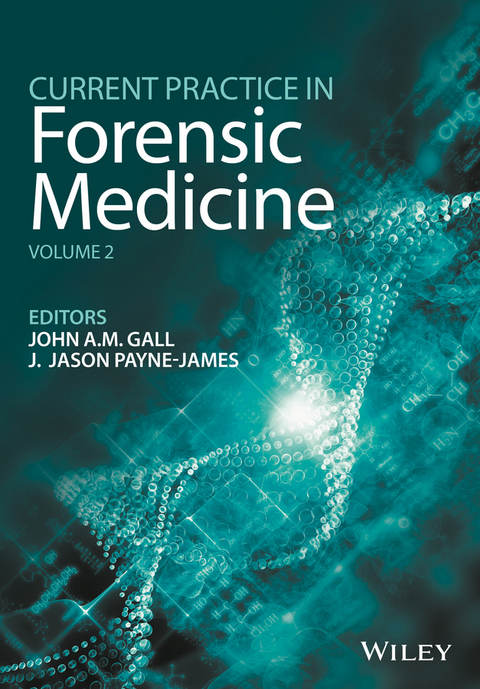
Current Practice in Forensic Medicine, Volume 2 (eBook)
John Wiley & Sons (Verlag)
978-1-118-45601-9 (ISBN)
Forensic medicine is a broad and evolving field with areas of rapid progress embracing both clinical and pathological aspects of practice, in which there may be considerable overlap. This is the second volume in a series that provides a unique, in-depth and critical update on selected topics of direct relevance to those practising in the field of clinical forensic medicine and related areas including lawyers, police, medical practitioners, forensic scientists, and students.
The chapters endeavour to maintain a relevance to an international, multi-professional audience and
include chapters on:
- DNA decontamination,
- The toxicity of novel psychoactive substances,
- The relevance of gastric contents in the timing of death,
- The effects of controlled energy devices,
- The main risk factors for driving impairment,
- The risk factors for harm to health of detainees in short-term custody,
- Autoerotic deaths,
- Child maltreatment and neglect, and
- The investigation of potential non-accidental head injury in children.
Also included are chapters on excited delirium syndrome, automatism and personality disorders. Two topics not generally covered in standard clinical forensic medical textbooks include a forensic anthropological approach to body recovery in potential crimes against humanity and risk management and security issues for the forensic practitioner investigating potential crimes against humanity in a foreign country.
Forensic medicine is a broad and evolving field with areas of rapid progress embracing both clinical and pathological aspects of practice, in which there may be considerable overlap. This is the second volume in a series that provides a unique, in-depth and critical update on selected topics of direct relevance to those practising in the field of clinical forensic medicine and related areas including lawyers, police, medical practitioners, forensic scientists, and students. The chapters endeavour to maintain a relevance to an international, multi-professional audience and include chapters on: DNA decontamination, The toxicity of novel psychoactive substances, The relevance of gastric contents in the timing of death, The effects of controlled energy devices, The main risk factors for driving impairment, The risk factors for harm to health of detainees in short-term custody, Autoerotic deaths, Child maltreatment and neglect, and The investigation of potential non-accidental head injury in children. Also included are chapters on excited delirium syndrome, automatism and personality disorders. Two topics not generally covered in standard clinical forensic medical textbooks include a forensic anthropological approach to body recovery in potential crimes against humanity and risk management and security issues for the forensic practitioner investigating potential crimes against humanity in a foreign country.
Dr John Gall is a consultant forensic physician. He is Director of Southern Medical Services Pty Ltd; Associate Professor in the Department of Paediatrics at The University of Melbourne; Consultant at the Victorian Forensic Paediatric Medical Service at the Royal Children's Hospital and Monash Medical Centre; President of the World Police Medical Officers; and Vice-President of the Australasian Association of Forensic Physicians. Jason Payne-James is a Consultant Forensic Physician & Specialist in Forensic & Legal Medicine. He is Honorary Consultant at the Paediatric & Emergency Medicine at St George's Hospital, London; Honorary Senior Lecturer at the Cameron Forensic Medical Sciences, Barts and the London SMD; President at the Faculty of Forensic & Legal Medicine (Royal College of Physicians); and Director of Forensic Healthcare Services Ltd.
List of Contributors
Preface
Chapter 1 DNA Contamination - a pragmatic clinical view
Chapter 2 THE TOXICITY OF THE NOVEL PSYCHOACTIVE
Chapter 3 Post-Mortem Gastric Content Analysis: Role in Determining Time Since Death
Chapter 4 CONDUCTED ENERGY DEVICES
Chapter 5 Autoerotic Deaths
Chapter 6 Excited Delirium Syndrome: Aetiology, Identification and Treatment
Chapter 7 AUTOMATISM - WADING THROUGH THE QUAGMIRE
Chapter 8 Classification of personality disorders, clinical manifestations and treatment
Chapter 9 DRIVING IMPAIRMENT: THE MAIN RISK FACTORS
Chapter 10 Risk Factors for Death or Harm to Health for Detainees in Short-Term Police Custody
Chapter 11 THE UTILITY OF RADIOLOGICAL INVESTIGATION OF SUSPECTED ABUSIVE HEAD TRAUMA IN CHILDREN
Chapter 12 Child maltreatment: detection and diagnosis
Chapter 13 BODY RECOVERY IN POTENTIAL CRIMES AGAINST HUMANITY INVESTIGATIONS - A FORENSIC ANTHROPOLOGICAL APPROACH
Chapter 14 FIELD MISSIONS
Index
List of Contributors
Paul I. Dargan MB BS, FRCPE, FACMT, FRCP, ERT, FAACT, FEAPCCT, FBPhS
Paul Dargan is a consultant physician and clinical toxicologist, and clinical director at Guy’s and St Thomas’ NHS Foundation Trust, London, UK. He is also Professor of Clinical Toxicology at King’s College London. He has an active research and teaching programme, with a focus on recreational drug toxicity, self‐poisoning and heavy metal toxicity. He has published over 220 peer‐reviewed papers and numerous book chapters, and is a member of the editorial board of a number of medical journals. Paul sits on the Advisory Council on the Misuse of Drugs (ACMD) and the Scientific Committee of the European Monitoring Centre for Drugs and Drugs Addiction (EMCDDA). He is an expert adviser on numerous other bodies, including the US Food and Drug Administration (FDA), Médecins Sans Frontières (MSF) and the World Health Organization (WHO).
John A.M. Gall BSc (Hons), MB, BS, PhD, FACLM, FFFLM (RCP Lond), FFCFM (RCPA), DMJ (Clin & Path)
John Gall is a consultant forensic physician. He is an Associate Professor, Department of Paediatrics, The University of Melbourne, Director of Southern Medical Services, Principal of Era Health and is a staff specialist forensic physician in the Victorian Paediatric Forensic Medical Service, located at the Royal Children’s Hospital and Monash Medical Centre, Melbourne. He is a member of the international editorial board of the Journal of Forensic and Legal Medicine, Egyptian Journal of Forensic Sciences and Internet Journal of Forensic Medicine and Toxicology. John is the current President of the World Police Medical Officers and was Vice President of the Australasian Association of Forensic Physicians. John qualified initially as a biochemist, completed his doctorate in the Department of Pathology at the University of Melbourne and engaged in postdoctoral research in anatomy. He later read medicine at the University of Melbourne and undertook training in anatomical and forensic pathology, and clinical forensic medicine. He has practised clinical forensic medicine for over 20 years, initially as a forensic medical officer with Victoria Police and later as a consultant at the Victorian Institute of Forensic Medicine. John has been extensively involved in undergraduate and postgraduate education at the University of Melbourne and Monash University. He was an honorary senior lecturer in the Department of Forensic Medicine, Monash University, during which time he taught custodial medicine in the University’s Graduate Diploma of Forensic Medicine. He also devised, developed and administered an international continuing education programme in forensic medicine and, with co‐authors, wrote and edited Forensic Medicine Colour Guide and the first edition of this series. John has been involved in forensic medical research and much of these findings have been published. In addition to forensic medicine, he practises occupational and military medicine.
Clare M. Legge BSc, MSc, DipFHID
Clare Legge is a Publishing Editor at SAGE Publications, London where she works in the STM Journals editorial department on a diverse list of engineering and materials science journals. Clare graduated from Bournemouth University in 2008 with a first class BSc honours degree in forensic and crime scene science. She subsequently obtained an MSc in forensic medical sciences from Cameron Forensic Medical Sciences, Barts and the London School of Medicine and Dentistry, Queen Mary University London, where her thesis focused on the use of gastric contents in estimating time since death. In 2012 Clare was awarded a diploma in forensic human identification from the Faculty of Forensic and Legal Medicine, The Royal College of Physicians.
Johan Marchand MD
Johan Marchand is a general paediatrician and consultant in child abuse at the University Hospital for Children of the Brussels Free University. He studied medicine at Brussels Free University and was trained in paediatrics in Brussels and Paris. Formerly he worked as confidential doctor in the Child Confidential Centre for Child Abuse of Ghent, and was director and paediatrician of the Child Confidential Centre, Brussels. He also worked in the Medical Institute Clairs Vallons, Ottignies, as head of a multidisciplinary team caring for abused children in residential care. He is a clinical tutor at the Brussels Free University and participates in the study programme for medical students (child abuse, psychosocial medicine). Johan is a frequent speaker at conferences on child abuse in Belgium, and organizer of a three‐day course on forensic aspects of child abuse in the past. He actively participates in many European and world conferences on child abuse organized by the International Society for Prevention of Child Abuse and Neglect.
Willie Nugent
Willie Nugent is the founder and managing director of Eurocheck Security Consultants Limited. Willie served in the Irish Defence Forces for over 20 years, retired with the rank of captain in 2001 and set up Eurocheck Security Consultants Limited. While serving in the Irish Defence Forces, he served in the Military Police, Army Ranger Wing and the Cavalry Corps. He served three years in South Lebanon as part of UNIFIL (the United Nations Interim Force in Lebanon). While he was heavily involved in security, operational and training aspects, he also has extensive experience in the areas of logistics and transport. Willie is strongly committed to human rights and democracy and served as special security officer with rhe European Union Border Assist Mission at Rafah, in Gaza and Israel in 2009. In recent years he has conducted hostile environment, security awareness and war crimes investigation training throughout Europe, Africa, the Middle East and South America. Willie holds a Level 7 certificate in further education from the National University of Ireland at Maynooth.
J. Jason Payne‐James LLM MSc FRCS PFFLM FCSFS FACLM FCLM DFM Mediator
Jason Payne‐James is an independent specialist in forensic and legal medicine with a range of research and clinical interests. He qualified in medicine in 1980 at the London Hospital Medical College. He has undertaken additional postgraduate qualifications at Cardiff Law School, the Department of Forensic Medicine and Science at the University of Glasgow and with the University of Ulster, Northern Ireland. He has been a forensic medical examiner with the Metropolitan Police for almost 25 years. His clinical and research interests include healthcare in custody, restraint and less‐lethal systems, harm and death in custody and torture. He has published peer‐reviewed research on a wide range of subjects, including healthcare in custody, use of force, TASER®, and irritant spray.
Jason is honorary senior lecturer at Cameron Forensic Medical Sciences, Barts and the London School of Medicine and Dentistry. He is honorary consultant in emergency medicine at St George’s Hospital, London. He is external consultant to the UK National Crime Agency and National Injuries Database. He is editor‐in‐chief of the Journal of Forensic & Legal Medicine. He is president of the Faculty of Forensic and Legal Medicine of the Royal College of Physicians. In addition to Current Practice in Forensic Medicine he has co‐edited and co‐authored other publications, including the Encyclopedia of Forensic and Legal Medicine, Forensic Medicine: Clinical and Pathological Aspects and Symptoms and Signs of Substance Misuse. He is lead author of the 13th edition of Simpson’s Forensic Medicine; he co‐authored the Oxford Handbook of Forensic Medicine and co‐edited Age Estimation in the Living. He is currently co‐editing Monitoring and Documenting Conditions of Detention and Custody, Torture and Ill‐Treatment.
Mercedes Salado Puerto PhD
Mercedes Salado Puerto first qualified as a biologist and completed her doctorate in the Department of Biological Anthropology, Universidad Autónoma de Madrid, Spain. As a forensic anthropologist, she was member of the Guatemalan forensic anthropology team from 1998 to 2003. Since 2003 she has been a member of the Argentine Forensic Anthropology Team (EAAF), where she currently works as identification coordinator. She specializes in the historical investigation of cases of political violence (analysis of written and oral sources, collecting ante‐mortem data from relatives of the missing, interviewing witnesses, information management and databases), archaeological exhumation of individual and mass graves, and analysis of skeletal human remains in order to identify them and determine the cause of death. She has been involved in forensic investigations and training in Argentina, Bosnia‐Herzegovina, Burundi, Colombia, Cyprus, Chile, Guatemala, Iran, Iraq, Morocco, Mexico, Nepal, Panama, Peru, South Africa, Sudan, Thailand, Timor‐Leste, Togo, Uruguay and Vietnam. She has been lecturer in the postgraduate diploma in forensic anthropology and human rights (Universidad Nacional Mayor de San Marcos, Perú), the master’s degree in forensic anthropology and bioarchaeology (Graduate School of the Pontificia Universidad Católica del Perú) and the doctorate in anthropology at the Universidad Nacional de Córdoba, Argentina. She is a member of the Latin American Association of Forensic Anthropology and...
| Erscheint lt. Verlag | 16.8.2016 |
|---|---|
| Sprache | englisch |
| Themenwelt | Medizin / Pharmazie ► Gesundheitsfachberufe |
| Studium ► 2. Studienabschnitt (Klinik) ► Rechtsmedizin | |
| Naturwissenschaften ► Biologie | |
| Naturwissenschaften ► Chemie | |
| Technik | |
| Schlagworte | Abusive head traum • Analytische Chemie / Forensik • Autoerotic death • Biowissenschaften • Chemie • Chemistry • child neglect • Death and harm in custody • DNA decontamination • Excited delirium syndrome (ExDS) • Forensics • Forensic Science • Forensik • Gastric contents • Life Sciences • Medical Science • Medizin • Pathologie • Pathology • personality disorders • psychoactive substances • Traffic medicine |
| ISBN-10 | 1-118-45601-7 / 1118456017 |
| ISBN-13 | 978-1-118-45601-9 / 9781118456019 |
| Informationen gemäß Produktsicherheitsverordnung (GPSR) | |
| Haben Sie eine Frage zum Produkt? |
 EPUB (Adobe DRM)
Kopierschutz: Adobe-DRM
Adobe-DRM ist ein Kopierschutz, der das eBook vor Mißbrauch schützen soll. Dabei wird das eBook bereits beim Download auf Ihre persönliche Adobe-ID autorisiert. Lesen können Sie das eBook dann nur auf den Geräten, welche ebenfalls auf Ihre Adobe-ID registriert sind.
Details zum Adobe-DRM
Dateiformat: EPUB (Electronic Publication)
EPUB ist ein offener Standard für eBooks und eignet sich besonders zur Darstellung von Belletristik und Sachbüchern. Der Fließtext wird dynamisch an die Display- und Schriftgröße angepasst. Auch für mobile Lesegeräte ist EPUB daher gut geeignet.
Systemvoraussetzungen:
PC/Mac: Mit einem PC oder Mac können Sie dieses eBook lesen. Sie benötigen eine
eReader: Dieses eBook kann mit (fast) allen eBook-Readern gelesen werden. Mit dem amazon-Kindle ist es aber nicht kompatibel.
Smartphone/Tablet: Egal ob Apple oder Android, dieses eBook können Sie lesen. Sie benötigen eine
Geräteliste und zusätzliche Hinweise
Buying eBooks from abroad
For tax law reasons we can sell eBooks just within Germany and Switzerland. Regrettably we cannot fulfill eBook-orders from other countries.
aus dem Bereich