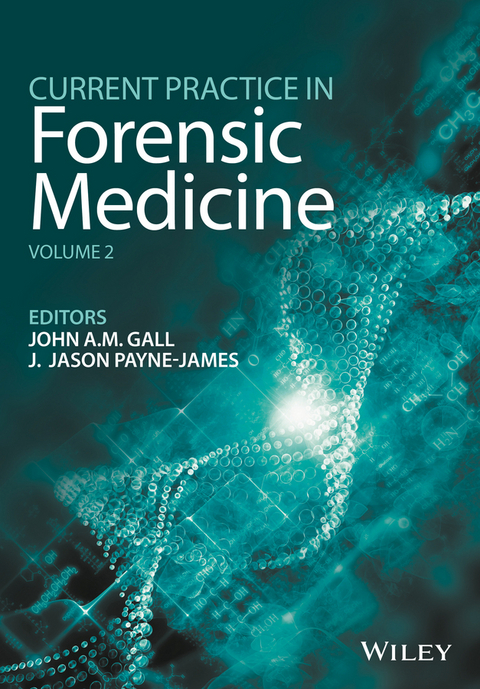
Current Practice in Forensic Medicine, Volume 2 (eBook)
John Wiley & Sons (Verlag)
978-1-118-45599-9 (ISBN)
Forensic medicine is a broad and evolving field with areas of rapid progress embracing both clinical and pathological aspects of practice, in which there may be considerable overlap. This is the second volume in a series that provides a unique, in-depth and critical update on selected topics of direct relevance to those practising in the field of clinical forensic medicine and related areas including lawyers, police, medical practitioners, forensic scientists, and students.
The chapters endeavour to maintain a relevance to an international, multi-professional audience and include chapters on:
- DNA decontamination,
- The toxicity of novel psychoactive substances,
- The relevance of gastric contents in the timing of death,
- The effects of controlled energy devices,
- The main risk factors for driving impairment,
- The risk factors for harm to health of detainees in short-term custody,
- Autoerotic deaths,
- Child maltreatment and neglect, and
- The investigation of potential non-accidental head injury in children.
Also included are chapters on excited delirium syndrome, automatism and personality disorders. Two topics not generally covered in standard clinical forensic medical textbooks include a forensic anthropological approach to body recovery in potential crimes against humanity and risk management and security issues for the forensic practitioner investigating potential crimes against humanity in a foreign country.
Dr John Gall is a consultant forensic physician. He is Director of Southern Medical Services Pty Ltd; Associate Professor in the Department of Paediatrics at The University of Melbourne; Consultant at the Victorian Forensic Paediatric Medical Service at the Royal Children's Hospital and Monash Medical Centre; President of the World Police Medical Officers; and Vice-President of the Australasian Association of Forensic Physicians.
Jason Payne-James is a Consultant Forensic Physician & Specialist in Forensic & Legal Medicine. He is Honorary Consultant at the Paediatric & Emergency Medicine at St George's Hospital, London; Honorary Senior Lecturer at the Cameron Forensic Medical Sciences, Barts and the London SMD; President at the Faculty of Forensic & Legal Medicine (Royal College of Physicians); and Director of Forensic Healthcare Services Ltd.
Forensic medicine is a broad and evolving field with areas of rapid progress embracing both clinical and pathological aspects of practice, in which there may be considerable overlap. This is the second volume in a series that provides a unique, in-depth and critical update on selected topics of direct relevance to those practising in the field of clinical forensic medicine and related areas including lawyers, police, medical practitioners, forensic scientists, and students. The chapters endeavour to maintain a relevance to an international, multi-professional audience and include chapters on: DNA decontamination, The toxicity of novel psychoactive substances, The relevance of gastric contents in the timing of death, The effects of controlled energy devices, The main risk factors for driving impairment, The risk factors for harm to health of detainees in short-term custody, Autoerotic deaths, Child maltreatment and neglect, and The investigation of potential non-accidental head injury in children. Also included are chapters on excited delirium syndrome, automatism and personality disorders. Two topics not generally covered in standard clinical forensic medical textbooks include a forensic anthropological approach to body recovery in potential crimes against humanity and risk management and security issues for the forensic practitioner investigating potential crimes against humanity in a foreign country.
Dr John Gall is a consultant forensic physician. He is Director of Southern Medical Services Pty Ltd; Associate Professor in the Department of Paediatrics at The University of Melbourne; Consultant at the Victorian Forensic Paediatric Medical Service at the Royal Children's Hospital and Monash Medical Centre; President of the World Police Medical Officers; and Vice-President of the Australasian Association of Forensic Physicians. Jason Payne-James is a Consultant Forensic Physician & Specialist in Forensic & Legal Medicine. He is Honorary Consultant at the Paediatric & Emergency Medicine at St George's Hospital, London; Honorary Senior Lecturer at the Cameron Forensic Medical Sciences, Barts and the London SMD; President at the Faculty of Forensic & Legal Medicine (Royal College of Physicians); and Director of Forensic Healthcare Services Ltd.
Title Page 5
Copyright Page 6
Contents 7
List of Contributors 11
Preface 21
Chapter 1 DNA contamination – a pragmatic clinical view 23
Contamination considerations 23
The ‘Phantom of Heilbronn’ 24
DNA profiling 28
Sample collection 28
DNA extraction and quantification 29
DNA amplification 29
DNA separation and detection 30
The DNA profile 31
DNA interpretation 31
DNA deposits 32
Decontamination 33
Decontamination – the science 34
General approach to DNA decontamination 42
Contamination 42
The non-science 43
Cleaning and the DNA laboratory 44
Good laboratory practice 45
Cleaning and decontamination of forensic examination suites – the way forward 48
Decontamination and its evaluation 52
DNA elimination databases 53
References 53
Chapter 2 The toxicity of the novel psychoactive substances 57
Introduction 57
Acute toxicity 57
Mephedrone (4-methylmethcathinone) 59
Synthetic cannabinoid receptor agonists 61
Chronic toxicity 62
Deaths 63
Mephedrone 64
Synthetic cannabinoid receptor agonists 64
References 66
Chapter 3 Postmortem gastric content analysis: its role in determining time since death 69
Introduction 69
The physiology of gastric emptying 70
Gastrointestinal tract physiology 70
Stomach physiology 70
Digestion and absorption 70
Gastric motility and emptying 71
Neurohumoral control of gastric emptying 71
Normal gastric emptying in adults 72
Gastric emptying in children 73
Methods for measuring gastric emptying 74
Experimental studies 74
Factors affecting gastric emptying (in adults) 75
Analysis of gastric contents 78
Quantitative analysis 79
Qualitative analysis 80
Macroscopic analysis 80
Microscopic analysis 81
DNA analysis 82
Usefulness of gastric contents in time of death estimations 83
Conclusion 84
Acknowledgments 85
References 85
Chapter 4 Conducted energy devices 89
Overview 89
What are conducted energy devices? 89
TASER® International devices dominate the market 89
Modes of use of the TASER® X26, TASER® X26P and TASER® X2 90
The electrical outputs of the TASER® X26, X26P and X2 90
Operationally exploited effects of TASER® CEDs: pain and neuromuscular incapacitation 92
Adverse effects associated with use of the TASER® X26 93
Sources of evidence 93
Injuries associated with use of the TASER® 93
Direct effects of TASER® discharge on the heart: animal and human studies 94
Direct effects of TASER® discharge on the heart: evidence from operational use 95
What are the implications of a direct effect of CED discharge on the heart? 97
Conclusions 98
References 99
Chapter 5 Autoerotic deaths 103
Historical context 103
The early period (1947–1980) 103
The golden age (1981–1990) 104
The turning point (1991) 104
The modern era 105
Definition 105
Incidence 107
Investigation of autoerotic deaths 108
Death scene characteristics 108
Review of the history 110
Examination of the body 110
Typical methods of autoerotic death 110
Hanging 111
Asphyxia by plastic bag and chemical substances 113
Atypical methods of autoerotic deaths 113
Electrocution 114
Overdressing/body wrapping 114
Foreign body insertion 114
Atypical asphyxia methods 114
Typical and atypical victims 114
Teenagers and elderly victims 115
Non-white victims 115
Female victims 115
Summary 116
References 116
Chapter 6 Excited Delirium Syndrome: aetiology, identification and treatment 119
Introduction 119
Aetiology 123
Diagnosis 125
Initial approach and work-up 126
Medication treatment options for ExDS 128
Benzodiazepines 130
Conventional or first-generation antipsychotics 130
Second-generation antipsychotics 131
Supportive treatment 132
Intravenous fluids 132
Sodium bicarbonate 133
Cooling measures 133
Conclusions 134
References 136
Chapter 7 Automatism – wading through the quagmire 141
Introduction 141
Definitions of automatism 142
Medical 142
Legal 142
The law 143
Procedure 143
Prior fault 143
Self-induced intoxication 144
The internal–external test 144
The degree of impairment 145
Medical conditions capable, or possibly capable, of founding a defence of automatism 145
Diabetes 145
Sleep disorders 147
Psychiatric disorder 152
Epilepsy 153
Miscellaneous conditions 154
Prescribed drugs 155
Sentencing and mitigation 156
Proposals for reform in England and Wales 157
Acknowledgments 157
Law reports 157
References 158
Chapter 8 Classification of personality disorders, clinical manifestations and treatment 161
Introduction 161
What is personality disorder? 161
Dimensional or categorical diagnostic approaches? 163
Prevalence 164
The hybrid model 165
Assessment 165
Categories of personality disorder in ICD and DSM 166
Specific issues in forensic medicine settings 171
References 172
Chapter 9 Driving impairment: the main risk factors 175
Introduction 175
Legislative approaches 177
Zero tolerance 177
Impairment 178
Per se or legal limits 178
Sobriety assessment 180
Specific drugs 184
Alcohol 184
Amphetamine-type stimulants 185
Cannabis 187
Cocaine and benzoylecgonine 188
Benzodiazepines 188
Z drugs 189
Opiates 189
Gammahydroxybutrate (GHB) 190
Ketamine 190
Forensic specimens in drug driving cases 190
Medical conditions and fitness to drive 191
Sleep deprivation 193
Conclusions 194
References 194
Chapter 10 Risk factors for death or harm to health for detainees in short?term police custody 201
Introduction 201
The background to healthcare in police custody 201
The nature of health problems of detainees 202
Deaths and harm in police custody 207
Excited Delirium Syndrome 212
Broad principles of care 213
Identification and diversion 219
Prevention of death and harm in police custody 224
References 225
Chapter 11 The utility of radiological investigation of suspected abusive head trauma in children 229
Introduction 229
Injury patterns 229
Anatomy of the head 230
Scalp injury 231
Skull injury 231
Estimate of time of injury of skull fractures 235
Mimics of skull fractures 236
Tips for investigating suspected skull fracture 239
Intracranial manifestations of head injury 240
Intracranial haemorrhage in non?accidental injury 240
Subdural haemorrhage 241
Imaging of subdural haemorrhages 244
Ultrasound 245
Computed tomography 246
Potential pitfalls of interpreting abnormal CT findings in the context of suspected AHT 248
Magnetic resonance imaging 250
Subarachnoid haemorrhage 255
Potential pitfalls of interpreting abnormal CT and MRI findings suggestive of SAH in the context of suspected AHT 255
Extradural haemorrhage 256
Cortical contusions 257
Diffuse axonal injury (shear injury) 257
Brain oedema, swelling and hypoxic ischaemic brain injury 258
Conclusion 262
References 262
Chapter 12 Child maltreatment: detection and diagnosis 265
Introduction 265
Defining child abuse and neglect 266
The physician’s role in detecting child abuse 266
Contributing and risk factors for child abuse 268
General signs and symptoms of child abuse 268
Physical signs of child abuse 269
Accidental versus non-accidental injury 269
Bruises 270
Human bites 270
Lacerations, abrasions and scars 273
Fractures 273
Burns and cold injury 275
Visceral lesions 277
Abusive head trauma 278
Eye trauma 278
Spinal injury 279
Dental and oral lesions 279
Fabricated or induced illness 279
Specific clinical presentations suspect for child abuse 281
Teen pregnancy 281
Apparent life-threatening events 281
Poisoning 281
Near-drowning 281
Recognizing neglect 282
Screening instruments for detection of child abuse in Emergency Departments 282
Checklists 283
Routine review of all medical records by a trained professional 283
Reporting all children known to have had previous contact with social services, mental health services or child protection services 283
Performing a complete physical inspection of every child presenting in the Emergency Department 283
Reporting all children of parents who attend an Emergency Department because of alcohol or drug intoxication, severe psychiatric disorder or with injuries due to spouse abuse 283
Identifying and reporting all pregnant women presenting at an Emergency Department with psychosocial risk factors related to drug addiction, mental health problems and antenatal risk for pregnancy and childrearing 284
Medical conditions that mimic child abuse 284
Summary and conclusion 284
References 287
Chapter 13 Recovery of remains in potential crimes against humanity investigations – a forensic anthropological approach 291
Forensic anthropology and investigations into human rights violations and crimes against humanity 291
The characteristics of forensic anthropological investigations into human rights violations and crimes against humanity 294
Types of case 295
The legal framework 296
The main mistakes made in forensics 296
Phases of the forensic anthropological investigation in the context of human rights violations 297
Preliminary investigation 297
Archaeological recovery (excavation) 299
Anthropological or medico-legal analysis of the recovered remains 301
A multidisciplinary approach 303
Complex cases 304
Lessons learned and considerations 305
Conclusions 306
Acknowledgments 306
References 307
Chapter 14 Field missions 309
Introduction 309
S: Situation 310
M: Mission 311
E: Execution 311
General outline 311
Group tasks 312
Coordinating instructions 313
A: Administration and logistics 313
Mandate, permissions, privileges and immunities, memoranda of understanding 313
Transport 313
Interpreters 314
Equipment 314
Financial arrangements 315
Accommodation 316
Visas 316
Local requirements 316
Other logistics 316
C: Communications and command 317
S: Security 317
Other mission-related matters 318
Mission diary 318
Mission reports 318
Some notes on equipment 318
Personal documentation 319
International SOS 319
Strategic security assessments 319
Threat/risk as collateral from hostilities in volatile or unstable political or conflict environments 320
Threats from armed forces, bodies or agencies hostile to your mission 320
Threats from irregular or rebel groups in an area 321
Threats from hazards that are introduced into conflict and post?conflict environments 321
Threats from the physical environment, such as excessive heat, lack of water, food or accommodation 322
Security culture 322
Security responsibility 322
Security threat and risk assessment 323
Risk countermeasures 324
Conclusion 333
Appendix A- Mission plan template 334
Appendix B- Example of team functions for personnel required for the exhumation of human remains from a mass grave 336
Index 339
EULA 347
| Erscheint lt. Verlag | 5.8.2016 |
|---|---|
| Sprache | englisch |
| Themenwelt | Medizin / Pharmazie ► Gesundheitsfachberufe |
| Studium ► 2. Studienabschnitt (Klinik) ► Rechtsmedizin | |
| Naturwissenschaften ► Biologie | |
| Naturwissenschaften ► Chemie | |
| Technik | |
| Schlagworte | Abusive head traum • Analytische Chemie / Forensik • Autoerotic death • Biowissenschaften • Chemie • Chemistry • child neglect • Death and harm in custody • DNA decontamination • Excited delirium syndrome (ExDS) • Forensics • Forensic Science • Forensik • Gastric contents • Life Sciences • Medical Science • Medizin • Pathologie • Pathology • personality disorders • psychoactive substances • Traffic medicine |
| ISBN-10 | 1-118-45599-1 / 1118455991 |
| ISBN-13 | 978-1-118-45599-9 / 9781118455999 |
| Informationen gemäß Produktsicherheitsverordnung (GPSR) | |
| Haben Sie eine Frage zum Produkt? |
 PDF (Adobe DRM)
Kopierschutz: Adobe-DRM
Adobe-DRM ist ein Kopierschutz, der das eBook vor Mißbrauch schützen soll. Dabei wird das eBook bereits beim Download auf Ihre persönliche Adobe-ID autorisiert. Lesen können Sie das eBook dann nur auf den Geräten, welche ebenfalls auf Ihre Adobe-ID registriert sind.
Details zum Adobe-DRM
Dateiformat: PDF (Portable Document Format)
Mit einem festen Seitenlayout eignet sich die PDF besonders für Fachbücher mit Spalten, Tabellen und Abbildungen. Eine PDF kann auf fast allen Geräten angezeigt werden, ist aber für kleine Displays (Smartphone, eReader) nur eingeschränkt geeignet.
Systemvoraussetzungen:
PC/Mac: Mit einem PC oder Mac können Sie dieses eBook lesen. Sie benötigen eine
eReader: Dieses eBook kann mit (fast) allen eBook-Readern gelesen werden. Mit dem amazon-Kindle ist es aber nicht kompatibel.
Smartphone/Tablet: Egal ob Apple oder Android, dieses eBook können Sie lesen. Sie benötigen eine
Geräteliste und zusätzliche Hinweise
Buying eBooks from abroad
For tax law reasons we can sell eBooks just within Germany and Switzerland. Regrettably we cannot fulfill eBook-orders from other countries.
aus dem Bereich