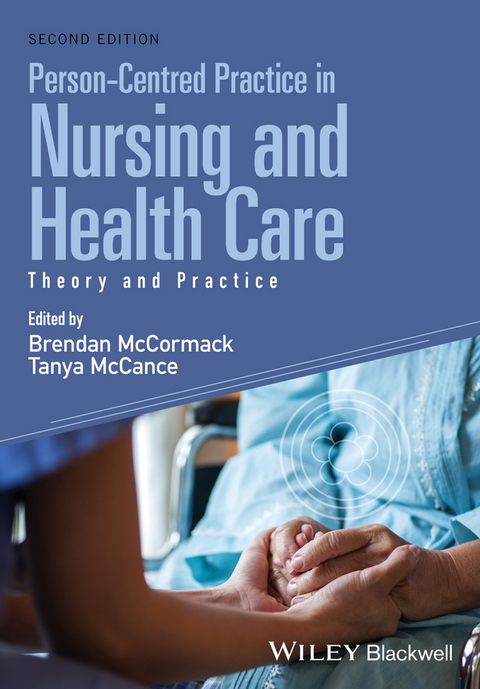
Person-Centred Practice in Nursing and Health Care (eBook)
John Wiley & Sons (Verlag)
9781118990582 (ISBN)
Person-centred Practice in Nursing and Health Care is a comprehensive and practical resource for all nurses and healthcare practitioners who want to develop person-centred ways of working. This second edition which builds on the original text Person Centred Nursing, has been significantly revised and expanded to provide a timely and topical exploration of an important subject which underpins all nursing and healthcare, edited by internationally renowned experts in the field.
Person-centred Practice in Nursing and Health Care looks at the importance of person-centred practice (PCP) from a variety of practice, strategic, and policy angles, exploring how the principles of PCP underpin a variety of perspectives, including within leadership and in the curriculum. The book explores not only a range of methodologies, but also covers a variety of different healthcare settings and contexts, including working within mental health services, acute care, nursing homes, the community, and working with children and people with disabilities.
Key features:
- Significantly updated and expanded since the previous edition, taking into account the considerable changes in recent health care advancements, including the 'Francis' report
- Builds on previous perspectives of person-centredness in nursing and applies them in a broader nursing and health care context
- Includes a stronger exploration on the role of the service-user
- Shows the use of life-story and narrative approaches as a way of putting the individual's identity at the heart of the care relationship
- Includes learning features such as links to current practice developments and reflective questions
Professor Brendan McCormack is Head of the Division of Nursing at the School of Health Sciences, Queen Margaret University, Scotland. He is Editor-in-Chief of The International Journal of Older People Nursing and a member of the editorial board of: The Journal of Applied Gerontology; International Practice Development Journal; Online Journal of Issues in Nursing; Worldviews on Evidence-Based Nursing; Educational Action Research: an international journal; and, the Journal of Compassionate Care.
Tanya McCance is Mona Grey Professor for Nursing Research and Development at the Institute of Nursing Research/School of Nursing, University of Ulster & Co-Director - Nursing R&D, Belfast Health & Social Care Trust, Northern Ireland.
Professor Brendan McCormack is Head of the Division of Nursing at the School of Health Sciences, Queen Margaret University, Scotland. He is Editor-in-Chief of The International Journal of Older People Nursing and a member of the editorial board of: The Journal of Applied Gerontology; International Practice Development Journal; Online Journal of Issues in Nursing; Worldviews on Evidence-Based Nursing; Educational Action Research: an international journal; and, the Journal of Compassionate Care. Tanya McCance is Mona Grey Professor for Nursing Research and Development at the Institute of Nursing Research/School of Nursing, University of Ulster & Co-Director - Nursing R&D, Belfast Health & Social Care Trust, Northern Ireland.
List of Contributors ix
Foreword xiii
Acknowledgements xv
1 Introduction 1
Brendan McCormack & Tanya McCance
Section I: A framework for person-centred practice
2 Underpinning principles of person-centred practice 13
Brendan McCormack & Tanya McCance
3 The Person-centred Practice Framework 36
Tanya McCance & Brendan McCormack
Section II: The building blocks to enable person-centredness
4 Person-centred approaches: a policy perspective 67
Jon Glasby
5 Person-centredness in nursing strategy and policy 77
Annette Solman & Val Wilson
6 Person-centred nursing leadership 86
Shaun Cardiff
7 Person-centred nursing education 99
Deirdre O'Donnell, Neal Cook & Pauline Black
8 Person-centred research 118
Belinda Dewar, Aisling McBride & Cathy Sharp
Section III: Developing person-centred cultures: a practice development approach
9 An overview of practice development 133
Kim Manley
10 Creating flourishing workplaces 150
Jan Dewing & Brendan McCormack
11 Helping health-care practitioners to flourish: critical companionship at work 162
Angie Titchen & Karen Hammond
12 Navigating organisational change: being a person-centred facilitator 172
Famke van Lieshout
Section IV: Adapting the principles of person-centred practice
13 A narrative approach to person-centredness with older people in residential long-term care 183
Catherine Buckley
14 Person-centred health services for children 193
Val Wilson & Annette Solman
15 Meeting the challenges of person-centredness in acute care 205
Christine Boomer & Tanya McCance
16 Person-centredness, recovery and user involvement in mental health services 215
Marit Borg & Bengt Karlsson
17 Weathering the seasons of practice development: moving towards a person-centred culture incomplex continuing care 225
Nadine Janes, Barbara Cowie, Jennifer Haynes, Penney Deratnay, Shannon Burke & Barbara Bell
18 Person-centred community nursing 236
Caroline Dickson
19 Person-centredness in palliative care 248
Antonia Lannie & Lorna Peelo-Kilroe
20 A considered reflection and re-presenting the Person-centred Practice Framework 259
Tanya McCance & Brendan McCormack
Index 265
"The book is a simple and easy read. However, it clearly states the importance of patient-centered practice and is filled with pertinent examples of how readers can use this framework in every nursing/healthcare setting." (Doody Enterprises, 2016)
Chapter 1
Introduction
Brendan McCormack1 & Tanya McCance2
1Queen Margaret University, Edinburgh, UK
2Ulster University, Northern Ireland, UK
Since publishing Person-Centred Nursing: Theory and Practice (McCormack & McCance 2010) the field of person-centredness in health care has grown significantly. In that short 5-year period, we have seen a burgeoning of interest in the topic, the development of a range of initiatives to promote person-centredness, and an increased volume of research exploring, understanding and evaluating person-centred practices. Person-centred care has a long association with nursing, with a focus on treating people as individuals; respecting their rights as a person; building mutual trust and understanding; and developing therapeutic relationships. However, this has now become a more inclusive health-care philosophy and strategic focus. It is for this reason that we have adopted a more broad-based health-care perspective in this book.
The promotion of ‘person-centredness’ is consistent with health-care policy direction internationally. There have been a number of challenges to the focus on person-centredness in nursing and health care and a view that other approaches such as relationship-centred care, compassionate care and even dignified care are more appropriate frameworks for expressing an inclusive family and community approach to what can generally be understood as holistic care practices. However, none of these have stood the test of time as ‘alternatives’ but instead are increasingly seen as components of person-centred nursing and health care, or as constructs that explain different dimensions of person-centredness. This goes some way to affirming the importance of person-centred approaches, not just as care practices in particular professional groups, but as a philosophical underpinning of health-care systems that places people at the centre.
This endorsement of people at the centre of care systems is particularly exemplified by the World Health Organization, which has set out a comprehensive framework of people-centred health services. They describe people-centred health services as
…an approach to care that consciously adopts the perspectives of individuals, families and communities, and sees them as participants as well as beneficiaries of trusted health systems that respond to their needs and preferences in humane and holistic ways. People-centred care requires that people have the education and support they need to make decisions and participate in their own care. It is organized around the health needs and expectations of people rather than diseases.
World Health Organization (2015; p. 10)
This all-encompassing description of people-centredness calls for the delivery of health services that are organised, managed and delivered in a way that ensures people as individuals, communities and populations are at the heart of planning and policy making. It challenges health-care practitioners to think of the person first and then the disease. It requires governments to ensure that people have access to health-care services that reflect their needs, promote health, manage disease, support self-management of long-term conditions and in which people are educated about health in order to maximise well-being. The ‘person’ is at the heart of the WHO policy framework, and whilst it is a demanding ‘ask’ of nations all over the world to consider individual needs, many of which are at different stages of development of their health-care systems, the intention is that of a global movement in person-centredness.
The WHO has a global goal of humanising health care by ensuring that health care is rooted in universal principles of human rights and dignity, non-discrimination, participation and empowerment, access and equity, and a partnership of equals:
The overall vision for people-centred health care is one in which individuals, families and communities are served by and are able to participate in trusted health systems that respond to their needs in humane and holistic ways…
World Health Organization (2007, p. 7)
Many countries are embracing this challenge, and health-care policy and strategy initiatives are focused on reorganising for people-centredness. The Health Foundation (2015a 2015b) has been central to many of these strategic developments and ensuring that, at least at the level of health systems, people are at the centre of care:
We want a more person-centred healthcare system, where people are supported to make informed decisions about and to successfully manage their own health and care, and choose when to invite others to act on their behalf … We want healthcare services to understand and deliver care responsive to people's individual abilities, preferences, lifestyles and goals.
The Health Foundation (2015a)
The Health Foundation has produced a range of resources to enable an increased understanding of person-centred care and to support its development across the whole health-care system (The Health Foundation, 2015b). In the United Kingdom for example, person-centredness has been at the heart of health-care policy and strategy developments, through initiatives in England such as the ‘personalisation agenda’ (Department of Health, 2010), the '1000 Lives+ campaign in Wales (http://www.1000livesplus.wales.nhs.uk/pp-driven-care) and the Person-centred Health and Care Collaborative in Scotland (http://www.qihub.scot.nhs.uk/person-centred/person-centred-health-and-care-collaborative-.aspx). In Northern Ireland, the Service Framework for Older People is based on person-centred values and principles and has person-centred care at the heart of its quality framework.
In other countries such as Norway, Canada, the United States, Australia and Denmark, person-centredness forms the basis of health-care reform that is focused on humanising health-care systems and how care is provided – cf. Impact NSW (2008), Department of Health and Human Services (2012), Norwegian Ministry of Health and Care Services (2009), Alzheimer Society Canada (2014), and Healthcare Transformation and Integrated Care in Denmark (Henrikson 2015). These strategies and frameworks influence the delivery patterns of health care and ways in which practice is developed.
Despite all of these developments the focus continues to be on ‘care’ and less on how organisations create person-centred cultures. There is much still to be done in developing health-care cultures towards ones that truly place people at the centre of their care in order to achieve effective and meaningful outcomes. Richards et al. (2015, p. 3) suggest that it is ‘time to get real about delivering person-centred care’ and argue that it requires a sea change in the mindset of health professionals and patients/clients alike. Part of this need for change is a move away from the discourse of person-centred care to that of person-centred cultures. Over the past 10 years, nursing and health-care practice have been dominated by negative reports of poor, undignified, uncompassionate and at times inhumane care, particularly of older people, people living with learning/intellectual disabilities and other vulnerable adults. In all of the investigations into these breaches of what counts as acceptable care standards, the issue of care culture has been identified as a key issue. Whilst highlighting unacceptable practices, these reports all raised the significance of ‘culture’ and its influence on the experiences of care workers, service users and families. However, whilst culture has been highlighted, the proposed solutions reflect a continued managerialist-led agenda and a philosophy of ‘training’ of staff for change. However, increasing evidence (Davies 2002; Scott et al. 2003; Carlström & Inger 2012; McCance et al. 2013; Laird et al. 2015) demonstrates that bringing about culture change requires significant and deep change of patterns in organisational systems and approaches to change that are founded on humanistically derived principles of adult learning. Person-centredness can only happen if there are cultures in place in care settings that enable staff to experience person-centredness and work in a person-centred way. With a focus on culture, we adopt the following definition of person-centredness; the origins of this definition will be elucidated further in Chapter 3:
…an approach to practice established through the formation and fostering of healthful relationships between all care providers, service users and others significant to them in their lives. It is underpinned by values of respect for persons, individual right to self-determination, mutual respect and understanding. It is enabled by cultures of empowerment that foster continuous approaches to practice development.
This definition is relationship-orientated, but includes all relationships in any health-care situation or context. The focus on healthfulness is consistent with contemporary theories of well-being and wellness as health goals, and reflects the diversity of relationships that people experience. Effective cultures have clearly articulated and shared values and so this definition is also clear about the kinds of values that are important in a person-centred culture. Finally, we argue through this definition that creating a person-centred culture is not a ‘one-off’ event that can be achieved through a short-term project or education/training programme. Instead it requires an ongoing and sustained...
| Erscheint lt. Verlag | 20.7.2016 |
|---|---|
| Sprache | englisch |
| Themenwelt | Medizin / Pharmazie ► Pflege |
| Schlagworte | Acute • Altenpflege • geriatric medicine • Geriatrie • Health • individual care plan • Krankenpflege • <p>Dementia • Medical Science • Medizin • Mental • nursing • Nursing Older People • Older people • person-centred</p> • Therapeutic |
| ISBN-13 | 9781118990582 / 9781118990582 |
| Informationen gemäß Produktsicherheitsverordnung (GPSR) | |
| Haben Sie eine Frage zum Produkt? |
 EPUB (Adobe DRM)
Kopierschutz: Adobe-DRM
Adobe-DRM ist ein Kopierschutz, der das eBook vor Mißbrauch schützen soll. Dabei wird das eBook bereits beim Download auf Ihre persönliche Adobe-ID autorisiert. Lesen können Sie das eBook dann nur auf den Geräten, welche ebenfalls auf Ihre Adobe-ID registriert sind.
Details zum Adobe-DRM
Dateiformat: EPUB (Electronic Publication)
EPUB ist ein offener Standard für eBooks und eignet sich besonders zur Darstellung von Belletristik und Sachbüchern. Der Fließtext wird dynamisch an die Display- und Schriftgröße angepasst. Auch für mobile Lesegeräte ist EPUB daher gut geeignet.
Systemvoraussetzungen:
PC/Mac: Mit einem PC oder Mac können Sie dieses eBook lesen. Sie benötigen eine
eReader: Dieses eBook kann mit (fast) allen eBook-Readern gelesen werden. Mit dem amazon-Kindle ist es aber nicht kompatibel.
Smartphone/Tablet: Egal ob Apple oder Android, dieses eBook können Sie lesen. Sie benötigen eine
Geräteliste und zusätzliche Hinweise
Buying eBooks from abroad
For tax law reasons we can sell eBooks just within Germany and Switzerland. Regrettably we cannot fulfill eBook-orders from other countries.
aus dem Bereich