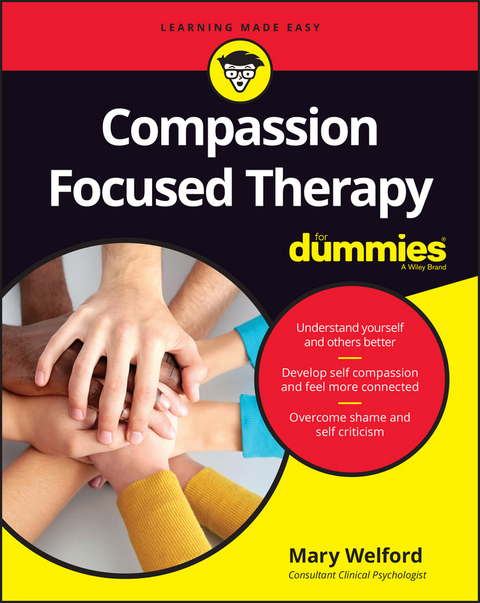
Compassion Focused Therapy For Dummies (eBook)
John Wiley & Sons (Verlag)
978-1-119-07869-2 (ISBN)

It's often said that we're our own worst critics-and it's true, Compassion Focused Therapy For Dummies offers straightforward and practical advice that helps you view yourself through a more sympathetic lens, This motivating text covers the key principles of compassion focused therapy, which guide you in caring for your wellbeing, becoming sensitive to your needs, recognising when you are distressed, and extending warmth and understanding to yourself, This transformative resource provides you with metrics that you can use to monitor your progress, including sensitivity, sympathy, empathy, and overall wellbeing,
Initially developed to assist people experiencing high levels of shame and self-criticism, compassion focused therapy increases your awareness of the automatic reactions that you experience-and motivates you to combat negative reactions with kindness and affection, Used on its own or in combination with other therapeutic approaches, the value of compassion focused therapy is supported by strong neuropsychological evidence,
- Understand how to handle difficult emotions with greater ease-and less stress
- Transform difficult, potentially damaging relationships into positive aspects of your life
- Encourage and motivate yourself to continually meet your goals, rather than criticise yourself for perceived failures
- Stop being so hard on yourself, and appreciate yourself for who you are
Compassion Focused Therapy For Dummies is a wonderful resource if you are seeing-or thinking about seeing-a therapist who utilises compassion techniques, or if you would like to leverage the principles of compassion focused therapy to manage your own wellbeing,
Dr, Mary Welford, Consultant Clinical Psychologist, lives and works in the South West of England, She is a founding member of the Compassionate Mind Foundation, Chair to the charity from 2009-2015 and authored the Compassionate Mind Guide to Building Self Confidence,
Don't be so hard on yourself use compassion focused therapy as your guide It's often said that we're our own worst critics and it's true. Compassion Focused Therapy For Dummies offers straightforward and practical advice that helps you view yourself through a more sympathetic lens. This motivating text covers the key principles of compassion focused therapy, which guide you in caring for your wellbeing, becoming sensitive to your needs, recognising when you are distressed, and extending warmth and understanding to yourself. This transformative resource provides you with metrics that you can use to monitor your progress, including sensitivity, sympathy, empathy, and overall wellbeing. Initially developed to assist people experiencing high levels of shame and self-criticism, compassion focused therapy increases your awareness of the automatic reactions that you experience and motivates you to combat negative reactions with kindness and affection. Used on its own or in combination with other therapeutic approaches, the value of compassion focused therapy is supported by strong neuropsychological evidence. Understand how to handle difficult emotions with greater ease and less stress Transform difficult, potentially damaging relationships into positive aspects of your life Encourage and motivate yourself to continually meet your goals, rather than criticise yourself for perceived failures Stop being so hard on yourself, and appreciate yourself for who you are Compassion Focused Therapy For Dummies is a wonderful resource if you are seeing or thinking about seeing a therapist who utilises compassion techniques, or if you would like to leverage the principles of compassion focused therapy to manage your own wellbeing.
Dr. Mary Welford, Consultant Clinical Psychologist, lives and works in the South West of England. She is a founding member of the Compassionate Mind Foundation, Chair to the charity from 2009-2015 and authored the Compassionate Mind Guide to Building Self Confidence.
Introduction 1
Part 1: Getting Started with Compassion Focused Therapy 5
Chapter 1: Introducing Compassion Focused Therapy 7
Chapter 2: Understanding Compassion 25
Chapter 3: Making Sense of Life's Challenges 39
Part 2: Understanding Ourselves 53
Chapter 4: Introducing the Three Circles 55
Chapter 5: Getting to Know Ourselves: Exploring Our Life Stories 73
Chapter 6: Considering Your Beliefs about Compassion 91
Chapter 7: Facing Barriers to Compassion 107
Part 3: Developing Our Compassionate Mind 119
Chapter 8: Directing Our Attention 121
Chapter 9: Preparing for Compassion 133
Chapter 10: Practising Compassion for Others 151
Chapter 11: Allowing Compassion In 165
Chapter 12: Delving Deeper into Self-Compassion 179
Part 4: Compassionate Practices 191
Chapter 13: Cultivating Compassionate Thoughts 193
Chapter 14: The Power of the Pen: Writing to Strengthen Your Compassionate Mind 213
Chapter 15: Taking Action! 231
Chapter 16: Expressing Yourself 251
Chapter 17: Understanding the Different Aspects of Yourself 265
Chapter 18: Placing Compassion at the Centre of Your Life 277
Part 5: The Part of Tens 285
Chapter 19: Ten Pointers for Seeking a Professional Therapist 287
Chapter 20: Ten Tips You May Want to Share 297
Chapter 21: Ten Ways to Change the World with Compassion 303
Appendix: Additional Resources 309
Index 313
Chapter 1
Introducing Compassion Focused Therapy
IN THIS CHAPTER
Understanding how Compassion Focused Therapy works
Discovering the benefits of compassion
Exploring the effects of shame and self-criticism
Beginning your journey
Reaching out to others with compassion
People are more similar than different. We’re all born into a set of circumstances that we don’t choose, and in possession of a phenomenal yet very tricky brain. We’re all trying to get by, doing the best we can. The sooner we wake up to this reality the better.
Compassion Focused Therapy (CFT) is here to help. This approach aims to liberate you from shame and self-criticism, replacing these feelings with more helpful ways of relating to yourself. It helps you to choose the type of person you want to be and to develop ways to make this choice a reality.
In this chapter, I introduce you to CFT, offering you an understanding of how it works and helping you to understand the benefits. I also point out the steps you may take along the way as you work with the information in this book. Finally, I take a moment to help you connect to the wider community around you as you begin this journey.
CFT advocates that you don’t rush to ‘learn’ about the approach but instead allow space to experience and ‘feel’ it. So take your time with this book as you apply it to your life, and really discover the benefits.
Getting to Grips with Compassion Focused Therapy
CFT was founded by UK clinical psychologist Paul Gilbert, OBE. The name of the approach was chosen to represent three important aspects:
- Compassion, in its simplest yet potentially most powerful definition, involves a sensitivity to our own, and other people’s, distress, plus a motivation to prevent or alleviate this distress. As such, it has two vital components. One involves engaging with suffering while the other involves doing something about it. Chapter 2 delves into the ins and outs of compassion in more detail.
- Focused means that we actively develop and apply compassion to ourselves. It also involves accepting and experiencing compassion from and for others.
- Therapy is a term to describe the processes and techniques used to address an issue or difficulty.
CFT looks to social, developmental and evolutionary psychology and neuroscience to help us understand how our minds develop and work, and the problems we encounter. This scientific understanding (of ourselves and others) calls into question our experiences of shame and self-criticism and helps us to develop the motivation to make helpful changes in our lives.
CFT utilises a range of Eastern and Western methods to enhance our wellbeing. Attention training, mindfulness and imagery combine with techniques used in Cognitive Behavioural Therapy (CBT), and Person Centred, Gestalt and Narrative therapies (to name but a few), resulting in a powerful mix of strategies that can help you become the version of yourself you wish to be.
CFT is often referred to as part of a ‘third-wave’ of cognitive behavioural therapy because it incorporates a number of CBT techniques. However, CFT derives from an evolutionary model (which you find out more about in Chapters 3, 4 and 5) and it uses techniques from many other therapies that have been found to be of benefit. As such, CFT builds upon and integrates with other therapies. As therapies become more rooted in science, we may see increasing overlap rather than diversification.
Compassion can involve kindness and warmth, but it also takes strength and courage to engage with suffering and to do something about it. CFT is by no means the easy or ‘fluffy’ option. Head to Chapter 6 to address some of the myths associated with compassion.
You may be reading this book because you want to find out more about this form of therapy. Alternatively, you may want to develop your compassionate mind and compassionate self out of care for your own wellbeing. The why or your motivation for reading this book has a big effect on the experience and, potentially, the outcome. Personally, I hope that whatever your motivation, you consider applying the approach to yourself in order that you can learn it ‘from the inside out’.
Defining common terms
You may find that some of the terms used in CFT are new to you. Here are a few common terms that I use throughout this book, along with an explanation of what they mean:
- Common humanity: This refers to the fact that, as human beings, we all face difficulties and struggles. We’re more alike than different, and this realisation brings with it a sense of belonging to the human family.
- Tricky brain: Our highly complex brains can cause us problems. For example, our capacity to think about the future and the past makes us prone to worry and rumination, while our inbuilt tendency to work out our place in a hierarchy can have a huge impact on our mood and self-esteem. In CFT, we use the term tricky brain to recognise our brain’s complexity and the problems this complexity can lead to. We consider our tricky brain in more detail in Chapter 3.
- Compassionate mind: This is simply an aspect of our mind. It comes with a set of attributes and skills that are useful for us to cultivate (I introduce these attributes and skills in Chapter 2). This frame of mind is highly important for our wellbeing, relationships and communities. But just as we have a compassionate mind, we also have a competitive and threat-focused mind – which is highly useful, if not a necessity, at certain times (Chapter 4 takes a look at our threat-focused mind).
- Compassionate mind training: This describes specific activities designed to develop compassionate attributes and skills, particularly those that influence and help us to regulate emotions. Attention training and mindfulness are used as a means to prepare us for this work, and we look at these practices in Part 3.
- Compassionate self: This is the embodiment of your compassionate mind. It’s a whole mind and body experience. Your compassionate self incorporates your compassionate mind but also moves and interacts with the world.
-
Compassionate self cultivation: Your compassionate self is an identity that you can embody, cultivate and enhance. Compassionate self cultivation describes the range of activities that help you develop your compassionate self. Head to Chapter 10 for more on the cultivation of your compassionate self.
Engagement in the compassionate mind training and compassionate self cultivation activities provided in this book is often referred to as ‘physiotherapy for the brain’, as their use has been found to literally change the brain!
Compassionate mind training and compassionate self cultivation are integral to CFT, but there’s so much more to CFT. For many, getting to a point at which you can see the relevance and benefits of compassionate mind training and compassionate self cultivation, and overcome blocks and barriers to compassion, is the most significant aspect of your compassionate journey.
- Exercises: These are activities for you to try. Sometimes they help to illustrate a point or provide a useful insight. Other exercises can give you an idea of what helps you to develop and maintain your compassionate mind.
- Practice: Once you’re aware of which exercises are helpful to you, you can then incorporate these into your everyday life. Regular use of these exercises becomes your practice.
Observing the origins of CFT
CFT is closely tied to advances in our understanding of the mind and, because scientific advances never stop, the therapy continues to adapt and change based upon it. Much of this book focuses on sharing the science to help develop a compassionate understanding of yourself and a sense of connection with fellow travellers on this mortal coil.
CFT is also born out of a number of clinical observations:
- People demonstrating high levels of shame and self-criticism often struggle with standard psychological therapies. For example, using CBT, many find that they’re not reassured by the generation or discovery of alternative beliefs and views and that this doesn’t result in changes to the way they feel. Individuals may say ‘Logically, I know I’m not bad/not to blame, but I still feel it’ and ‘I know it’s unlikely that things will go wrong, but I still feel terrible’.
-
What we say to ourselves is important, but how we say it is even more important. Ever called yourself ‘idiot’ in a light-hearted and jovial manner? You probably did so without feeling any negative effects. But, have you ever called yourself an idiot in a harsh and judgemental manner? You probably felt much worse on that occasion, perhaps resulting in an urge to withdraw or isolate yourself.
Consider phrases such as, ‘look on the bright side’ or ‘count your blessings’. Sometimes these phrases can be said in a life-affirming way, but using a condescending, frustrated or angry tone represents a whole different ball game. This helps illustrate that your emotional tone is important.
- Therapy can result in improvement in mood, self-esteem, sense of control and...
| Erscheint lt. Verlag | 2.6.2016 |
|---|---|
| Sprache | englisch |
| Themenwelt | Sachbuch/Ratgeber ► Gesundheit / Leben / Psychologie ► Esoterik / Spiritualität |
| Sachbuch/Ratgeber ► Gesundheit / Leben / Psychologie ► Psychologie | |
| Geisteswissenschaften ► Psychologie | |
| Medizin / Pharmazie ► Gesundheitsfachberufe | |
| Medizin / Pharmazie ► Medizinische Fachgebiete ► Psychiatrie / Psychotherapie | |
| Schlagworte | compassionate therapy • Compassion Focused Therapy • Compassion Focused Therapy For Dummies • compassion focused therapy for self-criticism • compassion focused therapy for shame • empathetic therapy • Ergotherapie • Ergotherapie u. psychische Verfassung • Gesundheits- u. Sozialwesen • Health & Social Care • how to conduct compassion focused therapy • Mary Welford • Occupational Therapy and Mental Health • positivity in therapy • Psychologie • Psychology • Psychotherapie • Psychotherapie u. Beratung • Psychotherapy & Counseling • sympathetic therapy • therapy for self-criticism • therapy for shame • using compassion focused therapy • what is compassion focused therapy |
| ISBN-10 | 1-119-07869-5 / 1119078695 |
| ISBN-13 | 978-1-119-07869-2 / 9781119078692 |
| Informationen gemäß Produktsicherheitsverordnung (GPSR) | |
| Haben Sie eine Frage zum Produkt? |
 EPUB (Adobe DRM)
Kopierschutz: Adobe-DRM
Adobe-DRM ist ein Kopierschutz, der das eBook vor Mißbrauch schützen soll. Dabei wird das eBook bereits beim Download auf Ihre persönliche Adobe-ID autorisiert. Lesen können Sie das eBook dann nur auf den Geräten, welche ebenfalls auf Ihre Adobe-ID registriert sind.
Details zum Adobe-DRM
Dateiformat: EPUB (Electronic Publication)
EPUB ist ein offener Standard für eBooks und eignet sich besonders zur Darstellung von Belletristik und Sachbüchern. Der Fließtext wird dynamisch an die Display- und Schriftgröße angepasst. Auch für mobile Lesegeräte ist EPUB daher gut geeignet.
Systemvoraussetzungen:
PC/Mac: Mit einem PC oder Mac können Sie dieses eBook lesen. Sie benötigen eine
eReader: Dieses eBook kann mit (fast) allen eBook-Readern gelesen werden. Mit dem amazon-Kindle ist es aber nicht kompatibel.
Smartphone/Tablet: Egal ob Apple oder Android, dieses eBook können Sie lesen. Sie benötigen eine
Geräteliste und zusätzliche Hinweise
Buying eBooks from abroad
For tax law reasons we can sell eBooks just within Germany and Switzerland. Regrettably we cannot fulfill eBook-orders from other countries.
aus dem Bereich