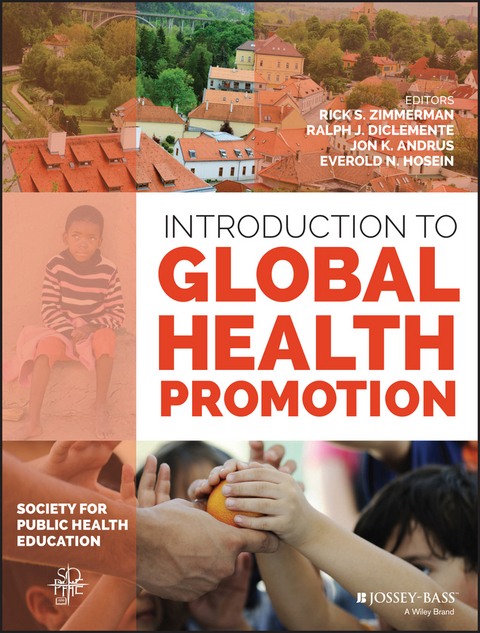
Introduction to Global Health Promotion (eBook)
John Wiley & Sons (Verlag)
978-1-118-89783-6 (ISBN)
The world's biggest health care challenges-including HIV, malaria, heart disease, smoking, and violence, among others-are explored in detail in Introduction to Global Health Promotion. The state of the science, including the latest empirical data, is distilled into 19 chapters that update readers on the complex issues surrounding a variety of illnesses and conditions, and disease epidemics and individual, social, institutional, and governmental barriers to preventing them. Expert authors bring to the fore human rights issues, new uses of technology, and practical application of theory. These perspectives, along with the book's multidisciplinary approach, serve to create a well-rounded understanding of global health today.
Learn more from the Editors of Introduction to Global Health Promotion here.
EDITORS
RICK S. ZIMMERMAN, PHD, is a Professor and Associate Dean for Research in the College of Nursing at the University of Missouri-St. Louis.
RALPH J. DICLEMENTE, PHD, is Charles Howard Candler Professor of Public Health and Associate Director, Emory Center for AIDS Research.
JON K. ANDRUS, MD, is Executive Vice President of the Sabin Vaccine Institute and Director of the Vaccine Advocacy and Education (VAE) program.
EVEROLD N. HOSEIN, PHD, is a Senior Communication Advisor-Consultant for the World Health Organization and Communication Consultant for the United Nations Children's Fund.
SOCIETY FOR PUBLIC HEALTH EDUCATION (SOPHE) is the leading international professional association for health education professionals, faculty, and students. Founded in 1950, SOPHE is the only independent, professional organization devoted exclusively to health education and health promotion in all settings.
Introduction to Global Health Promotion addresses a breadth and depth of public health topics that students and emerging professionals in the field must understand as the world's burden of disease changes with non-communicable diseases on the rise in low- and middle-income countries as their middle class populations grow. Now more than ever, we need to provide health advocacy and intervention to prevent, predict, and address emerging global health issues. This new text from the Society for Public Health Education (SOPHE) prepares readers with thorough and thoughtful chapters on global health promotion theories, best practices, and perspectives on the future of the field, from the individual to the global level. The world's biggest health care challenges including HIV, malaria, heart disease, smoking, and violence, among others are explored in detail in Introduction to Global Health Promotion. The state of the science, including the latest empirical data, is distilled into 19 chapters that update readers on the complex issues surrounding a variety of illnesses and conditions, and disease epidemics and individual, social, institutional, and governmental barriers to preventing them. Expert authors bring to the fore human rights issues, new uses of technology, and practical application of theory. These perspectives, along with the book's multidisciplinary approach, serve to create a well-rounded understanding of global health today. Learn more from the Editors of Introduction to Global Health Promotion here.
EDITORS RICK S. ZIMMERMAN, PHD, is a Professor and Associate Dean for Research in the College of Nursing at the University of Missouri--St. Louis. RALPH J. DICLEMENTE, PHD, is Charles Howard Candler Professor of Public Health and Associate Director, Emory Center for AIDS Research. JON K. ANDRUS, MD, is Executive Vice President of the Sabin Vaccine Institute and Director of the Vaccine Advocacy and Education (VAE) program. EVEROLD N. HOSEIN, PHD, is a Senior Communication Advisor-Consultant for the World Health Organization and Communication Consultant for the United Nations Children's Fund. SOCIETY FOR PUBLIC HEALTH EDUCATION (SOPHE) is the leading international professional association for health education professionals, faculty, and students. Founded in 1950, SOPHE is the only independent, professional organization devoted exclusively to health education and health promotion in all settings.
Preface xiii
Acknowledgments xix
The Editors xxi
SOPHE xxv
The Contributors xxvii
Chapter 1 The State of Global Health 1
Richard Skolnik
Chapter 2 Global Health Promotion: The State of the Science 31
David V. McQueen
Chapter 3 Global Health Promotion and the Social Determinants of Health 49
Kumanan Rasanathan and Alyssa Sharkey
Chapter 4 Models of Health Behavior Change: International Applications 65
Rick S. Zimmerman, Zhiwen Xiao, Purnima Mehrotra, and Charles Roy
Chapter 5 Two Health Communication Approaches: Communication for Behavioral Impact (COMBI) and Entertainment Education 99
Everold N. Hosein, May G. Kennedy, and Sandra de Castro Buffington
Chapter 6 Global Health Promotion in the Context of Human Rights 129
Elvira Beracochea and Lubna Ahmed
Chapter 7 eHealth and Global Health Promotion 145
Sheana S. Bull, Gretchen Domek, and Deborah Thomas
Chapter 8 Reducing Maternal and Infant Mortality: Meeting a Global Challenge 173
Padmini Murthy
Chapter 9 Malaria Prevention and Control 191
Fouzia Farooq and Elke S. Bergmann-Leitner
Chapter 10 Global Immunization Initiatives from a Health Promotion Perspective 209
Marilyn E. Rice, Jon K. Andrus, Virginia Swezy, and Rick S. Zimmerman
Chapter 11 The Evolving Global HIV Pandemic: Epidemiology, Prevention, and Future Priorities 239
Ralph J. DiClemente, Puja Seth, and Purnima Mehrotra
Chapter 12 Community-Based Risk Communication in Epidemics and Emerging Disease Settings 271
Renata Schiavo, Karen M. Hilyard, and Ewart C. Skinner
Chapter 13 Noncommunicable Diseases (NCDs): Moving Toward Health Promotion 303
C. James Hospedales, Andr´e Pascal Kengne, Branka Legetic, and Adriana Blanco Marquizo
Chapter 14 Women's Cancers 339
Silvana Luciani and Irene Agurto
Chapter 15 Health Promotion in Families and Communities: An Integrated Approach from Latin America and the Caribbean 363
Fernando Zacarias, Adrian Diaz, Manuel Pena, Adela Paez Jimenez, Leticia Martinez, and Gina Tambini
Chapter 16 Oral Health Promotion 383
Margaret Scarlett and Gary L. Kreps
Chapter 17 Adaptation and Implementation of Public Health Innovations in Developing Countries 425
Bonita Stanton, Xiaoming Li, and Linda Kaljee
Chapter 18 Health Promotion in the Global Setting: The Role of International Organizations and Governments 445
John (Jack) Bryant and F. Curtiss Swezy
Chapter 19 The Future of Global Health Promotion 467
Rick S. Zimmerman, Jon K. Andrus, and C. James Hospedales
Author Index 491
Subject Index 499
"Bravo! At last, a solid reference on the latest, state-of-the art thinking and approaches of health promotion in the ever-changing context of practice. . . . In my opinion, this publication should be on the standard reading list for all health promotion departments in schools of public health. The content explores various dimensions of health promotion work in global settings that helps showcase good practice and lessons learned. I especially appreciated the book's practicality and easily accessible language. As such, this publication serves as a valuable, a 'must have' resource for health promotion practitioners working in both developing and industrialized countries."
--Erma Manoncourt, Ph.D. Vice-President of Communications for the International Union of Health Promotion and Education
"This book provides a clear pathway to learn and explore the nuanced details of global health promotion concepts, theories, and implementation strategies used in contemporary health and development projects across the globe. [It] espouses not only some of the most important content areas for global health students and professionals, but such content is infused and enriched by key perspectives and case studies from the field that demonstrate real applications of global health surveillance and program implementation in practice. . . . This book gives a much needed update of global health texts that both contextualizes new complexities and challenges in health promotion work and illustrates critical application of techniques in health promotion delivery. Additional iterations of this text may include more specific data on the successes and failures at the level of health promotion professionals across the globe."
--Muhiuddin Haider, Ph.D., research associate professor, University of Maryland School of Public Health's Institute for Applied Environmental Health
"The state of global health has changed dramatically over the past two decades. Developing a competent health promotion workfoce is key for building the future and is critical to delivering the vision, values, and commitment of global health promotion (Barry, Allegrante, Lamarre, Auld & Taub, 2009). The book Introduction to Global Health Promotion shares the best evidence on the approaches that have been successful in promoting health and reducing mobidity and mortality in a variety of areas. (...) Global health promotion is more relevant today than ever in addressing public health problems especially with the growth of noncummunicable and chronic diseases globally. These factors have caused an increased interest in health within universities and a call for students to study health from the global perspective."
--Health Promotion Practice, Jennifer Torres, Los Angeles County Department of Public Health, Los Angeles, and Teachers College, Columbia University, New York.
Preface
When my coeditors and I decided to respond to SOPHE's (Society for Public Health Education) request for prospectuses for a book on global health promotion, we were excited to have the opportunity to create the kind of book that we really hadn't seen: one that is focused on the relatively new domain of health promotion and disease prevention globally. With so much of the history of epidemiology presenting largely communicable diseases and mortality related to childbirth and the first few years of life, it has been only in the past 60 or so years that health promotion and disease prevention have become central to public health: first in what used to be called developed nations (and what we now refer to as high-income countries); and, second, in the past 15 or so years, during which life expectancies have increased sufficiently in low- and middle-income countries that the focus of public health in these countries has begun to include health promotion and disease prevention. So it was with great enthusiasm that we submitted a prospectus, and with which we reacted when our prospectus was chosen by SOPHE to become this book.
Organization of the Book
We put the book together wanting to share the best evidence with our readers about the approaches that have been successful in promoting health and reducing morbidity and mortality in a variety of areas. We also decided that health promotion strategies and approaches should be viewed through the lenses of theories and models of behavior change, human rights, and the exploding use of technology. As a result of these decisions, we organized the book as follows:
- introductory chapters,
- foundational chapters,
- strategies and best practices in global health promotion in topical areas,
- concluding chapters.
Three introductory chapters set the stage for the rest of the book. In “The State of Global Health,” Richard Skolnik, the author of a major global health text, presents data about trends in causes of morbidity and mortality around the world. In “Global Health Promotion: The State of the Science,” David McQueen, an internationally renowned global health promotion (GHP) scholar, talks about a fairly new and increasingly evidence-based approach to global health promotion strategies. Then, in “Global Health Promotion and the Social Determinants of Health,” Kumanan Rasanathan and Alyssa Sharkey, both of whom work with UNICEF on children's health in under-resourced parts of the world, present the critical role of social and social structural variables as determinants of global health and health promotion. These introductory chapters present important ideas that are referred to throughout the book: (a) prevalence and incidence of various causes of morbidity (illness and risk factors for illness and various conditions) and mortality (death) patterns over time and across regions of the world, which should drive approaches to health promotion around the world; (b) the current status of the development and use of science- and evidence-based approaches to health promotion around the world; and (c) key underlying causes of health and illness related to social structure, processes, and resources—known as “social determinants.”
The next section of the book (Chapters 4 through 7) includes foundational chapters on theory and models, human rights, and the use of technology as they relate to global health promotion. Indeed, these three lenses are used to present examples of best practices in disease and mortality reduction and prevention in the major portion of the book. Rick Zimmerman, one of the co-editors of the book and an expert in HIV prevention and behavior change theory development, and his colleagues Zhiwen Xiao, Purnima Mehrotra, and Charles Roy present “Models of Health Behavior Change: International Applications,” in which key health behavior change models are described and international applications of these models are discussed, as Chapter 4. Everold Hosein (co-editor of the book), and his colleagues (senior health communication scholars May Kennedy and Sandra de Castro Buffington) describe two additional communication approaches related to behavior change, in Chapter 5, “Two Health Communication Approaches: Communication for Behavioral Impact (COMBI) and Entertainment Education.” Elvira Beracochea, an internationally known advocate for health and for implementation of health systems that see health as a right, and her co-author, Lubna Ahmed, present some definitions of ethical concepts, articulate the overlap between health promotion and human rights, and describe case examples to show how sometimes health is but sometimes how it is not delivered as a right in Chapter 6, “Global Health Promotion in the Context of Human Rights.” Sheana Bull, one of the international experts in the use of technology and social media in the delivery of health promotion interventions, and co-authors Gretchen Domek and Deborah Thomas, discuss ways that technology can be used most effectively in “eHealth and Global Health Promotion,” Chapter 7.
The next nine chapters (Chapters 8–16) present what is currently known about best practices in global health promotion and disease prevention in nine different domains:
- Chapter 8, “Reducing Maternal and Infant Mortality: Meeting a Global Challenge” by Padmini Murthy, an obstetrician/gynecologist who is an expert on global health;
- Chapter 9, “Malaria Prevention and Control,” by Fouzia Farooq and Elke Bergmann-Leitner, scientists in the US Military Malaria Research Program;
- Chapter 10, “Global Immunization Initiatives From a Health Promotion Perspective,” by Marilyn Rice, a seasoned international health worker, with extensive experience in Latin America, and her colleagues Jon K. Andrus, Virginia Swezy, and Rick S. Zimmerman;
- Chapter 11, “The Evolving Global HIV Pandemic: Epidemiology, Prevention, and Future Priorities,” by Ralph DiClemente, one of the co-editors of the book and an internationally renowned expert in HIV prevention, and his colleagues Puja Seth and Purnima Mehrotra;
- Chapter 12, “Community-Based Risk Communication in Epidemics and Emerging Disease Settings,” by Renata Schiavo, well-known researcher and advocate in health equity and health communication, and her colleagues Karen Hilyard and Ewart Skinner;
- Chapter 13, “Noncommunicable Diseases (NCDs): Moving Toward Health Promotion,” by C. James Hospedales (emphasis on Latin America) and André Pascal Kengne (emphasis on Africa), both international experts in NCDs, and their colleagues Adriana Blanco Marquizo and Branka Legetic;
- Chapter 14, “Women's Cancers,” by Silvana Luciani and Irene Arguto, both of whom have spent years working for PAHO (Pan-American Health Organization, a regional arm of the World Health Organization) in the area of cancer;
- Chapter 15, “Health Promotion in Families and Communities: An Integrated Approach From Latin America and the Caribbean,” by Fernando Zacarias and Gina Tambini, both experts in family and community health with experience at PAHO, and their colleagues Adrian Diaz, Manuel Pena, Adela Paez Jimenez, and Leticia Martinez; and
- Chapter 16, “Oral Health Promotion,” by Margaret Scarlett, an internationally known leader in global oral health, and Gary Kreps, an internationally known global health communication researcher.
Each chapter in this core section of the text includes text boxes that highlight theories and models, human rights, and the use of technology relevant to their topic. We believe this is an important feature of this book: linking of applications across diseases/conditions/prevention domains to models and theories (the two are often presented separately, not showing the way theories are used), human rights (we believe this lens is used too rarely in considering global health promotion efforts), and technology (in ways that might suggest to readers how to use technology within their content areas of greatest interest).
The final three chapters cover issues we thought should be considered as broader concerns in moving forward with global health promotion. In Chapter 17, “Adaptation and Implementation of Public Health Innovations in Developing Countries,” Bonita Stanton, Xiaoming Li, and Linda Kaljee, all senior researchers who have adapted and implemented Western-developed interventions in various international settings, discuss that process. In Chapter 18, “Health Promotion in the Global Setting: The Role of International Organizations and Governments,” Jack Bryant, a pioneer in global health promotion, and Curtiss Swezy, a longtime global health program administrator, describe the history of the role of international organizations and governments in global health promotion. In the final chapter, “The Future of Global Health Promotion,” Rick Zimmerman, Jon Andrus (a co-editor of the book and a long-time public health expert with more than 30 years of experience of working in the field of vaccines, immunization, and primary care in developing countries, including as deputy director of PAHO), and C. James Hospedales (long-time expert on health promotion in Latin America and the Caribbean) first look at progress in disease...
| Erscheint lt. Verlag | 3.5.2016 |
|---|---|
| Reihe/Serie | Jossey-Bass Public Health |
| Jossey-Bass Public Health/Health Services Text | Jossey-Bass Public Health/Health Services Text |
| Sprache | englisch |
| Themenwelt | Medizin / Pharmazie ► Allgemeines / Lexika |
| Medizin / Pharmazie ► Gesundheitswesen | |
| Studium ► Querschnittsbereiche ► Prävention / Gesundheitsförderung | |
| Schlagworte | Best Practices • cancer prevention • Disease epidemics • Disease Transmission • Empirical data • Everold N. Hosein • Gesundheits- u. Sozialwesen • Global health issues • global health models • Global nutrition • health advocacy • Health & Social Care • health care challenges • Heart disease • history of global health • HIV • Human Rights • immunization • International Public Health • Intervention • Introduction to Global Health Promotion • Jon Kim Andrus • Malaria • multidisciplinary • Population • practical application of theory • Public Health • Public Health / Ausbildung u. Verhaltensweisen • Public Health Behavior & Education • Public Health / International • Ralph J. DiClemente • Rick S. Zimmerman • Smoking • Society for Public Health Education (SOPHE) • STIs • Technology • Theories • Violence |
| ISBN-10 | 1-118-89783-8 / 1118897838 |
| ISBN-13 | 978-1-118-89783-6 / 9781118897836 |
| Informationen gemäß Produktsicherheitsverordnung (GPSR) | |
| Haben Sie eine Frage zum Produkt? |
 EPUB (Adobe DRM)
Kopierschutz: Adobe-DRM
Adobe-DRM ist ein Kopierschutz, der das eBook vor Mißbrauch schützen soll. Dabei wird das eBook bereits beim Download auf Ihre persönliche Adobe-ID autorisiert. Lesen können Sie das eBook dann nur auf den Geräten, welche ebenfalls auf Ihre Adobe-ID registriert sind.
Details zum Adobe-DRM
Dateiformat: EPUB (Electronic Publication)
EPUB ist ein offener Standard für eBooks und eignet sich besonders zur Darstellung von Belletristik und Sachbüchern. Der Fließtext wird dynamisch an die Display- und Schriftgröße angepasst. Auch für mobile Lesegeräte ist EPUB daher gut geeignet.
Systemvoraussetzungen:
PC/Mac: Mit einem PC oder Mac können Sie dieses eBook lesen. Sie benötigen eine
eReader: Dieses eBook kann mit (fast) allen eBook-Readern gelesen werden. Mit dem amazon-Kindle ist es aber nicht kompatibel.
Smartphone/Tablet: Egal ob Apple oder Android, dieses eBook können Sie lesen. Sie benötigen eine
Geräteliste und zusätzliche Hinweise
Buying eBooks from abroad
For tax law reasons we can sell eBooks just within Germany and Switzerland. Regrettably we cannot fulfill eBook-orders from other countries.
aus dem Bereich