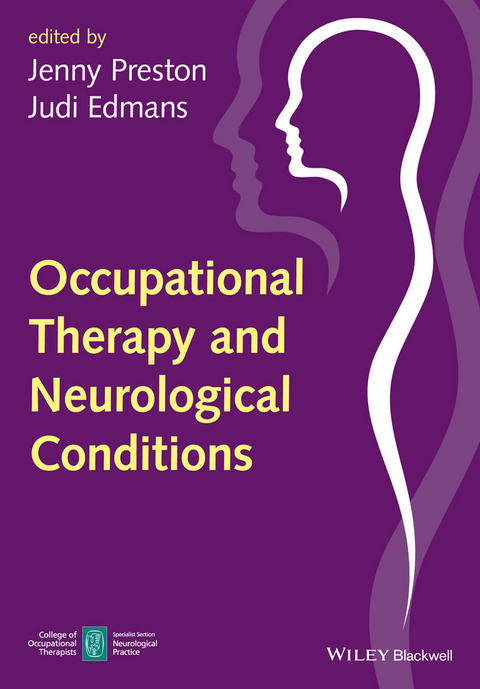
Occupational Therapy and Neurological Conditions (eBook)
John Wiley & Sons (Verlag)
978-1-118-93613-9 (ISBN)
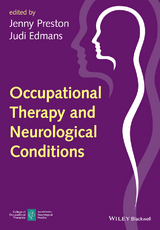
While diagnosis with a neurological condition may not be life-threatening, it can have significant impact on everyday life and on participation in activities. Occupational therapists must be able to fully consider the physical, cognitive, emotional, psychological and behavioural problems which may occur as a consequence of a neurological disorder, and understand the impact of diagnosis from a person-centred perspective. Occupational Therapy and Neurological Conditions incorporates theoretical, clinical and research evidence to support occupational therapists in the management of people with neurological conditions.
- Covers the key symptoms of neurological conditions and the biological basis of these within the ICF framework
- Provides an overview of therapy and management for all neurological conditions
- Includes key occupational therapy theory
- Case studies root concepts in real-life practice
- End-of-chapter self-evaluation questions help test understanding
Occupational Therapy and Neurological Conditions is the ideal resource to support students, newly-qualified practitioners, and occupational therapists looking for an overview or introduction to this key area of practice.
Jenny Preston, PhD, BSc (Hons), DipCOT is a Consultant Occupational Therapist within NHS Ayrshire & Arran, and Glasgow Caledonian University. She has over 30 years clinical experience working with people with a range of neurological conditions, and is currently Chair of the College of Occupational Therapists Specialist Section Neurological Practice.
Judi Edmans, PhD, MPhil, DipCOT, FCOT is a Senior Research Fellow in the Division of Rehabilitation and Ageing at the University of Nottingham. She has been qualified for over 35 years, has worked mainly in stroke both in clinical practice and research and is the editor of the book Occupational Therapy and Stroke.
Jenny Preston, PhD, BSc (Hons), DipCOT is a Consultant Occupational Therapist within NHS Ayrshire & Arran, and Glasgow Caledonian University. She has over 30 years clinical experience working with people with a range of neurological conditions, and is currently Chair of the College of Occupational Therapists Specialist Section Neurological Practice. Judi Edmans, PhD, MPhil, DipCOT, FCOT is a Senior Research Fellow in the Division of Rehabilitation and Ageing at the University of Nottingham. She has been qualified for over 35 years, has worked mainly in stroke both in clinical practice and research and is the editor of the book Occupational Therapy and Stroke.
CHAPTER 1
Introduction
1.1 Economic impact of long-term neurological conditions
It is estimated that 10 million people in the United Kingdom live with some form of neurological condition that impacts on their everyday lives (Department of Health [DoH], 2005). Neurological conditions account for one in five emergency hospital admissions, one in eight general practice consultations and a high proportion of severe and progressive disability in the population (Association of British Neurologists, 2003). As many as 350 000 people in the United Kingdom need help with activities of daily living because of a neurological condition and 850 000 people care for someone with a neurological condition (DoH, 2005). Due to their devastating impact and their generally progressive nature, neurological conditions are considered as long-term affecting individuals throughout their life span.
Occupational therapy is defined as ‘a client-centred health profession concerned with promoting health and well-being through occupation enabling people to participate in everyday life’ (World Federation of Occupational Therapists, 2011). Occupational therapy practice focuses on enabling individuals to modify and adapt elements of their roles, occupations or environments to support occupational participation in response to changes within their lives. Occupational therapists have a key role to play in supporting people living with a long-term neurological condition to manage a life of unpredictability and uncertainty. This requires a complex combination of knowledge and skills to address the physical, psychological, cognitive and emotional needs of people together with a broad range of assessments and interventions.
1.2 Definition of long-term neurological conditions
The DoH (2005) describes ‘long-term neurological conditions’ as
a range of conditions affecting the brain or spinal cord which occur through a variety of mechanisms which include the following:
- Sudden onset conditions (e.g. acquired brain injury of any cause, stroke and spinal cord injury)
- Intermittent conditions (e.g. epilepsy)
- Progressive conditions (e.g. multiple sclerosis (MS), motor neurone disease (MND), Parkinson’s and other degenerative disorders)
- Stable conditions with/without age-related degeneration (e.g. polio or cerebral palsy).
This book specifically focuses on the following progressive neurological conditions:
- Huntington’s disease (HD)
- Motor neurone disease (MND)
- Multiple sclerosis (MS)
- Parkinson’s.
Whilst there is an abundance of literature relating to each of these medical conditions the primary aim of this book is to place this knowledge and understanding within the context of occupational therapy practice. In order to fully understand the holistic needs of their clients occupational therapists are required to develop knowledge of the underlying pathology of each of these neurological conditions. However this understanding from a medical perspective should not be assumed to represent a medical model of care with an emphasis on symptomatic management. Throughout this book the focus is on delivering person-centred models of practice which support the complexity of the needs of people with neurological conditions from an occupational perspective.
1.3 International Classification of Functioning, Disability and Health
The International Classification of Functioning, Disability and Health (ICF) offers a conceptual basis for the definition and measurement of health and disability (World Health Organisation [WHO], 2002). Developed within a biopsychosocial model, ICF views disability and functioning as outcomes of interactions between health conditions (diseases, disorders and injuries) and contextual factors, as shown in Figure 1.1. Amongst contextual factors are external environmental factors (e.g., social attitudes, architectural characteristics, legal and social structures) and internal factors which include gender, age, coping styles, social background, past and current experience, character and other factors that influence how disability is experienced by the individual (WHO, 2002).
Figure 1.1 Model of disability that is the basis for ICF.
(Source: WHO, 2002, p. 9. Reproduced with permission of World Health Organisation.)
Within this framework ICF defines three levels of human functioning: functioning at the level of body or body part (impairment), the whole person (activity limitations) and the whole person in a social context (participation restrictions). The formal definitions of these components of ICF are provided in Box 1.1 (WHO, 2002).
Box 1.1 Formal definitions of the components of ICF.
Body functions are physiological functions of body systems (including psychological functions).
Body structures are anatomical parts of the body such as organs, limbs and their components.
Impairments are problems in body function or structure such as significant deviation or loss.
Activity is the execution of a task or action by an individual.
Participation is involvement in a life situation.
Activity limitations are difficulties an individual may experience in involvement in life situations.
Participation restrictions are problems an individual may experience in involvement in life situations.
Environmental factors make up the physical, social and attitudinal environment in which people live and conduct their lives.
Source: WHO (2002, p. 10). Reproduced with permission of World Health Organisation.
The remainder of this chapter presents each of the four neurological conditions in relation to body functions, body structures and impairments, highlighting the differences and similarities of each condition. Subsequent chapters explore the wider implications for activity and participation.
1.4 Huntington’s disease
HD is a rare disease, affecting an estimated 7–10 people per 100 000 or somewhere in the region of between 4200 and 6000 people in the United Kingdom (Quarrell, 2008). The onset of the disease is insidious and the age of onset depends on a number of different factors. Most people develop the condition between the ages of 30 and 50 years, but the disease can appear in all age groups (Nance et al., 2013). The HD gene is dominant, which means that each child of a parent with HD has a 50% chance of inheriting the disease and is said to be ‘at-risk’. Males and females have the same risk of inheriting the disease. HD occurs in all races (Nance et al., 2013).
There is currently no cure or treatment which can halt, slow or reverse the progression of the disease (Nance et al., 2013) and people with HD tend to die, on average, between 15 and 16 years after the onset of symptoms (Quarrell, 2008). People don’t die from HD itself, but they die from complications such as choking, heart failure, and infection or aspiration pneumonia (Nance et al., 2013).
1.4.1 Body functions
HD is a hereditary neurodegenerative genetic disorder caused by an expansion of a repeating CAG triplet series in the huntingtin gene on chromosome 4, which results in a protein with an abnormally long polyglutamine sequence (Nance et al., 2013).
1.4.2 Body structures
HD causes cells in the brain to die, specifically the caudate and the putamen and, as the disease progresses, the cerebral cortex. These organic changes lead to cognitive, motor and psychiatric changes that have a devastating impact on the individual. As the brain cells die, a person with HD becomes less able to control their movements, recall events, make decisions and control their emotions (Nance et al., 2013).
1.4.3 Stages of HD
Early stage
Symptoms may include minor involuntary movements, subtle loss of coordination, difficulty thinking through complex problems, depression, irritability, or disinhibition (Nance et al., 2013). Early symptoms of the disease often include subtle cognitive changes including the following:
- Difficulty organising routine matters or coping effectively with new situations
- Difficulty recalling information may make them appear forgetful
- Work activities may become more time-consuming
- Decision-making and attention to details may be impaired
- Irritability
- Slight physical changes may also develop at this stage. There can be involuntary movements which may initially consist of ‘nervous’ activity, fidgeting, a twitching of the hands or feet, or excessive restlessness. Individuals may also notice a little awkwardness, changes in handwriting or difficulty with daily tasks such as driving (Nance et al., 2013).
Middle stage
Chorea may be prominent, and people with HD have increasing difficulty with voluntary motor tasks. There may be issues with swallowing, balance, falls and weight loss. Problem solving becomes more difficult due to difficulties sequencing, organising or prioritising information (Nance et al., 2013).
The initial physical symptoms will gradually develop into more obvious involuntary movements such as jerking and twitching of the head, neck and arms and legs. These movements may interfere...
| Erscheint lt. Verlag | 22.3.2016 |
|---|---|
| Sprache | englisch |
| Themenwelt | Medizin / Pharmazie ► Medizinische Fachgebiete ► Neurologie |
| Medizin / Pharmazie ► Naturheilkunde | |
| Medizin / Pharmazie ► Physiotherapie / Ergotherapie ► Ergotherapie | |
| Schlagworte | behavioural • Cognitive • Conditions • COT • Diagnosis • disorder • Emotional • Ergotherapie • Ergotherapie / Praxis • Gesundheits- u. Sozialwesen • Health & Social Care • Medical Science • Medizin • Neurological • Neurologie • Neurology • Occupation • Occupational • occupational therapy • Occupational Therapy Practice • Physical • Psychological • SSNP • stroke • Therapist • therapy |
| ISBN-10 | 1-118-93613-2 / 1118936132 |
| ISBN-13 | 978-1-118-93613-9 / 9781118936139 |
| Informationen gemäß Produktsicherheitsverordnung (GPSR) | |
| Haben Sie eine Frage zum Produkt? |
 EPUB (Adobe DRM)
Kopierschutz: Adobe-DRM
Adobe-DRM ist ein Kopierschutz, der das eBook vor Mißbrauch schützen soll. Dabei wird das eBook bereits beim Download auf Ihre persönliche Adobe-ID autorisiert. Lesen können Sie das eBook dann nur auf den Geräten, welche ebenfalls auf Ihre Adobe-ID registriert sind.
Details zum Adobe-DRM
Dateiformat: EPUB (Electronic Publication)
EPUB ist ein offener Standard für eBooks und eignet sich besonders zur Darstellung von Belletristik und Sachbüchern. Der Fließtext wird dynamisch an die Display- und Schriftgröße angepasst. Auch für mobile Lesegeräte ist EPUB daher gut geeignet.
Systemvoraussetzungen:
PC/Mac: Mit einem PC oder Mac können Sie dieses eBook lesen. Sie benötigen eine
eReader: Dieses eBook kann mit (fast) allen eBook-Readern gelesen werden. Mit dem amazon-Kindle ist es aber nicht kompatibel.
Smartphone/Tablet: Egal ob Apple oder Android, dieses eBook können Sie lesen. Sie benötigen eine
Geräteliste und zusätzliche Hinweise
Buying eBooks from abroad
For tax law reasons we can sell eBooks just within Germany and Switzerland. Regrettably we cannot fulfill eBook-orders from other countries.
aus dem Bereich