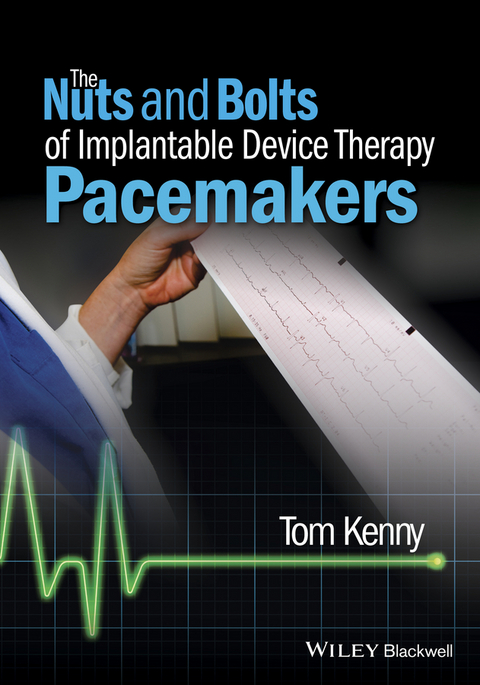
The Nuts and Bolts of Implantable Device Therapy (eBook)
John Wiley & Sons (Verlag)
978-1-118-67065-1 (ISBN)
- Tom Kenny, one of the best-known and well-respected educators in EP brings his signature style to this new primer
- Practical, accessible, highly illustrated approach makes learning easy
- Provides an overview of the algorithms and devices offered by the world's five pacemaker manufacturers
- Offers clinicians learning objectives, test questions and essential points in bulleted lists
- Perfect introductory guide to the topic, assumes little baseline knowledge and appropriate for residents, fellows, EP nurses, general clinical cardiologists, EP fellows and industry professionals
Tom Kenny, FHRS, CCDS
Tom Kenny has always been an educator. From his start as a Critical Care Educator for the North Broward Hospital District in Fort Lauderdale, Florida, to serving as Director of Education at PrepMD in Braintree, Massachusetts, Tom has focused on providing real-world, practical education for clinicians. Although he has served on faculty at Broward Community College and lectures for the Heart Rhythm Society and the Food and Drug Administration, Tom has always believed that it was imperative to educate the 'front lines' of healthcare, the men and women clinicians across the country who treat patients day in and day out. He has served at Intermedics and St. Jude Medical in corporate medical device education, where he sought to make highly complicated therapies easily understood. In his tenure at both companies, he expanded training programs and developed educational materials. Finding that there was little in the way of pacemaker training for educated clinicians who just did not happen to know pacing, Tom brought his style of training to the classroom and now to book form. Tom is a native New Yorker who currently divides his time between Massachusetts and Texas. He has five children.
Tom Kenny, one of the best-known and well-respected educators in EP brings his signature style to this new primer Practical, accessible, highly illustrated approach makes learning easy Provides an overview of the algorithms and devices offered by the world s five pacemaker manufacturers Offers clinicians learning objectives, test questions and essential points in bulleted lists Perfect introductory guide to the topic, assumes little baseline knowledge and appropriate for residents, fellows, EP nurses, general clinical cardiologists, EP fellows and industry professionals
Tom Kenny, FHRS, CCDS Tom Kenny has always been an educator. From his start as a Critical Care Educator for the North Broward Hospital District in Fort Lauderdale, Florida, to serving as Director of Education at PrepMD in Braintree, Massachusetts, Tom has focused on providing real-world, practical education for clinicians. Although he has served on faculty at Broward Community College and lectures for the Heart Rhythm Society and the Food and Drug Administration, Tom has always believed that it was imperative to educate the "front lines" of healthcare, the men and women clinicians across the country who treat patients day in and day out. He has served at Intermedics and St. Jude Medical in corporate medical device education, where he sought to make highly complicated therapies easily understood. In his tenure at both companies, he expanded training programs and developed educational materials. Finding that there was little in the way of pacemaker training for educated clinicians who just did not happen to know pacing, Tom brought his style of training to the classroom and now to book form. Tom is a native New Yorker who currently divides his time between Massachusetts and Texas. He has five children.
Title Page 5
Copyright 6
Contents 7
Preface 8
Acknowledgments 9
Chapter 1 Cardiovascular anatomy and physiology 11
Introduction 11
The healthy heart 11
Blood flow through the heart 12
Volume, valves, and pressure 17
The right atrial appendage 18
Arteries and veins 19
Test your knowledge 23
Answer the following questions 23
Chapter 2 Cardiac conduction system 25
Introduction 25
The conduction pathways 25
Polarization, depolarization, and repolarization 25
Intrinsic pacemakers 26
Refractoriness 27
Conductivity 27
Autonomic nervous system 27
Test your knowledge 29
Chapter 3 The cardiac cycle and hemodynamics 31
Introduction 31
Common terms related to hemodynamics 31
The cardiac cycle 32
Cardiac output 33
Systolic and diastolic pressures 33
The nervous system and the heart 34
The cardiovascular anatomy and hemodynamics 35
Conclusion 37
Test your knowledge 38
Chapter 4 Heart disease 39
Introduction 39
CAD 39
Nonischemic heart disease 43
Congenital heart disease 43
Conclusion 44
Test your knowledge 45
Chapter 5 Cardiac medications related to cardiac rhythm management devices 47
Introduction 47
Drug actions and interactions 47
Ten of the most frequently encountered cardiac drugs for pacemaker patients 48
Emergency drugs 54
Conclusion 55
Test your knowledge 57
Chapter 6 The basics of ECG and rhythm interpretation 58
Introduction 58
Einthoven’s triangle 58
Lead configurations: leads I, II, and III 59
Waveform landmarks 60
Systematic rhythm strip analysis 61
Refractory periods 65
Conclusion 65
Test your knowledge 67
Chapter 7 Arrhythmia analysis 68
Introduction 68
Interpretative challenges 68
Arrhythmias that originate in the sinus node 69
Sinus tachycardia 69
Sinus bradycardia 70
Sinus arrhythmia 70
Sinus arrest and SA exit block 70
Arrhythmias that originate in the atria 72
Atrial tachyarrhythmias 72
Arrhythmias that originate in the AV junction 75
Junctional rhythms 75
Arrhythmias that originate in the ventricles 78
Ectopic ventricular rhythms 78
VT 79
Idioventricular rhythm 80
Ventricular standstill 80
AV block 80
Conclusion 83
Test your knowledge 86
Quiz 1 86
Quiz 2 (Relates to Question 4) 86
Chapter 8 Electricity 101 88
Introduction 88
Electricity basics 88
Unipolar and bipolar systems 89
Pacemaker battery 90
Ohm’s law 90
Test your knowledge 92
Chapter 9 Pacing 101 94
Introduction 94
Pacing and sensing 94
Thresholds 94
Capture 95
Sensing 98
The pacing system 99
Leads 104
Polarity 104
Fixation mechanism 106
Myocardial/epicardial leads 107
Steroid-eluting leads 107
Insulation 107
Conductor coil 108
Electrodes 109
Impedance 109
Leads and thresholds 110
Putting it all together 110
Test your knowledge 112
Chapter 10 Indications for pacing 114
Introduction 114
Classes and levels of evidence 114
Sinus node dysfunction 115
Sinus node dysfunction pacing indications: class I 115
Sinus node dysfunction pacing indications: class IIa 116
Sinus node dysfunction pacing indications: class IIb 116
Sinus node dysfunction pacing indications: class III 116
Sinus node dysfunction pacing indications wrap-up 117
AV block 117
AV block: class I 117
AV block: class IIa 118
AV block: class IIb 119
AV block: class III 119
AV block pacing indications wrap-up 119
Other indications for pacing 120
Hypersensitive carotid sinus syndrome 120
Neurocardiogenic syncope 120
Other indications for pacing: class I 122
Other indications for pacing: class IIa 122
Other indications for pacing: class IIb 122
Other indications for pacing: class III 122
Conclusion 123
Test your knowledge 125
Reference 125
Chapter 11 Pacemaker implantation 126
Introduction 126
The pacemaker implantation procedure: prepping the patient 126
Selecting a vein 127
Venous access 127
The introducer kit 128
Introducing the lead into the vein 128
Ventricular lead 130
Atrial lead 131
Active versus passive fixation 132
Intraoperative testing 132
Current of injury 135
Closure 135
Complications 135
Patient education 137
Conclusion 137
Test your knowledge 139
Reference 140
Chapter 12 Connecting the leads to the pulse generator 141
Introduction 141
Implantable pulse generator 141
Leads 142
Lead insertion 142
Troubleshooting lead connections 144
The single-pass lead (VDD) 144
Characteristics of the ideal lead 145
Lead extraction 145
Methods of lead extraction 146
Test your knowledge 148
Chapter 13 Pacemaker modes and codes 150
Introduction 150
NBG code 150
First and second positions 151
Third position 151
Fourth position 152
Fifth position 152
Manufacturers’ designation only 152
Putting It together 153
Single-chamber pacing 153
Single-chamber atrial pacing 153
Single-chamber ventricular pacing 155
Dual-chamber pacing 155
Asynchronous dual-chamber pacing 155
Tracking 155
Types of dual-chamber events 157
Nontracking dual-chamber modes 157
Rate response 158
Mode Selection 159
Conclusion 159
Test your knowledge 161
Chapter 14 Single-chamber timing cycles 163
Introduction 163
Magnet mode 164
What pacemakers do 165
Sensing 166
Rhythm strips 167
Inhibition 168
Pacing 168
Fusion, pseudofusion, and mass confusion 170
Timing cycles 171
Refractory and alert periods 171
Automatic and escape intervals 173
Rate hysteresis 173
Search hysteresis 174
Conclusion 174
Test your knowledge 177
Chapter 15 Introduction to dual-chamber timing cycles 179
Introduction 179
The four states of dual-chamber pacing 179
General overview of atrial and ventricular pacing in a dual-chamber system 180
The four states in the real world 184
A fast review: Avoiding common misconceptions 185
Conclusion 186
Test your knowledge 187
Chapter 16 Dual-chamber timing cycles: the atrial channel 189
Introduction 189
Refractory and alert periods 189
The AV delay 190
Optimizing AV delay 191
Postventricular atrial refractory period 192
PVARP: preventing PMT 194
PVAB: preventing far-field R-wave oversensing 194
PMT 194
Identifying PMT 197
Stopping PMT 197
Preventing PMT 197
Automatic PMT prevention algorithms 198
Automatic PMT termination algorithms 199
Total atrial refractory period 199
Conclusion 200
Test your knowledge 203
Reference 204
Chapter 17 Dual-chamber timing cycles: the ventricular channel 205
Introduction 205
Ventricular blanking period 205
Ventricular safety pacing 207
Ventricular refractory period 208
Ventricular alert period 209
The VA interval 209
Conclusion 211
Test your knowledge 213
Chapter 18 Paced ECG and EGM analysis 215
Introduction 215
Gathering information 216
You can’t beat the system 216
Questions for analysis 216
Navigating the paced ECG: Things to look out for 218
Functional noncapture 219
Not enough information 219
Failure to output 220
Clean atrial capture 221
Dual-chamber strategies 221
Pacemaker refractory periods 222
Strategies to force capture 222
The system in steps 223
Eyeballing versus the system 224
Rhythm strips 224
Conclusion 225
Test your knowledge 227
Chapter 19 Upper-rate behavior 229
Introduction 229
Speed limits 229
Atrial tracking and the MTR 230
Upper-rate behavior 231
Total atrial refractory period 232
Pacemaker Wenckebach 232
The atrial continuum 233
Two-to-one block 233
The Wenckebach window 234
Upper-rate programming strategies 235
Programming possibilities (and impossibilities) 235
Programming other parameters for upper-rate behavior 236
Mode switching 237
Conclusion 238
Test your knowledge 241
Chapter 20 Advanced dual-chamber timing 243
Introduction 243
Base rate revisited 243
Ventricular-based timing 244
Quirks of ventricular-based timing 245
Atrial-based timing 245
Advantages of atrial-based timing 246
Quirks of atrial-based timing 246
True atrial-based timing versus modified atrial-based timing 246
The real-world importance of understanding timing cycles 248
Conclusion 249
Test your knowledge 250
Chapter 21 Rate-responsive pacing 252
Introduction 252
Chronic incompetence (CI) 252
Determining heart rate needs in pacemaker patients 254
Normal exercise physiology 254
Metabolic equivalents 255
Minute ventilation (MV) 255
Healthy chronotropic response: a review 256
Diagnosing CI in pacemaker patients 257
Histograms 257
Counters 257
Trends 257
Managing pacemaker patients with CI 258
Rate response in pacemakers 258
The optimal sensor 259
Activity sensors 259
Accelerometer 260
Minute ventilation (MV) 261
Blended sensors 262
Closed-loop stimulation 262
Other sensors 263
Programming rate response 263
Turning rate response on 264
Optimizing rate response 265
AUTO 266
Conclusion 266
Test your knowledge 268
Reference 269
Chapter 22 Special features 270
Introduction 270
Features related to the AV delay 270
shorter AV delays 270
Longer AV delays 271
Clinician considerations 273
Features related to sensitivity and pacemaker output 273
Automatic sensing 273
Pacemaker outputs 274
Features related to refractory periods 275
Postventricular atrial refractory periods 275
PMT prevention algorithms 276
PMT Termination algorithms 276
Features related to AT 277
Mode switching 277
Other atrial arrhythmia management features 279
Features to prevent or suppress AF 279
Features related to rate 280
Sleep rates 280
Rate hysteresis 280
Rate smoothing 281
A brief note on pacemaker rates 282
Features related to neurocardiogenic syncope 282
Conclusion 283
Test your knowledge 286
Chapter 23 Automatic capture algorithms 288
Introduction 288
A short history of automatic capture 289
The problem of noncapture 289
The optimal safety margin 290
How these algorithms work 290
Historical advances 290
Capture confirmation 290
AutoCapture Pacing Systems™ from St. Jude Medical 290
Threshold search 293
Backup pulses 293
Evoked response test 294
Capture verification 294
Long-term threshold record 297
ACap™ Confirm (Automatic Atrial Capture) 297
Review of St. Jude Medical AutoCapture pacing systems 298
Automatic Capture from Boston Scientific 299
Boston Scientific automatic capture summary 301
Capture management from Medtronic 302
Medtronic capture management summary 302
A look at all three algorithms 303
Conclusion 303
Test your knowledge 305
Chapter 24 Pacemaker follow-up 307
Introduction 307
Types of follow-up 307
Transtelephonic Monitoring (TTM) 307
Remote Monitoring (RM) 308
In-clinic follow-up 309
Benefits of follow-up 309
Communication 310
Frequency of follow-up 310
The guidelines 311
Lost to follow-up 311
The complete pacemaker follow-up 312
Interrogation evaluation 312
Periprocedural evaluation 312
Patient-initiated RM 312
Follow-up steps 313
Roles in follow-up 313
Conclusion 317
Test your knowledge 318
Reference 319
Chapter 25 Follow-up and troubleshooting 320
Introduction 320
Principles of troubleshooting 320
Identify the issue 320
Determine the cause 321
Take corrective action 322
Conclusion 323
Test your knowledge 324
Answer key 326
Index 330
End User License Agreement 339
| Erscheint lt. Verlag | 2.3.2016 |
|---|---|
| Reihe/Serie | The Nuts and Bolts Series | The Nuts and Bolts Series |
| Sprache | englisch |
| Themenwelt | Medizin / Pharmazie ► Allgemeines / Lexika |
| Medizinische Fachgebiete ► Innere Medizin ► Kardiologie / Angiologie | |
| Medizin / Pharmazie ► Physiotherapie / Ergotherapie ► Orthopädie | |
| Schlagworte | Advocate • Better • Book • Cardiac • Cardiovascular Disease • Clinicians • Complicated • downtoearth • Educational • electrophysiology • Elektrophysiologie • Illustrations • Interventional cardiology • Introduction • Invasive Kardiologie • Kardiovaskuläre Erkrankungen • Kardiovaskuläre Erkrankungen • Kenny • Medical • Medical Science • Medizin • New • Pacing • practical tips • prepmd • provides • realworld • remarkable • sometimes • Style • Subject • Tom • Work • World |
| ISBN-10 | 1-118-67065-5 / 1118670655 |
| ISBN-13 | 978-1-118-67065-1 / 9781118670651 |
| Informationen gemäß Produktsicherheitsverordnung (GPSR) | |
| Haben Sie eine Frage zum Produkt? |
 PDF (Adobe DRM)
Kopierschutz: Adobe-DRM
Adobe-DRM ist ein Kopierschutz, der das eBook vor Mißbrauch schützen soll. Dabei wird das eBook bereits beim Download auf Ihre persönliche Adobe-ID autorisiert. Lesen können Sie das eBook dann nur auf den Geräten, welche ebenfalls auf Ihre Adobe-ID registriert sind.
Details zum Adobe-DRM
Dateiformat: PDF (Portable Document Format)
Mit einem festen Seitenlayout eignet sich die PDF besonders für Fachbücher mit Spalten, Tabellen und Abbildungen. Eine PDF kann auf fast allen Geräten angezeigt werden, ist aber für kleine Displays (Smartphone, eReader) nur eingeschränkt geeignet.
Systemvoraussetzungen:
PC/Mac: Mit einem PC oder Mac können Sie dieses eBook lesen. Sie benötigen eine
eReader: Dieses eBook kann mit (fast) allen eBook-Readern gelesen werden. Mit dem amazon-Kindle ist es aber nicht kompatibel.
Smartphone/Tablet: Egal ob Apple oder Android, dieses eBook können Sie lesen. Sie benötigen eine
Geräteliste und zusätzliche Hinweise
Buying eBooks from abroad
For tax law reasons we can sell eBooks just within Germany and Switzerland. Regrettably we cannot fulfill eBook-orders from other countries.
aus dem Bereich