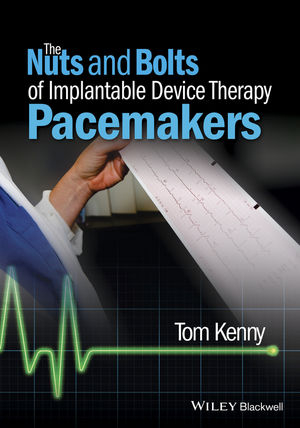
The Nuts and Bolts of Implantable Device Therapy (eBook)
John Wiley & Sons (Verlag)
978-1-118-67066-8 (ISBN)
- Tom Kenny, one of the best-known and well-respected educators in EP brings his signature style to this new primer
- Practical, accessible, highly illustrated approach makes learning easy
- Provides an overview of the algorithms and devices offered by the world’s five pacemaker manufacturers
- Offers clinicians learning objectives, test questions and essential points in bulleted lists
- Perfect introductory guide to the topic, assumes little baseline knowledge and appropriate for residents, fellows, EP nurses, general clinical cardiologists, EP fellows and industry professionals
Tom Kenny, one of the best-known and well-respected educators in EP brings his signature style to this new primer Practical, accessible, highly illustrated approach makes learning easy Provides an overview of the algorithms and devices offered by the world s five pacemaker manufacturers Offers clinicians learning objectives, test questions and essential points in bulleted lists Perfect introductory guide to the topic, assumes little baseline knowledge and appropriate for residents, fellows, EP nurses, general clinical cardiologists, EP fellows and industry professionals
Tom Kenny, FHRS, CCDS Tom Kenny has always been an educator. From his start as a Critical Care Educator for the North Broward Hospital District in Fort Lauderdale, Florida, to serving as Director of Education at PrepMD in Braintree, Massachusetts, Tom has focused on providing real-world, practical education for clinicians. Although he has served on faculty at Broward Community College and lectures for the Heart Rhythm Society and the Food and Drug Administration, Tom has always believed that it was imperative to educate the "front lines" of healthcare, the men and women clinicians across the country who treat patients day in and day out. He has served at Intermedics and St. Jude Medical in corporate medical device education, where he sought to make highly complicated therapies easily understood. In his tenure at both companies, he expanded training programs and developed educational materials. Finding that there was little in the way of pacemaker training for educated clinicians who just did not happen to know pacing, Tom brought his style of training to the classroom and now to book form. Tom is a native New Yorker who currently divides his time between Massachusetts and Texas. He has five children.
Preface, vi
Acknowledgments, vii
1 Cardiovascular anatomy and physiology, 1
2 Cardiac conduction system, 15
3 The cardiac cycle and hemodynamics, 21
4 Heart disease, 29
5 Cardiac medications related to cardiac rhythm management devices, 37
6 The basics of ecg and rhythm interpretation, 48
7 Arrhythmia analysis, 58
8 E lectricity 101, 78
9 Pacing 101, 84
10 Indications for pacing, 104
11 Pacemaker implantation, 116
12 Connecting the leads to the pulse generator, 131
13 Pacemaker modes and codes, 140
14 Single-chamber timing cycles, 153
15 Introduction to dual-chamber timing cycles, 169
16 Dual-chamber timing cycles: the atrial channel, 179
17 Dual-chamber timing cycles: the ventricular channel, 195
18 Paced ECG and EGM analysis, 205
19 Upper-rate behavior, 219
20 Advanced dual-chamber timing, 233
21 Rate-responsive pacing, 242
22 Special features, 260
23 Automatic capture algorithms, 278
24 Pacemaker follow-up, 297
25 Follow-up and troubleshooting, 310
Key answer, 316
Index, 320
Chapter 1
Cardiovascular anatomy and physiology
Learning objectives
- Point out the key landmarks in the human heart relevant to cardiac rhythm management.
- Name the four chambers of the heart, the four valves, and the major vessels.
- Describe the flow of blood through the heart.
- Define AV synchrony and explain why it is important.
- State the difference between the body’s arterial versus venous systems.
Introduction
An encyclopedia could be written on the anatomy and physiology of the human heart, and that is not our purpose. Device clinicians must understand the cardiovascular system to understand arrhythmias and device therapy. This chapter will introduce the important concepts of cardiac anatomy and physiology necessary for an understanding of cardiac rhythm management. To that end, this chapter will describe the chambers, valves, and major vessels of the heart and how these control the flow of blood in the body. Although we think of the heart—rightly—as a pump, it also possesses a complex electrical system. The cells of the human heart are unique in many ways, and how they produce, conduct, and dissipate electrical energy is very important, particularly to pacing. Our goal here is to describe the anatomy and physiology of the healthy heart and cardiovascular system in terms of what device clinicians need to know.
The healthy heart
The human heart is a double pump (right and left) that sits in the middle of the chest, slightly to the left, and rotated so that the right side is more anterior than the left. An average adult human heart is relatively large, about 13 by 9 by 6 cm and weighing about 300 g. The heart is protected by the rib cage and sits directly behind one of the body’s thickest bones, the sternum. The bottom of the heart rests on the diaphragm muscle. The heart is encased in this protected but somewhat crowded area—it also contains the lungs (three lobes on the right, two on the left), the stomach, and the intestines.
The bottom tip of the heart (called the apex) taps up against the chest when the heart contracts. By placing his hands on the chest, a physician can feel the place where the apex of the heart makes contact with the chest; this place is called the point of maximal impulse (PMI). Knowing the precise location of the PMI can be very useful in treating cardiology patients, because the PMI of a healthy heart occurs slightly to the left, while the PMI of a person with an enlarged heart is going to occur much farther to the left, even off to the side. A healthy heart is roughly the size of the fist, but when hearts enlarge, such as occurs with disease progression, the enlargement occurs toward the left. Thus, PMI can provide a fast, noninvasive way of determining if and to what degree the heart has enlarged.
The left ventricle composes most of the mass of the heart, being by far the largest of the four pumping chambers. A healthy heart circulates about 4–6 l of blood a minute—which is the entire blood volume of the body! That means the entire circulating volume of blood in the body moves around every minute or once per beat.
The heart consists of four chambers: two upper chambers called atria (singular atrium) and two lower and larger chambers called ventricles. To understand the healthy heart, it is useful to think of the heart in terms of right side (right atrium and right ventricle) and left side (left atrium and left ventricle). The right side of the heart circulates deoxygenated blood to the lungs (where it can be oxygenated). The left side of the heart pumps oxygenated blood out to the rest of the body (see Figure 1.1).
Figure 1.1 Cross section of the heart showing the chambers.
The heart is a muscle and consists of four distinct layers. The endocardium is the innermost layer and composes a lining for the interior of the heart. The epicardium is the outer layer of the heart. Between the endocardium and epicardium lies the myocardium—the thickest layer—which is muscle. The entire heart is encased in a liquid-filled sac called the pericardium, which acts like a shock absorber for the heart. The pericardial sac contains about 15–20 cc of pericardial fluid in a healthy individual. In the event that fluid builds up to abnormally high levels in the pericardial sac (such as might occur when a lead or catheter inside the heart perforates the endocardium, myocardium, and epicardium and goes exterior to the heart), this fluid can place pressure on the heart in a condition known as cardiac tamponade. Since the heart is contained in a relatively small space, this pressure can compromise the heart’s ability to fill with blood and pump efficiently. During device implantation, perforation is an important concern because it can lead to cardiac tamponade. In the event that perforation results in cardiac tamponade, a needle is inserted into the pericardial sac (through the chest wall) to drain the blood. Lead perforation does not always result in cardiac tamponade, but it is a serious concern.
Blood flow through the heart
The heart is a pump and it is located amid a network of vessels that carry deoxygenated blood into the right side of the heart and reoxygenated blood into the left side of the heart. The flow is actually fairly simple. Deoxygenated blood enters the right side of the heart and is pumped over to the lungs via the pulmonary arteries and is returned back (as oxygen-rich blood) to the left side of the heart by way of the pulmonary veins (PV). While both right and left sides of the heart contract at the same time as a single unit, the right side is busy pumping deoxygenated blood to the lungs, while the left side is pumping reoxygenated blood out to the rest of the body.
Deoxygenated blood enters the right side of the heart via the superior vena cava (SVC), but once it has become oxygenated again, blood is pumped back out from the left side of the heart into the aorta. The aorta is the largest vessel in the body, and it forms a U shape at the top of the heart. These portions of the aorta are called the ascending, the descending, and the arch. Coming off the aortic arch are three main arteries: the left subclavian artery, the left common carotid artery, and the brachiocephalic trunk.
To better understand the blood flow through the heart, it is important to review the structure of the heart. The atria or upper chambers of the heart are smaller, have thinner walls, and are smoother on the inside than the ventricles. Within the ventricles is a network of fibrous strands known as trabeculae. These structural differences become important in lead implantation within the heart; it is much easier to affix or lodge a lead in the trabeculae of the ventricles than to try to anchor the lead to a smooth atrial wall. Historically, atrial leads have almost always been active-fixation screw-in-type leads, while ventricular leads were almost always passive-fixation leads (fins or tines that lodge in the trabeculae). Today, active-fixation leads are often used in both chambers since they facilitate lead removal (Figure 1.2).
Figure 1.2 Note that the atria are smooth walled, while the ventricles contain a spongelike fibrous network of trabeculae.
Overall, blood flow to the heart is discussed, right and left sides, although it is important to recognize that what happens in the heart, that is, systole (contraction) and diastole (relaxation), are happening on both sides at the same time. The right atrium of the heart receives blood from the SVC, the inferior vena cava (IVC), and the coronary sinus (CS). The CS is technically a vein and it has an opening or ostium (sometimes just called os) at the base of the right atrium, slightly posterior. The CS delivers oxygen-depleted blood to the right atrium from the coronary arteries that encircle the exterior of the heart. The CS is of interest in cardiac resynchronization therapy (CRT) because the left ventricular lead is passed through the CS (counter to the flow of blood) in order to be placed into the coronary vessels to pace the left ventricle. CRT is used in patients with heart failure, whose hearts have remodeled, that is, enlarged and changed shape. (It may be said that with heart failure, the heart changes from the shape of a football to the shape of a basketball!) The CS may be relocated in this remodeling, which can be challenging in implanting a CRT lead because the physician must first locate the os of the CS and then navigate through it in order to implant the left ventricular lead.
Anatomically, the heart is dominated by the large muscle mass of the left ventricle, which makes up about two-thirds of the heart in terms of weight and volume. This greater size is typically ascribed to the fact that the left ventricle must pump blood throughout the whole body, whereas the right ventricle only has to pump blood to the lungs. The left and right ventricles pump blood to different destinations, but the left ventricle is larger and more muscular for a reason—pressure. It is important to review the pressures against which the heart must work to understand cardiac blood flow (Figure 1.3).
Figure 1.3 The blood flow within the heart takes oxygen-depleted blood from the body into the right atrium, where it flows to the right ventricle and is pumped out over the lungs; the reoxygenated blood from the lungs is...
| Erscheint lt. Verlag | 19.11.2014 |
|---|---|
| Reihe/Serie | The Nuts and Bolts Series | The Nuts and Bolts Series |
| Sprache | englisch |
| Themenwelt | Medizin / Pharmazie ► Allgemeines / Lexika |
| Medizinische Fachgebiete ► Innere Medizin ► Kardiologie / Angiologie | |
| Medizin / Pharmazie ► Physiotherapie / Ergotherapie ► Orthopädie | |
| Schlagworte | Advocate • Better • Book • Cardiac • Cardiovascular Disease • Clinicians • Complicated • downtoearth • Educational • electrophysiology • Elektrophysiologie • Illustrations • Interventional cardiology • Introduction • Invasive Kardiologie • Kardiovaskuläre Erkrankungen • Kardiovaskuläre Erkrankungen • Kenny • Medical • Medical Science • Medizin • New • Pacing • practical tips • prepmd • provides • realworld • remarkable • sometimes • Style • Subject • Tom • Work • World |
| ISBN-10 | 1-118-67066-3 / 1118670663 |
| ISBN-13 | 978-1-118-67066-8 / 9781118670668 |
| Informationen gemäß Produktsicherheitsverordnung (GPSR) | |
| Haben Sie eine Frage zum Produkt? |
 EPUB (Adobe DRM)
Kopierschutz: Adobe-DRM
Adobe-DRM ist ein Kopierschutz, der das eBook vor Mißbrauch schützen soll. Dabei wird das eBook bereits beim Download auf Ihre persönliche Adobe-ID autorisiert. Lesen können Sie das eBook dann nur auf den Geräten, welche ebenfalls auf Ihre Adobe-ID registriert sind.
Details zum Adobe-DRM
Dateiformat: EPUB (Electronic Publication)
EPUB ist ein offener Standard für eBooks und eignet sich besonders zur Darstellung von Belletristik und Sachbüchern. Der Fließtext wird dynamisch an die Display- und Schriftgröße angepasst. Auch für mobile Lesegeräte ist EPUB daher gut geeignet.
Systemvoraussetzungen:
PC/Mac: Mit einem PC oder Mac können Sie dieses eBook lesen. Sie benötigen eine
eReader: Dieses eBook kann mit (fast) allen eBook-Readern gelesen werden. Mit dem amazon-Kindle ist es aber nicht kompatibel.
Smartphone/Tablet: Egal ob Apple oder Android, dieses eBook können Sie lesen. Sie benötigen eine
Geräteliste und zusätzliche Hinweise
Buying eBooks from abroad
For tax law reasons we can sell eBooks just within Germany and Switzerland. Regrettably we cannot fulfill eBook-orders from other countries.
aus dem Bereich