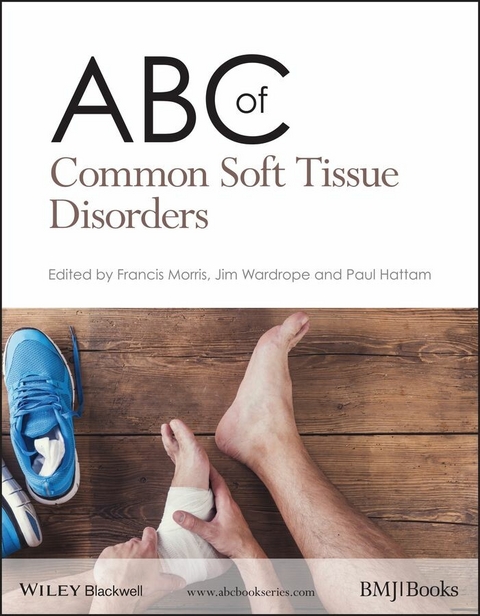
ABC of Common Soft Tissue Disorders (eBook)
John Wiley & Sons (Verlag)
978-1-118-79977-2 (ISBN)
Soft tissue problems are very common, with one in four people at any one time suffering with a musculoskeletal disorder. ABC of Soft Tissue Disorders is a practical, fully illustrated guide to their assessment and treatment.
Structured by body part, each chapter provides guidance on assessment, treatment and management, and covers common conditions such as sprains and strains, tendinopathy, ligament injuries, and sciatica. With particular focus on shoulders, back and knee problems (reflecting the frequency and complexity of problems in these parts of the body), it provides guidance on the essential history and examination required to reach an accurate diagnosis.
Written by an expert author team, ABC of Soft Tissue Disorders is important reading for all general practitioners, nurse practitioners, junior doctors and medical students working in a range of settings, including emergency, minor injury departments, as well as in orthopaedics and rheumatology.
Francis Morris, Consultant in Emergency Medicine, Northern General Hospital, Sheffield, UK
Jim Wardrope, Emeritus Consultant in Emergency Medicine, Northern General Hospital, Sheffield, UK
Paul Hattam, Principal Physiotherapist & Director, The Physios, Sheffield, UK
ABC of Common Soft Tissue Disorders Soft tissue problems are very common, with one in four people at any one time suffering with a musculoskeletal disorder. ABC of Common Soft Tissue Disorders is a practical, fully illustrated guide to their assessment and treatment. Structured by body part, each chapter provides guidance on assessment, treatment and management, and covers common conditions such as sprains and strains, tendinopathy, ligament injuries and sciatica. With particular focus on shoulders, back and knee problems (reflecting the frequency and complexity of problems in these parts of the body), it provides guidance on the essential history and examination required to reach an accurate diagnosis. Written by an expert author team, ABC of Common Soft Tissue Disorders is important reading for all general practitioners, nurse practitioners, junior doctors and medical students working in a range of settings, including emergency and minor injury departments, as well as in orthopaedics and rheumatology.
Francis Morris, Consultant in Emergency Medicine, Northern General Hospital, Sheffield, UK Jim Wardrope, Emeritus Consultant in Emergency Medicine, Northern General Hospital, Sheffield, UK Paul Hattam, Principal Physiotherapist & Director, The Physios, Sheffield, UK
List of Contributors vii
1 Introduction to Musculoskeletal Medicine 1
Jim Wardrope
2 Soft Tissue Problems of the Neck 12
Michael Athanassacopoulos and Neil Chiverton
3 Back Pain 19
Ben Cooper, Richard J. Follett and Neil Chiverton
4 Shoulder: Sub-acromial Pathology 25
Lennard Funk
5 Shoulder: The Articular Structures 33
Lennard Funk
6 Elbow 40
David Stanley and Santosh Venkatachalam
7 Soft Tissue Disorders at the Wrist 45
David Knott
8 Soft Tissue Injuries of the Hand 50
Helen Cugnoni
9 Common Soft Tissue Disorders of the Hip 55
Alison Smeatham
10 Soft Tissue Knee Injuries 62
Paul M. Sutton
11 Non-traumatic Knee Problems 68
Jim Wardrope and Paul M. Sutton
12 Calf and Shin Problems 72
Roger Dalton, Mark B. Davies and Ashley Jones
13 Soft Tissue Injuries of the Ankle 77
Hasan Qayyum, Chris M. Blundell and Joanna Ollerenshaw
14 The Foot 84
Sherif Hemaya and Carolyn Chadwick
Index 89
Chapter 1
Introduction to Musculoskeletal Medicine
Jim Wardrope
Northern General Hospital, Sheffield, UK
Overview
- This chapter will review the structure of the musculoskeletal system and how the ‘human machine’ works.
- How the musculoskeletal system is modified by age and illness.
- A system is outlined for history, examination, investigations and note taking.
- The principles of management of injury to muscles, tendons, ligaments and nerves are examined.
- How best to restore function is discussed.
Introduction
Musculoskeletal conditions are one of the commonest presentations in general practice. One in four people at any one time will have a musculoskeletal problem. Such conditions are responsible for one in seven primary care consultations. Almost 50% of the population will have back pain in 1 year. The cost to society is huge.
These conditions are often regarded by doctors as ‘minor’ problems, but to patients they are often painful and disabling. Very occasionally apparently minor problems can be life threatening.
Structure and function: the body as a machine
The skeleton
Any machine needs a rigid framework. The main functions of this framework are to overcome the effects of gravity, to protect vital parts and to provide a network of levers to enable the effective application of force.
A crane shows these functions as well (Figure 1.1). It has a network of steel girders to give it height (overcome gravity) and a very long arm to provide a means of reaching and for the effective application of force. It has specialized areas for protection, for example the driver's cab (skull). The human skeleton is much more complex but the principles are the same. The ‘girders’ of the skeleton are the bones, designed by evolution to be strong, to have some elasticity but still to be light.
Figure 1.1 A crane is a very simple machine but has many elements in common with the human body. The human body is subject to the laws of mechanics like any other machine.
Joints
The crane has a few simple joints that allow movement, flexibility and a degree of shock absorption. At the base there is a circular joint to allow 360° motility in one plane. It comprises load-bearing surfaces, lubrication and constraining structures that hold the joint in place. The nearest human equivalent would be a ball-and-socket joint such as the shoulder. There are also hinge-type joints allowing motion in one plane (e.g. the elbow).
Human joints are much more complex and of greater variety (synovial, symphyseal and syndesmotic). These joints all have articular surfaces, and ligaments that connect the bones together, and also contain stretch receptors and associated muscles. They may also have specialized structures such as intra-articular cartilages that may assist in shock absorption or in joint stability.
Muscles and tendons
The powerhouse needs a fuel supply, oxygen, a method of converting the energy in the fuel to mechanical energy and a method of transmission of that energy to the skeleton. Skeletal muscle uses sugar as its main energy source backed up by glycogen to meet the peak action of the ‘pistons’ of the actin and myosin filaments that cause contraction (and relaxation).
The muscle exerts its force through tendons. Tendons are immensely strong yet also have elastic stretch. This stops them breaking at times of sudden loading (see Figure 1.2).
Figure 1.2 The human ‘combustion engine’. (a) Fuel in a car engine is combusted with oxygen to create a force that moves the piston and turns the crankshaft. (b) Glucose in muscle cells is respired to create the ATP that drives muscle contraction.
Reciprocal groups of muscles
An important concept is that with many active muscle movements there are opposing muscles which contract to allow a stable platform for the active muscle. Using the crane analogy, the large counterbalance weight is essential to prevent the crane toppling over when lifting a load (see Figure 1.1). A good example of this is tennis elbow. There is pain at the extensor origin when gripping. The main active muscles are the finger flexors; however, the extensors of the wrist have to contract to stabilize the wrist. Without this reciprocal action the wrist would flex and grip strength would be lost. This powerful reciprocal contraction causes stress at the origin of the wrist extensors at the lateral epicondyle (see Figure 1.3).
Figure 1.3 Reciprocal muscle contraction. In gripping the finger flexor muscles contact strongly. If the wrist extensors do not ‘brace’ the wrist then the wrist would also flex and grip would be very weak (a). Strong contraction of the wrist extensors allows the finger flexors to exert maximum power (b).
Nerves
All machines need a control system. The brain, the spinal cord and the motor and sensory nerves provide that control system.
Much of the control of movement is carried on at an unconscious level. The simplest example of unconscious control is the spinal stretch reflex. If a muscle is stretched, then receptors in the muscle and tendon are activated, and signals are passed up the sensory nerves to the spinal cord and hence to the motor neurones that fire to cause the reflex contraction. This reflex arc is subject to many other influences, both from within the spinal cord and descending from the cerebellum and the cerebral cortex and associated nuclei. However, it is a key concept in understanding the importance of muscle power and the neural control in maintaining joint stability (see below).
Functions and stresses
The human body is a complex system of levers. In clinical practice we tend not to think of the physics of movement and function but understanding the rudiments of biomechanics is key to the practice of musculoskeletal medicine. We can only skim the surface of this subject but further information can be found in The human machine (McNeill 1992) or Physics in biology and medicine (Davidovits 2008).
Take the example of lifting a simple weight. If incorrect lifting technique is used, then the spine becomes a very long arm of a lever that has to support not only the weight being lifted but the weight of the upper body (Figure 1.4). The fulcrum of this lever is the lumbosacral junction. The forces across this joint are huge: lifting a 10 kg weight with an extended spine results in 0.5 tonne of force.
Figure 1.4 Lifting a 10 kg weight the wrong way, with a bent back. Upper body weight is 40 kg. The resultant force is weight in kg × acceleration of gravity: (40 kg + 10 kg) × 10 m/s2 = 500 N. This force is acting over a 1 m lever (distance between the fulcrum at the lumbosacral joint and the shoulders), giving a resulting moment of 500 Nm. The opposing lever at the lumbosacral joint is much shorter, approximately 10 cm. The moment that needs to be generated over this short 10 cm lever is 500 Nm, thus requiring 5000 N of force over the lumbosacral joint.
If the forces are so huge, why do we not fall apart? The musculoskeletal system has many modifications that allow it to withstand these forces. Many of the structures are immensely strong yet have a certain degree of elasticity that prevent failure with sudden peak loading. However, it is the ‘dynamic stability’ of muscle power that provides the majority of joint stability. For example:
- ankle is inverted,
- stretch receptors in the ligaments, evertor tendons and muscles are activated,
- a reflex contraction of the evertor muscles corrects the deforming force,
- ankle stability is protected (see Figure 1.5).
Figure 1.5 The ankle inverts, stretch receptors activate (a), there is a reflex contraction of the evertor muscles, the deforming force is overcome and the ankle returns to the normal position (b).
This contraction can be so strong that it may pull off the evertor attachment (fracture of the fifth metatarsal styloid process) or the tendon may snap.
If a joint is immobilized then two things happen: the speed of the stretch reflex is delayed and muscle bulk and power are lost. This is a key concept that demonstrates the absolutely vital importance of rehabilitation in the management of many musculoskeletal injuries. A simple grade 1 ankle sprain can result in wasted calf muscles and an unstable ankle if immobilization or non-weight bearing is prolonged.
Effects of age, other morbidity, drugs and training
Unlike machines the human body does not come to an exact specification. While it is true that machines will age and the various parts will become prone to failure, they are not subject to the huge variation in that is seen in the population attending the clinic or surgery.
As the population ages the burden of illness in the community rises exponentially. Age-related changes affect the structure and functioning of the musculoskeletal system.
- The skeleton becomes more brittle, resulting in an increase in fractures, often with little or no trauma.
- Muscle bulk is lost, resulting in a loss of capacity to withstand stresses across joints.
- Reflexes slow, resulting in less stability as a whole and a higher incidence of falls.
- Tendons lose strength, resulting in more tendon ruptures...
| Erscheint lt. Verlag | 8.3.2016 |
|---|---|
| Reihe/Serie | ABC Series |
| ABC Series | ABC Series |
| Sprache | englisch |
| Themenwelt | Medizin / Pharmazie ► Allgemeines / Lexika |
| Medizin / Pharmazie ► Gesundheitswesen | |
| Medizin / Pharmazie ► Medizinische Fachgebiete ► Allgemeinmedizin | |
| Medizin / Pharmazie ► Medizinische Fachgebiete ► Orthopädie | |
| Schlagworte | Allgemeine u. Innere Medizin • Allgemeinpraxis, hausärztliche Praxis • Allgemeinpraxis, hausärztliche Praxis • Back • bruise • brusiing • discomfort • Fascia • General & Internal Medicine • General Practice/Family Practice • Knee • Ligament • <p>Soft • Medical Science • Medizin • Muscle • Musculoskeletal • Pain • sciatica • shoulders • Sportmedizin • sports medicine • sprains • strains • swelling • Tendinopathy • tendons • tissue • trauma</p> • Weichgewebe |
| ISBN-10 | 1-118-79977-1 / 1118799771 |
| ISBN-13 | 978-1-118-79977-2 / 9781118799772 |
| Informationen gemäß Produktsicherheitsverordnung (GPSR) | |
| Haben Sie eine Frage zum Produkt? |
 EPUB (Adobe DRM)
Kopierschutz: Adobe-DRM
Adobe-DRM ist ein Kopierschutz, der das eBook vor Mißbrauch schützen soll. Dabei wird das eBook bereits beim Download auf Ihre persönliche Adobe-ID autorisiert. Lesen können Sie das eBook dann nur auf den Geräten, welche ebenfalls auf Ihre Adobe-ID registriert sind.
Details zum Adobe-DRM
Dateiformat: EPUB (Electronic Publication)
EPUB ist ein offener Standard für eBooks und eignet sich besonders zur Darstellung von Belletristik und Sachbüchern. Der Fließtext wird dynamisch an die Display- und Schriftgröße angepasst. Auch für mobile Lesegeräte ist EPUB daher gut geeignet.
Systemvoraussetzungen:
PC/Mac: Mit einem PC oder Mac können Sie dieses eBook lesen. Sie benötigen eine
eReader: Dieses eBook kann mit (fast) allen eBook-Readern gelesen werden. Mit dem amazon-Kindle ist es aber nicht kompatibel.
Smartphone/Tablet: Egal ob Apple oder Android, dieses eBook können Sie lesen. Sie benötigen eine
Geräteliste und zusätzliche Hinweise
Buying eBooks from abroad
For tax law reasons we can sell eBooks just within Germany and Switzerland. Regrettably we cannot fulfill eBook-orders from other countries.
aus dem Bereich