Environmental Health (eBook)
John Wiley & Sons (Verlag)
978-1-118-98806-0 (ISBN)
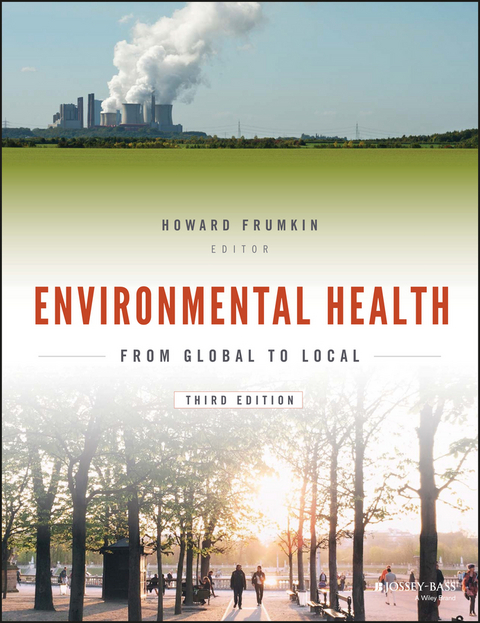
Environmental Health: From Global to Local is a comprehensive introduction to the subject, and a contemporary, authoritative text for students of public health, environmental health, preventive medicine, community health, and environmental studies. Edited by the former director of the CDC's National Center for Environmental Health and current dean of the School of Public Health at the University of Washington, this book provides a multi-faceted view of the topic, and how it affects different regions, populations, and professions. In addition to traditional environmental health topics-air, water, chemical toxins, radiation, pest control-it offers remarkably broad, cross-cutting coverage, including such topics as building design, urban and regional planning, energy, transportation, disaster preparedness and response, climate change, and environmental psychology. This new third edition maintains its strong grounding in evidence, and has been revised for greater readability, with new coverage of ecology, sustainability, and vulnerable populations, with integrated coverage of policy issues, and with a more global focus.
Environmental health is a critically important topic, and it reaches into fields as diverse as communications, technology, regulatory policy, medicine, and law. This book is a well-rounded guide that addresses the field's most pressing concerns, with a practical bent that takes the material beyond theory.
- Explore the cross-discipline manifestations of environmental health
- Understand the global ramifications of population and climate change
- Learn how environmental issues affect health and well-being closer to home
- Discover how different fields incorporate environmental health perspectives
The first law of ecology reminds is that 'everything is connected to everything else.' Each piece of the system affects the whole, and the whole must sustain us all for the long term. Environmental Health lays out the facts, makes the connections, and demonstrates the importance of these crucial issues to human health and well-being, both on a global scale, and in our homes, workplaces, and neighborhoods.
HOWARD FRUMKIN, MD, MPH, DrPH, is Dean and Professor of Environmental and Occupational Health Sciences at the University of Washington School of Public Health. He formerly served at the U.S. Centers for Disease Control and Prevention, first as director of the National Center for Environmental Health and Agency for Toxic Substances and Disease Registry, and later as Special Assistant to the CDC Director for Climate Change and Health.
The bestselling environmental health text, with all new coverage of key topics Environmental Health: From Global to Local is a comprehensive introduction to the subject, and a contemporary, authoritative text for students of public health, environmental health, preventive medicine, community health, and environmental studies. Edited by the former director of the CDC's National Center for Environmental Health and current dean of the School of Public Health at the University of Washington, this book provides a multi-faceted view of the topic, and how it affects different regions, populations, and professions. In addition to traditional environmental health topics air, water, chemical toxins, radiation, pest control it offers remarkably broad, cross-cutting coverage, including such topics as building design, urban and regional planning, energy, transportation, disaster preparedness and response, climate change, and environmental psychology. This new third edition maintains its strong grounding in evidence, and has been revised for greater readability, with new coverage of ecology, sustainability, and vulnerable populations, with integrated coverage of policy issues, and with a more global focus. Environmental health is a critically important topic, and it reaches into fields as diverse as communications, technology, regulatory policy, medicine, and law. This book is a well-rounded guide that addresses the field's most pressing concerns, with a practical bent that takes the material beyond theory. Explore the cross-discipline manifestations of environmental health Understand the global ramifications of population and climate change Learn how environmental issues affect health and well-being closer to home Discover how different fields incorporate environmental health perspectives The first law of ecology reminds is that 'everything is connected to everything else.' Each piece of the system affects the whole, and the whole must sustain us all for the long term. Environmental Health lays out the facts, makes the connections, and demonstrates the importance of these crucial issues to human health and well-being, both on a global scale, and in our homes, workplaces, and neighborhoods.
HOWARD FRUMKIN, MD, MPH, DrPH, is Dean and Professor of Environmental and Occupational Health Sciences at the University of Washington School of Public Health. He formerly served at the U.S. Centers for Disease Control and Prevention, first as director of the National Center for Environmental Health and Agency for Toxic Substances and Disease Registry, and later as Special Assistant to the CDC Director for Climate Change and Health.
Tables, Figures, Text Boxes, and Tox Boxes ix
The Editor xix
The Contributors xxi
Acknowledgments xxix
Potential Conflicts of Interest in Environmental Health: From Global to Local xxxi
PART 1 METHODS AND PARADIGMS 1
Chapter 1 Introduction to Environmental Health 3
Howard Frumkin
Chapter 2 Ecology and Ecosystems as Foundational for Health 27
Margot W. Parkes and Pierre Horwitz
Chapter 3 Sustainability and Health 59
Cindy L. Parker, Jessica D. Rhodes, and Brian S. Schwartz
Chapter 4 Environmental and Occupational Epidemiology 83
Kyle Steenland and Christine L. Moe
Chapter 5 Geospatial Data for Environmental Health 111
Lance A. Waller
Chapter 6 Toxicology 123
Gary W. Miller
Chapter 7 Genes, Genomics, and Environmental Health 153
David L. Eaton and Christopher M. Schaupp
Chapter 8 Exposure Science, Industrial Hygiene, and Exposure Assessment 181
Michael G. Yost and P. Barry Ryan
Chapter 9 Environmental Psychology 203
Nancy M. Wells, Gary W. Evans, and Kristin Aldred Cheek
Chapter 10 Environmental Health Ethics 231
Andrew Jameton
Chapter 11 Environmental Justice and Vulnerable Populations 251
Rachel Morello-Frosch and Manuel Pastor
PART 2 ENVIRONMENTAL HEALTH ON THE GLOBAL SCALE 273
Chapter 12 Climate Change and Human Health 275
Jonathan A. Patz and Howard Frumkin
PART 3 ENVIRONMENTAL HEALTH ON THE REGIONAL SCALE 317
Chapter 13 Air Pollution 319
Michelle L. Bell and Jonathan Samet
Chapter 14 Energy and Human Health 345
Howard Frumkin
Chapter 15 Healthy Communities 377
Andrew L. Dannenberg and Anthony G. Capon
Chapter 16 Water and Health 413
Timothy Ford
PART 4 ENVIRONMENTAL HEALTH ON THE LOCAL SCALE 451
Chapter 17 Solid and Hazardous Waste 453
Sven E. Rodenbeck and Henry Falk
Chapter 18 Pest Control and Pesticides 477
Mark Gregory Robson, George C. Hamilton, Wattasit Siriwong, and Héctor Luis Maldonado Pérez
Chapter 19 Food Systems, the Environment, and Public Health 503
Pamela Rhubart Berg, Leo Horrigan, and Roni Neff
Chapter 20 Buildings and Health 539
Howard Frumkin
Chapter 21 Work, Health, andWell-Being 581
David Michaels and Gregory R.Wagner
Chapter 22 Radiation 603
Matthew P. Moeller
Chapter 23 Injuries 635
Jeremy J. Hess, Anna Q. Yaffee, Jason R. Holmes, and Junaid A. Razzak
Chapter 24 Environmental Disasters 667
Mark E. Keim
Chapter 25 Nature Contact 693
Howard Frumkin
PART 5 THE PRACTICE OF ENVIRONMENTAL HEALTH 723
Chapter 26 Environmental Public Health: From Theory to Practice 725
Lynn R. Goldman
Chapter 27 Risk Assessment in Environmental Health 747
Mary C. Sheehan, Juleen Lam, and Thomas A. Burke
Chapter 28 Communicating Environmental Health 769
Edward Maibach and Vincent T. Covello
Index 791
Tables, Figures, Text Boxes, and Tox Boxes
Tables
| 2.1 | Scale in Ecology, and Some Disciplines That Contribute at Each Level |
| 2.2 | Type of Relationship Between Different Species |
| 2.3 | Links Between Ecology and Systems Thinking as a Basis for Health |
| 3.1 | Metrics of Sustainability |
| 6.1 | Carcinogen Classification of Chemicals: IARC Results as of March 2015 |
| 9.1 | Contrasting Toxicology and Environmental Psychology |
| 9.2 | Examples of Convenience, Attractiveness, and Normativeness Applied to a School Cafeteria |
| 12.1 | The Main Greenhouse Gases |
| 12.2 | Temperature and Precipitation Effects on Selected Vectors and Vector-Borne Pathogens |
| 12.3 | Co-Benefits of Climate Mitigation and Adaptation Activities |
| 13.1 | Major Ambient Air Pollutants: Sources, Health Effects, and Regulations |
| 14.1 | Energy Use Within Selected Countries, 2005–2009 |
| 15.1 | Stages of Urban Evolution and Characteristic Environmental Conditions and Health Issues |
| 15.2 | Comparison of Sprawl and Smart Growth |
| 16.1 | Hot Spots of Current and/or Potential Water Conflicts |
| 16.2 | Examples of Large-Scale Human Impacts on Aquatic Systems |
| 16.3 | Classes of Chemical Contaminants in Water |
| 16.4 | Examples of Studies of Possible Links Between Exposure to Chemicals in Drinking Water and Increased Health Risk |
| 16.5 | Pathogens in or Related to Water, Diseases They Cause, and Approaches to Prevention and Treatment |
| 16.6 | Global Challenges in Water and Sanitation, Particularly in Low- and Middle-Income Countries |
| 16.7 | The Indicator Approach to Monitoring Water Quality |
| 16.8 | Simple, Low-Cost Water Treatment Options |
| 16.9 | Approaches to Disinfection |
| 18.1 | Pesticides Classified by Target or Mode of Action |
| 19.1 | HACCP Principles |
| 19.2 | Jurisdiction over Food Safety in the United States |
| 19.3 | Some of the Many Policies Shaping the U.S. Food System |
| 20.1 | Average Exposure Concentrations of Formaldehyde and Contribution of Various Atmospheric Environments to Exposure to Formaldehyde |
| 20.2 | Hazardous Ingredients of Cleaners (Partial Listing) |
| 20.3 | Approaches to Protecting Health and Safety in Buildings |
| 21.1 | The Public Health Impact of OSHA Regulations |
| 22.1 | Units of Radiation Exposure and Dose |
| 22.2 | Average Amounts of Ionizing Radiation Received Annually by a U.S. Resident |
| 22.3 | Representative Radiation Doses in Select Medical Procedures Performed in the United States |
| 22.4 | Major Forms and Features of Acute Radiation Syndromes |
| 22.5 | Estimated Lifetime Risks of Fatal Cancer Attributable to 0.1 Sv Low-Dose-Rate Whole-Body Irradiation |
| 23.1 | The Haddon Matrix Applied to Motor Vehicle Crashes |
| 23.2 | Options Analysis in Injury Control |
| 23.3 | Countermeasures for Intentional Injuries |
| 23.4 | Countermeasures for Burns |
| 23.5 | Countermeasures for Poisoning |
| 23.6 | Countermeasures for Falls |
| 23.7 | Countermeasures for Drowning |
| 23.8 | Countermeasures for Road Injuries |
| 23.9 | Countermeasures for Playground Injuries |
| 23.10 | Countermeasures for Home Injuries |
| 24.1 | A Typology of Environmental Disasters |
| 24.2 | The Ten Deadliest Environmental Disasters—Worldwide, 1964–2013 |
| 24.3 | Major Causes of Death During Environmental Disasters |
| 24.4 | Public Health Consequences and Capabilities Associated with All Disasters |
| 26.1 | Essential Services of Environmental Public Health |
| 26.2 | The Protocol for Assessing Community Excellence in Environmental Health (PACE-EH) Process |
| 28.1 | Factors Important in Risk Perception |
Figures
| 1.1 | Title Page of Chadwick's Groundbreaking 1842 Report |
| 1.2 | A Victim of Minamata Disease Being Bathed: Photograph by W. Eugene Smith |
| 1.3 | The Need for Primary Prevention: An Early 20th-Century View |
| 1.4 | The DPSEEA Model |
| 2.1 | A Food Web in a North American Terrestrial Food Ecosystem |
| 2.2 | Invasive Species and Their Impacts |
| 2.3 | A Classical Model of Ecological Succession in a North American Forest Ecosystem |
| 2.4 | The Phosphorus Cycle |
| 2.5 | Transactions Between Atmosphere, Geosphere, and Hydrosphere Provide a Basis for the Earth's Capacity to Support Life |
| 2.6 | Linear Thinking Versus Systems Thinking |
| 2.7 | A Systems Map of U.K. Land Use and the Domains That Influence It |
| 2.8 | Ecosystems as Settings for Human Health and Well-Being |
| 2.9 | The Life Cycle and Transmission of Leptospira Bacteria |
| 2.10 | The MA Conceptual Framework |
| 2.11 | The Social Ecological Model |
| 3.1 | The Great Acceleration |
| 3.2 | Nested Model of Sustainability |
| 3.3 | A Safe Operating Space for Humanity |
| 4.1 | Area of PFOA Contamination |
| 5.1 | Hypothetical Example of the Layering GIS Operation |
| 5.2 | Examples of Buffers Around Point, Line, and Area Features |
| 5.3 | Map of Genesee County, Michigan, Block Groups (1990 Census) Showing Proportions of Respondents Self-Identifying Race as ``Black'' |
| 6.1 | Toxicology: From Populations to Molecules |
| 6.2 | Examples of Dose-Response Curves |
| 6.3 | Metabolic Transformations of Benzo(a)pyrene |
| 6.4 | Structures of Some Suspected Endocrine-Disrupting Chemicals |
| 6.5 | Key Steps in Toxicokinetics |
| 6.6 | The Metabolism of Acetaminophen |
| 6.7 | Molecular Structure and LD$_{50}$ for Eight Chemicals |
| 7.1 | The Human Genome |
| 7.2 | The Basic Structural Elements of a Gene |
| 7.3 | The Cystic Fibrosis Mutation |
| 7.4 | Chromatin Dynamics in Response to Epigenetic Modification |
| 7.5 | Schematic of the Agouti Gene and How Its Methylation Status Affects Phenotype in Mice |
| 7.6 | Primary Biotransformation Pathway for Alcohol |
| 8.1 | An Air Pollution Monitoring Station for Ozone and Particulate Matter, in Atlanta |
| 8.2 | Personal Protective Equipment |
| 8.3 | Assessing Exposure in an... |
| Erscheint lt. Verlag | 9.2.2016 |
|---|---|
| Reihe/Serie | Public Health/Enviromental Health NY |
| Public Health/Enviromental Health NY | Public Health/Environmental Health |
| Sprache | englisch |
| Themenwelt | Medizin / Pharmazie ► Allgemeines / Lexika |
| Medizin / Pharmazie ► Medizinische Fachgebiete ► Arbeits- / Sozial- / Umweltmedizin | |
| Studium ► Querschnittsbereiche ► Infektiologie / Immunologie | |
| Studium ► Querschnittsbereiche ► Klinische Umweltmedizin | |
| Schlagworte | Climate Change and Health • climate change and vulnerable populations • Environmental & Occupational Health • environmental health and food safety • environmental health and law • environmental health and occupational health • environmental health essentials • Environmental Health: From Global to Local, 3rd Edition • Environmental health implications • environmental health in medicine • environmental health issues • environmental health textbook • environmental justice • environmental science and health • Gesundheits- u. Sozialwesen • Gesundheitswesen • Gesundheitswesen / Umwelt u. Arbeitsplatz • global environmental health • Health & Social Care • Howard Frumkin • introduction to environmental health • Public health issues • Radiation • sustainability |
| ISBN-10 | 1-118-98806-X / 111898806X |
| ISBN-13 | 978-1-118-98806-0 / 9781118988060 |
| Informationen gemäß Produktsicherheitsverordnung (GPSR) | |
| Haben Sie eine Frage zum Produkt? |
 EPUB (Adobe DRM)
Kopierschutz: Adobe-DRM
Adobe-DRM ist ein Kopierschutz, der das eBook vor Mißbrauch schützen soll. Dabei wird das eBook bereits beim Download auf Ihre persönliche Adobe-ID autorisiert. Lesen können Sie das eBook dann nur auf den Geräten, welche ebenfalls auf Ihre Adobe-ID registriert sind.
Details zum Adobe-DRM
Dateiformat: EPUB (Electronic Publication)
EPUB ist ein offener Standard für eBooks und eignet sich besonders zur Darstellung von Belletristik und Sachbüchern. Der Fließtext wird dynamisch an die Display- und Schriftgröße angepasst. Auch für mobile Lesegeräte ist EPUB daher gut geeignet.
Systemvoraussetzungen:
PC/Mac: Mit einem PC oder Mac können Sie dieses eBook lesen. Sie benötigen eine
eReader: Dieses eBook kann mit (fast) allen eBook-Readern gelesen werden. Mit dem amazon-Kindle ist es aber nicht kompatibel.
Smartphone/Tablet: Egal ob Apple oder Android, dieses eBook können Sie lesen. Sie benötigen eine
Geräteliste und zusätzliche Hinweise
Buying eBooks from abroad
For tax law reasons we can sell eBooks just within Germany and Switzerland. Regrettably we cannot fulfill eBook-orders from other countries.
aus dem Bereich