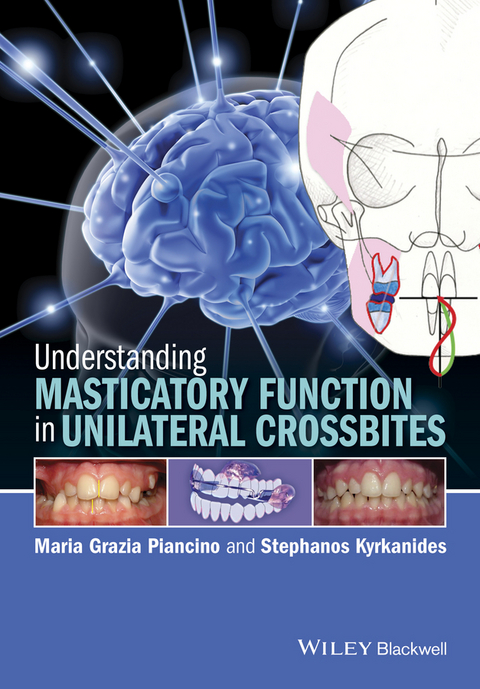
Understanding Masticatory Function in Unilateral Crossbites (eBook)
248 Seiten
Wiley-Blackwell (Verlag)
978-1-118-97188-8 (ISBN)
- Describes the physiology and pathology of chewing patterns and muscular activation in humans
- Explains chewing patterns and muscular coordination, and their influence on the growth and harmony of the stomatognathic system
- Clinical instruction for checking and correcting masticatory function and functional asymmetry in order to prevent the relapse of the malocclusion
- Clinical cases walk readers through the treatment of seven crossbites
Maria Grazia Piancino, MD, DDS, PhD, is Aggregate Professor and Researcher in orthodontics at the University of Turin, Turin, Italy. She has more than 25 years' experience in clinical orthodontics and related research. Dr. Piancino has written for numerous international peer-reviewed publications in the field and lectures on mastication, chewing cycles, and orthodontics at scientific conferences and professional meetings internationally. She is widely regarded as an expert in chewing patterns.
Stephanos Kyrkanides, DDS, MS, PhD, is Associate Dean for Research and Faculty Development, and Professor and Chair, Department of Orthodontics and Pediatric Dentistry, Stony Brook University School of Dental Medicine, Stony Brook, New York.
Maria Grazia Piancino, MD, DDS, PhD, is Aggregate Professor and Researcher in orthodontics at the University of Turin, Turin, Italy. She has more than 25 years' experience in clinical orthodontics and related research. Dr. Piancino has written for numerous international peer-reviewed publications in the field and lectures on mastication, chewing cycles, and orthodontics at scientific conferences and professional meetings internationally. She is widely regarded as an expert in chewing patterns. Stephanos Kyrkanides, DDS, MS, PhD, is Associate Dean for Research and Faculty Development, and Professor and Chair, Department of Orthodontics and Pediatric Dentistry, Stony Brook University School of Dental Medicine, Stony Brook, New York.
Understanding Masticatory Function in Unilateral Crossbites 3
Contents 7
Foreword 9
Preface 10
Masticatory Function as a Reference Point 10
A Consistent Reasoning from Diagnosis to Therapy 11
How to Use This Book 12
Acknowledgments 13
Chapter 1 Introductory Explanation of Masticatory Function 15
1.1 Introduction 16
1.2 The study of masticatory function 20
1.2.1 The case gnathic replicator 22
1.2.2 The Sirognathograph 23
1.3 The evolution of electrognathography and electromyography 24
1.3.1 Plotted masticatory cycles 24
1.3.2 1983: Early computer processing of plotted data on chewing cycles 26
1.3.3 1986: First recording of chewing cycles in alignment with electromyography of the masseter and anterior temporalis muscles – customization of software 27
1.3.4 1992: Replacement of the Sirognathograph with a customized K6-I kinesiograph instrument – rewriting of the software 30
1.3.5 2002: From K6-I to a customized and portable K7-I – the software is rewritten again 33
1.4 From the 1980s to today 37
1.4.1 The bolus 37
1.4.2 The protocol 37
1.5 Ready to start 38
References 40
Chapter 2 Physiology of Mastication: The Chewing Pattern and asticatory Function 42
2.1 Introduction 43
2.2 Features of masticatory function 43
2.2.1 Functional 43
2.2.2 Rhythmic 45
2.2.3 Semi-automatic 46
2.3 Terminology 48
2.3.1 Bolus side 49
2.3.2 Contralateral side to bolus side 49
2.3.3 Maximum functional intercuspation 49
2.3.4 Occlusal phase of closure 49
2.3.5 Muscular coordination 49
2.3.6 Adjustment to load 50
2.3.7 Chewing pattern 50
2.3.8 Reverse-sequencing chewing cycle 50
2.3.9 Adjustment 50
2.3.10 Compensation 51
2.3.11 Sagittal condylar pattern 51
2.3.12 Acronyms used in this book 51
2.4 The chewing pattern 51
2.4.1 First molar pattern 52
2.4.2 Condylar pattern in the frontal plane 54
2.4.3 Condylar pattern in the sagittal plane during chewing in deciduous and permanent dentition 56
2.5 The chewing pattern as an indicator of masticatory function 57
2.5.1 Symmetry and alternating movement 59
2.5.2 Repetitivity and variability 60
2.5.3 Diagnostic indices of chewing patterns 61
References 72
Chapter 3 Physiology of Mastication: Neuromuscular Control of Masticatory Function 75
3.1 Importance of the motor activity 76
3.2 The nervous system 79
3.2.1 The spinal cord 80
3.2.2 Medulla oblongata and pons 81
3.2.3 The cerebellum 81
3.2.4 The mesencephalon (midbrain) 81
3.2.5 The diencephalon 81
3.2.6 The cortical and subcortical structures 82
3.3 Receptors in the stomatognathic system 83
3.3.1 Receptors of the temporomandibular joint 84
3.3.2 Periodontal mechanoreceptors 85
3.3.3 Muscular receptors 89
3.4 Reflex movements 90
3.4.1 Closing reflexes (comparable to spinal extensor reflexes) 90
3.4.2 Opening reflexes (comparable to spinal flexor reflexes) 90
3.5 Automatic movements 91
3.6 Motor control: feedback and feed-forward 95
3.7 Neuromuscular control 97
3.7.1 General characteristics of masticatory muscles 98
3.7.2 Microscopic characteristics of masticatory muscles 99
3.8 Coordination of masticatory muscles during mastication 101
3.8.1 Coordinated activity of masticatory muscles 101
3.8.2 Activation of the masseter and anterior temporalis muscles in patients with normal occlusion 102
3.9 Neuromuscular adjustment to load 105
References 108
Chapter 4 Alterations to Masticatory Function in Unilateral Crossbites 112
4.1 Introduction 113
4.2 Crossbite=neuromuscular syndrome 114
4.2.1 Definition 115
4.2.2 Prevalence 116
4.2.3 Etiology 117
4.2.4 Functional classification 118
4.3 Unilateral posterior crossbite 121
4.3.1 Definition 121
4.3.2 Dental classification 122
4.3.3 Basal classification 122
4.4 Alteration to masticatory function in unilateral posterior crossbite 126
4.4.1 Avoiding biases 126
4.4.2 The study of masticatory function during chewing on the crossbite side 127
4.4.3 The study of mastication during chewing on the crossbite and non-crossbite side effects of asymmetry of the malocclusion on function
4.4.4 The study of masticatory function before and after orthognathodontic treatment effects of therapy on function
4.5 Anterior crossbite=neuromuscular syndrome 150
4.5.1 Effects of anterior crossbite on masticatory function 151
References 155
Chapter 5 Therapy with Function Generating Bite Appliance: Actions and Effects on Malocclusion and Masticatory Function 158
5.1 Orthognathodontic therapy aimed to restore physiological neuromuscular equilibrium to the stomatognathic system 159
5.2 Dental–alveolar–basal actions and effects of function generating bite appliances 163
5.2.1 Characteristics of the appliance components 163
5.2.2 Histomorphological issues of the palatal suture as a biological basis for the action of the function generating bite appliance 183
5.2.3 Physiological features of the force developed by functionalizing appliances 187
5.2.4 Recovery of chewing pattern and masticatory function 188
5.2.5 Cranial–maxillofacial basal actions and effects of the Function Generating Bite appliance 189
5.3 Therapy timing and duration and caries-free management 195
5.4 Compliance 196
References 196
Chapter 6 Cases 199
6.1 Introduction 200
6.2 Case 1: Right unilateral posterior crossbite (3 years, 9 months) 200
6.3 Case 2: Right unilateral posterior crossbite (6 years, 4 months) 203
6.4 Case 3: Positional crossbite (7 years, 6 months) 207
6.5 Case 4: Left unilateral posterior crossbite (7 years, 11 months) 214
6.6 Case 5: Right unilateral posterior crossbite (10 years, 3 months) 219
6.7 Case 6: Anterior open bite and left unilateral posterior crossbite (7 years, 9 months) 223
6.8 Case 7: Anterior open bite and bilateral posterior crossbite (7 years, 8 months) 229
Appendix: Terminology Update 239
Index 241
EULA 250
"I would highly recommend this book to postgraduate students, specialists in orthodontics, pedodontics, and stomatognathic physiology, and general dentists. It can be a great reference for anyone treating a young patient whose teeth may be developing in a questionable position." (AJO-DO May 2017)
| Erscheint lt. Verlag | 2.2.2016 |
|---|---|
| Sprache | englisch |
| Themenwelt | Medizin / Pharmazie ► Allgemeines / Lexika |
| Medizin / Pharmazie ► Gesundheitsfachberufe | |
| Medizin / Pharmazie ► Zahnmedizin | |
| Schlagworte | dentistry • Orthodontics • Orthodontik • Zahnmedizin |
| ISBN-10 | 1-118-97188-4 / 1118971884 |
| ISBN-13 | 978-1-118-97188-8 / 9781118971888 |
| Informationen gemäß Produktsicherheitsverordnung (GPSR) | |
| Haben Sie eine Frage zum Produkt? |
 PDF (Adobe DRM)
Kopierschutz: Adobe-DRM
Adobe-DRM ist ein Kopierschutz, der das eBook vor Mißbrauch schützen soll. Dabei wird das eBook bereits beim Download auf Ihre persönliche Adobe-ID autorisiert. Lesen können Sie das eBook dann nur auf den Geräten, welche ebenfalls auf Ihre Adobe-ID registriert sind.
Details zum Adobe-DRM
Dateiformat: PDF (Portable Document Format)
Mit einem festen Seitenlayout eignet sich die PDF besonders für Fachbücher mit Spalten, Tabellen und Abbildungen. Eine PDF kann auf fast allen Geräten angezeigt werden, ist aber für kleine Displays (Smartphone, eReader) nur eingeschränkt geeignet.
Systemvoraussetzungen:
PC/Mac: Mit einem PC oder Mac können Sie dieses eBook lesen. Sie benötigen eine
eReader: Dieses eBook kann mit (fast) allen eBook-Readern gelesen werden. Mit dem amazon-Kindle ist es aber nicht kompatibel.
Smartphone/Tablet: Egal ob Apple oder Android, dieses eBook können Sie lesen. Sie benötigen eine
Geräteliste und zusätzliche Hinweise
Buying eBooks from abroad
For tax law reasons we can sell eBooks just within Germany and Switzerland. Regrettably we cannot fulfill eBook-orders from other countries.
aus dem Bereich