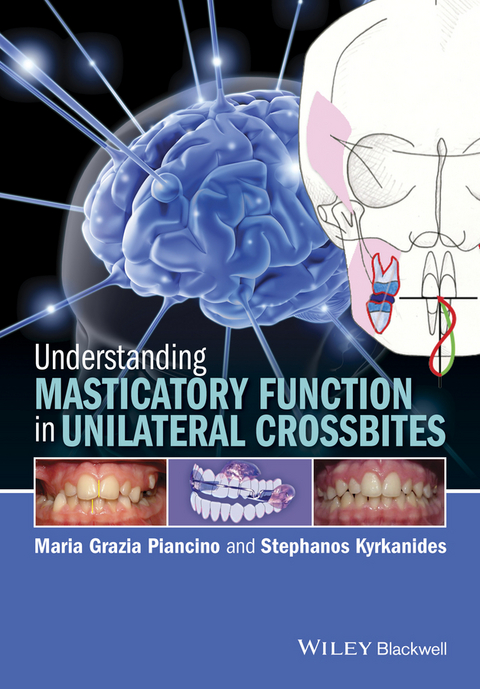
Understanding Masticatory Function in Unilateral Crossbites (eBook)
248 Seiten
Wiley-Blackwell (Verlag)
978-1-118-97189-5 (ISBN)
- Describes the physiology and pathology of chewing patterns and muscular activation in humans
- Explains chewing patterns and muscular coordination, and their influence on the growth and harmony of the stomatognathic system
- Clinical instruction for checking and correcting masticatory function and functional asymmetry in order to prevent the relapse of the malocclusion
- Clinical cases walk readers through the treatment of seven crossbites
Maria Grazia Piancino, MD, DDS, PhD, is Aggregate Professor and Researcher in orthodontics at the University of Turin, Turin, Italy. She has more than 25 years' experience in clinical orthodontics and related research. Dr. Piancino has written for numerous international peer-reviewed publications in the field and lectures on mastication, chewing cycles, and orthodontics at scientific conferences and professional meetings internationally. She is widely regarded as an expert in chewing patterns.
Stephanos Kyrkanides, DDS, MS, PhD, is Associate Dean for Research and Faculty Development, and Professor and Chair, Department of Orthodontics and Pediatric Dentistry, Stony Brook University School of Dental Medicine, Stony Brook, New York.
Maria Grazia Piancino, MD, DDS, PhD, is Aggregate Professor and Researcher in orthodontics at the University of Turin, Turin, Italy. She has more than 25 years' experience in clinical orthodontics and related research. Dr. Piancino has written for numerous international peer-reviewed publications in the field and lectures on mastication, chewing cycles, and orthodontics at scientific conferences and professional meetings internationally. She is widely regarded as an expert in chewing patterns. Stephanos Kyrkanides, DDS, MS, PhD, is Associate Dean for Research and Faculty Development, and Professor and Chair, Department of Orthodontics and Pediatric Dentistry, Stony Brook University School of Dental Medicine, Stony Brook, New York.
Foreword vii
Preface viii
How to Use This Book x
Acknowledgments xi
Chapter 1 Introductory Explanation of Masticatory Function 1
1.1 Introduction 2
1.2 The study of masticatory function 6
1.3 The evolution of electrognathography and electromyography 10
1.4 From the 1980s to today 23
1.5 Ready to start 24
References 26
Chapter 2 Physiology of Mastication: The Chewing Pattern and Masticatory Function 28
2.1 Introduction 29
2.2 Features of masticatory function 29
2.3 Terminology 34
2.4 The chewing pattern 37
2.5 The chewing pattern as an indicator of masticatory function 43
References 58
Chapter 3 Physiology of Mastication: Neuromuscular Control of Masticatory Function 61
3.1 Importance of the motor activity 62
3.2 The nervous system 65
3.3 Receptors in the stomatognathic system 69
3.4 Reflex movements 76
3.5 Automatic movements 77
3.6 Motor control: feedback and feed-forward 81
3.7 Neuromuscular control 83
3.8 Coordination of masticatory muscles during mastication 87
3.9 Neuromuscular adjustment to load 91
References 94
Chapter 4 Alterations to Masticatory Function in Unilateral Crossbites 98
4.1 Introduction 99
4.2 Crossbite=neuromuscular syndrome 100
4.3 Unilateral posterior crossbite 107
4.4 Alteration to masticatory function in unilateral posterior crossbite 112
4.5 Anterior crossbite=neuromuscular syndrome 136
References 141
Chapter 5 Therapy with Function Generating Bite Appliance: Actions and Effects on Malocclusion and Masticatory Function 144
5.1 Orthognathodontic therapy aimed to restore physiological neuromuscular equilibrium to the stomatognathic system 145
5.2 Dental-alveolar-basal actions and effects of function generating bite appliances 149
5.3 Therapy timing and duration and caries-free management 181
5.4 Compliance 182
References 182
Chapter 6 Cases 185
6.1 Introduction 186
6.2 Case 1: Right unilateral posterior crossbite (3 years, 9 months) 186
6.3 Case 2: Right unilateral posterior crossbite (6 years, 4 months) 189
6.4 Case 3: Positional crossbite (7 years, 6 months) 193
6.5 Case 4: Left unilateral posterior crossbite (7 years, 11 months) 200
6.6 Case 5: Right unilateral posterior crossbite (10 years, 3 months) 205
6.7 Case 6: Anterior open bite and left unilateral posterior crossbite (7 years, 9 months) 209
6.8 Case 7: Anterior open bite and bilateral posterior crossbite (7 years, 8 months) 215
References 215
Appendix 225
Index 227
"I would highly recommend this book to postgraduate students, specialists in orthodontics, pedodontics, and stomatognathic physiology, and general dentists. It can be a great reference for anyone treating a young patient whose teeth may be developing in a questionable position." (AJO-DO May 2017)
CHAPTER 1
Introductory Explanation of Masticatory Function
Contents
- 1.1 Introduction
- 1.2 The study of masticatory function
- 1.3 The evolution of electrognathography and electromyography
- 1.3.1 Plotted masticatory cycles
- 1.3.2 1983: Early computer processing of plotted data on chewing cycles
- 1.3.3 1986: First recording of chewing cycles in alignment with electromyography of the masseter and anterior temporalis muscles – customization of software
- 1.3.4 1992: Replacement of the Sirognathograph with a customized K6-I kinesiograph instrument – rewriting of the software
- 1.3.5 2002: From K6-I to a customized and portable K7-I – the software is rewritten again
- 1.4 From the 1980s to today
- 1.5 Ready to start
- References
1.1 Introduction
Mastication is one of the most important functions of the stomatognathic system. It is a highly coordinated neuromuscular operation and features rapid mandibular movements that demand continual modulation and adaptation to load. The nervous system, peripheral receptors (which determine sensory input), and the masticatory muscles (which produce the response from the brain and adaptation of movement) are continually involved during mastication. This is a complex process and plays a fundamental role in the quality of life for patients during childhood, maturity, and old age.
Mastication is a rhythmic and phylogenetically ancient movement. The best-known players in this process are the teeth; these are no longer a vital organ for humans (as they are for animals, for example), but they are still of fundamental importance both in terms of healthy functioning of the stomatognathic system and for social relationships. In fact, the peripheral input arriving from the periodontal receptors of teeth is numerically concentrated, sensitive, highly specialized, and extremely fast in reaching the neural centers allocated to masticatory control. Experimental studies on the topic have identified the mechanisms in animals during phylogenetic development that maintain and control the chewing cycles, mechanisms that are extremely precise in humans too. However, it is the cerebral cortex – which is so developed in human beings that it takes up half of the brain area – that controls the chewing pattern.
At this point, the “clinical physiopathology of masticatory function” becomes of specific interest, particularly the search to link masticatory function with dental occlusion, structural and neuromuscular structures, and the whole brain (Figure 1.1). This scientific interest emerged and was developed during the 1980s at the School of Orthognathic Studies in the University of Turin under the leadership of Professor P. Bracco. From the very outset, he focused on a functional, multidisciplinary, and especially gnathological approach to the diagnosis and therapy of malocclusions. The study and comprehension of masticatory function was supported by this underlying methodology, without which the research carried out would have been limited to the simple publication of statistical results without any true contribution being made to the improvement of diagnostic and therapeutic procedures. Such contribution is, however, the true objective of all research.
Figure 1.1 Linking masticatory function with dental occlusion, cranial structure, and neuromuscular activity.
In the fields of orthognathics and prosthetics, the study of occlusion is extremely important, particularly as the correlation between “occlusion” (involving the teeth of upper and lower dental arches), function, aesthetics, and social relationships becomes increasingly acknowledged. An understanding of the relationships between dental occlusion and neural control has been improved beyond question by gnathological knowledge of occlusion (Figure 1.2). It was also clear from very early on that, in order to understand and establish a meaningful clinical study, the gnathological base would have to be supported by an understanding of neurology. The concepts of functional occlusion and neuromuscular control are very close to the question of medical treatment of the psychophysical aspect of humans. This concept is clearly expressed in Springer’s International Journal of Stomatology and Occlusion Medicine, a title created by Professor R. Slavicek, one of the most important and dedicated modern-day gnathologists. Dentistry deals with one of the most refined anatomical areas of the body from a neuromuscular point of view – it has an incredible ability to adapt, which, instead of being abused, should be studied and understood in all its physiological aspects in order to allow treatments, “cures” even, that improve its functioning and, consequently, the general psychophysical health of the patient. We hope, then, that the study of mastication can help achieve this objective.
Figure 1.2 The stomatognathic system: relationships between dental occlusion, temporomandibular joint (TMJ) and neuromuscular control. Source for the muscles: redrawn from Neff (1999). Source for the brain: Purves et al. (2000). Reproduced with the permission of Sinauer Associates
The information gathered from chewing patterns is important in diagnosing the functional condition of the patient; for example, the repetition and variability of mandibular movement, neuromuscular coordination between the two sides, or the ability to adapt to load while chewing a hard bolus. As the brain is entirely engaged during chewing, the importance of this study from a clinical point of view is clear, but the technical, statistical–mathematical, and numeric difficulties have meant that only professionals working specifically in this field have been involved in the research so far. One aspect of evolution is to simplify complex processes, and this is the aim of this book, a first step in this direction. The fine-tuning of functional magnetic resonance imaging (fMRI) has allowed the study of neural control in humans, which we hope will permit us to better understand the functioning of the central nervous system.
The study of masticatory function began at the University of Turin in the 1980s, when the first devices for recording human chewing patterns were produced and sold. The necessary hardware and software were developed and fine-tuned over many years, thanks to the fundamental and collaborative work of the bioengineers Professor D. Farina and Dr A. Merlo. We will later look at the intrinsic difficulties encountered in the study of functional movement from a statistical–mathematical point of view, which were overcome thanks to the skill and effort of these professionals – without their contribution, none of the results later achieved would have been possible. Not only the bioengineers, but also many researchers, professionals, students, and volunteers dedicated their time and energy to this research, even during the period when its clinical significance was still unclear. We believe it important to underline this contribution to clinical research, which requires a true and homogeneous team who all offer hard work and intellectual integrity, albeit in different capacities. These elements, along with a smidgeon of good luck (or, rather, the open-minded approach necessary to identify an important finding amongst millions of others) are essential in achieving scientifically valid and sound results. True research (which presupposes the objective of increasing and developing knowledge) requires skill and passion, as opposed to personal interests connected to obscure indexes of scientific impact. Using research results that have clarified the correlation between masticatory function and occlusion as a starting point, two new directions have emerged thanks to a collaborative partnership between Professor G. Anastasi (University of Messina Italy) and Professor P. Bramanti (IRCCS Centro Neurolesi “Bonino Pulejo,” Messina, Italy) – the study in fMRI of neural control during chewing and the histological and biomolecular study of the sarcoglycan–integrin system of the masseter muscle:
- The use of fMRI has allowed the study of neural control in human chewing (Figure 1.3) and represents a step forward in the correlated research not only in dentistry but also, and principally, at a neurological level because it has permitted us to widen our knowledge about the central nervous system via the study of a complex automatism i.e., mastication. Both neural control of mastication and the phenomenon of occlusion differ greatly in their characteristics with regard to human beings as opposed to most species of animals (particularly small laboratory animals). Thus, the study of mastication is now moving beyond the confines of dentistry, the area in which it started, to develop within the field of human neurology and contribute, hopefully, to the understanding of much more serious and debilitating conditions than malocclusion.
- The morphological and biomolecular aspects of masticatory muscles are currently a focus of interest. Despite the fact that considerable information exists, various questions still remain about these muscles that are...
| Erscheint lt. Verlag | 4.2.2016 |
|---|---|
| Sprache | englisch |
| Themenwelt | Medizin / Pharmazie ► Allgemeines / Lexika |
| Medizin / Pharmazie ► Gesundheitsfachberufe | |
| Medizin / Pharmazie ► Zahnmedizin | |
| Schlagworte | dentistry • Orthodontics • Orthodontik • Zahnmedizin |
| ISBN-10 | 1-118-97189-2 / 1118971892 |
| ISBN-13 | 978-1-118-97189-5 / 9781118971895 |
| Informationen gemäß Produktsicherheitsverordnung (GPSR) | |
| Haben Sie eine Frage zum Produkt? |
Kopierschutz: Adobe-DRM
Adobe-DRM ist ein Kopierschutz, der das eBook vor Mißbrauch schützen soll. Dabei wird das eBook bereits beim Download auf Ihre persönliche Adobe-ID autorisiert. Lesen können Sie das eBook dann nur auf den Geräten, welche ebenfalls auf Ihre Adobe-ID registriert sind.
Details zum Adobe-DRM
Dateiformat: EPUB (Electronic Publication)
EPUB ist ein offener Standard für eBooks und eignet sich besonders zur Darstellung von Belletristik und Sachbüchern. Der Fließtext wird dynamisch an die Display- und Schriftgröße angepasst. Auch für mobile Lesegeräte ist EPUB daher gut geeignet.
Systemvoraussetzungen:
PC/Mac: Mit einem PC oder Mac können Sie dieses eBook lesen. Sie benötigen eine
eReader: Dieses eBook kann mit (fast) allen eBook-Readern gelesen werden. Mit dem amazon-Kindle ist es aber nicht kompatibel.
Smartphone/Tablet: Egal ob Apple oder Android, dieses eBook können Sie lesen. Sie benötigen eine
Geräteliste und zusätzliche Hinweise
Buying eBooks from abroad
For tax law reasons we can sell eBooks just within Germany and Switzerland. Regrettably we cannot fulfill eBook-orders from other countries.
aus dem Bereich