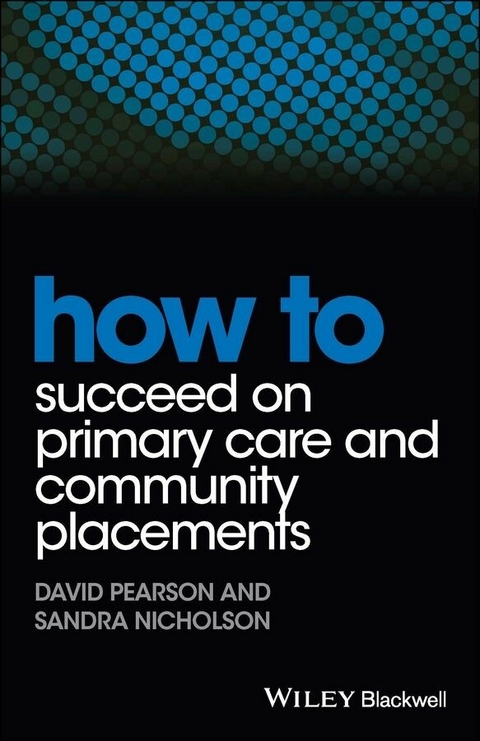
How to Succeed on Primary Care and Community Placements (eBook)
John Wiley & Sons (Verlag)
978-1-118-34343-2 (ISBN)
How to Succeed on Primary Care and Community Placements offers practical advice on how to get the most from your time on community visits, within patient consultations, and with the practice team. It highlights the unique opportunities and challenges you will face on placement, from using clinical information systems, to home visits and long term patient relationships, and how to take advantage of new ways of learning with web-based tools, mobile devices and social networking.
Key features include:
• Learning outcomes at the start of each chapter with links to web-based learning, case examples, and tasks to undertake whilst on placement
• An evidence-based, practical approach to improving learning, teaching, assessment and feedback in community settings
Written by a team of experienced community-based medical education specialists, it is ideal for all medical students, whether on early clinical placements or later in training, and for tutors and preceptors looking for novel ways to engage their students.
How to Succeed on Primary Care and Community Placements offers practical advice on how to get the most from your time on community visits, within patient consultations, and with the practice team. It highlights the unique opportunities and challenges you will face on placement, from using clinical information systems, to home visits and long term patient relationships, and how to take advantage of new ways of learning with web-based tools, mobile devices and social networking.Key features include: Learning outcomes at the start of each chapter with links to web-based learning, case examples, and tasks to undertake whilst on placement An evidence-based, practical approach to improving learning, teaching, assessment and feedback in community settingsWritten by a team of experienced community-based medical education specialists, it is ideal for all medical students, whether on early clinical placements or later in training, and for tutors and preceptors looking for novel ways to engage their students.
David Pearson is a?General Practitioner and?Director, Academy of Primary Care, Hull York Medical School, York. Sandra Nicholson is Lead, Academic Unit for Community-Based Medical Education, Barts and The London School of Medicine and Dentistry, London.
Chapter 1
What to learn in community settings
With Ann O’Brien
Introduction
Medicine is best learned from patients, and patients overwhelmingly engage with healthcare in their own community settings. Increasingly modern healthcare is structured to occur in community settings, and it necessarily follows that much of medicine can, and we believe should, be learned in these settings. This chapter highlights aspects of the undergraduate syllabus common to many medical schools that you will have the chance to learn in primary care and the community as you progress through your undergraduate curriculum. In Chapter 2 we focus particularly on public health and health promotion aspects of medicine, and in later chapters we explore the practicalities.
Helping you appreciate all that you can learn while on a community placement will motivate you to make the most of your time. This is important because some topics will only be covered during your time in the community and hence it’s useful for you to know how these learning opportunities may present. There are additionally many opportunities for you to see how community-based medical education complements and puts into perspective the science and theoretical learning you do at university and also your hospital-based experiences.
By the end of this chapter you should be able to:
- be aware of what areas of your curriculum can be covered within the community
- understand how early attachments lay the foundations for later clinical placements
- appreciate how this book will help support you to make the most of such learning opportunities
Making the most of your community time whether you eventually become a general practitioner (GP), hospital physician or surgeon is time well spent as what you learn in this setting will make you better clinicians.
It is important that medical students receive clinical experience in a range of healthcare settings. The healthcare system in the UK is varied, increasingly decentralised and subject to change. A varied medical education and clinical experience can help students adapt to these differences and changes when they graduate. Clinical placements should start early in the undergraduate curriculum.
Furthermore:
Placements should reflect the changing patterns of healthcare and must provide experience in a variety of environments including hospitals, general practices and community medical services.
(GMC Tomorrow’s Doctors, 2009)
This chapter is divided into four sections: early years, middle years, later years and further opportunities which reflect the range of community attachments occurring within an undergraduate medical curriculum. Each section outlines what you and your tutors might expect such a placement, at that time of the curriculum, to deliver. You will have different opportunities depending on how your medical school delivers its curriculum, but there is often a common core syllabus with similar aims and learning objectives. Although much of this book focuses on a UK perspective, the principles and many examples are of relevance if you are a student studying outside of the United Kingdom. Community placements are designed to provide increasing clinical exposure and responsibility across the years as you become more knowledgeable. Equally the concept of longitudinal integrated clerkships (LICs) is gathering momentum in medical education; primary and community care will tend to have a disproportionate role in delivering these longitudinal experiences and the advantages they are thought to bring. Ultimately all these placements aim to help you to prepare for independent clinical practice.
Take a look at what some of the world’s leading medical educationalists have to say about what competencies a doctor should have (CanMEDS Framework; http://www.royalcollege.ca/portal/page/portal/rc/canmeds/framework) or what the UK’s General Medical Council has to say (http://www.gmc-uk.org/education/undergraduate/tomorrows_doctors.asp):
The curriculum will include practical experience of working with patients throughout all years, increasing in duration and responsibility so that graduates are prepared for their responsibilities as provisionally registered doctors. It will provide enough structured clinical placements to enable students to demonstrate the ‘outcomes for graduates’ across a range of clinical specialties, including at least one student assistantship period.
GMC (2009) Tomorrow’s Doctors; Para 84
Early years
Meeting patients, learning how and why some people become ill, and how to help them were some of the reasons why you wanted to become doctors. The social and psychological aspects of health and illness are well covered during community attachments. You will therefore be able to learn about how patients’ lives and work affect their health and experience of disease.
This is one of the important learning outcomes stated by GMC:
Explain sociological factors that contribute to illness, the course of the disease and the success of treatment including issues relating to health inequalities, the links between occupation and health and the effects of poverty and affluence.
GMC (2009) Tomorrow’s Doctors: Outcomes 1 The doctor as scholar and a scientist
TASK
Why not take another look at the GMC’s document ‘Tomorrow’s Doctors, 2009’ or its equivalent alternatives such as the Scottish Doctor or the CanMEDS (for links, see reference section) and see what you need to know and what can be covered during your community placements.
Meeting your first patient as a medical student can seem daunting, and you may also feel that your patient may have unrealistic expectations of what you know and can do. Early patient contact often occurs within primary care and the community and sets a student’s mind at ease, increases your confidence and begins to make you feel like you are learning to be a real doctor, ensuring your theoretical knowledge is grounded in a patient-centred holistic framework.
Early on, it is easy to fixate on skills you think you lack, or believe that you must have answers for the patient, or be able to diagnose illness. In reality, this is an opportunity to develop innate skills that underpin this diagnostic ability. Learning how to talk to patients, empathise with their problems and appreciate the impact of illness on their life without a diagnostic or history taking agenda may be the most valuable thing you develop in your entire medical career.
(Final year medical student)
What to learn during early patient contact
Community placements are an opportunity for you to meet patients early on. Often referred to as early patient contact (EPC), these placements focus on authentic patient interactions, encourage you to appreciate the psycho-social aspects of medicine and contribute to your growing understanding of the varying roles of different health professionals involved in multi-professional team working (Dornan and Bundy, 2004). Opportunities will be available for you to actively engage with patients in a safe clinical environment, helping you to reflect on developing your communication skills and attitudes towards patients and illness. This is an important task which should complement your growing scientific knowledge. Becoming a doctor requires you to learn from a structured curriculum that balances learning to know with learning to care.
Benefits of early patient contact:
- Brings alive your scientific learning
- Encourages confidence in students
- Sets the scene for later clinical learning
- Develops a patient-centred approach
TASK
Introduce yourself to a patient by explaining who you are and that you would like to find out how their health affects them. Consider how you should best approach this interaction with a patient and whether there are any ethical issues involved such as confidentiality.
Community-based EPC provides you with a learning environment which integrates scientific and clinical education. With a more holistic view of medicine you will be able to better appreciate the clinical context of the underlying biomedical principles you are learning about elsewhere (Dahle et al., 2002). Your early clinical exposure contextualises the science you need to learn in order to fully understand the clinical scenarios, which you will engage with later on in your training (Dornan and Bundy, 2004). If you have been enthusiastic and engaged with earlier clinical opportunities that highlight the centrality of patients, you will feel better prepared and more confident when you start your clinical placements later. Primary care often reflects opportunities to meet with patients, who in their own environments, feel empowered to talk with you, and share their experiences with you, more so than when they are hospitalised.
TASK
Speak to your community tutor. Explain what you have recently covered at medical school. Your tutors should understand the content of your curriculum but their experiences at medical school may be very different compared to yours. Then discuss how the medical science that you are learning can be applied to the clinical situations you see each day.
Professionalism and personal...
| Erscheint lt. Verlag | 22.1.2016 |
|---|---|
| Reihe/Serie | HOW - How To |
| HOW - How To | How To |
| Sprache | englisch |
| Themenwelt | Medizin / Pharmazie ► Allgemeines / Lexika |
| Medizin / Pharmazie ► Gesundheitswesen | |
| Medizin / Pharmazie ► Medizinische Fachgebiete | |
| Schlagworte | Allgemeinpraxis, hausärztliche Praxis • Allgemeinpraxis, hausärztliche Praxis • General Practice/Family Practice • medical education • Medical Professional Development • Medical Science • Medizin • Medizinstudium • Perspektiven in medizinischen Berufen • Primary, Care, Community, Placements, clinical, non-clinical, skills,clinical method, clinical skills, teaching, assessment, third sector, charities, local authorities, NHS, Teamwork, practice, teams, home, visits, information, systems, social, media |
| ISBN-10 | 1-118-34343-3 / 1118343433 |
| ISBN-13 | 978-1-118-34343-2 / 9781118343432 |
| Informationen gemäß Produktsicherheitsverordnung (GPSR) | |
| Haben Sie eine Frage zum Produkt? |
 EPUB (Adobe DRM)
Kopierschutz: Adobe-DRM
Adobe-DRM ist ein Kopierschutz, der das eBook vor Mißbrauch schützen soll. Dabei wird das eBook bereits beim Download auf Ihre persönliche Adobe-ID autorisiert. Lesen können Sie das eBook dann nur auf den Geräten, welche ebenfalls auf Ihre Adobe-ID registriert sind.
Details zum Adobe-DRM
Dateiformat: EPUB (Electronic Publication)
EPUB ist ein offener Standard für eBooks und eignet sich besonders zur Darstellung von Belletristik und Sachbüchern. Der Fließtext wird dynamisch an die Display- und Schriftgröße angepasst. Auch für mobile Lesegeräte ist EPUB daher gut geeignet.
Systemvoraussetzungen:
PC/Mac: Mit einem PC oder Mac können Sie dieses eBook lesen. Sie benötigen eine
eReader: Dieses eBook kann mit (fast) allen eBook-Readern gelesen werden. Mit dem amazon-Kindle ist es aber nicht kompatibel.
Smartphone/Tablet: Egal ob Apple oder Android, dieses eBook können Sie lesen. Sie benötigen eine
Geräteliste und zusätzliche Hinweise
Buying eBooks from abroad
For tax law reasons we can sell eBooks just within Germany and Switzerland. Regrettably we cannot fulfill eBook-orders from other countries.
aus dem Bereich