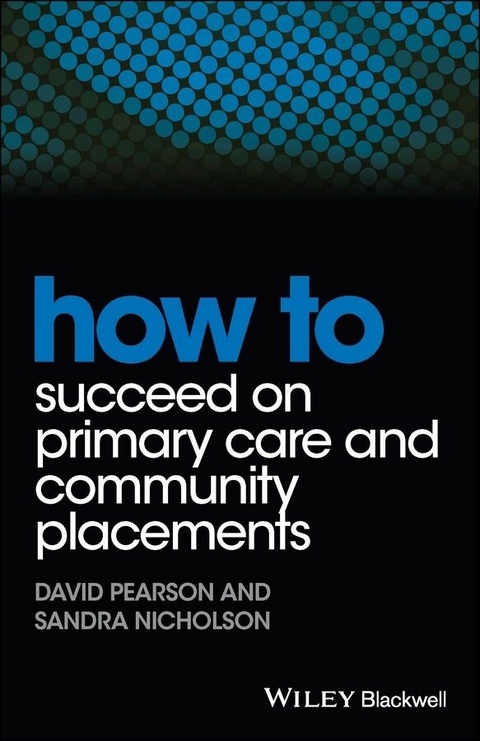
How to Succeed on Primary Care and Community Placements (eBook)
John Wiley & Sons (Verlag)
978-1-118-34342-5 (ISBN)
How to Succeed on Primary Care and Community Placements offers practical advice on how to get the most from your time on community visits, within patient consultations, and with the practice team. It highlights the unique opportunities and challenges you will face on placement, from using clinical information systems, to home visits and long term patient relationships, and how to take advantage of new ways of learning with web-based tools, mobile devices and social networking.
Key features include:
• Learning outcomes at the start of each chapter with links to web-based learning, case examples, and tasks to undertake whilst on placement
• An evidence-based, practical approach to improving learning, teaching, assessment and feedback in community settings
Written by a team of experienced community-based medical education specialists, it is ideal for all medical students, whether on early clinical placements or later in training, and for tutors and preceptors looking for novel ways to engage their students.
David Pearson is a?General Practitioner and?Director, Academy of Primary Care, Hull York Medical School, York.
Sandra Nicholson is Lead, Academic Unit for Community-Based Medical Education, Barts and The London School of Medicine and Dentistry, London.
How to Succeed on Primary Care and Community Placements offers practical advice on how to get the most from your time on community visits, within patient consultations, and with the practice team. It highlights the unique opportunities and challenges you will face on placement, from using clinical information systems, to home visits and long term patient relationships, and how to take advantage of new ways of learning with web-based tools, mobile devices and social networking.Key features include: Learning outcomes at the start of each chapter with links to web-based learning, case examples, and tasks to undertake whilst on placement An evidence-based, practical approach to improving learning, teaching, assessment and feedback in community settingsWritten by a team of experienced community-based medical education specialists, it is ideal for all medical students, whether on early clinical placements or later in training, and for tutors and preceptors looking for novel ways to engage their students.
David Pearson is a?General Practitioner and?Director, Academy of Primary Care, Hull York Medical School, York. Sandra Nicholson is Lead, Academic Unit for Community-Based Medical Education, Barts and The London School of Medicine and Dentistry, London.
Title Page 5
Copyright Page 6
Contents 7
Contributors 12
Introduction 13
Acknowledgements 17
Chapter 1 What to learn in community settings 19
Introduction 19
Early years 21
What to learn during early patient contact 22
Professionalism and personal growth 23
Patient perspectives on health and healthcare 26
Social and psychological aspects of health 27
Learning clinical method (history taking and examination) 29
Clinical and procedural skills 31
Middle clinical years 32
Learning clinical medicine in primary care 32
Learning about specialities in primary care 35
Mental health 39
Later clinical years 40
Learning about primary care 41
Learning about prescribing and management plans 41
Learning in the community ‘out of hours’ 43
Further opportunities 44
Selected student components and electives 44
Rural, remote health and other interesting placements 45
Audits and research projects 46
Summary 47
References 47
Further resources 48
Chapter 2 Learning the public health aspects of medicine 50
Public health perspectives 50
Health promotion 53
Primary and secondary disease prevention 54
Behaviour change: health promotion and prevention for individuals 56
Public health and health education 57
Summary 59
References 59
Chapter 3 Preparing for and learning on primary care and community placements 60
Introduction 60
Preparing for your community placements 63
How to get there 63
Health and safety on community placements 64
When you arrive on placements 65
Professionalism on community placements 66
Professional appearance 68
Practicalities while on placement 68
Developing personal learning plans and goals 71
Active learning – getting involved 72
Learning to be a doctor 74
Your responsibilities at the end of your placement 77
Summary 78
References 79
Chapter 4 Active learning in the consultation 80
Introduction 80
Learning objectives, learning plans 81
Learning consultation skills 82
Understanding the consultation 83
The art of consultation 84
Engaging with patients, introductions, information, consent 85
Engaging with patients 85
Introductions and information 86
What about consent for your being in the room? 86
Working with patients 86
Active learning in the consultation 89
Active listening 89
Active observation 90
Active involvement in consultation 91
Student-led consultations 94
Problems, pitfalls and suggested solutions 95
Complex consultations for the later clinical years 97
Consultations with children 97
Consultations across language barriers 98
Confidentiality in the consultation 99
Conflict 99
Summary 100
References 101
Chapter 5 What to learn from the primary healthcare team 103
Introduction 104
Professional behaviour in a team 105
Knowledge of team working 106
Skills for team working 107
Attitudes to teamwork 107
What the PHCT does 108
Learning with and from the primary healthcare team 113
Shadowing professionals 113
Enhancing clinical skills and practical procedures 113
Learning from the practice nurses 116
Immunisation 116
Travel vaccination 117
Learning from the pharmacy team 118
Repeat prescribing 119
Prescribing in elderly patients and those with multiple long-term conditions 120
Learning about adherence and patient safety issues 121
Primary health team meetings 123
Learning from mistakes 124
Patients and public involvement in your education 125
Summary 127
References 127
Further resources 128
Chapter 6 Learning medicine in community settings 129
Learning from community visits 130
Learning from doctor’s home visits 131
Visiting residential care and nursing homes 133
Learning from community mental health teams 134
Drug and alcohol services 134
Long-term mental healthcare in the community 137
Community mental health for the elderly 138
Community maternity and child health services 139
Pregnancy, childbirth and early newborn care 139
Children’s services in the community 140
Community sexual health services 140
Palliative and end of life care 141
Summary 144
References 144
Further resources 145
Chapter 7 Clinical information systems, opportunities to learn 146
What are clinical information systems? 146
Why learn about clinical information systems? 147
Clinical information systems in community practice 148
Making the most of the CIS in learning and teaching 148
What do clinical information systems offer in the diagnosis and management of acute illnesses? How do they support your learning of these conditions? 150
Clinical decision marking/clinical reasoning 150
Clinical management support in primary care 151
Support for learning about ‘minor illness’ 152
How do clinical information systems support the management of long-term conditions? How can they support your learning about this vital area of medicine? 152
Reminders, recalls and templates: why is this important to learn? 154
Learning from clinical guidelines 156
How can clinical information systems support the learning of prescribing (and patient safety)? 157
Family medicine, using clinical information systems to learn public health aspects – what do you need to know? 159
Clinical information systems: supporting learning about communication with patients, and colleagues 161
Using clinical information systems in supporting assessment 162
Clinical information systems: problems and pitfalls 163
Smart cards, information governance, confidentiality 164
Obtaining your access to clinical information systems 164
Information governance: what do you need to know? 165
Clinical information systems: projects, audit and research 166
Summary 167
References 168
Chapter 8 Supporting learning in primary care using social media and other technologies 169
Social media in your primary care placements 170
When media becomes social media 171
Social media landscape 172
Your online profile and digital professionalism 173
Your digital footprint 173
Doctors and patients online 174
Digital literacy and information literacy 175
Social media sites: Facebook, Twitter, Blogs, Wikis, YouTube, Slideshare/Prezi, Scoop.it/Pinterest 177
Facebook 178
Blogs 178
Twitter 179
Wikispaces 180
YouTube 181
Scoop.it/Pinterest 182
Summary 182
References 183
Further resources 184
Chapter 9 Assessment, feedback and quality assurance 185
Assessment in your primary care placement 186
Principles of assessment 186
Types of assessment 187
Assessments in medical courses, what should you expect? 187
What types of assessment should you expect on your primary care placements? 189
Assessment of contribution 189
Formative assessment 190
Summative assessment 191
How can you best use your time on primary care placements to survive (or even excel) in your medical school assessments? 192
Direct feedback on performance 192
Objective Structured Clinical Examinations (OSCE) 193
Long cases, linked OSCE stations and Objective Structured Long Examination Record (OSLER) 193
Workplace-based assessments (WPBA) 194
Using clinical portfolios in assessment 194
Some potential strengths of assessment in primary care 195
Longitudinal integrated clerkships and authentic assessments 195
Learning and assessment from written work and projects 196
Embedding learning about long-term conditions and multi-morbidity 196
Assessing professionalism, principles and portfolios 197
Opportunities for self-assessment in primary care settings 199
Some final thoughts: why authenticity in assessment matters 199
Feedback within your primary care placement 200
Types of feedback in primary care placements 202
Feedback from your tutor 202
Feedback from peers 203
Feedback from more senior colleagues and ‘near peers’ 203
Multisource (or 360 degree) feedback 203
Feedback from patients 204
Feedback from carers and family members 205
Giving and receiving feedback 205
Giving something back – your responsibility to offer feedback 206
Educational standards and quality assurance 206
Quality assurance of placements 207
Quality assurance of teaching practices 207
Clinical care and clinical governance, what role can you play? 208
Summary 209
References 210
Chapter 10 Conclusions: Looking to the future 212
Reference 215
Index 216
EULA 230
| Erscheint lt. Verlag | 22.1.2016 |
|---|---|
| Reihe/Serie | HOW - How To |
| HOW - How To | How To |
| Sprache | englisch |
| Themenwelt | Medizin / Pharmazie ► Allgemeines / Lexika |
| Medizin / Pharmazie ► Gesundheitswesen | |
| Medizin / Pharmazie ► Medizinische Fachgebiete | |
| Schlagworte | Allgemeinpraxis, hausärztliche Praxis • Allgemeinpraxis, hausärztliche Praxis • General Practice/Family Practice • medical education • Medical Professional Development • Medical Science • Medizin • Medizinstudium • Perspektiven in medizinischen Berufen • Primary, Care, Community, Placements, clinical, non-clinical, skills,clinical method, clinical skills, teaching, assessment, third sector, charities, local authorities, NHS, Teamwork, practice, teams, home, visits, information, systems, social, media |
| ISBN-10 | 1-118-34342-5 / 1118343425 |
| ISBN-13 | 978-1-118-34342-5 / 9781118343425 |
| Informationen gemäß Produktsicherheitsverordnung (GPSR) | |
| Haben Sie eine Frage zum Produkt? |
 PDF (Adobe DRM)
Kopierschutz: Adobe-DRM
Adobe-DRM ist ein Kopierschutz, der das eBook vor Mißbrauch schützen soll. Dabei wird das eBook bereits beim Download auf Ihre persönliche Adobe-ID autorisiert. Lesen können Sie das eBook dann nur auf den Geräten, welche ebenfalls auf Ihre Adobe-ID registriert sind.
Details zum Adobe-DRM
Dateiformat: PDF (Portable Document Format)
Mit einem festen Seitenlayout eignet sich die PDF besonders für Fachbücher mit Spalten, Tabellen und Abbildungen. Eine PDF kann auf fast allen Geräten angezeigt werden, ist aber für kleine Displays (Smartphone, eReader) nur eingeschränkt geeignet.
Systemvoraussetzungen:
PC/Mac: Mit einem PC oder Mac können Sie dieses eBook lesen. Sie benötigen eine
eReader: Dieses eBook kann mit (fast) allen eBook-Readern gelesen werden. Mit dem amazon-Kindle ist es aber nicht kompatibel.
Smartphone/Tablet: Egal ob Apple oder Android, dieses eBook können Sie lesen. Sie benötigen eine
Geräteliste und zusätzliche Hinweise
Buying eBooks from abroad
For tax law reasons we can sell eBooks just within Germany and Switzerland. Regrettably we cannot fulfill eBook-orders from other countries.
aus dem Bereich