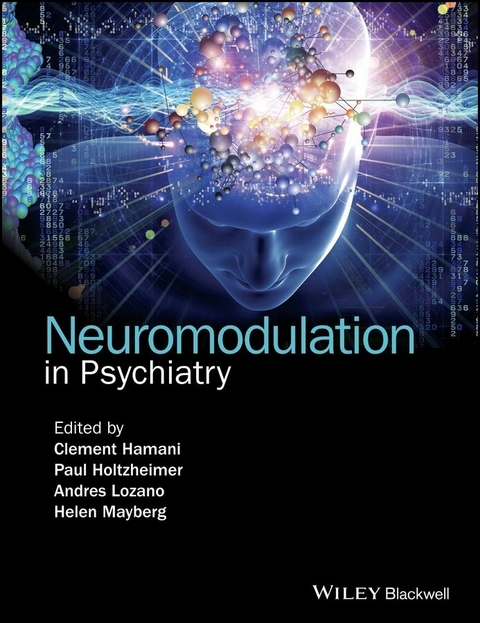
Neuromodulation in Psychiatry (eBook)
John Wiley & Sons (Verlag)
978-1-118-80106-2 (ISBN)
Edited by an expert multidisciplinary team, Neuromodulation in Psychiatry is the first reference guide to address both invasive and non-invasive neuromodulation strategies used in psychiatry.
- Covers basic principles, technical aspects, clinical applications and ethical considerations
- Presents up-to-date evidence in comprehensive summaries suitable for all levels of experience
- Each technique is clearly explained along with its implications for real-world clinical practice
- Allows psychiatrists to make informed decisions regarding neuromodulation for their patients
Clement Hamani
Division of Neurosurgery, Toronto Western Hospital, University of Toronto
Centre for Addiction and Mental Health
Paul Holtzheimer
Departments of Psychiatry and Surgery, Geisel School of Medicine at Dartmouth, Dartmouth-Hitchcock Medical Center
Andres Lozano
Division of Neurosurgery, Toronto Western Hospital
Helen Mayberg
Departments of Psychiatry, Neurology and Radiology, Emory University School of Medicine
Neuromodulation in Psychiatry Neuromodulation in Psychiatry This is the first comprehensive and detailed reference work that focuses on neuromodulation strategies in psychiatry. Neuromodulation strategies are no longer confined to tertiary hospitals but are used in community practices and even by individual psychiatrists. Surgery for psychiatric disorders is one of the main advances in the field of functional neurosurgery. Neuromodulation in psychiatry includes chapters on the history of this controversial field and the ethics of modern usage of such techniques. Specific chapters are devoted to neuromodulation and surgical strategies used in psychiatry including transcranial magnetic stimulation, transcranial direct current stimulation, vagus nerve stimulation, direct cortical stimulation and deep brain stimulation. A chapter describes the basic principles of each techniques, using figures and schematics to illustrate details for people who do not have personal experience of using these techniques. Another chapter then focuses on the results of clinical research, trials and applications for that strategy. Written by an expert multidisciplinary editorial team across the fields of neurosurgery, psychiatry and neurology, this title: Encompasses basic principles, technical aspects and clinical applications including ethical considerations Clearly explains each technique with implications for clinical practice Presents evidence in a comprehensive summary suitable for all levels Allows psychiatrists to evaluate results obtained using such strategies and to make decisions regarding the best course of treatment for their patients An essential reference guide for psychiatrists, psychologists neurosurgeons, neurologists and respective trainees. The book is the first comprehensive reference work to cover all neuromodulation strategies now used or with potential use in psychiatry. It allows psychiatrists to evaluate results obtained using such strategies and to make decision regarding the best course of treatment for their patients.
Clement Hamani Division of Neurosurgery, Toronto Western Hospital, University of Toronto Centre for Addiction and Mental Health Paul Holtzheimer Departments of Psychiatry and Surgery, Geisel School of Medicine at Dartmouth, Dartmouth-Hitchcock Medical Center Andres Lozano Division of Neurosurgery, Toronto Western Hospital Helen Mayberg Departments of Psychiatry, Neurology and Radiology, Emory University School of Medicine
Contributors, vii
1 History of invasive brain stimulation in psychiatry: Lessons for the current practice of neuromodulation, 1
Marwan Hariz
2 Ethics of neuromodulation in psychiatry, 15
Joseph J. Fins and Barbara R. Pohl
3 Neurocircuits commonly involved in psychiatric disorders and their stimulation and lesion therapies, 27
Sarah R. Heilbronner, Ziad Safadi and Suzanne N. Haber
4 Magnetic resonance imaging in neuromodulation, 49
Jonathan Downar and Karen D. Davis
5 Nuclear medicine in neuromodulation, 81
Alexandra M. Rodman and Darin D. Dougherty
6 Basic principles of deep brain and cortical stimulation, 101
Caio Matias, Scott Lempka and Andre Machado
7 Electrophysiology in neuromodulation: Current concepts of the mechanisms of action of electrical and magnetic cortical stimulation, 111
Jean?]Pascal Lefaucheur
8 Transcranial magnetic stimulation: Introduction and technical aspects, 125
Yiftach Roth, Gaby S. Pell and Abraham Zangen
9 Magnetic stimulation for depression: Subconvulsive and convulsive approaches, 155
Andrada D. Neacsiu and Sarah Hollingsworth Lisanby
10 Repetitive transcranial magnetic stimulation for psychiatric disorders other than depression, 181
Daniel M. Blumberger, Mera S. Barr and Zafiris J. Daskalakis
11 Direct current stimulation: Introduction and technical aspects, 203
André Russowsky Brunoni and Felipe Fregni
12 Transcranial direct current stimulation, 227
Colleen Loo and Donel Martin
13 Deep brain stimulation: Introduction and technical aspects, 245
Willard S. Kasoff and Robert E. Gross
14 Deep brain stimulation: Clinical results in treatment?]resistant depression, 277
Shane J. McInerney, Peter Giacobbe, Anna Cyriac and Sidney H. Kennedy
15 Deep brain stimulation for the treatment of obsessive-compulsive disorder, 295
Michael Giffin, Martijn Figee and Damiaan Denys
16 Deep brain stimulation: Emerging indications, 309
Yasin Temel, Sarah Hescham, Maartje Melse and Veerle Visser?]Vandewalle
17 Vagus nerve stimulation: Introduction and technical aspects, 325
Jared Pisapia and Gordon Baltuch
18 Vagus nerve stimulation for treatment?]refractory depression, 335
Charles R. Conway, Britt M. Gott and Naazia H. Azhar
19 Gamma Knife radiosurgery: Introduction and technical aspects, 353
Alessandra A. Gorgulho and Antônio A.F. De Salles
20 Gamma knife surgery: Clinical results, 369
Antonio Carlos Lopes, Marcelo Batistuzzo, Andre Felix Gentil, Marcelo Queiroz Hoexter and Euripedes Constantino Miguel
21 Radiofrequency lesions: Introduction and technical aspects, 385
Seth F. Oliveria, Kristopher G. Hooten and Kelly D. Foote
22 Ablative procedures in psychiatric neurosurgery, 399
David Huie, Joshua P. Aronson and Emad N. Eskandar
23 Electroconvulsive therapy: Introduction and technical aspects, 429
Sandarsh Surya, Peter B. Rosenquist and W. Vaughn McCall
24 Electroconvulsive therapy: Clinical results, 455
Malek Bajbouj
25 Neuromodulation in psychiatry: Conclusions, 467
Paul Holtzheimer, Helen Mayberg, Andres M. Lozano and Clement Hamani
Index, 471
| Erscheint lt. Verlag | 29.12.2015 |
|---|---|
| Sprache | englisch |
| Themenwelt | Medizin / Pharmazie ► Gesundheitsfachberufe |
| Medizin / Pharmazie ► Medizinische Fachgebiete ► Psychiatrie / Psychotherapie | |
| Schlagworte | Basic principles • Chirurgie u. chirurgische Spezialgebiete • Clinical applications • clinical practice • controversial • ethics • Evidence • invasive • Medical Science • Medizin • Neurologie • Neurology • Neuromodulation • neurostimulation • neurosurgery • non-invasive • Psychiatrie • Psychiatry • Reference • Review • schematics • specialized procedures • Surgery & Surgical Specialities • Technical aspects • techniques |
| ISBN-10 | 1-118-80106-7 / 1118801067 |
| ISBN-13 | 978-1-118-80106-2 / 9781118801062 |
| Informationen gemäß Produktsicherheitsverordnung (GPSR) | |
| Haben Sie eine Frage zum Produkt? |
 EPUB (Adobe DRM)
Kopierschutz: Adobe-DRM
Adobe-DRM ist ein Kopierschutz, der das eBook vor Mißbrauch schützen soll. Dabei wird das eBook bereits beim Download auf Ihre persönliche Adobe-ID autorisiert. Lesen können Sie das eBook dann nur auf den Geräten, welche ebenfalls auf Ihre Adobe-ID registriert sind.
Details zum Adobe-DRM
Dateiformat: EPUB (Electronic Publication)
EPUB ist ein offener Standard für eBooks und eignet sich besonders zur Darstellung von Belletristik und Sachbüchern. Der Fließtext wird dynamisch an die Display- und Schriftgröße angepasst. Auch für mobile Lesegeräte ist EPUB daher gut geeignet.
Systemvoraussetzungen:
PC/Mac: Mit einem PC oder Mac können Sie dieses eBook lesen. Sie benötigen eine
eReader: Dieses eBook kann mit (fast) allen eBook-Readern gelesen werden. Mit dem amazon-Kindle ist es aber nicht kompatibel.
Smartphone/Tablet: Egal ob Apple oder Android, dieses eBook können Sie lesen. Sie benötigen eine
Geräteliste und zusätzliche Hinweise
Buying eBooks from abroad
For tax law reasons we can sell eBooks just within Germany and Switzerland. Regrettably we cannot fulfill eBook-orders from other countries.
aus dem Bereich