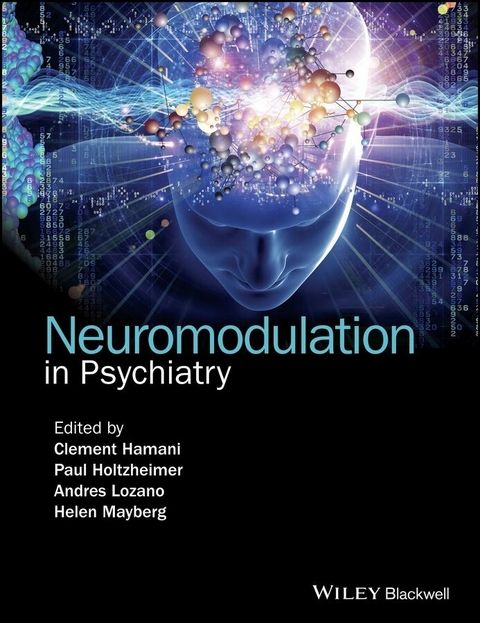
Neuromodulation in Psychiatry (eBook)
John Wiley & Sons (Verlag)
978-1-118-80105-5 (ISBN)
Edited by an expert multidisciplinary team, Neuromodulation in Psychiatry is the first reference guide to address both invasive and non-invasive neuromodulation strategies used in psychiatry.
- Covers basic principles, technical aspects, clinical applications and ethical considerations
- Presents up-to-date evidence in comprehensive summaries suitable for all levels of experience
- Each technique is clearly explained along with its implications for real-world clinical practice
- Allows psychiatrists to make informed decisions regarding neuromodulation for their patients
Clement Hamani
Division of Neurosurgery, Toronto Western Hospital, University of Toronto
Centre for Addiction and Mental Health
Paul Holtzheimer
Departments of Psychiatry and Surgery, Geisel School of Medicine at Dartmouth, Dartmouth-Hitchcock Medical Center
Andres Lozano
Division of Neurosurgery, Toronto Western Hospital
Helen Mayberg
Departments of Psychiatry, Neurology and Radiology, Emory University School of Medicine
Neuromodulation in Psychiatry Neuromodulation in Psychiatry This is the first comprehensive and detailed reference work that focuses on neuromodulation strategies in psychiatry. Neuromodulation strategies are no longer confined to tertiary hospitals but are used in community practices and even by individual psychiatrists. Surgery for psychiatric disorders is one of the main advances in the field of functional neurosurgery. Neuromodulation in psychiatry includes chapters on the history of this controversial field and the ethics of modern usage of such techniques. Specific chapters are devoted to neuromodulation and surgical strategies used in psychiatry including transcranial magnetic stimulation, transcranial direct current stimulation, vagus nerve stimulation, direct cortical stimulation and deep brain stimulation. A chapter describes the basic principles of each techniques, using figures and schematics to illustrate details for people who do not have personal experience of using these techniques. Another chapter then focuses on the results of clinical research, trials and applications for that strategy. Written by an expert multidisciplinary editorial team across the fields of neurosurgery, psychiatry and neurology, this title: Encompasses basic principles, technical aspects and clinical applications including ethical considerations Clearly explains each technique with implications for clinical practice Presents evidence in a comprehensive summary suitable for all levels Allows psychiatrists to evaluate results obtained using such strategies and to make decisions regarding the best course of treatment for their patients An essential reference guide for psychiatrists, psychologists neurosurgeons, neurologists and respective trainees. The book is the first comprehensive reference work to cover all neuromodulation strategies now used or with potential use in psychiatry. It allows psychiatrists to evaluate results obtained using such strategies and to make decision regarding the best course of treatment for their patients.
Clement Hamani Division of Neurosurgery, Toronto Western Hospital, University of Toronto Centre for Addiction and Mental Health Paul Holtzheimer Departments of Psychiatry and Surgery, Geisel School of Medicine at Dartmouth, Dartmouth-Hitchcock Medical Center Andres Lozano Division of Neurosurgery, Toronto Western Hospital Helen Mayberg Departments of Psychiatry, Neurology and Radiology, Emory University School of Medicine
Title Page 5
Copyright Page 6
Contents 7
Contributors 9
CHAPTER 1 History of invasive brain stimulation in psychiatry: Lessons for the current practice of neuromodulation 13
The birth, rise and fall of the 20th-century psychiatric DBS 14
What went wrong? 15
The contemporary discourse on psychiatric neuromodulation 18
Twenty-first century DBS: a tool for enhancement and social control? 20
Lessons learned for current practice 20
Conclusions 23
Acknowledgements 24
Disclosures 24
References 24
CHAPTER 2 Ethics of neuromodulation in psychiatry 27
Introduction 27
A brief history 27
History with a difference 29
Autonomy and the self 30
Informed consent 31
Proportionality: weighing individual benefits and harms 32
Distinguishing research from therapy 33
Neuromodulation research and the marketplace 33
A palliative care ethos 35
Conclusion 35
References 36
CHAPTER 3 Neurocircuits commonly involved in psychiatric disorders and their stimulation and lesion therapies 39
Introduction 39
Circuits of OCD, depression, schizophrenia and addiction 39
The prefrontal cortex 39
Striatum 42
WM pathways 43
Anterior limb of the internal capsule 44
Cingulum bundle 46
Uncinate fasciculus 47
Corpus callosum 47
Stimulation and lesion therapeutic approaches for psychiatric illnesses 48
Deep brain stimulation 48
Lesions: Capsulotomy and cingulotomy 50
TMS and tDCS in the dlPFC 50
Conclusions 51
References 51
CHAPTER 4 Magnetic resonance imaging in neuromodulation 61
Introduction 61
What can MRI offer the field of psychiatry? 61
MRI measures of grey matter 62
MRI measures of white matter and structural connectivity (DTI) 62
MRI measures of functional activity and functional connectivity 64
Functional activation within a brain region 64
Functional connectivity between brain regions 64
Dynamic functional connectivity 66
Regional cerebral blood flow measured with arterial spin labelling 67
Detecting functional and structural MRI abnormalities 67
Analysing network-level patterns in resting brain activity 68
Neuromodulation in the MRI environment 69
Repetitive transcranial magnetic stimulation 69
Transcranial direct current stimulation 70
Deep brain stimulation 70
Uses of MRI in neuromodulation 71
Identification of stimulation targets using structural and functional MRI 71
Repetitive transcranial magnetic stimulation 72
Transcranial direct current stimulation 73
Deep brain stimulation 74
Neuronavigation using MRI 74
Transcranial magnetic stimulation 74
Transcranial direct current stimulation 75
Deep brain stimulation 78
Characterizing the effects of neuromodulation using MRI 78
Transcranial direct current stimulation 78
Transcranial magnetic stimulation 79
DBS 81
Optimizing individual treatment parameters using MRI 82
Neuromodulatory effects of MRI itself 83
Conclusions 84
Acknowledgements 84
References 85
CHAPTER 5 Nuclear medicine in neuromodulation 93
Introduction 93
Basic principles of PET 95
Gamma ray detection 95
What can PET measure? 96
Radiopharmaceuticals 96
Clinical research applications 98
Pathophysiology of psychiatric illness 99
Major depressive disorder 99
Obsessive–compulsive disorder 100
Neuromodulation 101
Electroconvulsive therapy 101
Mechanistic changes 101
Transcranial magnetic stimulation and transcranial direct current stimulation 102
Functional targets 102
Mechanistic changes 103
Predictors 103
Vagus nerve stimulation 104
Mechanistic changes 104
Predictors 104
Ablative procedures 104
Mechanisms 105
Predictors 105
Deep brain stimulation 105
Functional targets 106
Mechanistic changes 106
Predictor studies 107
Discussion 107
References 107
CHAPTER 6 Basic principles of deep brain and cortical stimulation 113
The electrode 113
Effects of electrical stimulation on tissue 114
Voltage-gated sodium and potassium channels 114
Action potentials 114
Neuron 115
Distance to electrode 115
Strength-duration relationship 116
Orthodromical and antidromical propagation 116
Stimulation configuration 116
Cathode-anode configuration 117
Charge and charge density 117
Amplitude versus pulse width 118
Deep brain stimulation – specific concerns 118
Cortical stimulation 119
References 120
CHAPTER 7 Electrophysiology in neuromodulation: Current concepts of the mechanisms of action of electrical and magnetic cortical stimulation 123
References 129
CHAPTER 8 Transcranial magnetic stimulation: Introduction and technical aspects 137
Background 137
Historical background 137
Physical principles of TMS 138
Neuronal activation 138
Mechanisms that activate a neuron when stimulated 138
Cable equation 140
Long and curved axons 143
Nerve terminals and constrictions 144
TMS electronics 144
TMS circuit design 144
Pulse waveforms and sequences of pulses 146
The relationship of rTMS and synaptic plasticity 148
Coil design and construction 153
Types of TMS coils 153
Targeting deep neuronal structures 157
Electrical safety and technical considerations 158
Summary 161
References 161
CHAPTER 9 Magnetic stimulation for depression: Subconvulsive and convulsive approaches 167
Introduction 167
Definitions and regulatory status 168
Transcranial magnetic stimulation (TMS) 168
Magnetic seizure therapy (MST) 171
Comparing and contrasting actions of TMS, MST and ECT 171
Magnetic field (TMS and MST only) 172
Electric field (TMS, MST and ECT) 173
Neuronal depolarization (TMS, MST and ECT) 173
Seizure (MST and ECT only) 174
Subconvulsive TMS for depression treatment 174
Repetitive transcranial magnetic stimulation (rTMS) 174
Deep transcranial magnetic stimulation (dTMS) 179
Safety 181
Method of motor threshold assessment 182
Mechanisms of antidepressant action 182
Plasticity 182
Connectivity 183
Neural oscillations 184
Magnetic seizure therapy (MST) for depression 184
Conclusions 186
References 186
CHAPTER 10 Repetitive transcranial magnetic stimulation for psychiatric disorders other than depression 193
Introduction 193
rTMS in schizophrenia 193
rTMS applied to the DLPFC in schizophrenia 193
Conclusion 196
rTMS in addiction 199
rTMS in tobacco dependence 199
rTMS for cocaine dependence 200
rTMS for methamphetamine dependence 201
rTMS in alcohol dependence 201
Conclusion 201
rTMS for post-traumatic stress disorder 202
Conclusion 203
rTMS for cognitive disorders 203
Conclusion 204
rTMS for obsessive–compulsive disorder 204
Conclusion 205
Summary 206
References 206
CHAPTER 11 Direct current stimulation:: Introduction and technical aspects 215
Introduction 215
Historical remarks 215
Technical aspects 216
Electrode positioning 218
Parameters associated with tDCS effects 218
Safety and contraindications 219
Mechanisms of action of tDCS 219
Electrophysiological studies 221
Pharmacological studies 222
Computer?modelling studies 222
Preclinical studies of tDCS 223
Clinical aspects 224
Adverse effects, safety and tolerability 224
Sham methods of tDCS 227
Similarities and differences of tDCS compared to other neuromodulatory techniques 228
tDCS in special populations 229
Ethical aspects 229
Conclusion 231
Appendix 11.A? Positioning and montage of electrodes for tDCS 231
Materials 231
Identification of scalp areas for electrode positioning 231
The procedure 231
References 232
CHAPTER 12 Transcranial direct current stimulation 239
Introduction and technical aspects 239
History of transcranial direct current stimulation (tDCS) 239
Technical aspects 239
Mechanisms of action 241
Safety considerations 241
Clinical results 242
Studies of tDCS to treat depression 242
tDCS in the treatment of schizophrenia 247
Maintenance of treatment effects 248
Cognitive enhancing effects of tDCS 248
Future directions 250
References 251
CHAPTER 13 Deep brain stimulation: Introduction and technical aspects 257
Introduction 257
History of stereotaxy and deep brain stimulation 257
Mechanism of action 259
Advantages of DBS vs. ablation 260
Procedural and technical aspects of DBS 260
DBS equipment 260
Patient selection: general considerations 262
Medical fitness and pre-operative evaluation 262
DBS: procedural considerations 263
Coordinate systems and atlases 263
Stereotactic frames and ‘frameless’ aiming devices 265
Accuracy 267
Frame placement 267
Imaging 268
Operating room set-up and surgical planning 268
Anaesthetic considerations 269
Opening 269
Target selection 271
Physiological mapping and lead placement 272
Intraoperative radiological control 274
Closure and recovery 274
Intraoperative emergencies 275
Pulse generator placement 275
Post-operative care 276
Internal pulse generator programming 276
IPG replacement 276
Complications 276
Surgical complications 277
Stimulation-related adverse effects 277
Hardware-related complications 277
Future directions 279
References 280
CHAPTER 14 Deep brain stimulation: : Clinical results in treatment?resistant depression 289
Introduction and rationale for deep brain stimulation (DBS) for depression 289
Introduction – overview of the field 289
Neurostimulation therapies 289
Indication for use of DBS in depression 289
Clinical targets and anatomical sites for DBS in depression 290
Subcallosal cingulate gyrus 290
Ventral capsule/ventral striatum 293
Nucleus accumbens 293
Medial forebrain bundle 294
Other experimental targets – ITP and lateral habenula (LHb) 294
Current registered randomized controlled trials for TRD trials 294
Adverse effects of DBS 296
Surgery 296
Post-operative 297
Hypomania 297
Cognitive 297
Long-term outcomes 298
DBS and suicidal ideation 298
Future direction in DBS 299
Bioethics of DBS 299
Conclusion 300
Acknowledgement 301
References 301
CHAPTER 15 Deep brain stimulation for the treatment of obsessive–compulsive disorder 307
Introduction 307
Efficacy 307
Anterior limb of internal capsule 310
Ventral capsule/ventral striatum 310
Nucleus accumbens 311
Subthalamic nucleus 312
Inferior thalamic peduncle 313
Anteromedial globus pallidus internus 313
Complications and side effects of DBS 314
Response prediction 314
Conclusion DBS in OCD 316
References 316
CHAPTER 16 Deep brain stimulation: Emerging indications 321
Introduction 321
Addiction 321
Alzheimer’s disease 324
Disorders of consciousness 327
Schizophrenia 328
Aggressiveness 329
Anorexia nervosa 331
Conclusion 332
References 332
CHAPTER 17 Vagus nerve stimulation: Introduction and technical aspects 337
Introduction 337
Preclinical studies 337
Mechanism of VNS 338
Device 338
Surgical anatomy 340
Pre-operative evaluation 340
Surgical implantation 340
Stimulation programming 342
Battery change and system removal 343
Adverse events 343
Conclusion 344
References 344
CHAPTER 18 Vagus nerve stimulation for treatment-refractory depression 347
Introduction and rationale for VNS in treatment?refractory major depression (TRD) 347
Rationale for the use of VNS in TRD 347
How the VNS device applies current to the Vagus 348
The vagus nerve 349
Afferent vagal pathways 349
Afferent vagal projections to the thalamus and cerebrum 350
Results of clinical trials 350
Side effects and contraindications for VNS therapy in TRD patients 354
Side effects and adverse events associated with VNS in TRD 354
Contraindications for VNS in TRD 355
Clinical use of VNS in TRD 357
Indications for use of VNS in TRD 357
Managing the patient undergoing VNS 357
What constitutes a good VNS response in TRD? 360
The future of VNS in TRD 360
Future research directions 361
References 361
CHAPTER 19 Gamma Knife radiosurgery: Introduction and technical aspects 365
Introduction 365
The inception of the Gamma Knife 366
Collimation system 367
Robotic capabilities 368
Flow of patient treatment 369
Placement of the stereotactic frame 369
Treatment planning 369
Dosimetry 370
Functional lesion considerations 370
Prescribing to a point 370
Prescribing to a volume 371
Considerations of volumetric dosimetry 372
Radiation dose fall-off 372
Homogeneity 372
Volume shaping techniques 373
Imaging for radiosurgery 373
Clinical applications 374
Penetration worldwide 375
Technical aspects of specific treatment planning 375
Obsessive compulsive disorder 375
Conclusion 377
References 378
CHAPTER 20 Gamma knife surgery: Clinical results 381
Introduction 381
Historical background and operative techniques 381
Indications 383
Ethical issues 383
Selection criteria for surgical interventions 383
Selection criteria 383
Efficacy and safety 383
Neuropsychological changes 391
Comparative pros and cons of GK and DBS for treating mental disorders 392
Conclusion 392
References 393
CHAPTER 21 Radiofrequency lesions: Introduction and technical aspects 397
Introduction 397
Neuroanatomic basis for RFL in psychiatric conditions 398
Psychiatric indications for RFL 398
General principles of stereotactic brain RFL 400
RFL procedures for psychiatric indications 403
Anterior cingulotomy 403
Anterior capsulotomy 404
Subcaudate tractotomy 405
Limbic leucotomy 406
Conclusions 406
References 407
CHAPTER 22 Ablative procedures in psychiatric neurosurgery 411
Introduction 411
Depression 411
Cognitive models 413
Depression circuitry 413
Amygdala 413
Prefrontal cortex 415
Anterior cingulate cortex 416
Additional brain regions 416
Bipolar disorder 417
Obsessive-compulsive disorder 417
Cortico-striato-thalamo-cortical (CSTC) circuits 418
Striatum 418
Prefrontal cortices 418
Addiction 420
Surgical approaches to therapy 422
Anterior capsulotomy 423
Anterior cingulotomy 426
Subcaudate tractotomy 428
Limbic leucotomy 429
Conclusions 430
References 431
CHAPTER 23 Electroconvulsive therapy: Introduction and technical aspects 441
Introduction 441
Indications of ECT 442
Major depression 442
Mania 442
Schizophrenia 443
Catatonia and NMS 443
Parkinson’s disease 443
Status epilepticus 443
Technical aspects 444
Apparatus 444
Treatment 452
Therapeutic mechanisms of ECT 454
Acknowledgement 459
References 459
CHAPTER 24 Electroconvulsive therapy: Clinical results 467
Indication 467
Contraindications 468
Efficacy 469
Tolerability 474
Perspective 476
References 476
CHAPTER 25 Neuromodulation in psychiatry: Conclusions 479
References 481
Index 483
Supplemental Images 495
EULA 519
| Erscheint lt. Verlag | 29.12.2015 |
|---|---|
| Sprache | englisch |
| Themenwelt | Medizin / Pharmazie ► Gesundheitsfachberufe |
| Medizin / Pharmazie ► Medizinische Fachgebiete ► Psychiatrie / Psychotherapie | |
| Schlagworte | Basic principles • Chirurgie u. chirurgische Spezialgebiete • Clinical applications • clinical practice • controversial • ethics • Evidence • invasive • Medical Science • Medizin • Neurologie • Neurology • Neuromodulation • neurostimulation • neurosurgery • non-invasive • Psychiatrie • Psychiatry • Reference • Review • schematics • specialized procedures • Surgery & Surgical Specialities • Technical aspects • techniques |
| ISBN-10 | 1-118-80105-9 / 1118801059 |
| ISBN-13 | 978-1-118-80105-5 / 9781118801055 |
| Informationen gemäß Produktsicherheitsverordnung (GPSR) | |
| Haben Sie eine Frage zum Produkt? |
 PDF (Adobe DRM)
Kopierschutz: Adobe-DRM
Adobe-DRM ist ein Kopierschutz, der das eBook vor Mißbrauch schützen soll. Dabei wird das eBook bereits beim Download auf Ihre persönliche Adobe-ID autorisiert. Lesen können Sie das eBook dann nur auf den Geräten, welche ebenfalls auf Ihre Adobe-ID registriert sind.
Details zum Adobe-DRM
Dateiformat: PDF (Portable Document Format)
Mit einem festen Seitenlayout eignet sich die PDF besonders für Fachbücher mit Spalten, Tabellen und Abbildungen. Eine PDF kann auf fast allen Geräten angezeigt werden, ist aber für kleine Displays (Smartphone, eReader) nur eingeschränkt geeignet.
Systemvoraussetzungen:
PC/Mac: Mit einem PC oder Mac können Sie dieses eBook lesen. Sie benötigen eine
eReader: Dieses eBook kann mit (fast) allen eBook-Readern gelesen werden. Mit dem amazon-Kindle ist es aber nicht kompatibel.
Smartphone/Tablet: Egal ob Apple oder Android, dieses eBook können Sie lesen. Sie benötigen eine
Geräteliste und zusätzliche Hinweise
Buying eBooks from abroad
For tax law reasons we can sell eBooks just within Germany and Switzerland. Regrettably we cannot fulfill eBook-orders from other countries.
aus dem Bereich