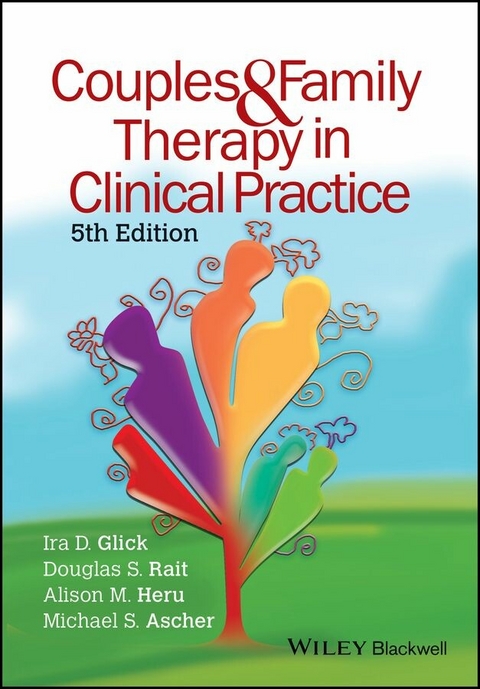
Couples and Family Therapy in Clinical Practice (eBook)
480 Seiten
Wiley-Blackwell (Verlag)
978-1-118-89724-9 (ISBN)
- Fifth edition of a classic text that views couples and family therapy through a psychiatric lens
- Written by clinicians with a biopsychosocial perspective on illness and family dysfunction
- Draws on case studies to present family-oriented interventions in an accessible manner
- Explores underlying principles along with a wide range of practical therapeutic techniques
- Culturally inclusive, enabling readers to work with patients from diverse backgrounds
Ira D. Glick is Professor Emeritus of Psychiatry and Behavioral Sciences and formerly Chief of the Schizophrenia Clinic at Stanford University School of Medicine, USA.
Douglas S. Rait is Clinical Professor of Psychiatry and Behavioral Sciences and Chief of the Couples and Family Therapy Clinic at Stanford University School of Medicine, USA.
Alison M. Heru is Associate Professor of Psychiatry at the University of Colorado, USA.
Michael S. Ascher is Clinical Associate in Psychiatry at the Perelman School of Medicine, University of Pennsylvania, USA.
Ira D. Glick is Professor Emeritus of Psychiatry and Behavioral Sciences and formerly Chief of the Schizophrenia Clinic at Stanford University School of Medicine, USA. Douglas S. Rait is Clinical Professor of Psychiatry and Behavioral Sciences and Chief of the Couples and Family Therapy Clinic at Stanford University School of Medicine, USA. Alison M. Heru is Associate Professor of Psychiatry at the University of Colorado, USA. Michael S. Ascher is Clinical Associate in Psychiatry at the Perelman School of Medicine, University of Pennsylvania, USA.
Forewords xix
Ellen M. Berman MD, Lloyd I. Sederer MD
Preface xxvii
Acknowledgments xxxi
A Guide for Using the Text xxxiii
List of Tables xxxvii
List of Figures xxxix
Section I Family Therapy in Context
1 The Field of Couples and Family Therapy: Development and Definition 5
2 Family Life in Historical and Sociological Perspective 23
Section II Functional and Dysfunctional Families
3 Understanding the Functional Family 41
4 Understanding the Functional Family in a Variety of Family Forms 59
5 Problems and Dysfunction from an Integrated Family Systems Perspective 75
Section III Family Evaluation
6 The Process of Evaluation 95
7 The Content of Evaluation 107
8 Formulating an Understanding of the Family Problem Areas 117
Section IV Family Treatment
9 Major Family Therapy Schools and Their Treatment Strategies 137
10 Goals 147
11 Family Treatment: Integrated Strategies and Techniques 157
12 The Course of Family Treatment 175
13 Promoting Change in Family Treatment: Issues of Alliance and Resistance 189
14 Family Therapy: General Considerations203
Section V Couples Therapy
15 Dysfunctional Couples and Couples Therapy 221
16 Sex Couples and Sex Therapy 235
17 Couples and Families Breaking Apart: Separation and Divorce 249
Section VI Family Treatment When One Member Has a Psychiatric Disorder or Other Special Problem
18 Family Treatment in the Context of Individual Psychiatric Disorders 267
19 Family Treatment in the Context of Other Special Problems--Violence to Self and Others 301
20 The Family and Treatment of Acute and Chronic Psychiatric Illness 321
21 Working with Families in the
Section VII Results of and Guidelines for Recommending Family Therapy
23 Controversies Relative Contraindications and the Use and Misuse of Couples and Family Therapy 371
24 Results: The Outcomes of Couples and Family Therapy 381
Section VIII Ethical Professional and Training Issues
25 Ethical and Professional Issues in Couples and Family Therapy 405
Suggested Reading 419
References 419
Index 421
"This superb text on couples and family therapy should be on every psychiatrist's bookshelf. We now view the individual patient as embedded in a family system that must be taken into account to provide state-of-the-art diagnosis and treatment."
--Glen O. Gabbard, MD, Clinical Professor of Psychiatry, Baylor College
"Substance use disorders (SUD) almost always involve family problems. Thus good practice always includes a family evaluation and often a period of family therapy. At the University of Pennsylvania we have conducted and published clinical trials that include medications and family therapy for SUD. Based on our research, we consider family therapy to be an essential component of good practice for the management of SUD."
- Charles P. O'Brien, MD, Ph.D., Kenneth Appel Professor of Psychiatry, University of Pennsylvania School of Medicine
"An essential part of becoming a psychiatrist is learning to work with families to help patients recover. Regardless of whether the intent is to become a family therapist, this key book should be a "must read" for psychiatric residents and clinical fellows alike."
- Maria A. Oquendo, MD, APA President, Chair of the Department of Psychiatry, Perelman School of Medicine, University of Pennsylvania
"Up to date, culturally sensitive, concise, organized, practical; I cannot imagine a more useful book for any therapist working with families. Therapists working in medical or psychiatric settings will find excellent chapters to guide them in bridging the gaps between a family systems and a medical model. EVERY FAMILY THERAPIST SHOULD HAVE THIS BOOK AT THEIR SIDE. It is a wonderful addition to the family therapy literature."
--Ellen Berman, MD, Clinical Professor of Psychiatry, University of Pennsylvania
Preface
Background
The five editions of this textbook of family therapy reflect the history and development of the family field, which has evolved rapidly since the 1960s. The first edition was an outline about a field that was just beginning to grow and gain momentum. The second edition was a statement that the family field, which began in the minds of creative individuals in diverse settings (and often unknown to one another), was blossoming with great enthusiasm. The field had arrived with full gusto, and many clinicians were doing family work and clamoring for theoretical clarity and more training in this form of intervention. The third edition heralded a field that had come of age. It had expanded in scope and was being commonly used in clinical practice.
In 2000, the fourth edition made a statement, like its predecessors, about the current state of the art of family intervention. As we saw it, the field had gone beyond its heyday of enthusiasm and advocacy of family intervention for every clinical condition, to a more sophisticated time of differentiation. This differentiation was taking place on many levels. Examples include differentiating when family therapy is indicated, when the symptoms are under systems control, and when they are more strongly determined by other factors such as biology and genetics; how one evaluates in order to make both individual diagnoses and a family diagnosis; when the whole family is the patient and when the family is best seen as part of the treatment team in order to help the individual with symptoms; and when behavioral or educational strategies of family intervention are particularly helpful. New developments in theory and technique, and a widened lens in terms of specific problem areas, have enriched the field.
Over the past two decades, the most critical changes in family theory are the incorporation of new attitudes and information about ethnicity, gender, sexual orientation, and social class into our theory building. The rules that govern all aspects of family life and the experience of persons in families may be vastly different for men and women. Families may operate by systems principles, but men and women bring to the system different ways of thinking and different types of influence. Norms of closeness and distance, emotional expression, basic aspects of viewing and disciplining children also vary greatly across ethnic group, social class, and age cohort. The integration of this knowledge into the broad principles of family therapy, enabling therapists to work with a wide variety of families, is one of our key goals. Theory building in this area is still in a period of rapid growth and will probably be altered again by the next edition.
More integrative ways of working have replaced narrowly based schools of family therapy, and brief therapy models such as solution-focused and narrative therapy have been added to our armamentarium. New information about previously ignored or inadequately researched issues—such as gay and lesbian families, the sequelae of abuse, the complexities of AIDS, and family response to reproductive events—have enriched our understanding of family life. Family systems medicine has become a new subspecialty in recent years. We hope that this edition adequately reflects this growing sophistication of the field.
Since the publication of the first edition of this book, we have consistently been gratified by the response of both readers and many reviewers, as well as by its adoption by some teachers as the standard introductory text. Since the publication of the second edition, it has been translated into Japanese and Spanish, and parts into Chinese; it has been adopted widely in Italy, England, and other European countries. Because of the growth and changes in the field, as well as suggestions received, we have decided that this is an opportune time to expand and rewrite the text. Most important, we are convinced that the field has matured. Presently there are many established schools of thought that continue to evolve. At the same time, just as in the adjacent field of individual psychotherapy, there is growing interest in adopting a more integrative (rather than parochial) perspective that highlights some of the factors shared by these different models. In this text, we offer our version of an integration of different models of family theory, that is, a framework for trainees and practitioners in the family therapy field and those persons in various fields that need an introduction to family therapy.
Fifth Edition Changes
The fifth edition brings the reader into the twenty-first century with a flowering of this psychotherapy technique. As such, couples and family intervention have become important components of an integrated prescription for the treatment of most mental disorders. The key message is that there is new evidence-based data suggesting that combining family intervention with medication is better than either modality alone.
Our aim/hope is that the material in the text will be used as a core curriculum for both psychiatric residency programs and family therapy institutes. Family interventions have positive implications for the family system as well as the patient who can feel ambivalent about adhering to individual therapy and medications on their own without a family aboard as “a treatment team member.”
As we mentioned, we have not provided detailed information on the details of specific approaches of couple and family psychotherapy. This is not to say other models do not have important virtues or clinical utility. Rather, we have tried to include in our integrated model, the best of their techniques, as such, we have provided some of the crucial elements of the classic models.
We have described some of the classic models, for example “systems, structural, behavioral” in Chapter 1. We mention a few of the newer models in Chapter 9 as they relate to our integrated theory of couples and family therapy. In Chapter 18, we discuss family interventions and certain models used to treat specific mental disorders such as psychoeducation in schizophrenia. We also borrowed heavily from the McMaster Model detailed in the Keitner, Heru, and Glick text entitled Clinical Manual of Couples and Family Therapy (2009).
Although the newer body of knowledge has required extensive rewriting, the basic organization of the book is largely unchanged. The history of the field precedes general concepts of how families function, which are followed by evaluation, treatment, indications, and finally, results.
For this edition, we have highlighted the essentials and have thoroughly updated our chapter on family life in its historical and sociological context, and throughout we have paid special attention to both classic and newer family forms. Our sections on function and dysfunction have been expanded and rewritten to present the latest information on how families globally cope with rapid changes in our society. Given the publication of DSM-5, we have made a thorough review of understanding and treatment of dysfunctional families both for Axis I conditions and for other problems of living together. In our treatment section we have added a special section on treating Axis I disorders by combining medication with family therapy. We have thoroughly rewritten the chapter on treatment as modified by cultural, ethnic, racial, gender, and class considerations.
Our section on marital/couples disorders has been revised thoroughly, including a focus on blended families. In addition we have rewritten the material on LGBTQ (an initialism that stands for lesbian, gay, bisexual, transgender or queer) families. We have added a section on couples and reproductive health. We have expanded in a major way the section on relational disorders including both Axis I disorders and other problems. The chapter on incest, violence, suicide, and the family responses to these problems is also revised.
Based on new outcome data, we have updated the section on guidelines and results (i.e., efficacy). Throughout the text we have made suggestions (where possible) to practitioners regarding how to practice the art of family therapy based on implications of research studies.
The section on family systems medicine has been rewritten thoroughly, adding a general overview of the field from the point of view of the physician (taking care of the medical problems of the patients) as well as from the family systems perspective. We close the book with guidelines and an overview of ethical, financial, and professional issues facing the field, including issues involved with training.
Conclusion
Past readers have been very helpful and generous with their comments for revisions.
Partly because of their suggestions, we have been able to add new chapters, revise chapters from the previous editions, and update the book. For this edition, we have been fortunate to add two new authors, both clinicians and teachers in the field (Alison M. Heru, MD, and Michael Ascher, MD). David Kessler, MD, was a coauthor on earlier editions, and Ellen Berman, MD, and John Clarkin, PhD, were coauthors of the fourth edition. Much of their wisdom still can be found in this revision.
In the last edition, we had many colleagues who contributed to specific topics. In this edition, we have reviewed and updated their sections like “Treatment of a suicidal patient and family” and checked for consistency on such a topic with a related topic (e.g., family treatments of patients with depression). For many of these topics...
| Erscheint lt. Verlag | 26.10.2015 |
|---|---|
| Sprache | englisch |
| Themenwelt | Geisteswissenschaften ► Psychologie ► Familien- / Systemische Therapie |
| Medizin / Pharmazie ► Gesundheitsfachberufe | |
| Medizin / Pharmazie ► Medizinische Fachgebiete ► Psychiatrie / Psychotherapie | |
| Schlagworte | Biopsychosocial • Case Studies • Clinical • Concepts • couples • cultural competency • ethics • Evidence • Family • History • Interventions • Medical Science • Medizin • Practice • Principles • Psychiatric • Psychiatrie • Psychiatry • Research • Social Psychiatry • Sozialpsychiatrie • techniques • Textbook • therapy • Training |
| ISBN-10 | 1-118-89724-2 / 1118897242 |
| ISBN-13 | 978-1-118-89724-9 / 9781118897249 |
| Informationen gemäß Produktsicherheitsverordnung (GPSR) | |
| Haben Sie eine Frage zum Produkt? |
 EPUB (Adobe DRM)
Kopierschutz: Adobe-DRM
Adobe-DRM ist ein Kopierschutz, der das eBook vor Mißbrauch schützen soll. Dabei wird das eBook bereits beim Download auf Ihre persönliche Adobe-ID autorisiert. Lesen können Sie das eBook dann nur auf den Geräten, welche ebenfalls auf Ihre Adobe-ID registriert sind.
Details zum Adobe-DRM
Dateiformat: EPUB (Electronic Publication)
EPUB ist ein offener Standard für eBooks und eignet sich besonders zur Darstellung von Belletristik und Sachbüchern. Der Fließtext wird dynamisch an die Display- und Schriftgröße angepasst. Auch für mobile Lesegeräte ist EPUB daher gut geeignet.
Systemvoraussetzungen:
PC/Mac: Mit einem PC oder Mac können Sie dieses eBook lesen. Sie benötigen eine
eReader: Dieses eBook kann mit (fast) allen eBook-Readern gelesen werden. Mit dem amazon-Kindle ist es aber nicht kompatibel.
Smartphone/Tablet: Egal ob Apple oder Android, dieses eBook können Sie lesen. Sie benötigen eine
Geräteliste und zusätzliche Hinweise
Buying eBooks from abroad
For tax law reasons we can sell eBooks just within Germany and Switzerland. Regrettably we cannot fulfill eBook-orders from other countries.
aus dem Bereich