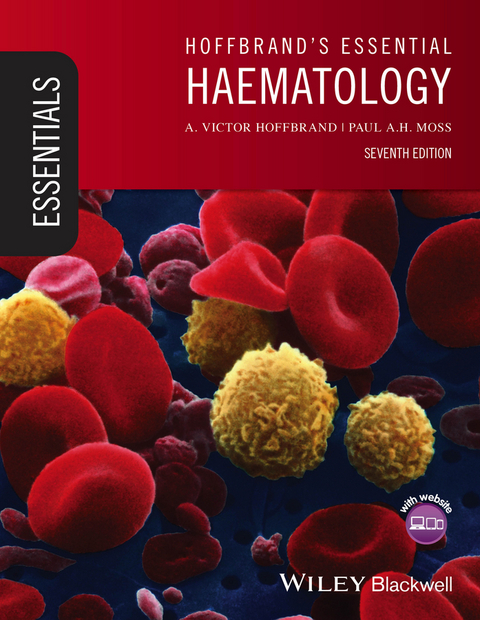
Hoffbrand's Essential Haematology (eBook)
John Wiley & Sons (Verlag)
978-1-118-40864-3 (ISBN)
British Medical Association Book Award Winner - Student Textbook of the Year 2016
The definitive haematology textbook of choice for medical students
Hoffbrand's Essential Haematology has built a reputation as the flagship haematology textbook for both students and junior doctors, providing an authoritative introduction to the subject.
Now in its 7th edition, this classic text provides up-to-date knowledge of the pathogenesis, clinical and laboratory features, treatment of blood and bone marrow disorders, in its concise and user-friendly style.
Hoffbrand's Essential Haematology outlines the basic principles of clinical and laboratory haematology and shows how manifestations of blood diseases can be explained by new knowledge of the disease processes. It is an indispensable resource for students and trainees and an essential read for all specialists who are interested in updating their knowledge.
Hoffbrand's Essential Haematology:
- Provides up-to-date knowledge of the pathogenesis, clinical and laboratory features and treatment of all blood disorders
- Features detailed information on the new genetics of leukaemia and lymphoma
- Includes a new chapter on thrombosis, focussing on the new oral anticoagulants
- Is beautifully presented, with over 300 colour illustrations
- Comprehensively covers both theory and treatment regimes
Includes a companion website at www.wileyessential.com/haematology featuring all the figures and tables from the book, and over 300 interactive multiple choice questions.
This title is also available as a mobile App from MedHand Mobile Libraries. Buy it now from iTunes, Google Play or the MedHand Store.
A. Victor Hoffbrand, MA DM FRCP FRCPath FRCP(Edin) DSc FMedSci; Emeritus Professor of Haematology, University College London; Honorary Consultant Haematologist, Royal Free Hospital, London, UK.
Paul A. H. Moss, PhD MRCP FRCPath; Professor of Haematology, University of Birmingham, Birmingham, UK.
British Medical Association Book Award Winner - Student Textbook of the Year 2016 The definitive haematology textbook of choice for medical students Hoffbrand's Essential Haematology has built a reputation as the flagship haematology textbook for both students and junior doctors, providing an authoritative introduction to the subject. Now in its 7th edition, this classic text provides up-to-date knowledge of the pathogenesis, clinical and laboratory features, treatment of blood and bone marrow disorders, in its concise and user-friendly style. Hoffbrand's Essential Haematology outlines the basic principles of clinical and laboratory haematology and shows how manifestations of blood diseases can be explained by new knowledge of the disease processes. It is an indispensable resource for students and trainees and an essential read for all specialists who are interested in updating their knowledge. Hoffbrand s Essential Haematology: Provides up-to-date knowledge of the pathogenesis, clinical and laboratory features and treatment of all blood disorders Features detailed information on the new genetics of leukaemia and lymphoma Includes a new chapter on thrombosis, focussing on the new oral anticoagulants Is beautifully presented, with over 300 colour illustrations Comprehensively covers both theory and treatment regimes Includes a companion website at www.wileyessential.com/haematology featuring all the figures and tables from the book, and over 300 interactive multiple choice questions. This title is also available as a mobile App from MedHand Mobile Libraries. Buy it now from iTunes, Google Play or the MedHand Store.
A. Victor Hoffbrand, MA DM FRCP FRCPath FRCP(Edin) DSc FMedSci; Emeritus Professor of Haematology, University College London; Honorary Consultant Haematologist, Royal Free Hospital, London, UK. Paul A. H. Moss, PhD MRCP FRCPath; Professor of Haematology, University of Birmingham, Birmingham, UK.
Cover 1
Title Page 5
Copyright 6
Contents 7
Preface to the Seventh Edition 8
Preface to the First Edition 9
How to use your textbook 10
About the companion website 12
CHAPTER 1 Haemopoiesis 13
Site of haemopoiesis 14
Haemopoietic stem and progenitor cells 14
Bone marrow stroma 16
The regulation of haemopoiesis 16
Haemopoietic growth factors 16
Growth factor receptors and signal transduction 18
Adhesion molecules 20
The cell cycle 20
Transcription factors 20
Epigenetics 20
Apoptosis 21
CHAPTER 2 Erythropoiesis and general aspects of anaemia 23
Blood cells 24
Erythropoietin 25
Indications for erythropoietin therapy 28
Haemoglobin 28
Haemoglobin synthesis 28
Haemoglobin function 29
Methaemoglobinaemia 29
The red cell 29
Red cell metabolism 30
Red cell membrane 30
Anaemia 31
Global incidence 31
Clinical features of anaemia 32
Classification and laboratory findings in anaemia 33
Assessment of erythropoiesis 37
CHAPTER 3 Hypochromic anaemias 39
Nutritional and metabolic aspects of iron 40
Body iron distribution and transport 40
Dietary iron 42
Iron absorption 42
Iron requirements 43
Iron deficiency 44
Clinical features 44
Causes of iron deficiency 44
Laboratory findings 45
Investigation of the cause of iron deficiency (Fig. 3.12) 47
Treatment 48
Iron refractory iron deficency anaemia (IRIDA) 49
Anaemia of chronic disorders 49
Sideroblastic anaemia 50
Lead poisoning 51
Differential diagnosis of hypochromic anaemia 51
CHAPTER 4 Iron overload 53
Assessment of iron status and organ function 54
Hereditary haemochromatosis 55
African iron overload 55
Thalassaemia intermedia 55
Transfusional iron overload 56
Iron chelation therapy 57
CHAPTER 5 Megaloblastic anaemias and other macrocytic anaemias 60
Introduction to macrocytic anaemia 61
Megaloblastic anaemias 61
Vitamin B12 (B12, cobalamin) 61
Absorption 61
Transport: the transcobalamins 61
Biochemical function 63
Folate 63
Absorption, transport and function 63
Biochemical basis for megaloblastic anaemia (Fig. 5.5) 64
Folate reduction 64
Vitamin B12 deficiency 64
Pernicious anaemia (PA) 64
Other causes of vitamin B12 deficiency 65
Folate deficiency 65
Clinical features of megaloblastic anaemia 65
Vitamin B12 neuropathy (subacute combined degeneration of the cord) 65
Neural tube defect 67
Other tissue abnormalities 67
Laboratory findings 67
Diagnosis of vitamin B12 or folate deficiency 68
Tests for cause of vitamin B12 or folate deficiency 69
Treatment 69
Response to therapy 70
Other megaloblastic anaemias 70
Abnormalities of vitamin B12 or folate metabolism 70
Other macrocytic anaemias 70
Differential diagnosis of macrocytic anaemias 71
CHAPTER 6 Haemolytic anaemias 72
Normal red cell destruction 73
Introduction to haemolytic anaemias 74
Classification 74
Clinical features 74
Laboratory findings 75
Intravascular and extravascular haemolysis 75
Hereditary haemolytic anaemias 76
Membrane defects 76
Defective red cell metabolism 78
Hereditary disorders of haemoglobin synthesis 80
Acquired haemolytic anaemias 80
Immune haemolytic anaemias 80
Red cell fragmentation syndromes 82
March haemoglobinuria 82
Infections 83
Chemical and physical agents 83
Secondary haemolytic anaemias 83
CHAPTER 7 Genetic disorders of haemoglobin 84
Haemoglobin synthesis 85
Molecular aspects 85
Switch from fetal to adult haemoglobin 86
Haemoglobin abnormalities 86
Thalassaemias 87
??Thalassaemia syndromes 88
??Thalassaemia syndromes 88
Non?transfusion dependent thalassaemia (thalassaemia intermedia) 91
???Thalassaemia 93
Haemoglobin Lepore 93
Hereditary persistence of fetal haemoglobin 93
Association of ??thalassaemia trait with other genetic disorders of haemoglobin 93
Sickle cell anaemia 93
Homozygous disease 93
Clinical features 93
Sickle cell trait 97
Combination of haemoglobin S with other genetic defects of haemoglobin 97
Prenatal diagnosis of genetic haemoglobin disorders 97
DNA diagnosis 97
CHAPTER 8 The white cells 1: granulocytes, monocytes and their benign disorders 99
Granulocytes 101
Neutrophil (polymorph) 101
Neutrophil precursors 101
Monocytes 101
Eosinophils 102
Basophils 102
Granulopoiesis 102
Control of granulopoiesis: myeloid growth factors 102
Clinical applications of G?CSF 103
Monocytes 104
Disorders of neutrophil and monocyte function 104
Chemotaxis (cell mobilization and migration) 104
Phagocytosis 104
Killing and digestion 105
Benign disorders 105
Other rare disorders 106
Common morphological abnormalities 106
Causes of neutrophil leucocytosis 106
The leukaemoid reaction 106
Leucoerythroblastic reaction 106
Neutropenia 107
Benign ethnic neutropenia 107
Congenital neutropenia 107
Drug?induced neutropenia 107
Cyclical neutropenia 107
Autoimmune neutropenia 108
Idiopathic benign neutropenia 108
Diagnosis 108
Management 108
Causes of monocytosis, eosinophil and basophil leucocytosis 108
Monocytosis 108
Eosinophilic leucocytosis (eosinophilia) 108
Basophil leucocytosis (basophilia) 109
Histiocytic and dendritic cell disorders 109
Dendritic cells 109
Langerhans’ cell histiocytosis 110
Haemophagocytic lymphohistiocytosis (haemophagocytic syndrome) 110
Sinus histiocytosis with massive lymphadenopathy 111
Lysosomal storage diseases 111
Gaucher’s disease 111
Niemann–Pick disease 111
CHAPTER 9 The white cells 2: lymphocytes and their benign disorders 114
Lymphocytes 115
B and T lymphocytes 115
Natural killer cells 116
Lymphocyte circulation 118
Immunoglobulins 118
Antigen–receptor gene rearrangements 119
Immunoglobulin gene rearrangements 119
T?cell receptor gene rearrangements 119
Complement 121
The immune response 121
Lymphocytosis 123
Infectious mononucleosis 123
Lymphopenia 125
Immunodeficiency 125
Differential diagnosis of lymphadenopathy 126
CHAPTER 10 The spleen 128
The anatomy and circulation of the spleen 129
The functions of the spleen 129
Control of red cell integrity 129
Immune function 129
Extramedullary haemopoiesis 130
Imaging the spleen 130
Splenomegaly 130
Tropical splenomegaly syndrome 131
Hypersplenism 131
Hyposplenism 132
Splenectomy 132
Prevention of infection in hyposplenic patients 133
CHAPTER 11 The aetiology and genetics of haematological malignancies 134
The incidence of haematological neoplasms 135
The aetiology of haemopoietic malignancy 136
Inherited factors 136
Environmental influences 136
Infection 136
The genetics of haemopoietic malignancy 137
Oncogenes 137
Tyrosine kinases 137
Tumour?suppressor genes 137
Clonal progression 137
Progression of subclinical clonal haematological abnormalities to clinical disease 139
Chromosome nomenclature 139
Telomeres 141
Specific examples of genetic abnormalities in haematological malignancies 141
Point mutation 141
Translocations 141
Deletions 142
Duplication or amplification 142
Epigenetic alterations 142
MicroRNAs 143
Diagnostic methods used to study malignant cells 143
Karyotype analysis 143
Fluorescence in situ hybridization analysis 143
Gene sequencing 143
DNA microarray platforms 143
Flow cytometry 143
Immunohistology (immunocytochemistry) 145
Value of genetic markers in management of haematological malignancy 145
Initial diagnosis 145
For establishing a treatment protocol 145
Monitoring the response to therapy 145
CHAPTER 12 Management of haematological malignancy 147
General support therapy 148
Insertion of a central venous catheter 148
Blood product support 148
Haemostasis support 149
Anti?emetic therapy 149
Tumour lysis syndrome 149
Psychological support 149
Reproductive issues 149
Nutritional support 149
Pain 150
Prophylaxis and treatment of infection 150
Bacterial infection 150
Viral infection 151
Fungal infection 151
Specific therapies for haematological malignancy 152
Drugs used in the treatment of haemopoietic malignancies 152
CHAPTER 13 Acute myeloid leukaemia 157
Classification of leukaemia 158
Diagnosis of acute leukaemia 158
Acute myeloid leukaemia 159
Pathogenesis 159
Incidence 159
Classification 159
Clinical features 160
Investigations 160
Cytogenetics and molecular genetics 161
Treatment 161
Outcome 166
CHAPTER 14 Chronic myeloid leukaemia 168
Chronic myeloid leukaemia 169
Clinical features 171
Laboratory findings 171
Prognostic scores (stages) 171
Treatment 172
Chronic neutrophilic leukaemia 176
Chronic eosinophilic leukaemia 176
CHAPTER 15 Myeloproliferative disease 177
Polycythaemia 180
Classification of polycythaemia 180
Primary polycythaemia (erythrocytosis) 180
Congenital 180
Acquired 180
Polycythaemia vera (PV) 180
Diagnosis 181
Clinical features 181
Laboratory findings 182
Treatment 182
Course and prognosis 183
Congenital causes of primary polycythaemia 183
Secondary polycythaemia 184
Apparent polycythaemia 184
Differential diagnosis of polycythaemia 184
Essential thrombocythaemia 184
Diagnosis 184
Clinical and laboratory findings 185
Prognosis and treatment 185
Course 185
Primary myelofibrosis 185
Clinical features 186
Laboratory findings 186
Treatment 186
Mastocytosis 187
CHAPTER 16 Myelodysplasia 189
Myelodysplasia (myelodysplasticsyndromes, MDS) 190
Pathogenesis 190
Classification 191
Clinical features 192
Laboratory findings 192
Treatment 194
Myelodysplastic/myeloproliferative neoplasms 196
Chronic myelomonocytic leukaemia 196
Atypical chronic myeloid leukaemia 196
Juvenile myelomonocytic leukaemia (JMML) 196
CHAPTER 17 Acute lymphoblastic leukaemia 198
Incidence and pathogenesis 199
Classification 200
Clinical features 200
Bone marrow failure 200
Organ infiltration 200
Investigations 200
Cytogenetics and molecular genetics 201
Treatment 204
General supportive therapy 204
Specific therapy of ALL in children 204
Minimal residual disease 204
Remission induction 204
Intensification (consolidation) 204
Central nervous system?directed therapy 205
Maintenance 205
Treatment of relapse 206
Toxicity 206
Specific therapy of ALL in adults 206
Treatment of BCR?ABL1 positive ALL 207
Prognosis 207
CHAPTER 18 The chronic lymphoid leukaemias 209
Diagnosis 210
B?cell diseases 210
Chronic lymphocytic leukaemia 210
B?cell prolymphocytic leukaemia 214
Hairy cell leukaemia 214
Lymphocytosis in non?Hodgkin lymphomas 215
T?cell diseases 215
T?cell prolymphocytic leukaemia 215
Large granular lymphocytic leukaemia 215
Adult T?cell leukaemia/lymphoma 216
CHAPTER 19 Hodgkin lymphoma 217
History and pathogenesis 218
Clinical features 218
Haematological and biochemical findings 218
Diagnosis and histological classification 219
Clinical staging 220
Positron emission tomography (PET) 221
Treatment 222
Early stage disease 223
Advanced stage disease 223
Assessment of response to treatment 223
Relapsed cases 223
Prognosis 224
The late effects of Hodgkin lymphoma and its treatment 224
CHAPTER 20 Non-Hodgkin lymphoma 225
Introduction to non-Hodgkin lymphoma 226
Classification 226
Low- and high-grade non-Hodgkin lymphoma 226
Pathogenesis 228
Clinical features of non-Hodgkin lymphoma 228
Investigations 228
Staging 230
General principles of treatment of non-Hodgkin lymphoma 232
Specific subtypes of non-Hodgkin lymphoma 232
Low-grade non-Hodgkin lymphoma 232
High-grade non-Hodgkin lymphoma 235
T-cell lymphomas 237
Peripheral T-cell non-Hodgkin lymphoma, unspecified 237
Angioimmunoblastic lymphadenopathy 238
Mycosis fungoides 238
Sézary syndrome 238
Adult T-cell leukaemia/lymphoma 238
Enteropathy-associated T-cell lymphomas 238
Anaplastic large cell lymphoma 238
Histiocytic and dendritic cell neoplasms 238
CHAPTER 21 Multiple myeloma and related disorders 240
Paraproteinaemia 241
Multiple myeloma 241
Pathogenesis 241
Smouldering myeloma 241
Diagnosis 243
Clinical features 243
Treatment 247
Prognosis 249
Other plasma cell tumours 249
Solitary plasmacytoma 249
Plasma cell leukaemia 249
Osteosclerotic myeloma (POEMS syndrome) 249
Monoclonal gammopathy of undetermined significance 249
Amyloidosis 249
Systemic AL amyloidosis 250
Hyperviscosity syndrome 252
CHAPTER 22 Aplastic anaemia and bone marrow failure 254
Pancytopenia 255
Aplastic anaemia 255
Pathogenesis 256
Congenital: Fanconi anaemia (FA) 256
Idiopathic acquired aplastic anaemia 256
Paroxysmal nocturnal haemoglobinuria (PNH) 259
Red cell aplasia 259
Chronic form 259
Transient form 260
Schwachman–Diamond syndrome 261
Congenital dyserythropoietic anaemia 261
Osteopetrosis 261
CHAPTER 23 Stem cell transplantation 262
Principles of stem cell transplantation 263
Collection of stem cells 263
Stem cell processing 263
Conditioning 265
Post-transplant engraftment and immunity 265
Autologous stem cell transplantation 266
Allogeneic stem cell transplantation 267
The human leucocyte antigen (HLA) system 267
Human leucocyte antigen and transplantation 268
Chimaerism analysis 268
Complications 268
Graft-versus-leukaemia effect and donor leucocyte infusions 273
Post-transplant lymphoproliferative diseases 274
CHAPTER 24 Platelets, blood coagulation and haemostasis 276
Platelets 277
Platelet production 277
Platelet structure 278
Platelet antigens 278
Platelet function 279
Blood coagulation 282
The coagulation cascade 282
Coagulation in vivo 282
Endothelial cells 285
Haemostatic response 285
Vasoconstriction 285
Platelet reactions and primary haemostatic plug formation 286
Stabilization of the platelet plug by fibrin 286
Physiological limitation of blood coagulation 286
Fibrinolysis 287
Inactivation of plasmin 288
Tests of haemostatic function 288
Blood count and blood film examination 288
Screening tests of blood coagulation 288
Specific assays of coagulation factors 289
Bleeding time 289
Tests of platelet function 289
Tests of fibrinolysis 289
CHAPTER 25 Bleeding disorders caused by vascular and platelet abnormalities 290
Abnormal bleeding 291
Vascular bleeding disorders 291
Inherited vascular disorders 291
Acquired vascular defects 291
Thrombocytopenia 293
Failure of platelet production 293
Increased destruction of platelets 294
Disorders of platelet function 299
Hereditary disorders 299
Acquired disorders 299
Diagnosis of platelet disorders 300
Thrombomimetics 301
Platelet transfusions 301
CHAPTER 26 Coagulation disorders 302
Hereditary coagulation disorders 303
Haemophilia A 303
Factor IX deficiency (haemophilia B, Christmas disease) 307
Von Willebrand disease 307
Hereditary deficiency of other coagulation factors 308
Acquired coagulation disorders 308
Vitamin K deficiency 308
Liver disease 309
Disseminated intravascular coagulation 309
Coagulation deficiency caused by antibodies 312
Massive transfusion syndrome 313
Thromboelastography: near?patient testing 313
CHAPTER 27 Thrombosis 1: pathogenesis and diagnosis 314
Arterial thrombosis 315
Pathogenesis 315
Clinical risk factors 315
Venous thrombosis 315
Pathogenesis and risk factors 315
Hereditary disorders of haemostasis 316
Acquired risk factors 318
Investigation of thrombophilia 319
Diagnosis of venous thrombosis 320
Deep vein thrombosis 320
Pulmonary embolus 320
CHAPTER 28 Thrombosis 2: treatment 323
Anticoagulant drugs 324
Heparin 324
Mode of action 325
Indications 325
Administration and laboratory control 325
Direct?acting parenteral anticoagulants 327
Oral anticoagulants 327
Principles of oral anticoagulation with VKAs 327
Drug interactions 327
Management of warfarin overdose 328
Management of surgery: bridging anticoagulation 328
Direct acting oral anticoagulants 329
Post?thrombotic syndrome 330
Mechanical methods of prophylaxis of DVT and PE 330
Graduated compression stockings 330
Intermittent compression devices 330
Inferior vena cava filter 330
Fibrinolytic agents 330
Antiplatelet drugs 330
CHAPTER 29 Haematological changes in systemic diseases 333
Anaemia of chronic disorders (ACD) 334
Haematological problems in the elderly 334
Anaemia 334
Thrombosis 334
Malignant diseases (other than primary bone marrow diseases) 334
Anaemia 334
Polycythaemia 334
White cell changes 334
Platelet and blood coagulation abnormalities 334
Rheumatoid arthritis (and other connective tissue disorders) 335
Renal failure 337
Anaemia 337
Platelet and coagulation abnormalities 338
Congestive heart failure 338
Liver disease 338
Hypothyroidism 339
Infections 339
Bacterial infections 339
Viral infections 340
Malaria 341
Toxoplasmosis 341
Kala?azar (visceral leishmaniasis) 341
Other parasitic diseases 341
Osteopetrosis 342
Non?specific monitoring of systemic disease 342
Erythrocyte sedimentation rate 342
Plasma viscosity 344
C?reactive protein 344
CHAPTER 30 Blood transfusion 345
Blood donor 346
Red cell antigens and blood group antibodies 346
Blood group antibodies 346
ABO system 346
Rh system 347
Other blood group systems 349
Hazards of allogeneic blood transfusion 350
Infection 350
Techniques in blood group serology 351
Cross?matching and pre?transfusion tests 352
From the patient 352
From the donor 352
The cross?match 352
Electronic cross?match 352
Complications of blood transfusion 352
Haemolytic transfusion reactions 352
Other transfusion reactions 354
Reduction of blood product use 354
Blood components 355
Leucodepletion 355
Red cells 355
Autologous donation and transfusion 355
Granulocyte concentrates 356
Platelet concentrates 356
Preparations from human plasma 356
Fresh frozen plasma (FFP) 356
Human albumin solution (4.5%) 356
Human albumin solution (20%) (salt?poor albumin) 356
Cryoprecipitate 356
Freeze?dried factor VIII concentrates 356
Freeze?dried factor IX–prothrombin complex concentrates 356
Protein C concentrate 357
Immunoglobulin 357
Specific immunoglobulin 357
Acute blood loss and massive haemorrhage 357
CHAPTER 31 Pregnancy and neonatal haematology 358
Haematology of pregnancy 359
Physiological anaemia 359
Iron deficiency anaemia 359
Folate and vitamin B12 deficiency 359
Thrombocytopenia 359
Haemostasis and thrombosis 360
Treatment of thrombosis 360
Neonatal haematology 360
Normal blood count 360
Anaemia in the neonate 361
Anaemia of prematurity 362
Neonatal polycythaemia 362
Fetomaternal alloimmune thrombocytopenia 362
Coagulation 362
Haemolytic disease of the newborn 362
Rh haemolytic disease of the newborn 362
ABO haemolytic disease of the newborn 364
Appendix: World Health Organization classification of tumours of the haematopoietic and lymphoid tissues 366
Myeloproliferative neoplasms 367
Myelodysplastic/myeloproliferative neoplasms 367
Myelodysplastic syndromes 367
Acute myeloid leukaemia 367
Precursor lymphoid neoplasms 367
Mature B?cell neoplasms 368
Mature T?cell and NK?cell neoplasms 368
Hodgkin lymphoma 368
Histiocytic and dendritic cell neoplasms 368
Post?transplant lymphoproliferative disorders 368
Index 369
EULA 382
| Erscheint lt. Verlag | 23.9.2015 |
|---|---|
| Reihe/Serie | Essentials | Essentials |
| Sprache | englisch |
| Themenwelt | Medizinische Fachgebiete ► Innere Medizin ► Hämatologie |
| Schlagworte | Allgemeine u. Innere Medizin • Basic Medical Sciences • General & Internal Medicine • Hämatologie • Hämatologie • Hematology • <p>Haematology hematology blood pathophysiology disorders biomedical textbook haemoglobin cells leukaemia Myelodysplasia lymphoma myeloma Platelets Coagulation Thrombosis transfusion</p> • Medical Science • Medizin • Medizinische Grundlagenfächer • Medizinische Grundlagenfächer |
| ISBN-10 | 1-118-40864-0 / 1118408640 |
| ISBN-13 | 978-1-118-40864-3 / 9781118408643 |
| Informationen gemäß Produktsicherheitsverordnung (GPSR) | |
| Haben Sie eine Frage zum Produkt? |
 PDF (Adobe DRM)
Kopierschutz: Adobe-DRM
Adobe-DRM ist ein Kopierschutz, der das eBook vor Mißbrauch schützen soll. Dabei wird das eBook bereits beim Download auf Ihre persönliche Adobe-ID autorisiert. Lesen können Sie das eBook dann nur auf den Geräten, welche ebenfalls auf Ihre Adobe-ID registriert sind.
Details zum Adobe-DRM
Dateiformat: PDF (Portable Document Format)
Mit einem festen Seitenlayout eignet sich die PDF besonders für Fachbücher mit Spalten, Tabellen und Abbildungen. Eine PDF kann auf fast allen Geräten angezeigt werden, ist aber für kleine Displays (Smartphone, eReader) nur eingeschränkt geeignet.
Systemvoraussetzungen:
PC/Mac: Mit einem PC oder Mac können Sie dieses eBook lesen. Sie benötigen eine
eReader: Dieses eBook kann mit (fast) allen eBook-Readern gelesen werden. Mit dem amazon-Kindle ist es aber nicht kompatibel.
Smartphone/Tablet: Egal ob Apple oder Android, dieses eBook können Sie lesen. Sie benötigen eine
Geräteliste und zusätzliche Hinweise
Buying eBooks from abroad
For tax law reasons we can sell eBooks just within Germany and Switzerland. Regrettably we cannot fulfill eBook-orders from other countries.
aus dem Bereich