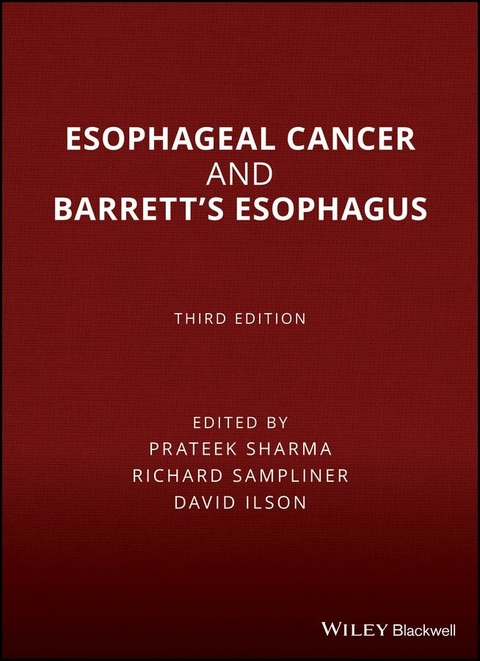
Esophageal Cancer and Barrett's Esophagus (eBook)
John Wiley & Sons (Verlag)
978-1-118-65518-4 (ISBN)

PROFESSOR PRATEEK SHARMA, Professor Medicine, University of Kansas School of Medicine and Veterans Affairs Medical Center, Kansas City, Missouri, and Southern Arizona Veterans Affairs Health Care System and Arizona Health Sciences Center, Tucson, Arizona, USA. PROFESSOR RICHARD SAMPLINER, Professor of Medicine at the University of Arizona, Tucson, AZ, USA, and Chief of Gastroenterology at the Southern Arizona VA Health Care System. DAVID ILSON, MD, PHD, Department of Medicine, Memorial Sloan-Kettering Cancer Center, New York, NY, USA.
1 Epidemiology of Esophageal Carcinoma
Mohammad H. Shakhatreh and Hashem El-Serag
2 Barrett's Esophagus: Definition and Diagnosis
Stuart Jon Spechler
3 Epidemiology and Prevalence of Barrett's Esophagus
Helen G. Coleman, Shivaram K. Bhat, and Liam J. Murray
4 Esophageal Adenocarcinoma: Risk Factors
Mariam Naveed, Kerry Dunbar
5 Esophageal Motility Abnormalities in Barrett's Esophagus
Kumar Krishnan, John E. Pandolfino, and Peter J. Kahrilas
6 Molecular Biology of Barrett's Esophagus and Esophageal Adenocarcinoma
Ayesha Noorani and Rebecca C. Fitzgerald
7 Histology of Barrett's Esophagus: Metaplasia and Dysplasia
Deepa T. Patil and John R. Goldblum
8 Helicobacter Pylori and Esophageal Neoplasia
Arne Kandulski, Marino Venerito, and Peter Malfertheiner
9 Screening and Surveillance
Krish Ragunath
10 New Surface Imaging Technologies for Dysplasia and Cancer Detection
David F. Boerwinkel, Wouter L. Curvers, and Jacques J.G.H.M. Bergman
11 New Cellular Imaging Technologies for Dysplasia and Cancer Detection
Ralf Kiesslich
12 Role of Endoscopic Ultrasound in Esophageal Cancer
A. Samad Soudagar andNeil Gupta
13 Staging of Esophageal Adenocarcinoma by CT, PET and Other Modalities
Florian Lordick, Katja Ott, Matthias Ebert, Lars Grenacher, Bernd-Joachim Krause, and Christian Wittekind
14 Medical Management of Barrett's Esophagus
Sachin Wani
15 Thermal Therapies and Photodynamic Therapy for Early Esophageal Neoplasia
Jacques Deviere
16 RFA for Early Esophageal Neoplasia
Daniel K. Chan, Cadman L. Leggett, and Kenneth K. Wang
17 The Role of Endoscopic Cryotherapy for Treatment and Palliation
Kristle Lee Lynch, Eun Ji Shin, and Marcia Irene Canto
18 Endoscopic Mucosal Resection
Oliver Pech
19 Endoscopic Sub-mucosal dissection
Hiro Yamamoto, Tsuneo Oyama, and Takuji Gotoda
20 Surgical Therapy of Early Esophageal Cancer
Toshitaka Hoppo and Blair A. Jobe
21 Chemoprevention: Can We Prevent Esophageal Cancer?
Janusz Jankowski and Mary Denholm
22 Selection of Patients for Eradication and Cancer Prevention
Aaron J. Small and Gary W. Falk
23 Combined Modality Therapy in Locally Advanced Esophageal Cancer
Geoffrey Y. Ku and David H. Ilson
24 Surgery in Locally Advanced Esophageal Cancer
Nabil Rizk
25 Radiation Therapy for Locally Advanced Esophageal Cancer
Heath D. Skinner and Bruce D. Minsky
26 Systemic Therapy and Targeted Agents in Advanced Esophageal Cancer
Mark A. Lewis and Harry H. Yoon
27 Role of Endoscopy and Nutritional Support in Advanced Esophageal Cancer
Manol Jovani, Andrea Anderloni, and Alessandro Repici
"Prateek Sharma and Richard Sampliner have assembled a superb,
comprehensive and up to date textbook on Barrett's esophagus and
esophageal adenocarcinoma. There are very few problems with this
book. The section on the management of esophageal adenocarcinoma is
brief and clearly directed to gastroenterologists rather than
surgeons or oncologists (as is most of the textbook). ...This is an
excellent textbook for anyone with an interest in esophageal
disease or gastrointestinal cancer. It should be an essential
textbook for any medical library."
-J. Patrick Waring, Atlanta GA
Practical Gastroenterology, January 2002
"Barrett's Esophagus and Esophageal Adenocarcinoma is a
comprehensive collection of chapters written by leading authorities
in the field. It has many fine qualities. The editors clearly
demonstrate that the study of Barrett's esophagus lends itself to a
multidisciplinary approach. Each chapter is introduced by a
background section that acquaints the reader with the concepts
underlying the material that follows. As a result, the book does a
remarkable job of presenting knowledge about Barrett's esophagus to
a general audience.
The figures and tables are excellent, the color plates are of
good quality, and the text is lucid, succinct and comprehensive.
This superb work effectively summarizes all the current topics
pertinent to Barrett's esophagus. It is comprehensive yet not
cumbersome and introduces the reader to a wide range of
disciplines. Gastroenterologists will reap great rewards from
reading this book, but it also reaches out to a larger audience and
is a model of how the study of a single disease lends itself to
many different specialities."
-David. A. Katzka, MD. The New England Journal of Medicine.
Volume 345(20) November 2001.
Chapter 1
Epidemiology of esophageal carcinoma
Mohammad H. Shakhatreh & Hashem B El-Serag
Section of Gastroenterology and Hepatology, Department of Medicine, Baylor College of Medicine and Houston VA HSR&D Center of Excellence, Michael E DeBakey Veterans Affairs Medical Center, Houston, TX, USA
1.1 The incidence and mortality related to esophageal cancer
Esophageal cancer is the sixth most common cancer among men and the ninth among women, affecting more than 450,000 people globally each year. Approximately 90% of cases of esophageal cancer are squamous cell carcinoma (ESCC) [1], and the rest are adenocarcinoma (EA). The highest reported incidence and mortality rates for ESCC occur in Jiashan, China, with an age-adjusted incidence rate of 14.6 cases per 100,000 (Figure 1.1). The highest age-adjusted incidence rates of EA occur in Scotland (6.6 per 100,000) and in other parts of the United Kingdom [2]. In the United States, the age-adjusted rate of esophageal cancer in 2009 was 4.1 per 100,000; EA alone had 2.7 cancers per 100,000, a sharp increase from the 1973 rate of 0.4 cancers per 100,000 [3] (Figure 1.2)
Figure 1.1 Age-adjusted incidence rates of EA (a) and ESCC (b) in 1998-2002 using world standard population (2000). EA: Esophageal adenocarcinoma. ESCC: Esophageal squamous cell carcinoma. CI5-IX: Cancer Incidence in Five Continents, volume 9. IARC: International Agency for Research on Cancer. SEER: Surveillance, epidemiology and end results. NECSN: North East Cancer Surveillance Network.
Data from CI5-IX (2007), IARC.
Figure 1.2 Trends in incidence and five-year relative survival of EA, ESCC, GEJ-CA. Data from SEER 9 Regs research data, Nov 2011 sub, vintage 2009 pops (1973–2009) <Katrina/Rita Population adjustment> – linked to county attributes – Total US, 1969–2010 counties, National Cancer Institute, DCCPS, Surveillance Research Program, Surveillance Systems Branch, released April 2012, based on the November 2011 submission. SEER: Surveillance, epidemiology, and end results. EA: Esophageal adenocarcinoma. ESCC: Esophageal squamous cell carcinoma. GEJ CA: Gastro-esophageal junction carcinoma.
Although EA is the fastest-rising malignancy among white men in the United States, its increase may be slowing [4]. The US average annual percentage change in incidence was 8.4 (95% CI 7.7–9.1) before 1997, but it decreased to 1.6 (95% CI 0.0–3.3) from 1998 to 2009 [5]. In Scandinavia, the average annual percentage change has continued to increase [6].
In addition to geographic differences in the distribution of EA, there are remarkable variations in the demographics of persons affected by this cancer. The incidence of EA increases with age and peaks in the eighth decade of life. Independent of age, however, people born in more recent years have a higher incidence of EA [7]. EA incidence is five-fold higher among non-Hispanic whites than among blacks, while ESCC incidence rates among black men are four times higher than for white men [8]. Finally, most esophageal cancer cases (77.7%) affect men [6].
The incidence of EA is 7–10 times higher in men, while the incidence of ESCC is only 2–3 times higher in men than in women, according to numerous cancer registries around the world [9, 10]. This sex discrepancy varies among different races; for example, in the 50–59 age group, the highest male-to-female ratio was 20.5 in Hispanics, followed by 10.8 in whites and then 7.0 in blacks. With EA, male predominance is evident globally (Figure 1.1). Whether the difference in incidence rates among men and women or between whites and blacks is due to less gastroesophageal reflux disease (GERD) and/or Barrett's Esophagus (BE) prevalence, or to a less progressive form of these diseases, is unknown. Despite an equal distribution of GERD between men and women [11, 12], men seem to have a more severe form of the disease, with a higher complication rate [13].
With ESCC, some areas (e.g. South Karachi, Pakistan; West Midlands, UK; Oman; Penang, Malaysia; South Australia; Kuwait) have a higher age-adjusted incidence rate among women than among men [2] (Figure 1.1). The reason behind this is unknown. The main risk factors for ESCC, which show broad regional variation, include heavy alcohol consumption, tobacco smoking and human papilloma virus infection, as well as few rare disorders, such as achalasia of the cardia, and tylosis. These will not be discussed further in this review.
1.2 Mortality
Esophageal cancer is a highly fatal disease. The overall five-year relative survival for patients diagnosed with esophageal cancer in the United States was approximately 17.3% between 2003 and 2009 (Figure 1.2). The disease stage at time of diagnosis impacts survival greatly, as the age-adjusted five-year relative survival of 38.6% in localized disease declines to 3.5% in disease associated with distant spread. However, the overall survival over the past two decades has slightly, but significantly, improved. Despite the use of screening endoscopy in high-risk groups, about 35% of EA cases between 2004 and 2010 were diagnosed at an advanced stage [14]. A higher mortality rate for nonwhite Hispanics and blacks mostly has been attributed to the decreased receipt of cancer-directed surgery, indicating possible ethnic disparities in treatment application or availability [15].
1.2.1 Progression of BE to EA
A summary of published annual EA-risk data of nondysplastic BE ranges from 0.12–0.50% to 0.33–0.70% in population-based studies and meta-analyses, respectively [16]. Recent studies have indicated that the risk of progression from BE to EA is lower than previously reported [17]. The risk in a Dutch study of 42,207 patients was 0.4% [18]; in an Irish study of 8,522 patients, it was 0.22% per year (95% CI 0.19–0.26%) [19]; and in a Danish study of 11,028 patients, it was 0.12% (95% CI 0.09–0.15) [20].
1.3 Risk factors for EA
Risk factors for esophageal adenocarcinoma are outlined in Table 1.1.
Table 1.1 Summary of risk factors for the development of esophageal adenocarcinoma
| Degree of confidence | Risk factor(s) |
| Definite risk |
| Increased | BE |
| Obesity |
| Central obesity |
| Smoking |
| GERD |
| Family history of BE or EA |
| Decreased | H. pylori |
| Aspirin/NSAIDs |
| No change | Alcohol |
| Possible risk |
| Increased | Bisphosphonates |
| Decreased | PPI |
| Statins |
GERD: Gastroesophageal reflux disease. EA: Esophageal adenocarcinoma. H. pylori: Helicobacter pylori. NSAIDs: Non-steroidal anti-inflammatory drugs. PPI: Proton pump inhibitor.
1.3.1 GERD
Several population-based case control studies have established a strong association, including a dose-response relationship between GERD symptoms and EA (and adenocarcinoma of the gastric cardia), but not ESCC [21, 22]. In a meta-analysis of five population-based studies, the presence of at least weekly GERD symptoms was associated with an odds ratio (OR) for developing EA of 4.92 (95% CI 3.90–6.22), which increased to 7.4 (95% CI 4.94–11.10) when the symptoms occurred on a daily basis, compared with asymptomatic controls or those with less frequent symptoms [23]. However, up to 40% of the patients with EA may not report bothersome GERD symptoms.
1.3.2 Tobacco smoking
A pooled analysis of individual data from ten case-control and two cohort studies from Australia, Canada, Ireland, the United Kingdom and the United States, including 1242 EA cases, 1263 gastroesopheageal junction cancer (GEJ-CA) cases, 954 ESCC cases and 7053 controls without cancer [24], reported an increased risk of both types of esophageal cancer with history of tobacco smoking. The calculated OR of EA increased from 1.66 (95% CI 1.1–2.4) with 1–29 pack-years of smoking to 2.77 (95% CI 1.4–5.6) with >60 pack-years smoking history, with a statistically significant trend (p < 0.01). The same study concluded that, for equal pack-years of smoking, more cigarettes per day for shorter duration was less deleterious than fewer cigarettes per day for longer duration. For example:
Previous smokers have in EA, when comparing those with equal pack-years of smoking, patients who smoked 10–19 cigarettes/day had an increased risk compared with those who smoked more than 40 cigarettes/day (p for trend = 0.40). Previous smokers have a lower risk of developing EA or ESCC than current smokers, but slightly higher than those who have never smoked [25]. Tobacco smoking does not seem to play a major role in developing BE [26]; however, in patients with established BE, the risk of EA increases with the magnitude and duration of smoking history [27]. Some studies indicate that the effect...
| Erscheint lt. Verlag | 14.9.2015 |
|---|---|
| Sprache | englisch |
| Themenwelt | Medizin / Pharmazie ► Allgemeines / Lexika |
| Medizinische Fachgebiete ► Innere Medizin ► Gastroenterologie | |
| Medizin / Pharmazie ► Medizinische Fachgebiete ► Onkologie | |
| Schlagworte | Cancer Detection • dysplasia • Esophageal cancer • esophageal carcinoma • Esophageal Neoplasia • Esophagus • Gastroenterologie • Gastroenterologists • gastroenterology • Gastrointestinal surgery • Magen-Darm-Chirurgie • Medical Science • Medizin • oncologists • Oncology & Radiotherapy • Onkologie • Onkologie u. Strahlentherapie |
| ISBN-10 | 1-118-65518-4 / 1118655184 |
| ISBN-13 | 978-1-118-65518-4 / 9781118655184 |
| Informationen gemäß Produktsicherheitsverordnung (GPSR) | |
| Haben Sie eine Frage zum Produkt? |
 EPUB (Adobe DRM)
Kopierschutz: Adobe-DRM
Adobe-DRM ist ein Kopierschutz, der das eBook vor Mißbrauch schützen soll. Dabei wird das eBook bereits beim Download auf Ihre persönliche Adobe-ID autorisiert. Lesen können Sie das eBook dann nur auf den Geräten, welche ebenfalls auf Ihre Adobe-ID registriert sind.
Details zum Adobe-DRM
Dateiformat: EPUB (Electronic Publication)
EPUB ist ein offener Standard für eBooks und eignet sich besonders zur Darstellung von Belletristik und Sachbüchern. Der Fließtext wird dynamisch an die Display- und Schriftgröße angepasst. Auch für mobile Lesegeräte ist EPUB daher gut geeignet.
Systemvoraussetzungen:
PC/Mac: Mit einem PC oder Mac können Sie dieses eBook lesen. Sie benötigen eine
eReader: Dieses eBook kann mit (fast) allen eBook-Readern gelesen werden. Mit dem amazon-Kindle ist es aber nicht kompatibel.
Smartphone/Tablet: Egal ob Apple oder Android, dieses eBook können Sie lesen. Sie benötigen eine
Geräteliste und zusätzliche Hinweise
Buying eBooks from abroad
For tax law reasons we can sell eBooks just within Germany and Switzerland. Regrettably we cannot fulfill eBook-orders from other countries.
aus dem Bereich