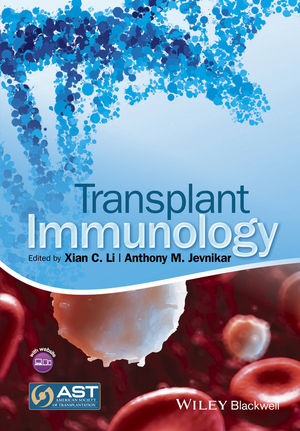
Transplant Immunology (eBook)
John Wiley & Sons (Verlag)
978-1-119-07300-0 (ISBN)
With all the complex issues of acceptance or rejection of a transplanted organ, immunology is a key subject for all transplantation clinicians. During recent years, there has been an explosion of research and knowledge in this area.
Produced in association with the American Society of Transplantation, and written by experts within the field, Transplant Immunology provides a comprehensive overview of the topic in relation to clinical transplantation.
Starting with the basic functionality of the immune system, it then moves on to cover the very latest developments in immunosuppressive drugs and protocols, as well as a look at all emerging technologies in the field.
Key chapters include:
- Transplant-related complications
- Immune responses to transplants
- Emerging issues in transplantation
- Biomarkers of Allograft rejection and tolerance
- T cells and the principles of immune responses
In full colour throughout, over 100 outstanding diagrams support the text, all figures being fully downloadable via the book's companion website. The result is an essential tool for all those responsible for managing patients awaiting and undergoing organ transplantation, including transplant surgeons and clinicians, immunologists and researchers.
Xian C. Li, MD, PhD, Professor of Immunology/surgery, Weill Cornell Medical College, Cornell University, New York, NY; and Director, Immunobiology and Transplant Science, Houston Methodist Hospital, Texas Medical Center, Houston, TX, USA.
Anthony M. Jevnikar MSc (Immunology), MD, FRCP(C), Professor of Medicine, Surgery, Immunology and Microbiology, Western University, Director Transplantation Nephrology and Director Matthew Mailing Centre for Translational Transplant Studies, London Health Sciences Centre, London ON, Canada.
With all the complex issues of acceptance or rejection of a transplanted organ, immunology is a key subject for all transplantation clinicians. During recent years, there has been an explosion of research and knowledge in this area.Produced in association with the American Society of Transplantation, and written by experts within the field, Transplant Immunology provides a comprehensive overview of the topic in relation to clinical transplantation. Starting with the basic functionality of the immune system, it then moves on to cover the very latest developments in immunosuppressive drugs and protocols, as well as a look at all emerging technologies in the field.Key chapters include: Transplant-related complications Immune responses to transplants Emerging issues in transplantation Biomarkers of Allograft rejection and tolerance T cells and the principles of immune responses In full colour throughout, over 100 outstanding diagrams support the text, all figures being fully downloadable via the book's companion website. The result is an essential tool for all those responsible for managing patients awaiting and undergoing organ transplantation, including transplant surgeons and clinicians, immunologists and researchers.
Xian C. Li, MD, PhD, Professor of Immunology/surgery, Weill Cornell Medical College, Cornell University, New York, NY; and Director, Immunobiology and Transplant Science, Houston Methodist Hospital, Texas Medical Center, Houston, TX, USA. Anthony M. Jevnikar MSc (Immunology), MD, FRCP(C), Professor of Medicine, Surgery, Immunology and Microbiology, Western University, Director Transplantation Nephrology and Director Matthew Mailing Centre for Translational Transplant Studies, London Health Sciences Centre, London ON, Canada.
Title Page 5
Copyright Page 6
Contents 7
Contributors 9
Foreword 14
Preface 16
About the companion website 17
Chapter 1 Tissues and organs of the immune system 19
Introduction 19
Primary lymphoid tissues 21
Bone marrow 21
Thymus 25
Secondary lymphoid tissues 28
Lymph nodes 29
Spleen 32
Peyer’s patches 35
Role of secondary lymphoid tissues in rejection and tolerance 36
Tertiary lymphoid tissues 38
Structure 38
Genesis 39
Function 39
Role in rejection and tolerance 40
Summary 40
References 41
Further reading 41
Chapter 2 Cells of the immune system 43
Introduction 43
Innate immune cells 44
Dendritic cells (DCs) 44
Natural killer cells 49
NK activation and signaling 49
The “missing self” hypothesis 51
NK cells and solid organ transplant 51
Macrophages and monocytes 51
Macrophage activation 52
Macrophages in transplant rejection 52
Adaptive immune cells 53
T cells 53
B cells 58
Natural killer T (NKT) cells 62
NKT cells and transplant response 63
Summary 64
Further reading 64
Chapter 3 Soluble mediators in the immune system 66
Introduction 66
Cytokines 67
Acute phase cytokines 67
The IL-1 family cytokines 69
IL-1? 69
IL-6 69
TNF? 70
The common ?c family of cytokines 72
IL-2 72
IL-7 73
IL-9 74
IL-15 74
The IL-12 family of cytokines 75
IL-12 75
IL-23 76
IL-27 76
Adaptive immunity cytokines 77
IFN-? 77
IL-17 78
Immunoregulatory cytokines 79
TGF-? 79
IL-10 80
Further reading 82
Chapter 4 Costimulatory molecules 83
Introduction 83
Costimulatory molecules 84
Immunoglobulin (Ig) superfamily 85
TNFR/TNF superfamily 95
TIM family 100
Summary and relevance to clinical transplantation 101
References 102
Chapter 5 Major histocompatibility complex 103
Introduction 103
Structure and function of MHC 104
Genomic organization of MHC 104
HLA gene polymorphism 106
HLA haplotypes and inheritance 106
HLA class I and class II molecules 108
HLA structure 108
Cellular responses to HLA alloantigens 108
HLA typing 110
HLA nomenclature 112
Anti-HLA antibodies in transplantation 112
Methods to detect and characterize HLA antibodies 114
Assessing sensitization before and after transplantation 116
Non-HLA antigens in organ transplantation 118
Anti-MICA antibodies 118
Summary 119
Further reading 119
Chapter 6 T cells and the principles of immune responses 121
Introduction 121
T cell activation 122
The TCR: A receptor for every possible antigen 122
Division of labor: CD4 and CD8 define two major T cell subsets 122
Amplification signals through phosphatidylinositol 3'-hydroxyl kinase (PI3K) 127
Sequential signaling is required for T cell triggering 129
Signal 2: Costimulation 130
Signal 3: Cytokine signaling and T effector cell differentiation 133
T cell differentiation to effector cells 135
Progression from naïve to memory T cells 137
Regulatory T cells 141
Summary 144
Further reading 144
Chapter 7 Ischemia and reperfusion injury 146
Introduction 146
Mechanism of organ injury 147
Toll-like receptors (TLRs) in innate immune activation during IRI 149
Non-TLRs in innate immune activation in IRI 153
IL-10 and innate immune activation 154
T cells, NK cells, and NKT cells in IRI 155
Conclusions 159
References 159
Chapter 8 Immune responses to transplants 160
Introduction 160
Tranpslant rejection 161
Clinical manifestations of rejection 162
Unsolved issues 165
Key areas of research 166
Transplant tolerance 167
Mechanisms of central tolerance 167
Mechanisms of peripheral tolerance 168
Tolerance induction strategies 169
Mechanisms of tolerance resistance 173
Challenges and unresolved issues in tolerance 175
Key areas of research in tolerance 176
Immune privilege and accommodation 177
Summary 179
References 180
Chapter 9 Principles of hematopoietic cell transplantation 182
Introduction 182
Principles of HCT 183
GVHD: Principles 187
Genetic basis of GVHD 187
Immunobiology of acute GVHD 189
Acknowledgments 200
References 200
Chapter 10 Therapeutic approaches to organ transplantation 202
Introduction 202
General aspects of ISDs 205
Small-molecule drugs 210
Mycophenolic acid 210
Azathioprine 214
CN inhibitors 215
Inhibitors of mammalian target of rapamycin (mTOR) 217
Tofacitinib (Tasocitinib, CP-690550) 218
Prednisone 219
Protein drugs and biologics 220
Depleting antibodies 220
Nondepleting antibodies and fusion proteins 221
Immunosuppression protocols 223
“Minimization” strategies: pros and cons 223
Steroid minimization regimen 223
CN inhibitor minimization 224
Managing antibody-mediated rejection and the positive crossmatch patient 225
Therapies to suppress donor-specific antibodies and treat antibody-mediated rejection 225
Strategies for desensitization and management of the positive crossmatch patient 229
Tolerance induction strategies 232
References 233
Further reading 233
Chapter 11 Organ-specific features in clinical transplantation 235
Introduction 235
Kidney 236
Current status of kidney transplantation 236
Challenges in renal transplantation 238
Liver 244
Current status of liver transplantation 244
Challenges in liver transplantation 246
Lung 248
Current status of lung transplantation 248
Challenges in lung transplantation 249
Heart 250
Current status of heart transplantation 250
Challenges in heart transplantation 251
Small bowel 251
Current status of small bowel transplantation 251
Challenges in small bowel transplantation 252
Conclusion 252
Acknowledgment 253
References 254
Chapter 12 Transplant-related complications 255
Introduction 255
Infections 256
Common infections in transplant patients 257
Post-transplant malignancy 261
Epidemiology 262
Clinical characteristics 262
Pathogenesis 265
Metabolic disorders 267
Transplant-associated Hyperglycemia (TAH) 267
Dyslipidemia 269
Post-transplant bone mineral disorder 271
Hypertension 273
Hematologic disorders 273
Summary 275
References 275
Further reading 275
Chapter 13 Biomarkers of allograft rejection and tolerance 277
Introduction 277
Biomarkers 278
The need for diagnostic and prognostic biomarkers 278
Biomarkers associated with allograft rejection 280
Biomarkers associated with allograft tolerance 286
New and emerging technologies 291
Current status and outlook 295
Summary 296
References 296
Further reading 297
Chapter 14 Emerging issues in transplantation 298
Introduction 298
Age and immune responses 299
Marginal donor organs 301
Organs from donors after cardiac or circulatory death (DCD) 302
Organ age and its roles in immunogenicity, injury/repair, and immune responses 303
Recipient age and transplant outcome 304
Immunosuppression in the elderly 306
Xenotransplantation 307
Artificial or biologic organ replacement 310
Artificial kidneys 310
Liver support systems 311
Ventricular assist devices and cardiac regeneration 312
Tissue engineering, organ scaffolds, and stem cells 312
Summary 313
Further reading 313
Chapter 15 New frontiers and new technologies 315
Regenerative medicine: past, present, and future possibilities 315
Definition of stem cell concepts 316
Sources of stem cells 316
Experimental studies and clinical applications 318
Brain 319
Heart 319
Lung 319
Kidney 320
Liver 320
Pancreatic beta cell regeneration 321
Hematopoietic system 321
Future challenges 321
Vascularized composite allotransplantation 322
Unique challenges 323
Complications 324
Current research 324
Nanotechnology 324
Imaging of allografts: nanotechnology and beyond 326
Gene therapy in transplantation 327
Gene delivery approaches 327
Viral vectors 328
Nonviral vectors 330
Application of gene therapy to transplantation 330
Cellular transplantation 330
Solid organs 331
References 332
Chapter 16 Experimental models in discovery and translational studies 334
Introduction 334
The need for animal models of transplantation 335
Choice of models—small animal models versus large animal models 335
Choice of models—organs 338
Small animal transplant models (see Table 16.1) 339
Skin transplantation 339
Heart transplantation 340
Kidney transplantation 341
Intestinal transplantation 342
Lung and trachea transplantation 342
Islet and pancreas transplantation 343
Liver and hepatocyte transplantation 343
Large animal transplant models 344
Kidney transplantation 345
Islet and pancreas transplantation 345
Heart transplantation 347
Intestinal transplantation 347
Use of experimental models to address key challenges 348
Ischemia-reperfusion injury (IRI) 348
Acute rejection 348
Chronic rejection 348
Composite tissue allotransplantation (CTA) 349
Tolerance 349
Summary and future directions 351
Models of B cell mediated injury and “humoral” immunity 351
MHC typing in NHP 352
Humanized mice 352
Further reading 354
Index 355
EULA 366
| Erscheint lt. Verlag | 9.9.2015 |
|---|---|
| Sprache | englisch |
| Themenwelt | Medizin / Pharmazie ► Medizinische Fachgebiete ► Chirurgie |
| Studium ► Querschnittsbereiche ► Infektiologie / Immunologie | |
| Schlagworte | immune system • Immunologie • immunology • Immunosuppressants • immunosupression • Medical Science • Medizin • organ rejection • organ transplants • Transplantation • Transplantationen |
| ISBN-10 | 1-119-07300-6 / 1119073006 |
| ISBN-13 | 978-1-119-07300-0 / 9781119073000 |
| Informationen gemäß Produktsicherheitsverordnung (GPSR) | |
| Haben Sie eine Frage zum Produkt? |
 PDF (Adobe DRM)
Kopierschutz: Adobe-DRM
Adobe-DRM ist ein Kopierschutz, der das eBook vor Mißbrauch schützen soll. Dabei wird das eBook bereits beim Download auf Ihre persönliche Adobe-ID autorisiert. Lesen können Sie das eBook dann nur auf den Geräten, welche ebenfalls auf Ihre Adobe-ID registriert sind.
Details zum Adobe-DRM
Dateiformat: PDF (Portable Document Format)
Mit einem festen Seitenlayout eignet sich die PDF besonders für Fachbücher mit Spalten, Tabellen und Abbildungen. Eine PDF kann auf fast allen Geräten angezeigt werden, ist aber für kleine Displays (Smartphone, eReader) nur eingeschränkt geeignet.
Systemvoraussetzungen:
PC/Mac: Mit einem PC oder Mac können Sie dieses eBook lesen. Sie benötigen eine
eReader: Dieses eBook kann mit (fast) allen eBook-Readern gelesen werden. Mit dem amazon-Kindle ist es aber nicht kompatibel.
Smartphone/Tablet: Egal ob Apple oder Android, dieses eBook können Sie lesen. Sie benötigen eine
Geräteliste und zusätzliche Hinweise
Buying eBooks from abroad
For tax law reasons we can sell eBooks just within Germany and Switzerland. Regrettably we cannot fulfill eBook-orders from other countries.
aus dem Bereich