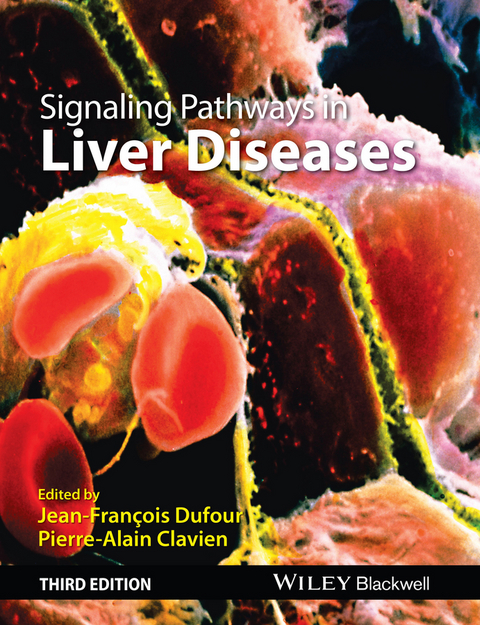
Signaling Pathways in Liver Diseases (eBook)
John Wiley & Sons (Verlag)
978-1-118-66335-6 (ISBN)
Signalling Pathways in Liver Diseases 3E again provides hepatologists and hepatology researchers with an expert overview of the complex and novel cellular/extracellular signalling pathways in the liver, and their role in liver diseases. The last few years have seen a great number of developments in this field, which in turn have led to new opportunities for innovative treatments; however the intricacy of these pathways and their interactions continue to provide a real challenge for clinicians. This outstanding book compiles the emerging knowledge into a single expert resource, cataloguing and organizing it into an accessible and understandable format.
With increased focus on the comprehension of cellular mechanisms involved in steatohatitis, cirrhosis and liver tumours, which has led in changes to the management of these diseases, this new edition also sees the introduction of exciting new chapters on key emerging areas such as:
- Autophagy
- Notch Pathway
- PI3K/PTEN Signaling in Liver Diseases
- Sirtuins
- Hepcidin and Iron
- Epigenetic Regulation of Hepatic Stellate Cells and Liver Fibrosis
- Oxidative Stress and Signaling in the Liver
Professors Dufour and Clavien have assembled an all-star cast of chapter authors, each of whom will provide write a clear yet comprehensive review of their chosen topic. Chapters will contain clear and appropriate illustrations to reinforce the text, with a key points box offering a concise and handy summary. Self-assessment questions and answers allow the reader to test their own knowledge.
Signalling Pathways in Liver Diseases 3E is the perfect educational and reference tool to bridge the information exchange between the laboratory, the clinical ward, and the operating room, and an essential tool for the modern-day hepatologist.
Signaling Pathways in Liver Diseases, Third Edition again provides hepatologists and hepatology researchers with an expert overview of the complex and novel cellular/extracellular signaling pathways in the liver, and their role in liver diseases. The last few years have seen a great number of developments in this field, which in turn have led to new opportunities for innovative treatments; however, the intricacy of these pathways and their interactions continue to provide a real challenge for clinicians. This outstanding book compiles the emerging knowledge into a single expert resource, cataloguing and organizing it into an accessible and understandable format. With increased focus on the comprehension of cellular mechanisms involved in steatohepatitis, cirrhosis, and liver tumors, which has led to changes in the management of these diseases, this new edition also sees the introduction of exciting new chapters on key emerging areas such as: Autophagy Notch Pathway P13K/PTEN Signaling in Liver Diseases Sirtuins Hepcidin and Iron Epigenetic Regulation of Hepatic Stellate Cells and Liver Fibrosis Oxidative Stress and Signaling in the Liver. Professors Dufour and Clavien have assembled an all-star cast of chapter authors, each of whom has provided clear and appropriate illustrations to reinforce the text, with a key points box offering a concise and handy summary. Self-assessment questions and answers allow the reader to test their own knowledge. Signaling Pathways in Liver Disease, Third Edition is the perfect educational and reference tool to bridge the information exchange between the laboratory, the clinical ward, and the operating room, and an essential tool for the modern-day hepatologist.
Professor Jean-François Dufour, MD, PhD, Chief, Department of Clinical Pharmacology, University Clinic Visceral Surgery and Medicine, Bern, Switzerland. Professor Dufour is on the governing board of the European Association for the Study of the Liver (EASL). He also serves as Associate Editor for the Wiley journal Liver International and is on the editorial board for the following journals: Journal of Hepatology; Clinical Science; World Journal of Gastroenterology Professor Pierre-Alain Clavien, MD, PhD, FACS, FRCS (Eng), FRCS (Ed), Professor and Chairman, Department of Surgery. Head, Division of Visceral & Transplantation Surgery, University Hospital Zurich, Switzerland. Professor Clavien is a world-wide renowned surgeon-scientist, currently professor and chairman of the Department of Surgery in Zurich, Switzerland. His areas of research include organ preservation, liver ischemia-reperfusion injury and regeneration, and pathogenesis of cancer, as well as outcome research. He received many competitive grants and awards, including one of the most prestigious prices for scientific research, the Otto Naegeli Award.
List of Contributors, vii
1 Hepatocytes 1
Jean-François Dufour and Joachim C. Mertens
2 Signaling pathways in biliary epithelial cells 15
M. Fatima Leite, Mateus T. Guerra, Viviane A. Andrade and Michael H. Nathanson
3 Stellate cells 34
Alessandra Caligiuri and Fabio Marra
4 Kupffer cells 61
Amirali Kiyani and Ekihiro Seki
5 Hepatic sinusoidal endothelial cells 73
Moira B. Hilscher Robert C. Huebert and Vijay H. Shah
6 Extracellular matrix 85
Scott L. Friedman
7 Platelets: a new cell type in liver physiology 97
Mickaël Lesurtel and Pierre?]Alain Clavien
8 Immune cell communication in liver disease and liver regeneration 110
R. Harminder Boghal, B.F. Stephenson and Simon C. Afford
9 Extracellular vesicle RNA in liver disease 130
Tushar Patel and Hiroaki Haga
10 Endoplasmic reticulum stress in nonalcoholic fatty liver disease 139
Fabienne Foufelle and Pascal Ferré
11 Autophagy 151
Hao Zhang, Bilon Khambu and Xiao?]Ming Yin
12 CXC chemokine receptor signaling in liver repair and regeneration 166
Gregory C. Wilson, Christopher M. Freeman, Hiroyuki Nojima and Alex B. Lentsch
13 Metabolic regulation of liver regeneration 174
Jiansheng Huang and David A. Rudnick
14 TNF signaling 186
Amrit Mann, Mark J. Czaja and Jörn M. Schattenberg
15 Fas/FasL 203
Maria Eugenia Guicciardi and Gregory J. Gores
16 Interferon signaling 214
Markus H. Heim
17 Endocannabinoid signaling in liver pathologies 226
Bostjan Humar and Nasser Semmo
18 The WNT/beta?]catenin pathway 240
Satdarshan P. Singh Monga
19 Hedgehog signaling in the liver 262
Mariana V. Machado and Anna Mae Diehl
20 Notch pathway 275
Sonja Rothweiler and David Semela
21 PI3K/PTEN signaling in liver diseases 287
Alfredo Fort, Nicolas Calo, Dorothea Portius, Lucie Bourgoin, Marion Peyrou and Michelangelo Foti
22 mTOR signaling in liver disease 314
Marion Cornu, Grégoire de Caudron de Coquereaumont and Michael N. Hall
23 LKB1/AMPK pathway in the control of hepatic energy metabolism 326
Benoit Viollet and Marc Fortes
24 NF-kappaB 339
Ekihiro Seki and David A. Brenner
25 c-Jun NH2?]terminal kinases in liver diseases 348
Johannes Kluwe and Robert F. Schwabe
26 p53 364
Aundrietta D. Duncan, Wen?]Wei Tsai and Michelle Craig Barton
27 Sirtuins 374
Frank K. Huynh, Eoin McDonnell, Kristin A. Anderson and Matthew D. Hirschey
28 Bile acids and their receptors 385
Thierry Claudel and Michael Trauner
29 Hepcidin and iron 400
Chiara Vecchi and Antonello Pietrangelo
30 Gut microbiome and liver diseases 411
Herbert Tilg and Alexander R. Moschen
31 Epigenetic regulation of hepatic stellate cells and liver fibrosis 421
Jelena Mann and Derek A. Mann
32 Signaling in hepatocellular carcinoma 435
Adam Pennycuick and Augusto Villanueva
33 Interplay between hepatitis B virus and innate immune signaling pathways 448
Barbara Testoni, David Durantel and Fabien Zoulim
34 Signaling of hepatitis C virus 459
Joachim Lupberger, Nicolaas Van Renne and Thomas F. Baumert
35 Oxidative stress and signaling in the liver 469
Mitchell R. McGill, Yuchao Xie and Hartmut Jaeschke
Index 000
List of Contributors
Simon C. Afford
NIHR Biomedical Research Unit and The Centre for Liver Research, School of Infection and Immunity, Institute of Biomedical Research, The University of Birmingham, Birmingham, UK
Kristin A. Anderson
Duke Molecular Physiology Institute, Sarah W. Stedman Nutrition and Metabolism Center, and Department of Pharmacology & Cancer Biology, Duke University Medical Center, Durham, NC, USA
Viviane A. Andrade
Department of Biochemistry and Immunology, UFMG, Belo Horizonte, Brazil
Thomas F. Baumert
Institut National de la Santé et de la Recherche Médicale (INSERM), Strasbourg, France; Institut de Recherche sur les Maladies Virales et Hépatiques, Université de Strasbourg, Strasbourg, France; Pôle Hépato-digestif, Nouvel Hôpital Civil, Strasbourg, France; Institut Hospitalo-universitaire, Strasbourg, France
Ricky H. Boghal
NIHR Biomedical Research Unit and The Centre for Liver Research, School of Infection and Immunity, Institute of Biomedical Research, The University of Birmingham, Birmingham, UK
Lucie Bourgoin
Department of Cell Physiology and Metabolism, Faculty of Medicine, University of Geneva, Switzerland
David A. Brenner
Department of Medicine, University of California San Diego, School of Medicine, La Jolla, CA, USA
Alessandra Caligiuri
Dipartimento di Medicina Sperimentale e Clinica, Università degli Studi di Firenze, Firenze, Italy
Nicolas Calo
Department of Cell Physiology and Metabolism, Faculty of Medicine, University of Geneva, Switzerland
Thierry Claudel
Hans Popper Laboratory of Molecular Hepatology, Division of Gastroenterology and Hepatology, Department of Internal Medicine III, Medical University of Vienna, Vienna, Austria
Pierre-Alain Clavien
Swiss HPB (Hepato-Pancreatico-Biliary) and Transplantation Center, Department of Surgery, University of Zurich, Zurich, Switzerland
Marion Cornu
Department of Biochemistry, Biozentrum, University of Basel, Basel, Switzerland
Michelle Craig Barton
Department of Epigenetics and Molecular Carcinogenesis, Center for Cancer Epigenetics, University of Texas MD Anderson Cancer Center, Houston, TX, USA
Mark J. Czaja
Department of Medicine, Marion Bessin Liver Research Center, Albert Einstein College of Medicine, Bronx, NY, USA
Grégoire de Caudron de Coquereaumont
Department of Biochemistry, Biozentrum, University of Basel, Basel, Switzerland
Jean-François Dufour
University Clinic for Visceral Surgery and Medicine, Inselspital, University of Berne, Berne, Switzerland
Aundrietta D. Duncan
Department of Epigenetics and Molecular Carcinogenesis, Center for Cancer Epigenetics, University of Texas MD Anderson Cancer Center, Houston, TX, USA
David Durantel
Cancer Research Center of Lyon (CRCL), Institut National de la Santé et de la Recherche Médicale (INSERM), Lyon, France
Pascal Ferré
Institut National de la Santé et de la Recherche Médicale (INSERM), Centre de Recherche des Cordeliers, and Université Pierre et Marie Curie and Université Paris Descartes, Paris, France
Marc Foretz
Département Endocrinologie, Métabolisme et Diabète, Institut National de la Santé et de la Recherche Médicale (INSERM), Institut Cochin; Centre National de la Recherche Scientifique (CNRS); and Université Paris Descartes, Paris, France
Alfredo Fort
Department of Cell Physiology and Metabolism, Faculty of Medicine, University of Geneva, Switzerland
Michelangelo Foti
Department of Cell Physiology and Metabolism, Faculty of Medicine, University of Geneva, Switzerland
Fabienne Foufelle
Institut National de la Santé et de la Recherche Médicale (INSERM), Centre de Recherche des Cordeliers, and Université Pierre et Marie Curie and Université Paris Descartes, Paris, France
Christopher M. Freeman
Department of Surgery, University of Cincinnati Medical Center, Cincinnati, OH, USA
Scott L. Friedman
Division of Liver Diseases, Icahn School of Medicine at Mount Sinai, New York, NY, USA
Gregory J. Gores
Division of Gastroenterology and Hepatology, Mayo Clinic, Rochester, MN, USA
Mateus T. Guerra
Department of Medicine and Cell Biology, Digestive Diseases Section, Yale University, New Haven, CT, USA
Maria Eugenia Guicciardi
Division of Gastroenterology and Hepatology, Mayo Clinic, Rochester, MN, USA
Hiroaki Haga
Department of Transplantation, Mayo Clinic, Jacksonville, FL, USA
Michael N. Hall
Department of Biochemistry, Biozentrum, University of Basel, Basel, Switzerland
Markus H. Heim
Division of Gastroenterology and Hepatology, University Hospital Basel, Basel, Switzerland
Moira B. Hilscher
GI Research Unit, Mayo Clinic, Rochester, MN, USA
Matthew D. Hirschey
Duke Molecular Physiology Institute, Sarah W. Stedman Nutrition and Metabolism Center, and Department of Pharmacology & Cancer Biology, Duke University Medical Center, Durham, NC, USA
Jiansheng Huang
Department of Pediatrics and Developmental Biology, Washington University School of Medicine, St Louis, MO, USA
Robert C. Huebert
GI Research Unit, Mayo Clinic, Rochester, MN, USA
Bostjan Humar
Hepatobiliary Laboratory, Department of Visceral & Transplantation Surgery, University Hospital Zürich, Zürich, Switzerland
Frank K. Huynh
Duke Molecular Physiology Institute, Duke University Medical Center, Durham, NC, USA
Hartmut Jaeschke
Department of Pharmacology, Toxicology and Therapeutics, University of Kansas Medical Center,
Kansas City, KS, USA
Bilon Khambu
Department of Pathology and Laboratory Medicine, School of Medicine, Indiana University, Indianapolis, IN, USA
Amirali Kiyani
Department of Medicine, Maricopa Medical Center, Phoenix, AZ, USA
Johannes Kluwe
Department of Medicine, University Medical Center Hamburg-Eppendorf, Hamburg, Germany
M. Fatima Leite
Department of Physiology and Biophysics, UFMG, Belo Horizonte, Brazil
Alex B. Lentsch
Department of Surgery, University of Cincinnati Medical Center, Cincinnati, OH, USA
Mickaël Lesurtel
Swiss HPB (Hepato-Pancreatico-Biliary) and Transplantation Center, Department of Surgery, University Hospital Zurich, Zurich, Switzerland
Joachim Lupberger
Institut National de la Santé et de la Recherche Médicale (INSERM); Institut de Recherche sur les Maladies Virales et Hépatiques, Université de Strasbourg, Strasbourg, France
Mariana V. Machado
Division of Gastroenterology, Department of Medicine, Duke University Medical Center, Durham, NC, USA; Department of Gastroenterology, Hospital de Santa Maria, CHLN, Lisbon, Portugal
Anna Mae Diehl
Division of Gastroenterology, Department of Medicine, Duke University Medical Center, Durham, NC, USA
Amrit Mann
Department of Medicine, University Medical Center of the Johannes Gutenberg University, Mainz, Germany
Jelena Mann
Institute of Cellular Medicine, Faculty of Medical Sciences, Newcastle University, Newcastle upon Tyne, UK
Derek A. Mann
Institute of Cellular Medicine, Faculty of Medical Sciences, Newcastle University, Newcastle upon Tyne, UK
Fabio Marra
Dipartimento di Medicina Sperimentale e Clinica, Università degli Studi di Firenze, Firenze, Italy
Eoin McDonnell
Duke Molecular Physiology Institute, Duke University Medical Center, Durham, NC, USA
Mitchell R. McGill
Department of Pharmacology, Toxicology and Therapeutics, University of Kansas Medical Center, Kansas City, KS, USA
Joachim C. Mertens
Division of Gastroenterology and Hepatology, University Hospital Zurich, Zürich, Switzerland
Satdarshan P. Singh Monga
Department of Pathology, University of Pittsburgh, School of Medicine, Pittsburgh, PA, USA
Alexander R. Moschen
Department of Internal Medicine I, Medical University Innsbruck, Innsbruck, Austria
Michael H. Nathanson
Department of Medicine and Cell Biology, Digestive Diseases Section, Yale University, New Haven, CT, USA
Hiroyuki Nojima
Department of Surgery, University of Cincinnati Medical Center, Cincinnati, OH, USA
Tushar...
| Erscheint lt. Verlag | 31.8.2015 |
|---|---|
| Sprache | englisch |
| Themenwelt | Medizin / Pharmazie ► Allgemeines / Lexika |
| Medizinische Fachgebiete ► Innere Medizin ► Gastroenterologie | |
| Medizinische Fachgebiete ► Innere Medizin ► Hepatologie | |
| Schlagworte | Hepatologie • hepatology • Liver Disease, Hepatology, Steatohatitis, Cirrhosis, Liver Tumours, Hepatologist. • Medical Science • Medizin |
| ISBN-10 | 1-118-66335-7 / 1118663357 |
| ISBN-13 | 978-1-118-66335-6 / 9781118663356 |
| Informationen gemäß Produktsicherheitsverordnung (GPSR) | |
| Haben Sie eine Frage zum Produkt? |
 EPUB (Adobe DRM)
Kopierschutz: Adobe-DRM
Adobe-DRM ist ein Kopierschutz, der das eBook vor Mißbrauch schützen soll. Dabei wird das eBook bereits beim Download auf Ihre persönliche Adobe-ID autorisiert. Lesen können Sie das eBook dann nur auf den Geräten, welche ebenfalls auf Ihre Adobe-ID registriert sind.
Details zum Adobe-DRM
Dateiformat: EPUB (Electronic Publication)
EPUB ist ein offener Standard für eBooks und eignet sich besonders zur Darstellung von Belletristik und Sachbüchern. Der Fließtext wird dynamisch an die Display- und Schriftgröße angepasst. Auch für mobile Lesegeräte ist EPUB daher gut geeignet.
Systemvoraussetzungen:
PC/Mac: Mit einem PC oder Mac können Sie dieses eBook lesen. Sie benötigen eine
eReader: Dieses eBook kann mit (fast) allen eBook-Readern gelesen werden. Mit dem amazon-Kindle ist es aber nicht kompatibel.
Smartphone/Tablet: Egal ob Apple oder Android, dieses eBook können Sie lesen. Sie benötigen eine
Geräteliste und zusätzliche Hinweise
Buying eBooks from abroad
For tax law reasons we can sell eBooks just within Germany and Switzerland. Regrettably we cannot fulfill eBook-orders from other countries.
aus dem Bereich