Essential Clinical Neuroanatomy (eBook)
John Wiley & Sons (Verlag)
978-1-118-43997-5 (ISBN)
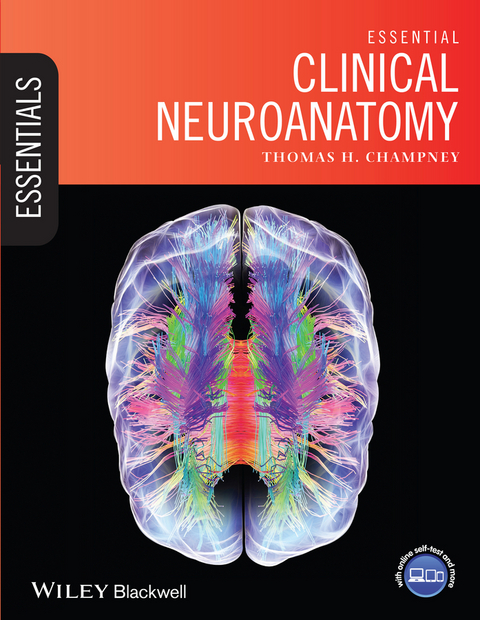
Essential Clinical Neuroanatomy is an accessible introduction to regional and functional neuroanatomy, which cuts through the jargon to help you engage with the key concepts. Beautifully presented in full color, with hundreds of annotated illustrations and images, Essential Clinical Neuroanatomy begins with an introductory section on the regional aspects of the topic, then discusses each structure in detail in relation to function. Clinical examples are provided throughout, to reinforce the concepts learned and highlight their clinical relevance.
Essential Clinical Neuroanatomy:
- Features a dedicated chapter on the use of imaging studies used in clinical neuroanatomy, including how to evaluate these images
- Highlights topics important to clinical medicine, but often neglected in other neuroanatomy texts, such as trauma, infection and congenital considerations
- All illustrations and images are oriented in the clinical view, so the correlation between drawings, photomicrographs and clinical imaging is standardized and there is a seamless transition between illustrations containing basic neuroanatomical information and the relevant clinical imaging
- The functional aspects of neuroanatomical structures are color-coded (green = sensory; red = motor; purple = autonomic), so that structure to function relationships can be more easily learned and retained
- Includes self-assessment and thought questions in every chapter
- Supported by a companion website at wileyessential.com/neuroanatomy featuring fully downloadable images, flashcards, and a self-assessment question bank with USMLE-compatible multiple-choice questions
Essential Clinical Neuroanatomy is the perfect resource for medical and health science students taking a course on neuroanatomy, as part of USMLE teaching and as an on-going companion during those first steps in clinical practice.
Thomas Champney, Ph.D. Associate Professor, Educator Track, Miami Miller School of Medicine, Florida, USA.
Thomas Champney, Ph.D. Associate Professor, Educator Track, Miami Miller School of Medicine, Florida, USA.
Preface vi
Acknowledgments vii
About the Companion Website viii
Part 1: Neuroanatomy of the Central Nervous System
1 Overview of the nervous system 3
2 Blood vessels, meninges, and ventricles 20
3 Neurodevelopment 39
4 Spinal cord 49
5 Medulla oblongata 61
6 Pons 77
7 Midbrain 95
8 Diencephalon 107
9 Telencephalon 119
10 Cerebellum 131
11 Spinal tracts 145
Part 2: The Sensory, Motor, and Integration Systems
12 Visual system 175
13 Auditory and vestibular system 192
14 Olfaction and taste 210
15 Central motor control 219
16 Limbic system 235
17 Cortical integration 245
18 Imaging essentials 259
Answers to study questions 268
Answers to figures 275
Glossary 278
Index 301
CHAPTER 1
Overview of the nervous system
Learning objectives
- Describe the basic subdivisions of the human nervous system.
- Understand basic neuroanatomical terminology.
- Identify the major structures on the external surface of the gross brain.
- Identify the major structures on the midsagittal surface of the brain.
- Identify the cranial nerves.
Divisions of the nervous system
Anatomic
- Central nervous system (CNS)
- Brain and spinal cord
- Collection of nerve cell bodies = nucleus
- Peripheral nervous system (PNS)
- Peripheral nerves
- Collection of nerve cell bodies = ganglia
Functional
- Sensory (afferent)
- General – touch
- Special senses – sight, sound, taste, smell, balance
- Motor (efferent)
- Voluntary (somatic) – skeletal muscle
- Involuntary (autonomic) – smooth and cardiac muscle
- Parasympathetic – craniosacral (III, VII, IX, X, S2–S4)
- Sympathetic – thoracolumbar (T1–L2)
- Integrative – interneurons within the CNS
Components of the nervous system
Neurons
- Highly specialized, excitable cells
- Morphologic diversity
Glia – supporting cells
- Schwann cells (neurolemmocytes) – myelin producing
- Oligodendrocytes – myelin producing
- Astrocytes – nutritional support
- Microglia – macrophages (immune support)
Neurons
Cellular structure
- Dendrites
- Axon
- Axon hillock
- Terminal arborization/terminal boutons
- Synapse/synaptic vesicles
- Anterograde/retrograde flow
- Soma (perikaryon, cell body)
- Nucleus/nucleolus
- Nissl bodies (rough endoplasmic reticulum and polyribosomes)
- Lipofuscin
- Cell membrane (plasmalemma, neurolemma)
- Types: unipolar, bipolar, multipolar, pseudounipolar
Glia – central nervous system
Oligodendrocytes – myelin production; one oligodendrocyte for many axons
Astrocytes – support cells, glial fibrillary acid protein (GFAP), end feet
- Fibrous astrocytes – white matter
- Protoplasmic astrocytes – gray matter
Microglia – macrophage-like, scavenging cells
Ependymal cells – columnar, ciliated cells lining the ventricles
Central nervous system
Gray matter
- Nerve cell bodies (nuclei)
- Dendrites and axons
- Glia
White matter
- Nerve fibers (axons) – myelinated
- Glia
Brain neuroanatomy
Orientation of the brain – 90 degree rotation at midbrain flexure
- Superior – inferior
- Anterior – posterior
- Dorsal – ventral
- Rostral – caudal
Planes of the brain
- Sagittal plane
- Midsagittal
- Parasagittal
- Horizontal plane (transverse, axial)
- Frontal plane (coronal)
Views of the brain
- Superior
- Interhemispheric fissure (sagittal)
- Precentral gyrus (primary motor)
- Central sulcus
- Postcentral gyrus (primary somatosensory)
- Inferior
- Interhemispheric fissure (sagittal)
- Lateral fissure (Sylvian)
- Midbrain – cerebral peduncles
- Pons
- Medulla oblongata – pyramids, inferior olives
- Cerebellum
- Olfactory bulb and tract
- Optic chiasm and tract
- Infundibulum (pituitary stalk)
- Mammillary bodies
- Cranial nerves (12)
- Olfactory nerve (I)
- Optic nerve (II)
- Occulomotor nerve (III)
- Trochlear nerve (IV)
- Trigeminal nerve (V)
- Abducens nerve (VI)
- Facial nerve (VII)
- Vestibulocochlear nerve (VIII)
- Glossopharyngeal nerve (IX)
- Vagus nerve (X)
- Spinal accessory nerve (XI)
- Hypoglossal nerve (XII)
- Lateral
- Lateral fissure (Sylvian)
- Brain stem (midbrain, pons, and medulla)
- Cerebellum
- Central sulcus
- Precentral gyrus (primary motor)
- Postcentral gyrus (primary sensory)
- Lobes of the brain
- Frontal lobe
- Parietal lobe
- Occipital lobe (vision)
- Temporal lobe (auditory)
- Insular cortex
- Superior temporal gyrus (auditory)
- Midsagittal
- Frontal cortex
- Parietal cortex
- Occipital cortex
- Cerebellum
- Corpus callosum
- Hypothalamus
- Thalamus
- Pineal gland
- Midbrain
- Pons
- Medulla oblongata
- Cingulate gyrus
- Fornix
- Amygdala
- Hippocampus
Subdivisions of the brain and spinal cord
- Spinal cord
- Central grey matter
- Posterior (dorsal) horn – sensory (afferent)
- Lateral horn – autonomic
- Anterior (ventral) horn – motor (efferent) – alpha motor neurons
- Peripheral white matter
- Reflexes and basic integration
- Cervical (8 nerves)
- Thoracic (12 nerves)
- Lumbar (5 nerves)
- Sacral (5 nerves)
- Coccygeal (1 nerve)
- Central grey matter
- Brain stem
- Midbrain
- Pons
- Medulla oblongata
- Diencephalon
- Thalamus
- Hypothalamus
- Epithalamus – pineal gland
- Cerebrum – cerebral hemispheres – telencephalon
- Frontal lobe
- Parietal lobe
- Temporal lobe
- Occipital lobe
- Six histological layers
- Integration of afferent and efferent information
- Cerebellum
- Three histological layers
- Molecular layer
- Purkinje cell layer
- Granule cell layer
- Coordinates balance and muscle tone
- Three histological layers
- Cranial nerves (12)
- Olfactory nerve (I)
- Optic nerve (II)
- Occulomotor nerve (III)
- Trochlear nerve (IV)
- Trigeminal nerve (V)
- Abducens nerve (VI)
- Facial nerve (VII)
- Vestibulocochlear nerve (VIII)
- Glossopharyngeal nerve (IX)
- Vagus nerve (X)
- Spinal accessory nerve (XI)
- Hypoglossal nerve (XII)
Clinical considerations
Caveats
- Anterior (ventral) and posterior (dorsal)
- Ipsilateral and contralateral
- Anatomical axial view versus clinical axial view
Lesions
Neighborhood effects
Case studies
Multiple sclerosis
Age-related cognitive decline
Study questions
Introduction
The nervous system is a remarkable communication system that can send a message from one part of the body to the brain, react to that message, and produce a response within seconds. The goal of this chapter is to introduce the components and organization of the nervous system. This may be a review for some, but it will set a foundation on which the remainder of the text can be built.
Nervous system organization
The nervous system can be described in two ways: anatomically or functionally. Anatomically, the nervous system is divided into a central component (brain and spinal cord) and a peripheral component (cranial nerves...
| Erscheint lt. Verlag | 12.6.2015 |
|---|---|
| Reihe/Serie | Essentials |
| Essentials | Essentials |
| Sprache | englisch |
| Themenwelt | Medizin / Pharmazie ► Medizinische Fachgebiete ► Neurologie |
| Studium ► 1. Studienabschnitt (Vorklinik) ► Anatomie / Neuroanatomie | |
| Schlagworte | clinical neuroanatomy medical health science student regional function structure imaging trauma infection practice • Medical Science • Medizin • Neuroanatomie • Neuroanatomy • Neurologie • Neurology |
| ISBN-10 | 1-118-43997-X / 111843997X |
| ISBN-13 | 978-1-118-43997-5 / 9781118439975 |
| Informationen gemäß Produktsicherheitsverordnung (GPSR) | |
| Haben Sie eine Frage zum Produkt? |
 EPUB (Adobe DRM)
Kopierschutz: Adobe-DRM
Adobe-DRM ist ein Kopierschutz, der das eBook vor Mißbrauch schützen soll. Dabei wird das eBook bereits beim Download auf Ihre persönliche Adobe-ID autorisiert. Lesen können Sie das eBook dann nur auf den Geräten, welche ebenfalls auf Ihre Adobe-ID registriert sind.
Details zum Adobe-DRM
Dateiformat: EPUB (Electronic Publication)
EPUB ist ein offener Standard für eBooks und eignet sich besonders zur Darstellung von Belletristik und Sachbüchern. Der Fließtext wird dynamisch an die Display- und Schriftgröße angepasst. Auch für mobile Lesegeräte ist EPUB daher gut geeignet.
Systemvoraussetzungen:
PC/Mac: Mit einem PC oder Mac können Sie dieses eBook lesen. Sie benötigen eine
eReader: Dieses eBook kann mit (fast) allen eBook-Readern gelesen werden. Mit dem amazon-Kindle ist es aber nicht kompatibel.
Smartphone/Tablet: Egal ob Apple oder Android, dieses eBook können Sie lesen. Sie benötigen eine
Geräteliste und zusätzliche Hinweise
Buying eBooks from abroad
For tax law reasons we can sell eBooks just within Germany and Switzerland. Regrettably we cannot fulfill eBook-orders from other countries.
aus dem Bereich