Essential Clinical Neuroanatomy (eBook)
John Wiley & Sons (Verlag)
978-1-118-43996-8 (ISBN)
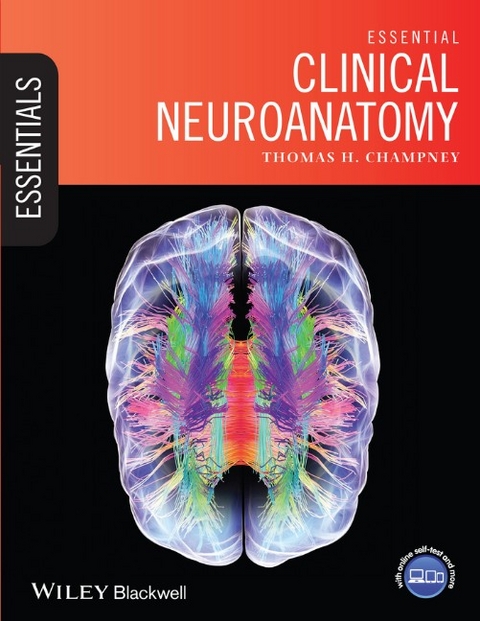
Essential Clinical Neuroanatomy is an accessible introduction to regional and functional neuroanatomy, which cuts through the jargon to help you engage with the key concepts. Beautifully presented in full color, with hundreds of annotated illustrations and images, Essential Clinical Neuroanatomy begins with an introductory section on the regional aspects of the topic, then discusses each structure in detail in relation to function. Clinical examples are provided throughout, to reinforce the concepts learned and highlight their clinical relevance.
Essential Clinical Neuroanatomy:
- Features a dedicated chapter on the use of imaging studies used in clinical neuroanatomy, including how to evaluate these images
- Highlights topics important to clinical medicine, but often neglected in other neuroanatomy texts, such as trauma, infection and congenital considerations
- All illustrations and images are oriented in the clinical view, so the correlation between drawings, photomicrographs and clinical imaging is standardized and there is a seamless transition between illustrations containing basic neuroanatomical information and the relevant clinical imaging
- The functional aspects of neuroanatomical structures are color-coded (green = sensory; red = motor; purple = autonomic), so that structure to function relationships can be more easily learned and retained
- Includes self-assessment and thought questions in every chapter
- Supported by a companion website at wileyessential.com/neuroanatomy featuring fully downloadable images, flashcards, and a self-assessment question bank with USMLE-compatible multiple-choice questions
Essential Clinical Neuroanatomy is the perfect resource for medical and health science students taking a course on neuroanatomy, as part of USMLE teaching and as an on-going companion during those first steps in clinical practice.
Thomas Champney, Ph.D. Associate Professor, Educator Track, Miami Miller School of Medicine, Florida, USA.
Essential Clinical Neuroanatomy is an accessible introduction to regional and functional neuroanatomy, which cuts through the jargon to help you engage with the key concepts. Beautifully presented in full color, with hundreds of annotated illustrations and images, Essential Clinical Neuroanatomy begins with an introductory section on the regional aspects of the topic, then discusses each structure in detail in relation to function. Clinical examples are provided throughout, to reinforce the concepts learned and highlight their clinical relevance. Essential Clinical Neuroanatomy: Features a dedicated chapter on the use of imaging studies used in clinical neuroanatomy, including how to evaluate these images Highlights topics important to clinical medicine, but often neglected in other neuroanatomy texts, such as trauma, infection and congenital considerations All illustrations and images are oriented in the clinical view, so the correlation between drawings, photomicrographs and clinical imaging is standardized and there is a seamless transition between illustrations containing basic neuroanatomical information and the relevant clinical imaging The functional aspects of neuroanatomical structures are color-coded (green = sensory; red = motor; purple = autonomic), so that structure to function relationships can be more easily learned and retained Includes self-assessment and thought questions in every chapter Supported by a companion website at wileyessential.com/neuroanatomy featuring fully downloadable images, flashcards, and a self-assessment question bank with USMLE-compatible multiple-choice questions Essential Clinical Neuroanatomy is the perfect resource for medical and health science students taking a course on neuroanatomy, as part of USMLE teaching and as an on-going companion during those first steps in clinical practice.
Thomas Champney, Ph.D. Associate Professor, Educator Track, Miami Miller School of Medicine, Florida, USA.
Title Page 5
Copyright Page 6
Contents 7
Preface 8
Acknowledgments 9
About the companion website 10
Part 1 Neuroanatomy of the Central Nervous System 11
Chapter 1 Overview of the nervous system 13
Introduction 15
Nervous system organization 15
Components of the nervous system 18
Central nervous system structure 19
Central nervous system orientation 21
Views of the brain 23
Central nervous system subdivisions 24
Caveats 26
Clinical considerations 26
Study questions 28
Further reading 29
Chapter 2 Blood vessels, meninges, and ventricles 30
Introduction 31
Cranial meninges 31
Cranial ventricular system 32
Arterial supply 34
The cerebral arterial circle (of Willis) 39
Venous drainage 40
The blood-brain barrier 43
Clinical considerations 44
Study questions 48
Further reading 48
Chapter 3 Neurodevelopment 49
Introduction 50
Early neural development 50
Neurodevelopment histology 53
Clinical considerations 54
Study questions 58
Further reading 58
Chapter 4 Spinal cord 59
Introduction 60
Spinal cord relationships 60
Spinal cord anatomy 61
Gray matter 62
White matter 64
Central canal 66
Intervertebral foramen 67
Intervertebral discs 67
Clinical considerations 68
Study questions 70
Further reading 70
Chapter 5 Medulla oblongata 71
Introduction 72
Brain stem anatomy 73
Anatomy of the medulla oblongata 73
Cross section of the caudal medulla oblongata 74
Cross section of the rostral medulla oblongata 76
Cranial nerves 77
Clinical considerations 82
Study questions 85
Further reading 86
Chapter 6 Pons 87
Introduction 89
Anatomy of the pons 89
Cross section of the pontomedullary junction 89
Cross section of the caudal pons 90
Cross section of the middle pons 92
Cross section of the rostral pons 92
Cranial nerves 93
Clinical considerations 100
Study questions 103
Further reading 104
Chapter 7 Midbrain 105
Introduction 106
Anatomy of the midbrain 106
Cross section of the caudal midbrain 107
Cross section of the rostral midbrain 108
Cranial nerves 109
Clinical considerations 112
Study questions 115
Further reading 116
Chapter 8 Diencephalon 117
Introduction 118
Neuroanatomy 118
Neural tracts 119
Cranial nerves 123
Clinical considerations 126
Study questions 127
Further reading 128
Chapter 9 Telencephalon 129
Introduction 130
Development 130
Cerebral cortex 130
Corpus callosum 132
Basal ganglia 132
Amygdala and hippocampus 134
Lateral ventricles 136
Clinical considerations 137
Study questions 139
Further reading 140
Chapter 10 Cerebellum 141
Introduction 142
Cerebellar anatomy 143
Cerebellar input pathways 144
Cerebellar cortex histology 149
Cerebellar output pathways 151
Clinical considerations 152
Study questions 154
Further reading 154
Chapter 11 Spinal tracts 155
Introduction 157
Ascending (sensory) tracts 157
Posterior (dorsal) columns 158
Spinothalamic tract 161
Spinocerebellar pathway 164
Descending tracts 164
Corticospinal tract 164
Corticobulbar tract 166
Corticopontine tracts 171
Rubrospinal tract 171
Anterior (ventral) columns 171
Clinical considerations 175
Study questions 180
Further reading 180
Part 2 The Sensory, Motor, and Integration Systems 183
Chapter 12 Visual system 185
Introduction 187
Development of the eye 187
Anatomy of the eye 187
Visual pathway 190
Direct and consensual light reflexes 192
Clinical considerations 192
Study questions 200
Further reading 201
Chapter 13 Auditory and vestibular system 202
Introduction 204
Development 204
External ear 204
Middle ear 204
Inner ear 205
Auditory system 205
Vestibular system 209
Clinical considerations 211
Study questions 218
Further reading 219
Chapter 14 Olfaction and taste 220
Introduction 221
Olfactory system 221
Taste system 222
Clinical considerations 226
Study questions 227
Further reading 228
Chapter 15 Central motor control 229
Introduction 231
Motor pathways 231
Central control of movement 235
Clinical considerations 240
Study questions 243
Further reading 244
Chapter 16 Limbic system 245
Introduction 246
Anatomy of the limbic system 246
Functions of the limbic system 251
Clinical considerations 252
Study questions 254
Further reading 254
Chapter 17 Cortical integration 255
Introduction 256
Anatomical organization of the cortex 256
Cerebral functional anatomy 257
Cerebral hemisphere localization 257
Clinical considerations 262
Summary 264
Study questions 267
Further reading 268
Chapter 18 Imaging essentials 269
Introduction 270
Neuroanatomical imaging 270
Ultrasound 275
Clinical considerations 276
Study questions 277
Further reading 277
Answers to study questions 278
Answers to figures 285
Answer to Figure 4.8 285
Answer to Figure 5.17 285
Answer to Figure 6.19 285
Answer to Figure 7.9 285
Answer to Figure 11.21 285
Answer to Figure 11.22 286
Answer to Figure 11.23 286
Answer to Figure 11.24 286
Answer to Figure 11.25 286
Answer to Figure 11.26 286
Answer to Figure 11.27 287
Answer to Figure 11.28 287
Answer to Figure 11.29 287
Answer to Figure 15.10 287
Glossary 288
Index 311
EULA 322
| Erscheint lt. Verlag | 12.6.2015 |
|---|---|
| Reihe/Serie | Essentials |
| Essentials | Essentials |
| Sprache | englisch |
| Themenwelt | Medizin / Pharmazie ► Medizinische Fachgebiete ► Neurologie |
| Studium ► 1. Studienabschnitt (Vorklinik) ► Anatomie / Neuroanatomie | |
| Schlagworte | clinical neuroanatomy medical health science student regional function structure imaging trauma infection practice • Medical Science • Medizin • Neuroanatomie • Neuroanatomy • Neurologie • Neurology |
| ISBN-10 | 1-118-43996-1 / 1118439961 |
| ISBN-13 | 978-1-118-43996-8 / 9781118439968 |
| Informationen gemäß Produktsicherheitsverordnung (GPSR) | |
| Haben Sie eine Frage zum Produkt? |
 PDF (Adobe DRM)
Kopierschutz: Adobe-DRM
Adobe-DRM ist ein Kopierschutz, der das eBook vor Mißbrauch schützen soll. Dabei wird das eBook bereits beim Download auf Ihre persönliche Adobe-ID autorisiert. Lesen können Sie das eBook dann nur auf den Geräten, welche ebenfalls auf Ihre Adobe-ID registriert sind.
Details zum Adobe-DRM
Dateiformat: PDF (Portable Document Format)
Mit einem festen Seitenlayout eignet sich die PDF besonders für Fachbücher mit Spalten, Tabellen und Abbildungen. Eine PDF kann auf fast allen Geräten angezeigt werden, ist aber für kleine Displays (Smartphone, eReader) nur eingeschränkt geeignet.
Systemvoraussetzungen:
PC/Mac: Mit einem PC oder Mac können Sie dieses eBook lesen. Sie benötigen eine
eReader: Dieses eBook kann mit (fast) allen eBook-Readern gelesen werden. Mit dem amazon-Kindle ist es aber nicht kompatibel.
Smartphone/Tablet: Egal ob Apple oder Android, dieses eBook können Sie lesen. Sie benötigen eine
Geräteliste und zusätzliche Hinweise
Buying eBooks from abroad
For tax law reasons we can sell eBooks just within Germany and Switzerland. Regrettably we cannot fulfill eBook-orders from other countries.
aus dem Bereich