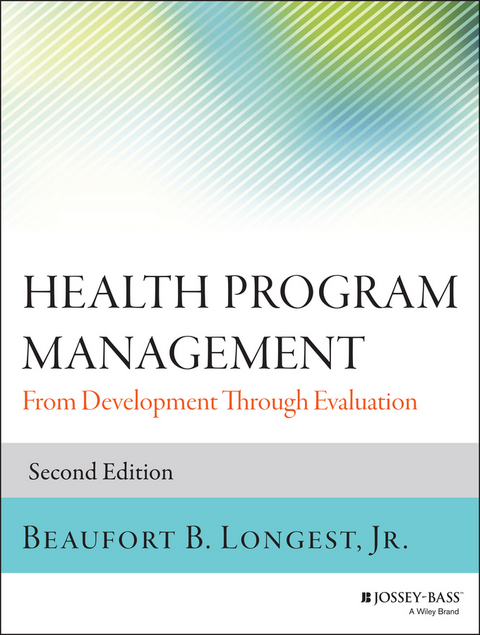
Health Program Management (eBook)
John Wiley & Sons (Verlag)
978-1-118-83476-3 (ISBN)
Health Program Management: From Development Through Evaluation, Second Edition is a practical and useful introduction to the management of health programs. While providing an overview of the current best practices in management, the textbook goes beyond simple management techniques, teaching students how to develop, lead, and evaluate their programs to ensure quality outcomes. The focus is on the three core management concepts of strategy, design, and leadership, but time is also devoted to describing facilitative management activities integral to successful programs. Students will learn techniques for communication, decision-making, quality assurance, marketing, and program evaluation within the structure of the book's program management model. Logically organized with a separate chapter for each activity, this resource provides a thorough, systematic overview of the effective development, implementation, and evaluation of health programs.
Health Program Management: From Development Through Evaluation, Second Edition provides a comprehensive approach to management throughout all stages of a health program.
- Learn to develop a strategy that steers the program toward specific goals
- Discover how to design, market, and lead an effective health program
- Become familiar with the manager's role in a quality health program
- Evaluate potential and existing programs for performance and capability
Students and aspiring managers and leaders preparing themselves for the challenges of managing health programs will find the information and techniques to develop the skills they need in Health Program Management: From Development Through Evaluation, Second Edition.
BEAUFORT B. LONGEST, JR., PHD, is professor of health policy and management at the University of Pittsburgh Graduate School of Public Health. He has written eight books and coauthored three others. He is a fellow of the American College of Healthcare Executives and holds memberships in the Academy of Management, Academy Health, and the American Public Health Association.
Learn how to effectively plan, implement, and evaluate health programs Health Program Management: From Development Through Evaluation, Second Edition is a practical and useful introduction to the management of health programs. While providing an overview of the current best practices in management, the textbook goes beyond simple management techniques, teaching students how to develop, lead, and evaluate their programs to ensure quality outcomes. The focus is on the three core management concepts of strategy, design, and leadership, but time is also devoted to describing facilitative management activities integral to successful programs. Students will learn techniques for communication, decision-making, quality assurance, marketing, and program evaluation within the structure of the book's program management model. Logically organized with a separate chapter for each activity, this resource provides a thorough, systematic overview of the effective development, implementation, and evaluation of health programs. Health Program Management: From Development Through Evaluation, Second Edition provides a comprehensive approach to management throughout all stages of a health program. Learn to develop a strategy that steers the program toward specific goals Discover how to design, market, and lead an effective health program Become familiar with the manager's role in a quality health program Evaluate potential and existing programs for performance and capability Students and aspiring managers and leaders preparing themselves for the challenges of managing health programs will find the information and techniques to develop the skills they need in Health Program Management: From Development Through Evaluation, Second Edition.
BEAUFORT B. LONGEST, JR., PHD, is professor of health policy and management at the University of Pittsburgh Graduate School of Public Health. He has written eight books and coauthored three others. He is a fellow of the American College of Healthcare Executives and holds memberships in the Academy of Management, Academy Health, and the American Public Health Association.
Preface
Acknowledgments
The Author
Chapter 1 The Work of Managers in Health Programs
Chapter 2 Developing and Strategizing the Future
Chapter 3 Designing for Effectiveness
Chapter 4 Leading to Accomplish Desired Results
Chapter 5 Making Good Management Decisions
Chapter 6 Communicating for Understanding
Chapter 7 Managing Quality - Totally
Chapter 8 Commercial and Social Marketing
Chapter 9 Program Evaluation
Index
Preface
This book is about managing health programs. Effective management of programs is important because these are mechanisms through which a great many health services are organized and provided in both the public health and health care sectors. I provide information drawn from management research to assist you in developing a comprehensive approach to the practice of management in health programs. A focused reader will take away a solid overview of the current best practices in management that apply to managing health programs.
Health programs target any of the determinants of health. They can focus on some aspect of the physical environments in which people live and work, on human behavior, on biology, on the social factors that affect people, or on the health services offered to them. There is therefore a broad array of health programs. For example, at the prevention end of the health services spectrum, people receive information about safe sex practices or how to eat healthier in the context of health education programs. At the advanced acute care end of the spectrum of services, people receive kidney transplants within the context of transplant programs.
A persistent, decades-long trend has created ever larger and more elaborate structures that organize, deliver, and finance health services throughout the industrialized world. Current manifestations of this phenomenon can be seen in major public health agencies, such as the California Department of Public Health (www.cdph.ca.gov), or large health services organizations, such as the Massachusetts General Hospital (www.massgeneral.org). Within these large and complex structures, however, health services are provided directly through relatively small units called programs.
A substantial literature exists pertaining to the management of large and complex public- and private-sector health agencies, organizations, and systems. I have contributed to this literature myself. Nevertheless, there is a relative paucity of literature about managing at the level of health programs, where so much of the direct delivery of health services occurs. With this book, I seek to partially address this imbalance.
The intended audience for this book includes students in public health, in health services management, and in a wide variety of health professions who want to prepare themselves for the challenges of managing health programs. Even those who aspire to leadership positions in large agencies, organizations, and systems may begin their management career at the level of programs. The book will also be useful for those who already occupy a program management position, because it comprehensively and systematically presents current information about management.
Programs are defined in this book as organizational units intended to accomplish one or more objectives through a plan of action that describes what work is to be done, by whom, when, and how, as well as what resources will be used. Programs are embedded in organizations and should be of benefit to the larger host organization. Program management is defined as the activities through which the mission and objectives of a program are established and pursued by means of various processes using human and other resources.
As a way of organizing the discussion of program management, and to give a sense of the structure of the book itself, I present in Chapter 1 a model of the activities managers engage in as they manage programs. These activities are divided into two sets: core activities and facilitative activities. All health program managers engage in three core activities as they perform management work: developing/strategizing, designing, and leading. In addition, managers also engage in other activities that facilitate and support the accomplishment of a program's mission and objectives. Program managers engage extensively in such facilitative activities as decision making and communicating as they carry out their management work. Increasingly, they also engage in managing quality, marketing, and evaluating. Individual chapters of the book are devoted to each of these activities, presenting in-depth information about each of them. A brief précis of each chapter follows.
Chapter 1, “The Work of Managers in Health Programs,” contains key definitions and a background discussion of programs and program management. The work of managers is considered in terms of the core activities in which all managers engage as they do management work: developing/strategizing, designing, and leading. Consideration of this work is extended to include managers' facilitative activities: decision making, communicating, managing quality, marketing, and evaluating. The entire set of core and facilitative activities in management work is modeled graphically in Figure 1.4. This figure is the chapter's centerpiece, depicting the core and facilitative activities of management work as an integrated and interactive set of activities. There is also a discussion of the roles played by managers and the competencies necessary to manage health programs well.
Chapter 2, “Developing/Strategizing the Future,” emphasizes the initial development and strategizing that bring programs into existence. Developing a program initially simply means conceptualizing the program as a vehicle for delivering services or products that may succeed in the marketplace. In ongoing programs, development pertains to improving established services or products, or to expanding a program's portfolio of services or products. Development triggers strategizing, which is the work that managers do as they establish or revise the specific mission and objectives of a program and plan the means of achieving them.
Chapter 3, “Designing for Effectiveness,” is built around discussion of the work managers do when establishing and changing the intentional patterns of relationships among human and other resources within a program, and when establishing and changing the program's relationship to its external environment, including to the larger organizational home in which it is embedded. Attention is also given to designing logic models for programs.
Chapter 4, “Leading to Accomplish Desired Results,” describes leading as the work managers do when influencing other participants to contribute to the performance of a program. Emphasis is given to the fact that leading requires managers to help participants be motivated to contribute to programs in positive ways. Attention is given to specific leader behaviors that can improve management in programs.
Chapter 5, “Making Good Management Decisions,” emphasizes that decision making permeates all management work. The discussion of decision making represents a turn from core management activities to facilitative activities. Decisions are divided into two subsets: problem-solving decisions and opportunistic decisions. Problem-solving decisions are made to solve existing or anticipated problems. Opportunistic decisions are typically sporadic and arise with opportunities to reshape or advance accomplishment of a program's mission and objectives. Although decision making is defined simply as making a choice from among alternatives, the decision-making process is discussed in terms of seven steps: (1) becoming aware that a decision must be made, whether it stems from a problem or an opportunity; (2) defining in as much detail as possible the problem or opportunity; (3) developing relevant alternatives; (4) assessing the alternatives; (5) choosing from among the alternatives; (6) implementing the decision; and (7) evaluating the decision, and making necessary follow-up decisions.
Chapter 6, “Communicating for Understanding,” stresses that communicating activities are also ubiquitous in facilitating a manager's performance of all other management activities. Communicating is discussed as being both vital to the successful performance of management work and a challenge for managers. It is described as an activity that involves senders (individuals, groups, or organizations) conveying ideas, intentions, and information to receivers (also individuals, groups, or organizations). Communication is effective when receivers understand ideas, intentions, or information as senders intend, but several environmental and interpersonal barriers must be overcome to communicate effectively. The communicating activity is discussed as a key to managing relationships with a program's internal and external stakeholders.
Chapter 7, “Managing Quality—Totally,” discusses why managers of health programs typically make effectively managing the quality of the services provided a high priority. Quality is important not only to those who use the services of a program, having an important impact on their service-seeking decisions, but also to people who work in programs. This chapter stresses that above all else, managing quality in a health program requires a systematic approach. Three components of what is called a total quality approach to managing quality in health programs are presented: patient/customer focus, continuous improvement, and teamwork.
Chapter 8, “Commercial and Social Marketing,” discusses two important ways managers of health programs can use marketing to facilitate program performance. The financial or commercial success of many programs is affected by the use of commercial marketing. In addition, especially in programs focused on health promotion and education, social marketing is used in the provision of services. The...
| Erscheint lt. Verlag | 17.9.2014 |
|---|---|
| Reihe/Serie | Jossey-Bass Public Health |
| Jossey-Bass Public Health/Health Services Text | Jossey-Bass Public Health/Health Services Text |
| Sprache | englisch |
| Themenwelt | Medizin / Pharmazie ► Allgemeines / Lexika |
| Studium ► Querschnittsbereiche ► Prävention / Gesundheitsförderung | |
| Schlagworte | Ãffentlicher Gesundheitsdienst u. Gesundheitspolitik • AUPHA • Beaufort B. Longest, Jr. • Gesundheits- u. Sozialwesen • health administration text • Health & Social Care • Health Care • Health Care Administration • health care graduate text • health care institution management • health care services administration • Health Management • health management communication • health management core concepts</p> • health management decision making • health management leadership • health organization management • health program evaluation • Health Program Management • health program planning • health services management • hospital management • <p>Health Program Management: From Development Through Evaluation, Second Edition • managing health programs • managing health projects • Öffentlicher Gesundheitsdienst u. Gesundheitspolitik • Public Health • public health management text • Public Health Services & Policy |
| ISBN-10 | 1-118-83476-3 / 1118834763 |
| ISBN-13 | 978-1-118-83476-3 / 9781118834763 |
| Informationen gemäß Produktsicherheitsverordnung (GPSR) | |
| Haben Sie eine Frage zum Produkt? |
 EPUB (Adobe DRM)
Kopierschutz: Adobe-DRM
Adobe-DRM ist ein Kopierschutz, der das eBook vor Mißbrauch schützen soll. Dabei wird das eBook bereits beim Download auf Ihre persönliche Adobe-ID autorisiert. Lesen können Sie das eBook dann nur auf den Geräten, welche ebenfalls auf Ihre Adobe-ID registriert sind.
Details zum Adobe-DRM
Dateiformat: EPUB (Electronic Publication)
EPUB ist ein offener Standard für eBooks und eignet sich besonders zur Darstellung von Belletristik und Sachbüchern. Der Fließtext wird dynamisch an die Display- und Schriftgröße angepasst. Auch für mobile Lesegeräte ist EPUB daher gut geeignet.
Systemvoraussetzungen:
PC/Mac: Mit einem PC oder Mac können Sie dieses eBook lesen. Sie benötigen eine
eReader: Dieses eBook kann mit (fast) allen eBook-Readern gelesen werden. Mit dem amazon-Kindle ist es aber nicht kompatibel.
Smartphone/Tablet: Egal ob Apple oder Android, dieses eBook können Sie lesen. Sie benötigen eine
Geräteliste und zusätzliche Hinweise
Buying eBooks from abroad
For tax law reasons we can sell eBooks just within Germany and Switzerland. Regrettably we cannot fulfill eBook-orders from other countries.
aus dem Bereich