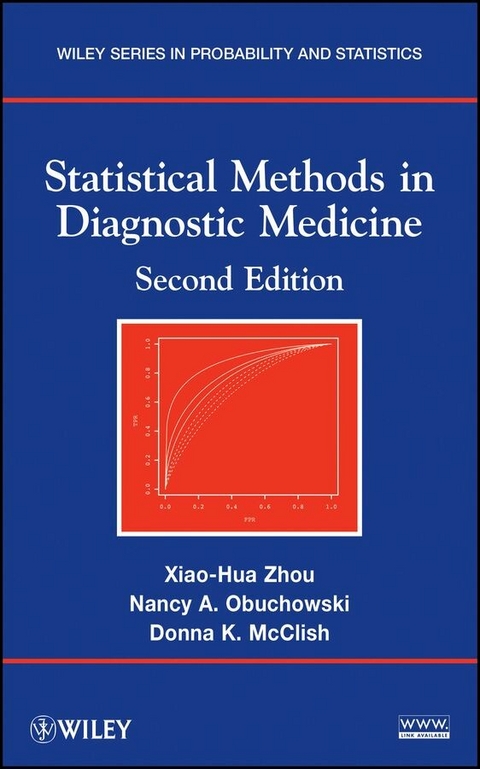
Statistical Methods in Diagnostic Medicine (eBook)
John Wiley & Sons (Verlag)
978-1-118-62604-7 (ISBN)
' . . . the book is a valuable addition to the literature in the field, serving as a much-needed guide for both clinicians and advanced students.'-Zentralblatt MATH
A new edition of the cutting-edge guide to diagnostic tests in medical research
In recent years, a considerable amount of research has focused on evolving methods for designing and analyzing diagnostic accuracy studies. Statistical Methods in Diagnostic Medicine, Second Edition continues to provide a comprehensive approach to the topic, guiding readers through the necessary practices for understanding these studies and generalizing the results to patient populations.
Following a basic introduction to measuring test accuracy and study design, the authors successfully define various measures of diagnostic accuracy, describe strategies for designing diagnostic accuracy studies, and present key statistical methods for estimating and comparing test accuracy. Topics new to the Second Edition include:
-
Methods for tests designed to detect and locate lesions
-
Recommendations for covariate-adjustment
-
Methods for estimating and comparing predictive values and sample size calculations
-
Correcting techniques for verification and imperfect standard biases
-
Sample size calculation for multiple reader studies when pilot data are available
-
Updated meta-analysis methods, now incorporating random effects
Three case studies thoroughly showcase some of the questions and statistical issues that arise in diagnostic medicine, with all associated data provided in detailed appendices. A related web site features Fortran, SAS®, and R software packages so that readers can conduct their own analyses.
Statistical Methods in Diagnostic Medicine, Second Edition is an excellent supplement for biostatistics courses at the graduate level. It also serves as a valuable reference for clinicians and researchers working in the fields of medicine, epidemiology, and biostatistics.
Xiao-Hua Zhou, PhD, is Professor of Biostatistics at the University of Washington and Director and Research Career Scientist at the Biostatistics Unit of the Veterans Affairs Puget Sound Healthcare System. He is a Fellow of the American Statistical Association and the author of more than 100 published articles on statistical methods in diagnostic medicine and causal inferences.
Nancy A. Obuchowski, PhD, is Vice Chairperson of the Department of Quantitative Health Sciences at the Cleveland Clinic Foundation. A Fellow of the American Statistical Association, she has written more than 100 journal articles on the design and analysis of studies of screening and diagnostic tests.
Donna K. McClish, PhD, is Associate Professor and Graduate Program Director in Biostatistics at Virginia Commonwealth University. She has written more than 100 journal articles on statistical methods in epidemiology, diagnostic medicine, and health services research.
Praise for the First Edition "e; . . . the book is a valuable addition to the literature in the field, serving as a much-needed guide for both clinicians and advanced students."e; Zentralblatt MATH A new edition of the cutting-edge guide to diagnostic tests in medical research In recent years, a considerable amount of research has focused on evolving methods for designing and analyzing diagnostic accuracy studies. Statistical Methods in Diagnostic Medicine, Second Edition continues to provide a comprehensive approach to the topic, guiding readers through the necessary practices for understanding these studies and generalizing the results to patient populations. Following a basic introduction to measuring test accuracy and study design, the authors successfully define various measures of diagnostic accuracy, describe strategies for designing diagnostic accuracy studies, and present key statistical methods for estimating and comparing test accuracy. Topics new to the Second Edition include: Methods for tests designed to detect and locate lesions Recommendations for covariate-adjustment Methods for estimating and comparing predictive values and sample size calculations Correcting techniques for verification and imperfect standard biases Sample size calculation for multiple reader studies when pilot data are available Updated meta-analysis methods, now incorporating random effects Three case studies thoroughly showcase some of the questions and statistical issues that arise in diagnostic medicine, with all associated data provided in detailed appendices. A related web site features Fortran, SAS , and R software packages so that readers can conduct their own analyses. Statistical Methods in Diagnostic Medicine, Second Edition is an excellent supplement for biostatistics courses at the graduate level. It also serves as a valuable reference for clinicians and researchers working in the fields of medicine, epidemiology, and biostatistics.
Xiao-Hua Zhou, PhD, is Professor of Biostatistics at the University of Washington and Director and Research Career Scientist at the Biostatistics Unit of the Veterans Affairs Puget Sound Healthcare System. He is a Fellow of the American Statistical Association and the author of more than 100 published articles on statistical methods in diagnostic medicine and causal inferences. Nancy A. Obuchowski, PhD, is Vice Chairperson of the Department of Quantitative Health Sciences at the Cleveland Clinic Foundation. A Fellow of the American Statistical Association, she has written more than 100 journal articles on the design and analysis of studies of screening and diagnostic tests. Donna K. McClish, PhD, is Associate Professor and Graduate Program Director in Biostatistics at Virginia Commonwealth University. She has written more than 100 journal articles on statistical methods in epidemiology, diagnostic medicine, and health services research.
List of Figures xix
List of Tables xxiii
0.1 Preface xxix
0.2 Acknowledgements xxxi
Part I. Basic Concepts and Methods
1. Introduction 3
2. Measures of Diagnostic Accuracy 13
3. Design of Diagnostic Accuracy Studies 57
4. Estimation and Hypothesis Testing in a Single Sample 103
5. Comparing the Accuracy of Two Diagnostic Tests 165
6. Sample Size Calculations 193
7. Introduction to Meta-analysis for Diagnostic Accuracy Studies 231
Part II. Advanced Methods
8. Regression Analysis for Independent ROC Data 263
9. Analysis of Multiple Reader and/or Multiple Test Studies 297
10. Methods for Correcting Verification Bias 329
11. Methods for Correcting Imperfect Gold Standard Bias 389
12. Statistical Analysis for Meta-analysis 435
Appendix A. Case Studies and Chapter 8 Data 449
Appendix B. Jackknife and Bootstrap Methods of Estimating Variances and Confidence Intervals 477
"The authors, overall, have done a good job of revising their first edition, addressing the critical reviews as well as expanding and updating their coverage . . . In summary, this is a good book, focusing on medical diagnosis as the name promises, presenting a wealth of methods in detail with good discussion." (Journal of Biopharmaceutical Statistics, 2011)
"Early chapters are accessible to readers with a basic knowledge of statistical and medical terminology, and the second section addresses data analysts with basic training in biostatistics. Later chapters assume deeper background in statistics, but the examples should be accessible to all. The 2002 edition has been updated throughout, and three new case studies have been added." (Booknews, 1 June 2011)
LIST OF TABLES
| Erscheint lt. Verlag | 21.8.2014 |
|---|---|
| Reihe/Serie | Wiley Series in Probability and Statistics |
| Wiley Series in Probability and Statistics | Wiley Series in Probability and Statistics |
| Sprache | englisch |
| Themenwelt | Mathematik / Informatik ► Mathematik ► Statistik |
| Mathematik / Informatik ► Mathematik ► Wahrscheinlichkeit / Kombinatorik | |
| Studium ► 2. Studienabschnitt (Klinik) ► Anamnese / Körperliche Untersuchung | |
| Studium ► Querschnittsbereiche ► Epidemiologie / Med. Biometrie | |
| Technik | |
| Schlagworte | Biostatistics • Biostatistik • Diagnostik • Medical Science • Medical Statistics & Epidemiology • Medizin • Medizinische Statistik u. Epidemiologie • statistical methods in diagnostic medicine, diagnostic studies, diagnostic study design, diagnostic study analysis, diagnostic accuracy data, diagnostic test accuracy, diagnostic medicine research, FORTRAN program listings, statistical research in diagnostic medicine, meta-analysis methods, diagnostic accuracy studies • Statistics • Statistik |
| ISBN-10 | 1-118-62604-4 / 1118626044 |
| ISBN-13 | 978-1-118-62604-7 / 9781118626047 |
| Informationen gemäß Produktsicherheitsverordnung (GPSR) | |
| Haben Sie eine Frage zum Produkt? |
 EPUB (Adobe DRM)
Kopierschutz: Adobe-DRM
Adobe-DRM ist ein Kopierschutz, der das eBook vor Mißbrauch schützen soll. Dabei wird das eBook bereits beim Download auf Ihre persönliche Adobe-ID autorisiert. Lesen können Sie das eBook dann nur auf den Geräten, welche ebenfalls auf Ihre Adobe-ID registriert sind.
Details zum Adobe-DRM
Dateiformat: EPUB (Electronic Publication)
EPUB ist ein offener Standard für eBooks und eignet sich besonders zur Darstellung von Belletristik und Sachbüchern. Der Fließtext wird dynamisch an die Display- und Schriftgröße angepasst. Auch für mobile Lesegeräte ist EPUB daher gut geeignet.
Systemvoraussetzungen:
PC/Mac: Mit einem PC oder Mac können Sie dieses eBook lesen. Sie benötigen eine
eReader: Dieses eBook kann mit (fast) allen eBook-Readern gelesen werden. Mit dem amazon-Kindle ist es aber nicht kompatibel.
Smartphone/Tablet: Egal ob Apple oder Android, dieses eBook können Sie lesen. Sie benötigen eine
Geräteliste und zusätzliche Hinweise
Buying eBooks from abroad
For tax law reasons we can sell eBooks just within Germany and Switzerland. Regrettably we cannot fulfill eBook-orders from other countries.
aus dem Bereich