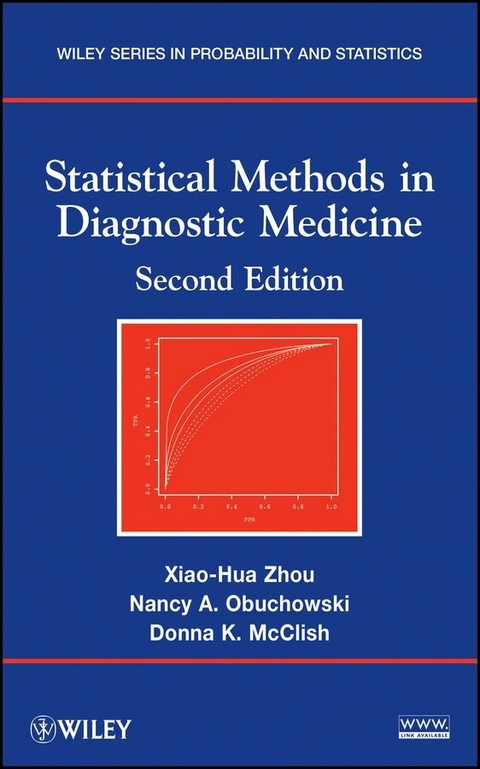
Statistical Methods in Diagnostic Medicine (eBook)
John Wiley & Sons (Verlag)
978-0-470-90650-7 (ISBN)
' . . . the book is a valuable addition to the literature in the field, serving as a much-needed guide for both clinicians and advanced students.'-Zentralblatt MATH
A new edition of the cutting-edge guide to diagnostic tests in medical research
In recent years, a considerable amount of research has focused on evolving methods for designing and analyzing diagnostic accuracy studies. Statistical Methods in Diagnostic Medicine, Second Edition continues to provide a comprehensive approach to the topic, guiding readers through the necessary practices for understanding these studies and generalizing the results to patient populations.
Following a basic introduction to measuring test accuracy and study design, the authors successfully define various measures of diagnostic accuracy, describe strategies for designing diagnostic accuracy studies, and present key statistical methods for estimating and comparing test accuracy. Topics new to the Second Edition include:
-
Methods for tests designed to detect and locate lesions
-
Recommendations for covariate-adjustment
-
Methods for estimating and comparing predictive values and sample size calculations
-
Correcting techniques for verification and imperfect standard biases
-
Sample size calculation for multiple reader studies when pilot data are available
-
Updated meta-analysis methods, now incorporating random effects
Three case studies thoroughly showcase some of the questions and statistical issues that arise in diagnostic medicine, with all associated data provided in detailed appendices. A related web site features Fortran, SAS®, and R software packages so that readers can conduct their own analyses.
Statistical Methods in Diagnostic Medicine, Second Edition is an excellent supplement for biostatistics courses at the graduate level. It also serves as a valuable reference for clinicians and researchers working in the fields of medicine, epidemiology, and biostatistics.
Xiao-Hua Zhou, PhD, is Professor of Biostatistics at the University of Washington and Director and Research Career Scientist at the Biostatistics Unit of the Veterans Affairs Puget Sound Healthcare System. He is a Fellow of the American Statistical Association and the author of more than 100 published articles on statistical methods in diagnostic medicine and causal inferences.
Nancy A. Obuchowski, PhD, is Vice Chairperson of the Department of Quantitative Health Sciences at the Cleveland Clinic Foundation. A Fellow of the American Statistical Association, she has written more than 100 journal articles on the design and analysis of studies of screening and diagnostic tests.
Donna K. McClish, PhD, is Associate Professor and Graduate Program Director in Biostatistics at Virginia Commonwealth University. She has written more than 100 journal articles on statistical methods in epidemiology, diagnostic medicine, and health services research.
Praise for the First Edition "e; . . . the book is a valuable addition to the literature in the field, serving as a much-needed guide for both clinicians and advanced students."e; Zentralblatt MATH A new edition of the cutting-edge guide to diagnostic tests in medical research In recent years, a considerable amount of research has focused on evolving methods for designing and analyzing diagnostic accuracy studies. Statistical Methods in Diagnostic Medicine, Second Edition continues to provide a comprehensive approach to the topic, guiding readers through the necessary practices for understanding these studies and generalizing the results to patient populations. Following a basic introduction to measuring test accuracy and study design, the authors successfully define various measures of diagnostic accuracy, describe strategies for designing diagnostic accuracy studies, and present key statistical methods for estimating and comparing test accuracy. Topics new to the Second Edition include: Methods for tests designed to detect and locate lesions Recommendations for covariate-adjustment Methods for estimating and comparing predictive values and sample size calculations Correcting techniques for verification and imperfect standard biases Sample size calculation for multiple reader studies when pilot data are available Updated meta-analysis methods, now incorporating random effects Three case studies thoroughly showcase some of the questions and statistical issues that arise in diagnostic medicine, with all associated data provided in detailed appendices. A related web site features Fortran, SAS , and R software packages so that readers can conduct their own analyses. Statistical Methods in Diagnostic Medicine, Second Edition is an excellent supplement for biostatistics courses at the graduate level. It also serves as a valuable reference for clinicians and researchers working in the fields of medicine, epidemiology, and biostatistics.
Xiao-Hua Zhou, PhD, is Professor of Biostatistics at the University of Washington and Director and Research Career Scientist at the Biostatistics Unit of the Veterans Affairs Puget Sound Healthcare System. He is a Fellow of the American Statistical Association and the author of more than 100 published articles on statistical methods in diagnostic medicine and causal inferences. Nancy A. Obuchowski, PhD, is Vice Chairperson of the Department of Quantitative Health Sciences at the Cleveland Clinic Foundation. A Fellow of the American Statistical Association, she has written more than 100 journal articles on the design and analysis of studies of screening and diagnostic tests. Donna K. McClish, PhD, is Associate Professor and Graduate Program Director in Biostatistics at Virginia Commonwealth University. She has written more than 100 journal articles on statistical methods in epidemiology, diagnostic medicine, and health services research.
Statistical Methods in Diagnostic Medicine 5
CONTENTS 11
List of Figures 21
List of Tables 25
0.1 PREFACE 31
0.2 ACKNOWLEDGEMENTS 32
PART I BASIC CONCEPTS AND METHODS 33
1 Introduction 35
1.1 Diagnostic Test Accuracy Studies 35
1.2 Case Studies 38
1.2.1 Case Study 1: Parathyroid Disease 38
1.2.2 Case Study 2: Colon Cancer Detection 39
1.2.3 Case Study 3: Carotid Artery Stenosis 41
1.3 Software 42
1.4 Topics Not Covered in This Book 42
2 Measures of Diagnostic Accuracy 45
2.1 Sensitivity and Specificity 46
2.1.1 Basic Measures of Test Accuracy: Case Study 2 48
2.1.2 Diagnostic Tests with Continuous Results: The Artificial Heart Valve Example 49
2.1.3 Diagnostic Tests with Ordinal Results: Case Study 1 51
2.1.4 Effect of Prevalence and Spectrum of Disease 51
2.1.5 Analogy to ? and ? Statistical Errors 53
2.2 Combined Measures of Sensitivity and Specificity 53
2.2.1 Problems Comparing Two or More Tests: Case Study 1 53
2.2.2 Probability of a Correct Test Result 53
2.2.3 Odds Ratio and Youden's Index 55
2.3 Receiver Operating Characteristic (ROC) Curve 56
2.3.1 ROC Curves: Artificial Heart Valve and Case Study 1 56
2.3.2 ROC Curve Assumption 57
2.3.3 Smooth, Fitted ROC Curves 58
2.3.4 Advantages of ROC Curves 59
2.4 Area Under the ROC Curve 59
2.4.1 Interpretation of the Area Under the ROC Curve 60
2.4.2 Magnitudes of the Area Under the ROC Curve 61
2.4.3 Area Under the ROC Curve: Case Study 1 61
2.4.4 Misinterpretations of the Area Under the ROC Curve 64
2.5 Sensitivity at Fixed FPR 66
2.6 Partial Area Under the ROC Curve 67
2.7 Likelihood Ratios 68
2.7.1 Three Examples to Illustrate Likelihood Ratios 69
2.7.2 Limitations of Likelihood Ratios 71
2.7.3 Proper and Improper ROC Curves 71
2.8 ROC Analysis When the True Diagnosis Is Not Binary 73
2.9 C-Statistics and Other Measures to Compare Prediction Models 75
2.10 Detection and Localization of Multiple Lesions 76
2.11 Positive and Negative Predictive Values, Bayes Theorem, and Case Study 2 79
2.11.1 Bayes Theorem 80
2.12 Optimal Decision Threshold on the ROC Curve 83
2.12.1 Optimal Thresholds for Maximizing Classification 83
2.12.2 Optimal Threshold for Minimizing Cost 84
2.12.3 Optimal Decision Threshold: Rapid Eye Movement as a Marker for Depression Example 85
2.13 Interpreting the Results of Multiple Tests 86
2.13.1 Parallel Testing 86
2.13.2 Serial, or Sequential, Testing 86
3 Design of Diagnostic Accuracy Studies 89
3.1 Establish the Objective of the Study 90
3.2 Identify the Target Patient Population 95
3.3 Select a Sampling Plan for Patients 96
3.3.1 Phase I: Exploratory Studies 96
3.3.2 Phase II: Challenge Studies 97
3.3.3 Phase III: Clinical Studies 99
3.4 Select the Gold Standard 104
3.5 Choose A Measure of Accuracy 111
3.6 Identify Target Reader Population 114
3.7 Select Sampling Plan for Readers 115
3.8 Plan Data Collection 116
3.8.1 Format for Test Results 116
3.8.2 Data Collection for Reader Studies 117
3.8.3 Reader Training 125
3.9 Plan Data Analyses 126
3.9.1 Statistical Hypotheses 126
3.9.2 Planning for Covariate Adjustment 128
3.9.3 Reporting Test Results 130
3.10 Determine Sample Size 133
4 Estimation and Hypothesis Testing in a Single Sample 135
4.1 Binary-Scale Data 136
4.1.1 Sensitivity and Specificity 136
4.1.2 Predictive Value of a Positive or Negative 139
4.1.3 Sensitivity, Specificity and Predictive Values with Clustered Binary-Scale Data 142
4.1.4 Likelihood Ratio (LR) 143
4.1.5 Odds Ratio 146
4.2 Ordinal-Scale Data 149
4.2.1 Empirical ROC Curve 149
4.2.2 Fitting a Smooth Curve 150
4.2.3 Estimation of Sensitivity at a Particular False Positive Rate 156
4.2.4 Area and Partial Area under the ROC Curve (Parametric Methods) 160
4.2.5 Confidence Interval Estimation 162
4.2.6 Area and Partial Area Under the ROC Curve (Nonparametric Methods) 165
4.2.7 Nonparametric Analysis of Clustered Data. 169
4.2.8 Degenerate Data 171
4.2.9 Choosing Between Parametric, Semi-parametric and Nonparametric Methods 173
4.3 Continuous-Scale Data 173
4.3.1 Empirical ROC Curve 175
4.3.2 Fitting a Smooth ROC Curve - Parametric, Semi-parametric and Nonparametric Methods 175
4.3.3 Confidence Bands Around the Estimated ROC Curve 181
4.3.4 Area and Partial Area Under the ROC Curve - Parametric, Nonparametric and Semi-parametric Methods 182
4.3.5 Confidence Intervals for the Area Under the ROC Curve 184
4.3.6 Fixed False Positive Rate - Sensitivity and the Decision Threshold 186
4.3.7 Choosing the Optimal Operating Point and Decision Threshold 190
4.3.8 Choosing between Parametric, Semi-parametric and Nonparametric Methods 194
4.4 Testing the Hypothesis that the ROC Curve Area or Partial Area Is a Specific Value 195
4.4.1 Testing Whether MRA has Any Ability to Detect Significant Carotid Stenosis 196
5 Comparing the Accuracy of Two Diagnostic Tests 197
5.1 Binary-Scale Data 198
5.1.1 Sensitivity and Specificity 198
5.1.2 Sensitivity and Specificity of Clustered Binary Data 201
5.1.3 Predictive Probability of a Positive or Negative 203
5.2 Ordinal- and Continuous-Scale Data 206
5.2.1 Testing the Equality of Two ROC Curves 207
5.2.2 Comparing ROC Curves at a Particular Point 209
5.2.3 Determining the Range of FPRs for which TPRs Differ 212
5.2.4 Comparison of the Area or Partial Area 214
5.3 Tests of Equivalence 221
5.3.1 Testing Whether ROC Curve Areas are Equivalent: Case Study 3 223
6 Sample Size Calculations 225
6.1 Studies Estimating the Accuracy of a Single Test 226
6.1.1 Sample Size Calculations for Estimating Sensitivity and/or Specificity - Case Study 1 226
6.1.2 Sample Size for Estimating the Area Under the ROC Curve - Case Study 2 228
6.1.3 Studies with Clustered Data 230
6.1.4 Testing the Hypothesis that the ROC Area is Equal to a Particular Value 231
6.1.5 Sample Size for Estimating Sensitivity at Fixed FPR - Case Study 2 232
6.1.6 Sample Size for Estimating the Partial Area Under the ROC Curve - Case Study 2 234
6.2 Sample Size for Detecting a Difference in Accuracies of Two Tests 235
6.2.1 Sample Size Software 236
6.2.2 Sample Size for Comparing Tests' Sensitivity and/or Specificity - Case Study 1 236
6.2.3 Sample Size for Comparing Tests' Positive and Negative Predictive Values - Case Study 1 238
6.2.4 Sample Size for Comparing Tests' Area Under the ROC Curve - Case Study 2 240
6.2.5 Sample Size for Comparing Tests with Clustered Data 241
6.2.6 Sample Size for Comparing Tests' Sensitivity at Fixed FPR - Case Study 2 243
6.2.7 Sample Size for Comparing Tests' Partial Area Under the ROC Curve - Case Study 2 244
6.3 Sample Size for Assessing Non-Inferiority or Equivalency of Two Tests 246
6.4 Sample Size for Determining a Suitable Cutoff Value 250
6.5 Sample Size Determination for Multi-Reader Studies 251
6.5.1 MRMC Sample Size Software 252
6.5.2 MRMC Sample Size Calculations with No Pilot Data 252
6.5.3 MRMC Sample Size Calculations with Pilot Data 258
6.6 Alternative to Sample Size Formulae 260
7 Introduction to Meta-analysis for Diagnostic Accuracy Studies 263
7.1 Objectives 264
7.2 Retrieval of the Literature 265
7.2.1 Literature Search: Meta-analysis of Ultrasound for PAD 269
7.3 Inclusion/Exclusion Criteria 269
7.3.1 Inclusion/Exclusion Criteria: Meta-analysis of Ultrasound for PAD 272
7.4 Extracting Information from the Literature 273
7.4.1 Data Abstraction: Meta-analysis of Ultrasound for PAD 275
7.5 Statistical Analysis 275
7.5.1 Binary-Scale Data 275
7.5.2 Ordinal- or Continuous- Scale Data 276
7.5.3 Area Under the ROC Curve 288
7.5.4 Other Methods 290
7.6 Public Presentation 290
7.6.1 Presentation of Results: Meta-analysis of Ultrasound for PAD 292
PART II ADVANCED METHODS 293
8 Regression Analysis for Independent ROC Data 295
8.1 Four Clinical Studies 296
8.1.1 Surgical Lesion in a Carotid Vessel Example 297
8.1.2 Pancreatic Cancer Example 297
8.1.3 Hearing Test Example 297
8.1.4 Staging of Prostate Cancer Example 298
8.2 Regression Models for Continuous-Scale Tests 299
8.2.1 Indirect Regression Models for ROC Curves 300
8.2.2 Direct Regression Models for ROC Curves 304
8.3 Regression Models for Ordinal-Scale Tests 319
8.3.1 Indirect Regression Models for Latent Smooth ROC Curves 320
8.3.2 Direct Regression Model for Latent Smooth ROC Curves 323
8.3.3 Detection of Periprostatic Invasion with Ultrasound 324
8.4 Covariate Adjusted ROC Curves of Continuous-Scale tests 326
9 Analysis of Multiple Reader and/or Multiple Test Studies 329
9.1 Studies Comparing Multiple Tests with Covariates 330
9.1.1 Two Clinical Studies 330
9.1.2 Indirect Regression Models for Ordinal-Scale Tests 331
9.1.3 Direct Regression Models for Continuous-scale Tests 337
9.2 Studies with Multiple Readers and Multiple Tests 342
9.2.1 Three MRMC Studies 342
9.2.2 Statistical Methods for Analyzing MRMC Studies 343
9.2.3 Analysis of the Interstitial Disease Example 355
9.2.4 Comparisons between MRMC Methods 356
9.3 Analysis of Multiple Tests Designed to Locate and Diagnose Lesions 357
9.3.1 LROC Approach 358
9.3.2 FROC Approach 358
9.3.3 ROI Approach 359
10 Methods for Correcting Verification Bias 361
10.1 Examples 362
10.1.1 Hepatic Scintigraph 363
10.1.2 Screening Tests for Dementia Disorder Example 363
10.1.3 Fever of Uncertain Origin 364
10.1.4 CT and MRI for Staging Pancreatic Cancer Example 364
10.1.5 NACC MDS on Alzheimer Disease (AD) 364
10.2 Impact of Verification Bias 365
10.3 A Single Binary-Scale Test 366
10.3.1 Correction Methods Under the MAR Assumption 366
10.3.2 Correction Methods Without the MAR Assumption 369
10.3.3 Analysis of Hepatic Scintigraph Example, Continued 371
10.4 Correlated Binary-Scale Tests 373
10.4.1 ML Approach Without Any Covariates 373
10.4.2 Analysis of Two Screening Tests for Dementia Disorder Example 376
10.4.3 ML Approach With Covariates 376
10.4.4 Analysis of Two Screening Tests for Dementia Disorder Example, Continued 379
10.5 A Single Ordinal-Scale Test 380
10.5.1 ML Approach Without Covariates 380
10.5.2 Analysis of Fever of Uncertain Origin Example 384
10.5.3 ML Approach With Covariates 386
10.5.4 Analysis of New Screening Test for Dementia Disorder 389
10.6 Correlated Ordinal-Scale Tests 392
10.6.1 Weighted Estimating Equation Approaches for Latent Smooth ROC Curves 393
10.6.2 Likelihood-Based Approach for ROC Areas 401
10.6.3 Analysis of CT and MRI for Staging Pancreatic Cancer 403
10.7 Continuous-Scale Tests 404
10.7.1 Estimation of ROC Curves and Their Areas Under the MAR Assumption 406
10.7.2 Estimation of ROC Curves and Areas under a Non-MAR Process 413
11 Methods for Correcting Imperfect Gold Standard Bias 421
11.1 Examples 422
11.1.1 Binary Stool Test for Strongyloides Infection 423
11.1.2 Binary Tine Test for Tuberculosis 423
11.1.3 Binary-Scale X-rays for Pleural Thickening 423
11.1.4 Bioassays for HIV 423
11.1.5 Ordinal-Scale Evaluation by Pathologists for Detecting Carcinoma in Situ of the Uterine Cervix 424
11.1.6 Ordinal-Scale and Continuous-Scale MRA for Carotid Artery Stenosis 424
11.2 Impact of Imperfect Gold Standard Bias 425
11.3 One Single Binary test in a Single Population 427
11.3.1 Conditions for Model Identifiability 428
11.3.2 The Frequentist-Based ML Method Under an Identifiable Model 429
11.3.3 Bayesian Methods Under a Non-Identifiable Model 430
11.3.4 Analysis of Strongyloides Infection Example 432
11.4 One Single Binary test in G Populations 434
11.4.1 Estimation Methods 435
11.4.2 Tuberculosis Example 438
11.5 Multiple Binary Tests in One Single Population 440
11.5.1 Checking for Model Identifiability 440
11.5.2 ML Estimates under the CIA 441
11.5.3 Assessment of Pleural Thickening Example 442
11.5.4 ML Approaches Under Identifiable Conditional Dependence Models 443
11.5.5 Bioassays for HIV Example 448
11.5.6 Bayesian Methods Under Conditional Dependence Models 453
11.5.7 Analysis of the MRA for Carotid Stenosis Example 453
11.6 Multiple Binary Tests in G Populations 455
11.6.1 ML Approaches Under the CIA 455
11.6.2 ML Approach Without the CIA Assumption 456
11.7 Multiple Ordinal-Scale Tests in One Single Population 457
11.7.1 Non-Parametric Estimation of ROC Curves Under the CIA 457
11.7.2 Estimation of ROC Curves Under Some Conditional Dependence Models 459
11.7.3 Analysis of Ordinal-Scale Tests for Detecting Carcinoma in Situ of the Uterine Cervix 460
11.8 Multiple-Scale Tests in One Single Population 461
11.8.1 Re-Analysis of the Accuracy of Continuous-Scale MRA for Detection of Significant Carotid Stenosis 465
12 Statistical Analysis for Meta-analysis 467
12.1 Binary-Scale Data 468
12.1.1 Random Effects Model: Meta-analysis of Ultrasound for PAD 469
12.2 Ordinal- or Continuous-Scale Data 470
12.2.1 Random Effects Model 470
12.2.2 Bivariate Approach 471
12.2.3 Binary Regression Model 473
12.2.4 Hierarchical SROC (HSROC) Curve 475
12.2.5 Other Methods 477
12.3 ROC Curve Area 477
12.3.1 Empirical Bayes Method: Meta-analysis of DST 480
Appendix A: Case Studies and Chapter 8 Data 481
Appendix B: Jackknife and Bootstrap Methods of Estimating Variances and Confidence Intervals 509
"The authors, overall, have done a good job of revising their first edition, addressing the critical reviews as well as expanding and updating their coverage . . . In summary, this is a good book, focusing on medical diagnosis as the name promises, presenting a wealth of methods in detail with good discussion." (Journal of Biopharmaceutical Statistics, 2011)
"Early chapters are accessible to readers with a basic knowledge of statistical and medical terminology, and the second section addresses data analysts with basic training in biostatistics. Later chapters assume deeper background in statistics, but the examples should be accessible to all. The 2002 edition has been updated throughout, and three new case studies have been added." (Booknews, 1 June 2011)
| Erscheint lt. Verlag | 23.3.2011 |
|---|---|
| Reihe/Serie | Wiley Series in Probability and Statistics |
| Wiley Series in Probability and Statistics | Wiley Series in Probability and Statistics |
| Zusatzinfo | Charts: 2 B&W, 0 Color; Tables: 0 B&W, 0 Color; Graphs: 42 B&W, 0 Color |
| Sprache | englisch |
| Themenwelt | Mathematik / Informatik ► Mathematik ► Statistik |
| Mathematik / Informatik ► Mathematik ► Wahrscheinlichkeit / Kombinatorik | |
| Medizin / Pharmazie ► Allgemeines / Lexika | |
| Studium ► 2. Studienabschnitt (Klinik) ► Anamnese / Körperliche Untersuchung | |
| Studium ► Querschnittsbereiche ► Epidemiologie / Med. Biometrie | |
| Schlagworte | Biostatistics • Biostatistik • Diagnostik • Medical Science • Medical Statistics & Epidemiology • Medizin • Medizinische Statistik u. Epidemiologie • statistical methods in diagnostic medicine, diagnostic studies, diagnostic study design, diagnostic study analysis, diagnostic accuracy data, diagnostic test accuracy, diagnostic medicine research, FORTRAN program listings, statistical research in diagnostic medicine, meta-analysis methods, diagnostic accuracy studies • Statistics • Statistik |
| ISBN-10 | 0-470-90650-2 / 0470906502 |
| ISBN-13 | 978-0-470-90650-7 / 9780470906507 |
| Informationen gemäß Produktsicherheitsverordnung (GPSR) | |
| Haben Sie eine Frage zum Produkt? |
 PDF (Adobe DRM)
Kopierschutz: Adobe-DRM
Adobe-DRM ist ein Kopierschutz, der das eBook vor Mißbrauch schützen soll. Dabei wird das eBook bereits beim Download auf Ihre persönliche Adobe-ID autorisiert. Lesen können Sie das eBook dann nur auf den Geräten, welche ebenfalls auf Ihre Adobe-ID registriert sind.
Details zum Adobe-DRM
Dateiformat: PDF (Portable Document Format)
Mit einem festen Seitenlayout eignet sich die PDF besonders für Fachbücher mit Spalten, Tabellen und Abbildungen. Eine PDF kann auf fast allen Geräten angezeigt werden, ist aber für kleine Displays (Smartphone, eReader) nur eingeschränkt geeignet.
Systemvoraussetzungen:
PC/Mac: Mit einem PC oder Mac können Sie dieses eBook lesen. Sie benötigen eine
eReader: Dieses eBook kann mit (fast) allen eBook-Readern gelesen werden. Mit dem amazon-Kindle ist es aber nicht kompatibel.
Smartphone/Tablet: Egal ob Apple oder Android, dieses eBook können Sie lesen. Sie benötigen eine
Geräteliste und zusätzliche Hinweise
Buying eBooks from abroad
For tax law reasons we can sell eBooks just within Germany and Switzerland. Regrettably we cannot fulfill eBook-orders from other countries.
aus dem Bereich