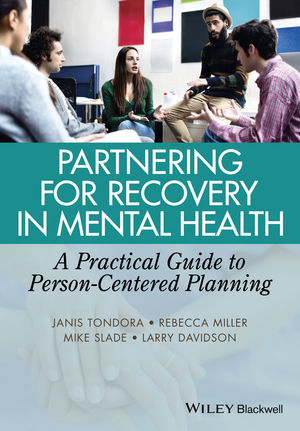
Partnering for Recovery in Mental Health (eBook)
Partnering for Recovery in Mental Health is a practical guide for conducting person and family-centered recovery planning with individuals with serious mental illnesses and their families. It is derived from the authors’ extensive experience in articulating and implementing recovery-oriented practice and has been tested with roughly 3,000 providers who work in the field as well as with numerous post-graduate trainees in psychology, social work, nursing, and psychiatric rehabilitation. It has consistently received highly favorable evaluations from health care professionals as well as people in recovery from mental illness.
This guide represents a new clinical approach to the planning and delivery of mental health care. It emerges from the mental health recovery movement, and has been developed in the process of the efforts to transform systems of care at the local, regional, and national levels to a recovery orientation. It will be an extremely useful tool for planning care within the context of current health care reform efforts and increasingly useful in the future, as systems of care become more person-centered. Consistent with other patient-centered care planning approaches, this book adapts this process specifically to meet the needs of persons with serious mental illnesses and their families.
Partnering for Recovery in Mental Health is an invaluable guide for any person involved directly or indirectly in the provision, monitoring, evaluation, or use of community-based mental health care.
Janis Tondora PsyD, Assistant Professor, Department of Psychiatry, Yale University School of Medicine, New Haven, CT, US
Rebecca Miller PhD, Associate Research Scientist, Department of Psychiatry, Yale University School of Medicine, New Haven, CT, US
Mike Slade PhD, Professor of Health Services Research, Health Service and Population Research Department, Institute of Psychiatry, King’s College London, London, UK
Larry Davidson PhD, Professor of Psychiatry, Department of Psychiatry, Yale University School of Medicine, New Haven, CT, US
Partnering for Recovery in Mental Health is a practical guide for conducting person and family-centered recovery planning with individuals with serious mental illnesses and their families. It is derived from the authors extensive experience in articulating and implementing recovery-oriented practice and has been tested with roughly 3,000 providers who work in the field as well as with numerous post-graduate trainees in psychology, social work, nursing, and psychiatric rehabilitation. It has consistently received highly favorable evaluations from health care professionals as well as people in recovery from mental illness. This guide represents a new clinical approach to the planning and delivery of mental health care. It emerges from the mental health recovery movement, and has been developed in the process of the efforts to transform systems of care at the local, regional, and national levels to a recovery orientation. It will be an extremely useful tool for planning care within the context of current health care reform efforts and increasingly useful in the future, as systems of care become more person-centered. Consistent with other patient-centered care planning approaches, this book adapts this process specifically to meet the needs of persons with serious mental illnesses and their families. Partnering for Recovery in Mental Health is an invaluable guide for any person involved directly or indirectly in the provision, monitoring, evaluation, or use of community-based mental health care.
Janis Tondora PsyD, Assistant Professor, Department of Psychiatry, Yale University School of Medicine, New Haven, CT, US Rebecca Miller PhD, Associate Research Scientist, Department of Psychiatry, Yale University School of Medicine, New Haven, CT, US Mike Slade PhD, Professor of Health Services Research, Health Service and Population Research Department, Institute of Psychiatry, King's College London, London, UK Larry Davidson PhD, Professor of Psychiatry, Department of Psychiatry, Yale University School of Medicine, New Haven, CT, US
Acknowledgments ix
Module 1: What is mental health recovery and how does it relate to person-centered care planning? 1
Module 2: Key principles and practices of person-centered care planning 23
Module 3: Preparing for the journey: Understanding various types of recovery plans and orienting participants to the PCCP process 53
Module 4: Strength-based assessment, integrated understanding, and setting priorities 71
Module 5: Creating the plan through a team meeting 91
Module 6: Documentation of PCCP: Writing the plan to honor the person AND satisfy the chart 113
Module 7: So you have a person-centered care plan, now what? Plan implementation and quality monitoring 147
Module 8: PCCP implementation: Common concerns and person-centered responses 181
Index 201
Module 1: What is mental health recovery and how does it relate to person-centered care planning?
Goal
This module introduces the key concepts in mental health recovery and recovery-oriented practice. It reviews the history and development of “person-centered” care planning and places it within the broader context of recovery-oriented efforts that are transforming the mental health system as a whole.
Learning Objectives
After completing this module, you will be better able to:
- define mental health recovery;
- describe the difference between traditional practices and recovery-oriented approaches;
- define person-centered care planning;
- understand how person-centered planning differs from past practice.
Learning Assessment
A learning assessment is included at the end of the module. If you are already familiar with mental health recovery and its implications for care planning, you can go to the end of this module to take the assessment section to test your understanding.
Recovery is about living a fulfilling and rewarding life in the context of mental health challenges. While some people recover in the sense that they no longer experience psychiatric symptoms, recovery is not necessarily about becoming symptom- or problem-free. A large part of recovery for many people is moving beyond being labeled as a “mental patient,” “client,” or even “consumer” to find new meaning, purpose, and possibility in life. For many people, recovery means [1]:
Recovery is a journey of healing and transformation enabling a person with a mental health problem to live a meaningful life in a community of his or her choice while striving to achieve his or her full potential.
—SAMHSA National Consensus Statement on Mental Health Recovery [2]
- No longer defining oneself by the experience of mental illness.
- Being a full participant in the community with valued roles such as worker, parent, student, neighbor, friend, artist, tenant, lover, and citizen.
- Running one's own life and making one's own decisions.
- Having a rich network of personal and social support outside of the mental health system.
- Celebrating the newfound strength and skills gained from living with, and recovering from, mental illness.
- Having hope and optimism for the future.
All around the world people have been demonstrating the possibility, and reality, of mental health recovery. Their stories of lived experience are supported by a mounting evidence base that suggests that recovery is more the norm than the exception in serious mental illness. Beginning with the World Health Organization's (WHO) International Pilot Study of Schizophrenia launched in 1967, there have been a series of long-term, longitudinal studies conducted that have produced a consistent picture of broad heterogeneity in outcome for persons with serious mental illnesses. For example, with respect to schizophrenia, the WHO study documented partial to full recovery in between 45% and 65% of each sample, even when recovery was defined in a clinical fashion as a remission in symptoms, while an even larger percentage of people were able to live independently despite continued symptoms [3].
Similarly, the Vermont Longitudinal Study conducted by Courtney Harding and colleagues found recovery or significant improvement in 62%–68% of the people studied—a finding that was all the more important given that the research was carried out on individuals discharged from a state hospital who were considered to have the most severe and persistent of conditions [4]. Since then, eight more long-term studies (e.g., 22–37 years) have been completed around the world, yielding comparable—and at times, better—results [5].
Recovery is a process, a way of life, an attitude, and a way of approaching the day's challenges… The need is to meet the challenge of the disability and to re-establish a new and valued sense of integrity and purpose within and beyond the limits of the disability; the aspiration is to live, work, and love in a community in which one makes a significant contribution.
—Deegan [7]
The evidence for the prevalence of recovery and the potential for recovery-oriented care to help people live full lives has recently been gathered in two landmark texts published by the Boston University Center for Psychiatric Rehabilitation [6]. These books present a summary of over 30 years of experience that challenges the long-held view that serious mental illnesses typically follow a deteriorating course, and explore the range of interventions that have been employed to promote recovery for persons with these conditions.1 Readers seeking a briefer overview of the empirical evidence for recovery in serious mental illness are referred to an essay on this topic by Ed Knight, Vice President of Recovery, Rehabilitation, and Mutual Support for Value Options.2
Where Did the Idea of Mental Health Recovery Come From?
The idea that people can—and do—actually recover from serious mental illnesses grew in large part from the personal experiences and stories of people who experienced recovery in their own lives. Their voices and perspectives were diverse and were from people who were receiving mental health services (“users” of services); individuals who believed they had survived despite the treatment they received (“psychiatric survivors”); and people who had once been patients receiving services, but who felt they had moved beyond that status in their lives and were now “ex-patients.” These voices provide the most powerful, and persuasive, testament to recovery, and readers who are interested in reading such stories can find them in websites such as www.SAMHSA.gov/Recoverytopractice (from the United States), www.recoverydevon.co.uk (from England) and www.scottishrecovery.net (from Scotland), to name a few.
Recovery is a process by which an individual with a disability recovers self-esteem, dreams, self worth, pride, choice, dignity, and meaning.
—Townsend & Glassner [9]
These voices and perspectives merged to form a movement that has not only survived, but has also grown and emerged as a powerful force for change in mental health policy and services around the world. Drawing on personal experiences, social justice values, civil and human rights, and a passion for changing the mental health system, users/survivors have been the driving force behind the recovery movement that promises to significantly impact both public policy and treatment practices around the globe [8].
Is Mental Health Recovery the Same as Recovery from Addiction?
A variety of self-help and 12-step programs in the addictions arena has influenced the recovery movement and the value it places on mutual support and shared experience. However, there are some unique differences between the actual experience of recovery in mental illness as compared to recovery from addiction. For example, there are core differences related to issues of power. A common requirement in 12-step programs is to admit powerlessness and turn one's self and life over to a “Higher Power.” While respecting the importance spirituality plays in many people's lives, mental health recovery emphasizes empowerment and self-determination as well; helping individuals to find their own voice and to take personal responsibility for their own lives. This is based on the belief that people need to reclaim, not turn over, their power as one of the first steps of recovery.
This distinction between mental health and addiction recovery impacts both the process of self-identification and the use of preferred language and terms. For example, traditional 12-step programs encourage individuals to introduce themselves as: “My name is X and I am an alcoholic.” This is consistent with the 12-step focus on acknowledging one's powerlessness over a substance, and self-identification in this manner is respected as a part of the individual's unique recovery process. In contrast, in the mental health recovery community, there is an emphasis on helping individuals to move beyond the diagnostic labels that have been applied to them by others. Therefore, individuals are encouraged to use “person-first” language and thereby NOT to identify themselves, or allow themselves to be identified by others, in any way that makes a psychiatric diagnosis their most salient or defining characteristic: for example, “My name is X and I am schizophrenic.” In both the addiction and mental health contexts, it is important to note that individual preferences around language and self-identification vary widely, and additional guidance on this topic is offered in Module 2.
Despite these differences in the process of recovery in mental illness and addiction, there are numerous areas of overlap and commonality [10]. The important thing to remember is that no matter what an individual's particular label or diagnosis, people with mental illnesses and addictions are first and foremost people, and people who know best what kind of life they will find worth living in the wake of a behavioral health condition. This is the hallmark of the recovery movement in both mental health and addiction.
Getting...
| Erscheint lt. Verlag | 19.5.2014 |
|---|---|
| Sprache | englisch |
| Themenwelt | Medizin / Pharmazie ► Gesundheitswesen |
| Medizin / Pharmazie ► Medizinische Fachgebiete ► Psychiatrie / Psychotherapie | |
| Schlagworte | Articulating • Authors • Clinical psychology • Experience • extensive • Field • Guide • Health • Illness • Individuals • Klinische Psychologie • Medical Science • Medizin • Mental • numerous • Person • Planning • postgraduate • Practical • Practice • providers • Psychiatrie • Psychiatry • Psychologie • Psychology • received • Recovery • recoveryoriented • roughly • Social Psychiatry • Sozialpsychiatrie • Trainees |
| ISBN-13 | 9781118388556 / 9781118388556 |
| Informationen gemäß Produktsicherheitsverordnung (GPSR) | |
| Haben Sie eine Frage zum Produkt? |
 EPUB (Adobe DRM)
Kopierschutz: Adobe-DRM
Adobe-DRM ist ein Kopierschutz, der das eBook vor Mißbrauch schützen soll. Dabei wird das eBook bereits beim Download auf Ihre persönliche Adobe-ID autorisiert. Lesen können Sie das eBook dann nur auf den Geräten, welche ebenfalls auf Ihre Adobe-ID registriert sind.
Details zum Adobe-DRM
Dateiformat: EPUB (Electronic Publication)
EPUB ist ein offener Standard für eBooks und eignet sich besonders zur Darstellung von Belletristik und Sachbüchern. Der Fließtext wird dynamisch an die Display- und Schriftgröße angepasst. Auch für mobile Lesegeräte ist EPUB daher gut geeignet.
Systemvoraussetzungen:
PC/Mac: Mit einem PC oder Mac können Sie dieses eBook lesen. Sie benötigen eine
eReader: Dieses eBook kann mit (fast) allen eBook-Readern gelesen werden. Mit dem amazon-Kindle ist es aber nicht kompatibel.
Smartphone/Tablet: Egal ob Apple oder Android, dieses eBook können Sie lesen. Sie benötigen eine
Geräteliste und zusätzliche Hinweise
Buying eBooks from abroad
For tax law reasons we can sell eBooks just within Germany and Switzerland. Regrettably we cannot fulfill eBook-orders from other countries.
aus dem Bereich