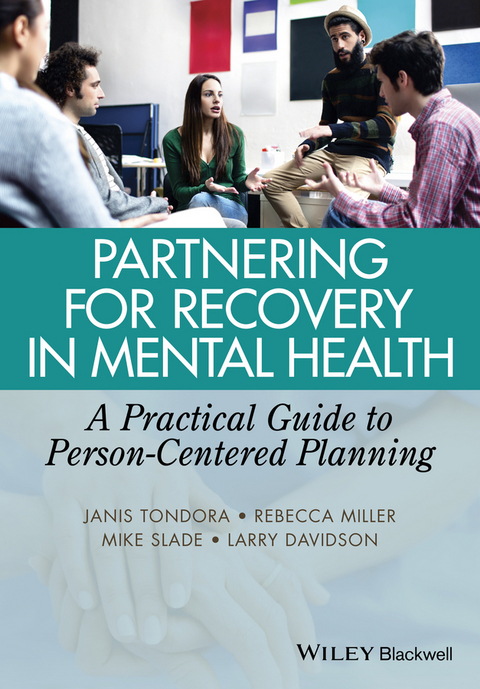
Partnering for Recovery in Mental Health (eBook)
Partnering for Recovery in Mental Health is a practical guide for conducting person and family-centered recovery planning with individuals with serious mental illnesses and their families. It is derived from the authors' extensive experience in articulating and implementing recovery-oriented practice and has been tested with roughly 3,000 providers who work in the field as well as with numerous post-graduate trainees in psychology, social work, nursing, and psychiatric rehabilitation. It has consistently received highly favorable evaluations from health care professionals as well as people in recovery from mental illness.
This guide represents a new clinical approach to the planning and delivery of mental health care. It emerges from the mental health recovery movement, and has been developed in the process of the efforts to transform systems of care at the local, regional, and national levels to a recovery orientation. It will be an extremely useful tool for planning care within the context of current health care reform efforts and increasingly useful in the future, as systems of care become more person-centered. Consistent with other patient-centered care planning approaches, this book adapts this process specifically to meet the needs of persons with serious mental illnesses and their families.
Partnering for Recovery in Mental Health is an invaluable guide for any person involved directly or indirectly in the provision, monitoring, evaluation, or use of community-based mental health care.
Janis Tondora PsyD, Assistant Professor, Department of Psychiatry, Yale University School of Medicine, New Haven, CT, US
Rebecca Miller PhD, Associate Research Scientist, Department of Psychiatry, Yale University School of Medicine, New Haven, CT, US
Mike Slade PhD, Professor of Health Services Research, Health Service and Population Research Department, Institute of Psychiatry, King's College London, London, UK
Larry Davidson PhD, Professor of Psychiatry, Department of Psychiatry, Yale University School of Medicine, New Haven, CT, US
Partnering for Recovery in Mental Health is a practical guide for conducting person and family-centered recovery planning with individuals with serious mental illnesses and their families. It is derived from the authors extensive experience in articulating and implementing recovery-oriented practice and has been tested with roughly 3,000 providers who work in the field as well as with numerous post-graduate trainees in psychology, social work, nursing, and psychiatric rehabilitation. It has consistently received highly favorable evaluations from health care professionals as well as people in recovery from mental illness. This guide represents a new clinical approach to the planning and delivery of mental health care. It emerges from the mental health recovery movement, and has been developed in the process of the efforts to transform systems of care at the local, regional, and national levels to a recovery orientation. It will be an extremely useful tool for planning care within the context of current health care reform efforts and increasingly useful in the future, as systems of care become more person-centered. Consistent with other patient-centered care planning approaches, this book adapts this process specifically to meet the needs of persons with serious mental illnesses and their families. Partnering for Recovery in Mental Health is an invaluable guide for any person involved directly or indirectly in the provision, monitoring, evaluation, or use of community-based mental health care.
Janis Tondora PsyD, Assistant Professor, Department of Psychiatry, Yale University School of Medicine, New Haven, CT, US Rebecca Miller PhD, Associate Research Scientist, Department of Psychiatry, Yale University School of Medicine, New Haven, CT, US Mike Slade PhD, Professor of Health Services Research, Health Service and Population Research Department, Institute of Psychiatry, King's College London, London, UK Larry Davidson PhD, Professor of Psychiatry, Department of Psychiatry, Yale University School of Medicine, New Haven, CT, US
Acknowledgments ix
Module 1: What is mental health recovery and how does it relate to person-centered care planning? 1
Module 2: Key principles and practices of person-centered care planning 23
Module 3: Preparing for the journey: Understanding various types of recovery plans and orienting participants to the PCCP process 53
Module 4: Strength-based assessment, integrated understanding, and setting priorities 71
Module 5: Creating the plan through a team meeting 91
Module 6: Documentation of PCCP: Writing the plan to honor the person AND satisfy the chart 113
Module 7: So you have a person-centered care plan, now what? Plan implementation and quality monitoring 147
Module 8: PCCP implementation: Common concerns and person-centered responses 181
Index 201
| Erscheint lt. Verlag | 19.5.2014 |
|---|---|
| Sprache | englisch |
| Themenwelt | Medizin / Pharmazie ► Gesundheitswesen |
| Medizin / Pharmazie ► Medizinische Fachgebiete ► Psychiatrie / Psychotherapie | |
| Schlagworte | Articulating • Authors • Clinical psychology • Experience • extensive • Field • Guide • Health • Illness • Individuals • Klinische Psychologie • Medical Science • Medizin • Mental • numerous • Person • Planning • postgraduate • Practical • Practice • providers • Psychiatrie • Psychiatry • Psychologie • Psychology • received • Recovery • recoveryoriented • roughly • Social Psychiatry • Sozialpsychiatrie • Trainees |
| ISBN-13 | 9781118388563 / 9781118388563 |
| Informationen gemäß Produktsicherheitsverordnung (GPSR) | |
| Haben Sie eine Frage zum Produkt? |
 PDF (Adobe DRM)
Kopierschutz: Adobe-DRM
Adobe-DRM ist ein Kopierschutz, der das eBook vor Mißbrauch schützen soll. Dabei wird das eBook bereits beim Download auf Ihre persönliche Adobe-ID autorisiert. Lesen können Sie das eBook dann nur auf den Geräten, welche ebenfalls auf Ihre Adobe-ID registriert sind.
Details zum Adobe-DRM
Dateiformat: PDF (Portable Document Format)
Mit einem festen Seitenlayout eignet sich die PDF besonders für Fachbücher mit Spalten, Tabellen und Abbildungen. Eine PDF kann auf fast allen Geräten angezeigt werden, ist aber für kleine Displays (Smartphone, eReader) nur eingeschränkt geeignet.
Systemvoraussetzungen:
PC/Mac: Mit einem PC oder Mac können Sie dieses eBook lesen. Sie benötigen eine
eReader: Dieses eBook kann mit (fast) allen eBook-Readern gelesen werden. Mit dem amazon-Kindle ist es aber nicht kompatibel.
Smartphone/Tablet: Egal ob Apple oder Android, dieses eBook können Sie lesen. Sie benötigen eine
Geräteliste und zusätzliche Hinweise
Buying eBooks from abroad
For tax law reasons we can sell eBooks just within Germany and Switzerland. Regrettably we cannot fulfill eBook-orders from other countries.
aus dem Bereich