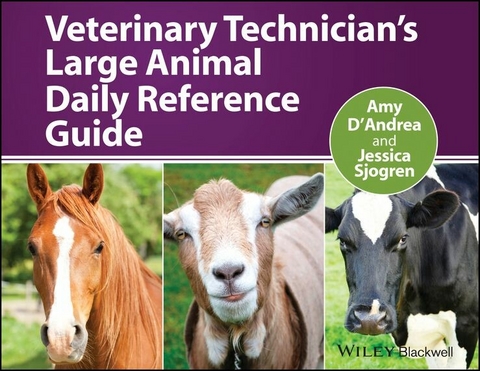
Veterinary Technician's Large Animal Daily Reference Guide (eBook)
John Wiley & Sons (Verlag)
978-1-118-69499-2 (ISBN)
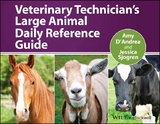
Veterinary Technician's Large Animal Daily Reference Guide is an indispensible resource in daily clinical practice. Covering all aspects of a veterinary technician's responsibilities in the care of large animals, the book provides fast access to practical information, aiding newly trained and skilled large animal technicians alike in performing their daily tasks. Designed as a quick yet comprehensive reference, the tables and charts throughout offer reliable, easy-to-follow information on horses, cattle, small ruminants, and pigs.
With chapter topics ranging from anatomy and nutrition to emergency and critical care, the book's coverage includes both the basics of veterinary care and more specialized nursing procedures. Veterinary Technician's Large Animal Daily Reference Guide is an invaluable tool for any veterinary technician working with large animals, as well as veterinary technology students seeking more information on these species.
Editors
Amy D'Andrea, BS, MEd, CVT, VTS (EVN), is an instructor at the New England Institute of Technology Veterinary Technology Program in Warwick, Rhode Island, USA.
Jessica Sjogren, BS in Veterinary Technology, CEST, is an emergency technologist at VCA South Shore Animal Hospital in South Weymouth, Massachusetts, USA.
Veterinary Technician s Large Animal Daily Reference Guide is an indispensible resource in daily clinical practice. Covering all aspects of a veterinary technician s responsibilities in the care of large animals, the book provides fast access to practical information, aiding newly trained and skilled large animal technicians alike in performing their daily tasks. Designed as a quick yet comprehensive reference, the tables and charts throughout offer reliable, easy-to-follow information on horses, cattle, small ruminants, and pigs. With chapter topics ranging from anatomy and nutrition to emergency and critical care, the book s coverage includes both the basics of veterinary care and more specialized nursing procedures. Veterinary Technician s Large Animal Daily Reference Guide is an invaluable tool for any veterinary technician working with large animals, as well as veterinary technology students seeking more information on these species.
Editors Amy D'Andrea, BS, MEd, CVT, VTS (EVN), is an instructor at the New England Institute of Technology Veterinary Technology Program in Warwick, Rhode Island, USA. Jessica Sjogren, BS in Veterinary Technology, CEST, is an emergency technologist at VCA South Shore Animal Hospital in South Weymouth, Massachusetts, USA.
"Overall, the book sets out to provide current data on the
daily responsibilities of the large animal veterinary technician in
an accessible format. There is no reason why it should not also be
a useful guide for newly qualified vets and veterinary
nurses." (Veterinary Record, 6 September
2014)
"Overall, this book is a very good reference that will
help technicians quickly review and perform many required tasks.
Given its extensive bibliography, it also provides a starting point
for additional study with crossreferences to standard textbooks and
scientific articles." (Journal of the American
Veterinary Medical Association, 15 June 2014)
Chapter 2
Preventative Health Care
Amy D'Andrea and Jessica Sjogren
Introduction
Preventative health care consists of services that are designed to help prevent diseases and/or ailments in animals. It includes routine physical examinations, vaccinations, deworming programs, nutrition, and hoof/foot and dental care (in large animals). Each species has a recommended preventative health care program that is designed for its optimum health benefits and encourages an overall healthier life. This approach to veterinary care is proactive, and it is important to establish a preventative program at every stage of life.
Physical Examinations
The physical examination is by far the most cost effect diagnostic tool available in veterinary medicine. Much can be learned about the animal through a thorough examination. Technicians can play vital roles by assisting the veterinarian in this process. It is also important that technicians have the ability to assess an animal's overall health so that they can better help their clients with compliance in animal care. Large animal species should have a physical examination at least once per year. A proper exam should be done prior to purchasing an animal, prior to immunization, prior to any procedure involving anesthetics, and when the veterinarian is visiting the farm to see an animal with a problem. The following tables will cover methods and specific areas of the physical examination in both pediatric and adult patients.
Table 2.1 / Large Animal History
| Type of Information | Information That Should Be Obtained |
|---|
| Person Providing Information |
|
| Insurance Information |
|
| Patient Signalment |
|
| Diet |
|
| Water |
|
| Housing/Type |
|
| Reproductive Status |
|
| Vaccination History |
|
| Deworming History |
|
| Previous Illness |
|
| Chief Complaint |
|
| Herd Information |
|
Table 2.2 / Preliminary Examination
| Definition/Normal/Abnormal | Equipment and Technique |
|---|
| Chief Complaint |
|
|
| Past History |
|
|
| Signalment |
|
|
| General Appearance |
|
|
| Heart Rate |
Normal
|
|
| Respiration |
Normal resting rates
|
|
| Pulses | Normal (see Heart Rate above.)
|
|
| Mucous Membranes | Normal
|
|
| Capillary Refill Time | Normal
|
|
| Temperature | Normal
|
|
| Weight |
|
|
Table 2.3 / Types of Physical Examinations
| Type of Examination | Reason | Skills Utilized |
|---|
| Diagnostic Physical Exam |
|
|
| Insurance Examination |
|
|
| Prepurchase Examination |
|
|
| Erscheint lt. Verlag | 20.8.2013 |
|---|---|
| Sprache | englisch |
| Themenwelt | Medizin / Pharmazie |
| Veterinärmedizin ► Großtier | |
| Schlagworte | ACCESS • alike • animal daily • animals • Aspects • Book • Care • Clinical • daily • Fast • Guide • indispensible • Information • Large • large animal • Pflege i. d. Veterinärmedizin • Pflege i. d. Veterinärmedizin • Practical • Practice • provides • Reference • resource • responsibilities • Veterinärmedizin • Veterinärmedizin f. Nutztiere • Veterinärmedizin f. Pferde • Veterinärmedizin • Veterinärmedizin f. Nutztiere • Veterinärmedizin f. Pferde • Veterinary Medicine • Veterinary Medicine - Equine • Veterinary Medicine - Farm Animals • Veterinary Nursing & Animal Care • veterinary technicians |
| ISBN-10 | 1-118-69499-6 / 1118694996 |
| ISBN-13 | 978-1-118-69499-2 / 9781118694992 |
| Informationen gemäß Produktsicherheitsverordnung (GPSR) | |
| Haben Sie eine Frage zum Produkt? |
 EPUB (Adobe DRM)
Kopierschutz: Adobe-DRM
Adobe-DRM ist ein Kopierschutz, der das eBook vor Mißbrauch schützen soll. Dabei wird das eBook bereits beim Download auf Ihre persönliche Adobe-ID autorisiert. Lesen können Sie das eBook dann nur auf den Geräten, welche ebenfalls auf Ihre Adobe-ID registriert sind.
Details zum Adobe-DRM
Dateiformat: EPUB (Electronic Publication)
EPUB ist ein offener Standard für eBooks und eignet sich besonders zur Darstellung von Belletristik und Sachbüchern. Der Fließtext wird dynamisch an die Display- und Schriftgröße angepasst. Auch für mobile Lesegeräte ist EPUB daher gut geeignet.
Systemvoraussetzungen:
PC/Mac: Mit einem PC oder Mac können Sie dieses eBook lesen. Sie benötigen eine
eReader: Dieses eBook kann mit (fast) allen eBook-Readern gelesen werden. Mit dem amazon-Kindle ist es aber nicht kompatibel.
Smartphone/Tablet: Egal ob Apple oder Android, dieses eBook können Sie lesen. Sie benötigen eine
Geräteliste und zusätzliche Hinweise
Buying eBooks from abroad
For tax law reasons we can sell eBooks just within Germany and Switzerland. Regrettably we cannot fulfill eBook-orders from other countries.
aus dem Bereich