Large Animal Medicine for Veterinary Technicians (eBook)
John Wiley & Sons (Verlag)
978-1-119-68830-3 (ISBN)
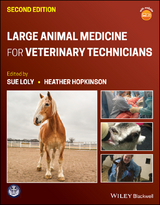
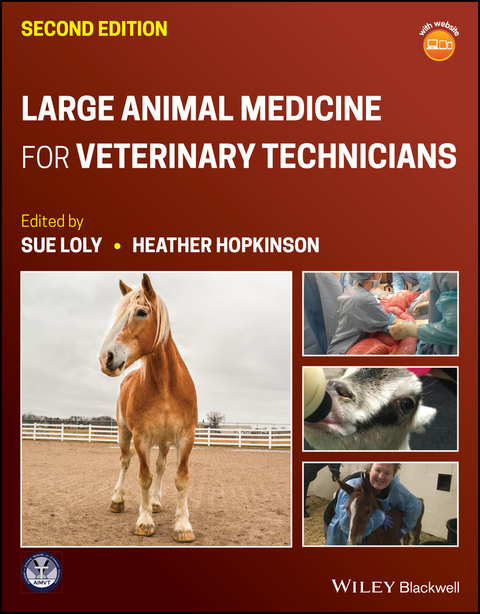
Large Animal Medicine for Veterinary Technicians provides comprehensive guidance on caring for horses, cattle, camelids, small ruminants, pigs, and other farm animals. Reflecting the topics required by the American Veterinary Medical Association (AMVA), this practical resource covers hospital biosecurity, restraint, physical examinations, clinical and diagnostic procedures, reproduction, nutrition, disease, and more. Detailed chapters written by expert contributors contain numerous full-color images, clinical applications, self-review questions, and accurate, species-specific information.
The second edition features revised and new content throughout, including brand-new chapters on common surgical procedures and general anesthesia, dentistry, and popular hobby farm animals such as fowl, poultry, and pet pigs. Updated and expanded sections on neonatology, diagnostics, and imaging are supported by a wealth of new images and examples. Covering the skills and knowledge necessary for success in both Veterinary Technician Specialty (VTS) programs and in clinical practice, this must-have guide:
- Offers new coverage of imaging and diagnostic technologies such as dynamic endoscoping and the use of treadmills
- Contains more than 500 high-quality color images, multiple-choice questions with answers, and a glossary of terms
- Features a range of pedagogical tools including learning objectives, clinical case problems, charts and diagrams, and 'Technician Tip' boxes
- Includes a significantly expanded companion website with self-review questions, case studies, PowerPoint slides, and an image bank to aid in breed identification
Authored and edited by experienced trainers and certified veterinary technicians, Large Animal Medicine for Veterinary Technicians, Second Edition is an invaluable reference for all students, educators, and working professionals in the field.
The Editors
Sue Loly, LVT, VTS-EVN, is an Equine Teaching Specialist at the College of Veterinary Medicine UMN and Leatherdale Equine Center in St. Paul, Minnesota, USA.
Heather Hopkinson, RVT, VTS-EVN, CCRP, is an Equine and Farm Animal Veterinary Center Technician and a Rehabilitation and Mobility Veterinary Technician at the College of Veterinary Medicine at North Carolina State University in Raleigh, North Carolina, USA.
Large Animal Medicine for Veterinary Technicians provides comprehensive guidance on caring for horses, cattle, camelids, small ruminants, pigs, and other farm animals. Reflecting the topics required by the American Veterinary Medical Association (AMVA), this practical resource covers hospital biosecurity, restraint, physical examinations, clinical and diagnostic procedures, reproduction, nutrition, disease, and more. Detailed chapters written by expert contributors contain numerous full-color images, clinical applications, self-review questions, and accurate, species-specific information. The second edition features revised and new content throughout, including brand-new chapters on common surgical procedures and general anesthesia, dentistry, and popular hobby farm animals such as fowl, poultry, and pet pigs. Updated and expanded sections on neonatology, diagnostics, and imaging are supported by a wealth of new images and examples. Covering the skills and knowledge necessary for success in both Veterinary Technician Specialty (VTS) programs and in clinical practice, this must-have guide: Offers new coverage of imaging and diagnostic technologies such as dynamic endoscoping and the use of treadmills Contains more than 500 high-quality color images, multiple-choice questions with answers, and a glossary of terms Features a range of pedagogical tools including learning objectives, clinical case problems, charts and diagrams, and Technician Tip boxes Includes a significantly expanded companion website with self-review questions, case studies, PowerPoint slides, and an image bank to aid in breed identification Authored and edited by experienced trainers and certified veterinary technicians, Large Animal Medicine for Veterinary Technicians, Second Edition is an invaluable reference for all students, educators, and working professionals in the field.
The Editors Sue Loly, LVT, VTS-EVN, is an Equine Teaching Specialist at the College of Veterinary Medicine UMN and Leatherdale Equine Center in St. Paul, Minnesota, USA. Heather Hopkinson, RVT, VTS-EVN, CCRP, is an Equine and Farm Animal Veterinary Center Technician and a Rehabilitation and Mobility Veterinary Technician at the College of Veterinary Medicine at North Carolina State University in Raleigh, North Carolina, USA.
Chapter 1
Hospital Biosecurity
Leslie Hiber, CVT, BS
Learning Objectives
- Describe the life cycle patterns of pathogens.
- List and describe the three main routes of transmission.
- List and describe ways to prevent disease in a patient.
- Describe the biosecurity steps that should be taken prior to patient arrival and on arrival.
- List and describe types of barrier precautions.
- Outline the steps of putting on and taking off the personal protective equipment when entering/exiting mini‐isolation and isolation areas.
- List categories of products used for good hand hygiene, and describe how to perform hand washing.
- Compare and contrast disinfection and sterilization in preventing nosocomial infection.
- Describe the role of the infection control team and the function of the veterinary technician on this team.
Clinical Case Problem 1.1
An eight‐year‐old quarter horse mare is presented to the clinic with colic‐type clinical signs. The owner reports no history of infectious diseases and has no history of traveling. The patient is treated medically and is hospitalized overnight in the main clinical area. The following day, she begins having diarrhea and a fever. What steps would you take in order to protect the other patients and staff? What type of communication needs to be dispersed and to whom? How would you follow up with cleaning?
See Clinical Case Resolution 1.1 at the end of this chapter.
Key Terms
Active surveillance
Aerosol transmission
Antibiotic stewardship
Antiseptics
Asymptomatic carrier
Biosecurity
Direct contact transmission
Disinfection
Hazard identification
Incubation period
Indirect contact transmission
Multidrug‐resistant organism (MDRO)
Nosocomial
Passive surveillance
Personal protective equipment (PPE)
Risk communication
Risk management
Risk perception
Sterilization
Vector‐borne transmission
Zoonotic diseases
Introduction
Biosecurity is security from exposure to harmful biological agents. It is emerging as a hot topic in veterinary hospitals and clinics throughout the world. As more diseases and superbugs are being discovered due to new technology, clients and communities are becoming more aware of what protocols are in place to ensure that their animals are safe while under the care of a veterinary care team. As a valuable member of this team, veterinary technicians need to understand the basics of disease transmission and how to protect the patients while in the clinic. Veterinary technicians are also evolving to become the leaders of the biosecurity team, and are referred to as the infection control (IC) team. They are often in communication with all members of the veterinary care team and fully understand the day‐to‐day operation of the hospital/clinic. It is the mission of this team to protect all staff, clients, and patients that enter the hospital/clinic.
TECHNICIAN TIP 1.1: In order to protect the patients when visiting the clinic, the veterinary technician should understand the basics of disease transmission.
Cycle of Infection
A pathogen has a very specific purpose in its life cycle, that is, to infect as many hosts as possible in order to maintain the disease in a population. In order to complete this task, the pathogen must:
- find a portal of exit from the current host;
- find a method of transmission;
- find a portal of entry into a host;
- seek a susceptible host; and
- multiply within the host (the reservoir).
The likelihood of a pathogen's success depends on a variety of factors: the pathogen, the environment, and the host (Figure 1.1).
Figure 1.1 Cycle of Infection: Each component of the cycle must be present in sequential order for an infection to occur. At any point, the cycle can be broken, decreasing the risk of disease transmission and infection.
For the pathogen to infect other susceptible hosts, it must first leave the host that has been serving as the reservoir. The portals of exit from the host can include: gastrointestinal tract, urogenital tract, respiratory tract, blood, broken skin (wounds/abrasions), and mucous membranes. Some hosts may be an accidental host in that the pathogen does not have a strong specificity to that species. This may cause clinical disease in the patient, but it will not be able to exit the host. Accidental hosts are often referred to as a “dead‐end” host for the pathogen because it is unable to replicate enough to exit the host. The more routes that a pathogen is able to utilize to exit the animal, the more successful it will be in finding a new host to start the infection process.
If a pathogen is able to successfully leave the host, it must move to another host. Contact, airborne, and vector‐borne are the three main routes of transmission. These routes are discussed in further detail later on in the chapter. Environmental conditions and hardiness of the pathogen must be ideal for the pathogen to survive long enough to find the next host. Those pathogens that cannot withstand adverse environmental conditions must find a susceptible host in a short period of time or else it will die. Pathogens will succeed if there are a number of vulnerable hosts living closely together. Transmission may also occur if cleaning and hand hygiene is not adequate. Pathogens that are resistant to adverse environmental conditions can survive for years and cannot be eradicated unless appropriate disinfectants are used.
Once the pathogen is successful in finding a method of transmission, it must find a portal of entry into a host. Entry points are the same as exit portals out of a host (mucous membranes, abrasions/wounds [broken skin], blood, respiratory tract, urogenital tract, and/or gastrointestinal tract). More sites available to a pathogen increases the chances that it will progress to the next stage in the infection process.
The infection process into a new host is only successful if the host is susceptible to infection. Susceptibility of the animal can include, but is not limited to, age, vaccination status, pregnancy, underlying disease, immune system status, antibiotic usage, and/or physiological status. Those patients that are being exposed to any immune‐suppressant medications (i.e. radiation therapy, chemotherapy, steroids) are at a higher risk of infection.
TECHNICIAN TIP 1.2: Age, vaccination status, pregnancy, underlying disease, immune system status, antibiotic usage, and/or physiologic status are all factors that come into play regarding the susceptibility of an animal to a pathogen.
Some pathogens can only infect one species of animal, while others can infect many. This is known as species specificity. The more diverse numbers of species that the pathogen is able to infect, the greater the chance that the pathogen has to survive. This is especially true when dealing with smaller populations of animals in a given area. It is important to know if the pathogen is zoonotic so that people working with infected animals can take proper precautions to protect themselves from disease.
TECHNICIAN TIP 1.3: It is important that the veterinary technician use proper precautions to protect themselves when working with animals that have a zoonotic disease to keep from becoming infected.
During the final phase, the pathogen will stay in the reservoir host to try to replicate and increase in numbers to eventually exit the host to start the chain of infection all over again. As the organism replicates and increases in the population, it will often cause a disease response in the host, which will begin to exhibit clinical signs of infection.
The time period between exposure to an infectious agent and the appearance of the first clinical signs is called the incubation period. This time period can vary significantly from one pathogen to another. If the host has a good immune response to the pathogen (either due to health status and/or vaccination against the pathogen), then the pathogen can be destroyed before causing any harm. A pathogen contains virulence factors or properties that enable it to establish itself on or within a host and enhance its potential to cause disease. The virulence factor plus immune status of the host will determine how clinically ill the patient will become.
Not all hosts present clinical signs of disease once infected. Some may be asymptomatic carriers or subclinical and may shed the pathogen without any apparent knowledge that they are infected. If you picture an iceberg, the part one can see from the surface depicts the clinical or obvious infections. Underneath the surface, the iceberg is an even larger mass and depicts the subclinical or colonized patients. This is why it is extremely important to take standard precautions to prevent exposure or movement of the potential pathogen.
Transmission
Routes of transmission can occur via three main pathways: contact (direct/indirect), airborne (droplet/aerosol), and vector‐borne transmission. Interrupting the transmission of a pathogen from the reservoir to the susceptible host is an important...
| Erscheint lt. Verlag | 29.12.2021 |
|---|---|
| Sprache | englisch |
| Themenwelt | Veterinärmedizin ► Großtier |
| Schlagworte | AMVA vet tech textbook</p> • large animal veterinary technician • large animal veterinary technician guide • large animal veterinary technician textbook • large animal veterinary technician training • <p>large animal medicine • Pflege i. d. Veterinärmedizin • Veterinärmedizin • Veterinärmedizin f. Nutztiere • Veterinary Medicine • Veterinary Medicine - Farm Animals • Veterinary Nursing & Animal Care • VTS curriculum • VTS textbook |
| ISBN-10 | 1-119-68830-2 / 1119688302 |
| ISBN-13 | 978-1-119-68830-3 / 9781119688303 |
| Informationen gemäß Produktsicherheitsverordnung (GPSR) | |
| Haben Sie eine Frage zum Produkt? |
 EPUB (Adobe DRM)
Kopierschutz: Adobe-DRM
Adobe-DRM ist ein Kopierschutz, der das eBook vor Mißbrauch schützen soll. Dabei wird das eBook bereits beim Download auf Ihre persönliche Adobe-ID autorisiert. Lesen können Sie das eBook dann nur auf den Geräten, welche ebenfalls auf Ihre Adobe-ID registriert sind.
Details zum Adobe-DRM
Dateiformat: EPUB (Electronic Publication)
EPUB ist ein offener Standard für eBooks und eignet sich besonders zur Darstellung von Belletristik und Sachbüchern. Der Fließtext wird dynamisch an die Display- und Schriftgröße angepasst. Auch für mobile Lesegeräte ist EPUB daher gut geeignet.
Systemvoraussetzungen:
PC/Mac: Mit einem PC oder Mac können Sie dieses eBook lesen. Sie benötigen eine
eReader: Dieses eBook kann mit (fast) allen eBook-Readern gelesen werden. Mit dem amazon-Kindle ist es aber nicht kompatibel.
Smartphone/Tablet: Egal ob Apple oder Android, dieses eBook können Sie lesen. Sie benötigen eine
Geräteliste und zusätzliche Hinweise
Buying eBooks from abroad
For tax law reasons we can sell eBooks just within Germany and Switzerland. Regrettably we cannot fulfill eBook-orders from other countries.
aus dem Bereich