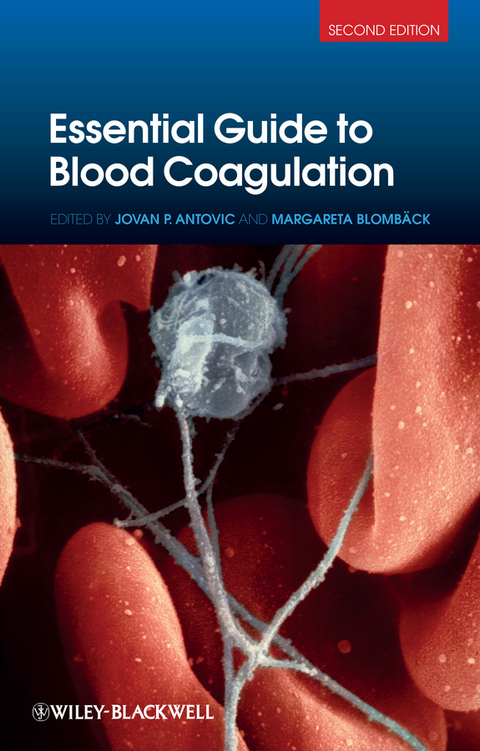
Essential Guide to Blood Coagulation (eBook)
John Wiley & Sons (Verlag)
978-1-118-32766-1 (ISBN)
A practical guide to laboratory diagnosis and treatment of hemostatic disorders.
This concise book distils the most clinically up-to-date information on thrombotic and bleeding disorders, including the latest treatment strategies, for key conditions and diseases. Essential Guide to Blood Coagulation covers both the stable and the acute stages of hereditary and acquired bleeding and thrombotic disorders.
Faced with a bleeding patient, it may be difficult to determine whether blood loss is due to a local factor, or an underlying hemostatic defect. There are a range of laboratory tests which can be performed to identify the cause of bleeding in a patient. This book highlights the tests that can be used in the laboratory to aid diagnosis.
Essential Guide to Blood Coagulation has been updated to include the new anticoagulants and now has a dedicated chapter on antiplatelet drugs. This invaluable guide will help all those treating patients to expand their knowledge of hemostatic disorders.
TITLES OF RELATED INTEREST
Hemophilia and Hemostasis: A Case-Based Approach to Management
Second Edition
Alice Ma, Harold Roberts, Miguel Escobar
ISBN: 978-0-470-65976-2
Quality in Laboratory Hemostasis and Thrombosis
Second Edition
Steve Kitchen, John Olson, Eric Preston (due May 2013)
ISBN: 978-0-470-67119-1
Edited by
Jovan P. Antovic and Margareta Blombäck
Department of Molecular Medicine and Surgery, Coagulation Research, Karolinska Institutet; Clinical Chemistry, Karolinska University Hospital,
Stockholm, Sweden
A practical guide to laboratory diagnosis and treatment of hemostatic disorders.This concise book distils the most clinically up-to-date information on thrombotic and bleeding disorders, including the latest treatment strategies, for key conditions and diseases. Essential Guide to Blood Coagulation covers both the stable and the acute stages of hereditary and acquired bleeding and thrombotic disorders. Faced with a bleeding patient, it may be difficult to determine whether blood loss is due to a local factor, or an underlying hemostatic defect. There are a range of laboratory tests which can be performed to identify the cause of bleeding in a patient. This book highlights the tests that can be used in the laboratory to aid diagnosis. Essential Guide to Blood Coagulation has been updated to include the new anticoagulants and now has a dedicated chapter on antiplatelet drugs. This invaluable guide will help all those treating patients to expand their knowledge of hemostatic disorders. TITLES OF RELATED INTEREST Hemophilia and Hemostasis: A Case-Based Approach to ManagementSecond EditionAlice Ma, Harold Roberts, Miguel EscobarISBN: 978-0-470-65976-2 Quality in Laboratory Hemostasis and ThrombosisSecond EditionSteve Kitchen, John Olson, Eric Preston (due May 2013)ISBN: 978-0-470-67119-1
Edited by Jovan P. Antovic and Margareta Blombäck Department of Molecular Medicine and Surgery, Coagulation Research, Karolinska Institutet; Clinical Chemistry, Karolinska University Hospital, Stockholm, Sweden
List of contributors
Preface
Abbreviations
PART 1: General hemostasis
1 Schematic presentation of the hemostatic system
Nils Egberg
2 Proposals for sampling instructions
Margareta Blombäck, Nils Egberg
3 Laboratory investigations
Jovan P. Antovic, Liselotte Onelöv, Nils Egberg
PART 2: Bleeding disorders
4 Hereditary bleeding disorders
Margareta Holmström, Lars-Göran Lundberg
5 Critical bleeding
Maria Bruzelius, Anna Ågren, Hans Johnsson
6 Investigation of increased bleeding tendency
Margareta Holmström, Lars-Göran Lundberg
PART 3: Thromboembolic disorders
7 Venous thrombosis and pulmonary embolism
Anders Carlsson
8 Investigations of thromboembolic tendency
Margareta Holmström
9 Heart disease
Håkan Wallen, Rickard Linder
10 Antiplatelet drug therapy and reversal of its effects
Håkan Wallen, Hans Johnsson, Bo-Michael Bellander
11 Stroke and transient ischemic attack (TIA)
Nils Wahlgren, Mia von Euler
12 Peripheral artery surgery
Jesper Swedenborg
13 New oral anticoagulants (NOACs): focus on currently approved oral factor Xa and thombin inhibitors Rickard E. Malmström, Hans Johnsson
PART 4: Special hemostasis
14 Hemostasis in obstetrics and gynecology
Katarina Bremme
15 Hemostatic defects in children
Pia Petrini, Susanna Ranta
16 Emergency conditions associated with coagulation: DIC, HIT and TTP/HUS
Jovan P. Antovic, Margareta Holmström
"Nevertheless, this book could one day become the
'oxford handbook' - equivalent for
coagulation." (The Haem Trainee, 1
August2013)
"This book would be useful to those wanting an
introduction to coagulation disorders. More experienced
practitioners will likely find its treatment of coagulation
disorders too superficial for their needs."
(Doody's, 23 August 2013)
CHAPTER 2
Proposals for sampling instructions
Margareta Blombäck and Nils Egberg
Department of Molecular Medicine and Surgery, Coagulation Research, Karolinska Institutet; Clinical Chemistry, Karolinska University Hospital, Stockholm, Sweden
Points to note prior to sampling
The concentrations of components of the hemostatic system often vary with the patient's condition, for example infection, emotional stress, physical exertion (e.g. rush to keep an appointment), lipid concentration in plasma, etc. Sampling conditions should be standardized as far as possible to minimize sources of error (see [1] and following).
- Sitting up/lying down. Due to changes in hydrostatic pressure, the concentrations of high molecular proteins and blood cells vary according to whether the patient is sitting up or lying down (hematocrit is as much as 15% higher when sitting up). A new balance is reached fairly quickly (after 15–20 min).
- Diurnal variations occur for several factors such as PAI-1, which peaks late at night.
- Acute phase reactants. Many hemostatic components, such as FVIII, von Willebrand Factor (VWF), PAI-1 and fibrinogen, are acute phase reactants (i.e. increased by inflammation, infection, surgery, etc.).
- Intraindividual variations occur mainly for FVIII and VWF but also for FVII. Thus, mental stress and physical activity increase the concentrations of FVIII and VWF many times over.
- Smoking and age affect the levels of several coagulation factors (e.g. VWF and fibrinogen are increased).
- Estrogen. High-dose contraceptives (and other hormone drugs) also affect coagulation and fibrinolysis (e.g. FVIII, VWF and fibrinogen are increased and antithrombin, protein C and FVII are lowered at high levels of estradiol).
- Influence of blood group. The level of FVIII is about 30% lower in blood group O and the difference for VWF (earlier known as FVIII R:Ag) is somewhat greater. Consequently, levels near the lower reference limit of these factors imply that the patient can be a normal variant or have mild von Willebrand disease (VWD).
Sampling time and patient preparation
See recommendations by ISTH/SSC Subcommittee on Women's Health Issues [1].
The patient should be calm and relaxed, arrive at the sampling room without hurrying and sit down there for a while (15–20 min) before samples are drawn.
The patient should have fat-fasted since midnight, or for at least 6 hours. Samples should be taken before 10 am with the patient sitting down. In an investigation for bleeding diathesis, the patient should not have taken acetylsalicylic acid (ASA) or clopidogrel for the previous 7–10 days or other antiphlogistic nonsteroidal anti-inflammatory drugs (NSAIDs) for the previous 1–3 days. If these drugs have been prescribed, they should not be withdrawn without consulting the physician in charge.
In an investigation of bleeding tendency, fertile women should preferably be sampled during menstrual days 1–4. It is then easier to diagnose a suspected mild VWD. Contraceptives and other hormone drugs should have been withdrawn, if possible, for at least 2 months, preferably 3 months. In women who have been pregnant, a deficiency cannot be determined exactly until breastfeeding has ceased and menstruation has become regular. If these recommendations are not followed, mild defects may not be detected.
To monitor the effect of heparin (unfractionated heparin (UFH)/low molecular weight heparin (LMH)) by determining anti-FXa, samples should be drawn 3 hours after an injection in patients receiving “low-dose” prophylactic treatment (1 injection per day) and prior to an injection in “high-dose” treatment (2 injections per day). In treatment that is not prophylactic, samples are usually taken prior to next injection.
A coagulation investigation after a thromboembolic complication should be performed, if possible, not less than 3 months after the latest event in order to avoid an acute phase reaction. For example, the amount of antithrombin decreases about 25% after 4–5 days of i.v. UFH/LMH treatment. Separate coagulation factor analyses cannot always be performed, since UFH/LMH interferes with the test systems. During vitamin-K antagonist (VKA) treatment, it is not possible to determine the basic levels of the vitamin K-dependent coagulation factors prothrombin, FVII, FIX and FX or the coagulation inhibitors protein C and protein S. If the diagnosis of a hereditary defect is an urgent matter, investigate parents or other relatives with a similar history. The medication could also be changed from VKA drugs to UFH/LMH at least 2 weeks prior to sampling combined with a short break in heparin treatment just before sampling.
If the patient is being treated with VKA drugs or UFH/LMH, you must consider the above. Consult a coagulation expert.
New antithrombotic agents, for example FXa and thrombin inhibitors, will most likely interfere with many functional coagulation assays and should preferably be withdrawn before investigation. However, consult the doctor in charge of the patient about how to proceed.
Mutation analyses, for instance of the FV Leiden mutation in the factor V gene 1691G>A and of the prothrombin gene mutation (2021G>A), can of course be performed regardless of whether the patient is on treatment.
Referrals for coagulation analyses
Remember to:
- provide a short case history, your question, results of any earlier analyses and list the analyses that you require;
- state the sender's name with full address, and include the name of your hospital and who is to be invoiced;
- always give your telephone/fax number/email if you want a quick reply;
- always state the date and time of the blood sampling and whether the patient is on VKA drugs, UFH/LMH (even just an occasional flush), or other anticoagulants;
- state if the patient has received a transfusion of blood, plasma or blood products during the past month.
Sampling
Analyses of plasma
- The sample should be taken by direct vein puncture, not from heparinized catheters or from an infusion apparatus for administering heparin (see also section on “Technique”). Stasis should be moderate (or nil) and the blood should flow easily.
- Samples that cannot be analyzed right away must be centrifuged etc. (see section on “Technique”) and the plasma frozen in 3–4 portions of 0.6 mL for each analysis in small plastic tubes at -70°C.
- The outcome of coagulation analyses can be markedly affected by the sampling conditions.
- For an investigation of thrombosis and bleeding, usually four citrate tubes, each containing 5 mL, are taken and the plasma is separated into nine small plastic tubes each containing 0.6 mL. For a single analysis, take one citrate tube and separate the plasma into 3–4 small tubes. When sampling from small children, special 2 mL citrate tubes can be used. Separate the plasma into as many tubes as possible, each containing 0.3 mL.
- For mutation (DNA) analyses, use one EDTA whole-blood plastic tube (5 mL) (if only glass tubes are available, the blood should be transferred to plastic tubes prior to freezing).
- For DNA analyses in children, use one EDTA whole-blood plastic tube, about 2 mL whole blood (for handling, see earlier point on sampling).
Technique
| Erscheint lt. Verlag | 11.3.2013 |
|---|---|
| Sprache | englisch |
| Themenwelt | Medizin / Pharmazie ► Allgemeines / Lexika |
| Medizinische Fachgebiete ► Innere Medizin ► Kardiologie / Angiologie | |
| Schlagworte | Acute • Bleeding • Blood • Blutgerinnung • Book • clinically • coagulation • concise • Conditions • Diagnosis • disorders • Essential • faced • Guide • Hemostatic • Hereditary • Information • Latest • Medical Science • Medizin • Practical • Stable • Strategies • Thrombose u. Hämostase • Thrombose u. Hämostase • Thrombosis & Hemostasis • thrombotic • Treatment • uptodate |
| ISBN-10 | 1-118-32766-7 / 1118327667 |
| ISBN-13 | 978-1-118-32766-1 / 9781118327661 |
| Informationen gemäß Produktsicherheitsverordnung (GPSR) | |
| Haben Sie eine Frage zum Produkt? |
 EPUB (Adobe DRM)
Kopierschutz: Adobe-DRM
Adobe-DRM ist ein Kopierschutz, der das eBook vor Mißbrauch schützen soll. Dabei wird das eBook bereits beim Download auf Ihre persönliche Adobe-ID autorisiert. Lesen können Sie das eBook dann nur auf den Geräten, welche ebenfalls auf Ihre Adobe-ID registriert sind.
Details zum Adobe-DRM
Dateiformat: EPUB (Electronic Publication)
EPUB ist ein offener Standard für eBooks und eignet sich besonders zur Darstellung von Belletristik und Sachbüchern. Der Fließtext wird dynamisch an die Display- und Schriftgröße angepasst. Auch für mobile Lesegeräte ist EPUB daher gut geeignet.
Systemvoraussetzungen:
PC/Mac: Mit einem PC oder Mac können Sie dieses eBook lesen. Sie benötigen eine
eReader: Dieses eBook kann mit (fast) allen eBook-Readern gelesen werden. Mit dem amazon-Kindle ist es aber nicht kompatibel.
Smartphone/Tablet: Egal ob Apple oder Android, dieses eBook können Sie lesen. Sie benötigen eine
Geräteliste und zusätzliche Hinweise
Buying eBooks from abroad
For tax law reasons we can sell eBooks just within Germany and Switzerland. Regrettably we cannot fulfill eBook-orders from other countries.
aus dem Bereich