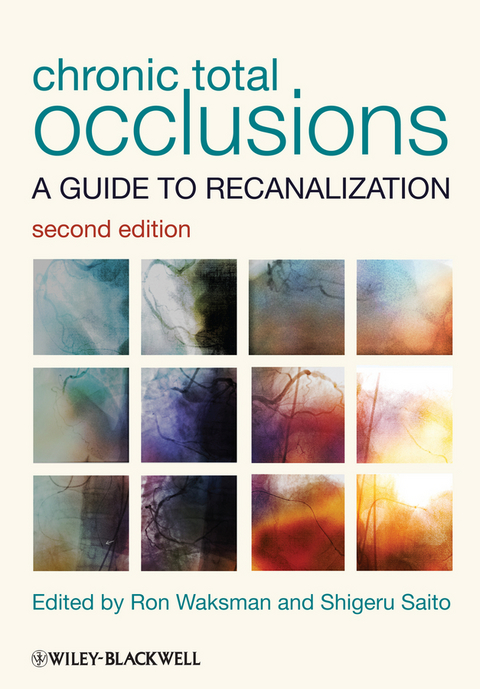
Chronic Total Occlusions (eBook)
John Wiley & Sons (Verlag)
978-1-118-54246-0 (ISBN)
'Chronic total occlusions continue to represent one of the greatest challenges to interventional cardiologists.' - Cardiovascular Research Foundation -
Chronic Total Occlusions or CTOs can be found in 30% of patients with coronary artery disease.
Despite advances, CTOs remain one of the most frequently identified lesions in interventional cardiology yet least likely to be successfully treated.
The prevalence of the disorder is vexing. The threat to your patients is significant. The condition is complex. And, treatment remains a challenge.
Learn how to approach CTOs from internationally-recognized physician-educators
Turn to Chronic Total Occlusions: A Guide to Recanalization, 2e for expert insight into the world of CTOs and clear, practical guidance you can apply directly and immediately in your cath lab.
Offering the most comprehensive information available, this completely updated second edition provides you wih:
- Full-color images from the diagnostic modalities that are essential in identifying CTOs
- Data on indications and efficacy from the most recent clinical trials
- Practical guidance on the selection and use of the latest wires and devices
- Even more tips and tricks from leading operators from the world's busiest centers
- Clinical cases to illustrate some of the more complex scenarios and common complications
- And more!
Chronic Total Occlusions: A Guide to Recanalization, 2e is the guide you can count on to improve the CTO success rate at your facility. Order your copy today!
Edited by
Ron Waksman, MD, FACC
Division of Cardiology, MedStar Washington Hospital Center, Washington, DC, USA
Shigeru Saito, MD, FACC, FSCAI, FJCC
Cardiology & Catheterization Laboratories, Shonan Kamakura General Hospital, Kamakura, Japan
"e;Chronic total occlusions continue to represent one of the greatest challenges to interventional cardiologists."e; - Cardiovascular Research Foundation - Chronic Total Occlusions or CTOs can be found in 30% of patients with coronary artery disease. Despite advances, CTOs remain one of the most frequently identified lesions in interventional cardiology yet least likely to be successfully treated. The prevalence of the disorder is vexing. The threat to your patients is significant. The condition is complex. And, treatment remains a challenge. Learn how to approach CTOs from internationally-recognized physician-educators Turn to Chronic Total Occlusions: A Guide to Recanalization, 2e for expert insight into the world of CTOs and clear, practical guidance you can apply directly and immediately in your cath lab. Offering the most comprehensive information available, this completely updated second edition provides you wih: Full-color images from the diagnostic modalities that are essential in identifying CTOs Data on indications and efficacy from the most recent clinical trials Practical guidance on the selection and use of the latest wires and devices Even more tips and tricks from leading operators from the world s busiest centers Clinical cases to illustrate some of the more complex scenarios and common complications And more! Chronic Total Occlusions: A Guide to Recanalization, 2e is the guide you can count on to improve the CTO success rate at your facility. Order your copy today!
Edited by Ron Waksman, MD, FACC Division of Cardiology, MedStar Washington Hospital Center, Washington, DC, USA Shigeru Saito, MD, FACC, FSCAI, FJCC Cardiology & Catheterization Laboratories, Shonan Kamakura General Hospital, Kamakura, Japan
Chronic Total Occlusions: A Guide to Recanalization 5
Copyright 6
Contents 7
List of Contributors 9
Foreword 13
Preface 14
Part I Pathology, Indications, and Review of Clinical Trials 15
Chapter 1 The pathobiology of CTO 17
Introduction 17
Current paradigm of CTO evolution 17
Development of CTOs 17
Neovascularization and angiogenesis 19
Calcification 19
Current research in CTO pathobiology 20
CTO imaging techniques 20
Summary 21
References 21
Chapter 2 Collateral circulation in CTO 23
Introduction 23
Coronary collateral arteries in healthy individuals in patients affected by CAD and after acute myocardial infarction 23
Stimuli of coronary collateral growth 24
Coronary collateral arteries classification 25
The prognostic value of collateral circulation 25
Changes in collateral circulation after CTO recanalization 28
References 29
Chapter 3 CTO: review of trials 32
Factors associated with successful CTO-PCI 32
Clinical benefits of CTO-PCI 33
Drug-eluting stents in CTO-PCI 35
Long-term follow-up 35
Conclusions 37
References 37
Chapter 4 CTO-percutaneous coronary intervention: what is the evidence? 40
Introduction 40
Outcome benefits associated with CTO-PCI 40
Predictors of CTO-PCI success 41
CTO-PCI techniques – planning the PCI strategy 42
Predictors of reocclusion and restenosis 43
Conclusions 44
References 44
Chapter 5 Case selection and long-term benefits 47
Prevalence of chronic total occlusion 47
Prognosis with CTO 47
CTO-PCI trends 48
Case selection and long-term benefits 51
Conclusion 52
References 53
Part II Imaging 57
Chapter 6 CT angiography: application in chronic total occlusions 59
Introduction 59
Overview of utility of CT scan to the coronary artery disease 59
Pathology 59
How is pathology reflected by CTA imaging? 60
What do we expect to see based on the CT density and spatial resolution? 60
Clinical results to date and impact on the interventional procedure 63
Future perspectives 63
Conclusions 63
References 64
Chapter 7 Co-registration CTO and CT angiography 65
Introduction 65
How image co-registration is performed 66
Initial experience using co-registration for CTO PCI 67
Conclusion 69
References 71
Chapter 8 Optical coherence tomography to guide the treatment of chronic total occlusions 74
Introduction 74
Principles of intra-coronary optical coherence tomography 74
Use of OCT for CTO assessment before stenting 75
Use of OCT to optimize stent deployment 77
OCT to assess the long-term success of PCI for CTO 78
Conclusion 79
References 79
Chapter 9 IVUS-guided CTO-PCI 81
Introduction 81
The role of IVUS-guided PCI for CTO lesions 81
Devices for IVUS-guided CTO-PCI with the antegrade approach 88
How to perform IVUS guided CTO-PCI with the antegrade approach 88
Impact of IVUS guidance on overall success rate 91
Conclusion 91
References 91
Chapter 10 IVUS evaluation of CTO 92
Introduction 92
IVUS morphological findings 92
IVUS findings during intervention 93
IVUS findings for follow-up after CTO procedures 97
References 97
Chapter 11 Magnetic navigation wire 99
Introduction 99
The current and future magnetic navigation wires 99
Navigational modes to orientate the magnetic tip 100
The theory of radiofrequency (RF) ablation in CTO 101
Magnetic navigation and MSCT co-integration in CTOs 103
Limitations 104
Conclusion 104
References 104
Part III Wires Technology 105
Chapter 12 Deflecting wire systems 107
References 109
Chapter 13 Asahi wires 111
Introduction 111
Important parameters for PCI guidewires 111
Line-up of Asahi guidewires for CTO lesions 113
Classification of Asahi guidewires for CTO lesions according to technique 115
Conclusion 118
Chapter 14 IVUS-guided recanalization of CTO 119
IVUS-guided wiring at CTO entrance 119
IVUS-guided penetration from subintimal space 120
References 122
Chapter 15 Frontrunner CTO technology 123
References 125
Chapter 16 Channel dilator: Corsair 127
Introduction 127
Structure of Corsair microcatheter 127
Retrograde approach and the role of the Corsair channel dilator 127
Case example of the successful recanalization of a complex CTO lesion with a Corsair microcatheter 129
Corsair Registry 130
Complications 130
Antegrade use of Corsair 130
Conclusions 130
References 130
Part IV Wires Technique 133
Chapter 17 Tornus catheter 135
Introduction 135
Device description 135
Penetration and removing 135
Breakage of the shaft 136
Another use of Tornus 136
Possible complication 136
Transradial approach 138
Case presentation 138
Acknowledgment 138
References 138
Chapter 18 Antegrade approach: step by step 140
Step 1: preparation 140
Step 2: access and guiding catheters 140
Step 3: wire selection 141
Step 4: wire shaping 142
Step 5: single wire manipulation 143
Step 6: the parallel wire technique 144
Step 7: penetrating the distal fibrous cap 145
Step 8: seesaw technique and beyond 146
Step 9: when to stop antegrade 147
References 147
Chapter 19 Use of two wires in the treatment of CTO 148
Use of a second wire for guiding catheter stability (anchoring wire technique) 148
Use of a second wire for side-branch protection 148
Second wire for correction of proximal tortuousities 148
Need for different types of wire for crossing the lesion 148
Two wires or more for parallel wire technique 149
Branch techniques 149
IVUS guidance 150
Wires and retrograde approach 152
Buddy wire technique 154
Anchoring balloon technique 154
Anchoring stent technique 155
Conclusion 155
References 156
Chapter 20 Parallel-wire techniques 157
Introduction 157
Parallel-wire technique 157
Technique description 157
Use of the parallel-wire technique 159
Conclusion 160
References 160
Chapter 21 Guidewire handling techniques for CTO lesions 161
Introduction 161
Unique physical properties of CTO guidewires 161
How to shape the tip of the guidewire 161
Use of an over-the-wire system 162
How to handle the guidewires 162
Selection of guidewires and handling techniques 165
Adjunctive techniques 166
Conclusion 168
References 168
Chapter 22 Subintimal angioplasty in coronary CTO 169
Introduction 169
Subintimal angioplasty: the concept 169
When to use subintimal angioplasty technique 169
Subintimal angioplasty related techniques 170
STAR technique 171
CART 172
Reverse CART 172
LAST technique 172
Knuckle-wire technique 172
IVUS-guided CTO 172
Dedicated re-entry devices system 174
Conclusion 174
Disclosure 174
References 174
Chapter 23 Antegrade device assisted re-entry techniques 176
Conclusion 178
References 178
Chapter 24 The microchannel technique 180
Background 180
The theory 181
The technique 181
Outcomes 183
Intra-plaque therapy 183
Evolution of the technique 184
Summary 184
References 185
Chapter 25 The STAR technique 186
The origins of the technique 186
The evolution of the STAR technique: the “guided-STAR” technique 187
Analogies between the STAR technique and the CART and reverse CART technique 189
Clinical outcome and risk of stent thrombosis after STAR technique 190
New devices to facilitate the re-entry techniques: Stingray re-entry system and the newest plastic-jacket hydrophilic guidewires 190
Clinical and procedural indications for the STAR technique and final considerations 191
References 191
Chapter 26 Attempting CTO after first failed attempt 192
Reasons for procedural failure 192
Rationale for attempting CTO after first failed attempt 192
Decision on the strategy after first failed attempt 193
Retrograde techniques following first failed CTO attempt 195
Inability to cross with the device following successful crossing of the guidewire 195
Clinical experience 195
Conclusions 196
References 196
Chapter 27 Transradial approach for CTO lesions and tapered-tip guidewires 198
Introduction 198
Rationale for the use of tapered-tip guidewire 198
Special considerations for TRI in CTO lesions 200
Novel techniques that are particularly useful during TRI 200
Conclusion 204
References 204
Chapter 28 Bilateral approach 205
Retrograde access 205
Chronic total occlusion crossing techniques in the retrograde approach 207
Conclusion 209
References 211
Chapter 29 Tips and tricks of the CART technique 212
Considerations in the CART technique 212
Tips and tricks 212
References 219
Part V Devices Technology 221
Chapter 30 Recanalizing total occlusion in the periphery: utilization of radio frequency and other technology 223
Introduction 223
Pathology of total occlusion 223
Patient selection 223
Crossing total occlusions 224
Subintimal angioplasty 224
Re-entry devices 225
Angioplasty and stenting 226
Complications 226
Chronic total occlusion devices 227
Medical management 232
Future technologies 233
Conclusions 234
References 235
Chapter 31 High-frequency mechanical revascularization 240
The Crosser system 240
Clinical study results 241
Clinical impact and future perspective 242
References 242
Chapter 32 Debulking of CTO 244
Indications of plaque debulking 244
Outcome of CTO-PCI 247
Role of plaque debulking in CTO-PCI 247
Conclusion 247
References 248
Chapter 33 Vibrational angioplasty 249
Introduction 249
Technology description 249
Vibrational angioplasty procedure 249
Advantages and potential disadvantages 250
Experimental experience 250
Clinical experience 250
Is vibrational angioplasty still a useful tool? 252
References 253
Chapter 34 Treatment of chronic total coronary occlusions with drug-eluting stents: overview of angiographic and clinical outcomes 254
Introduction 254
Clinical rationale for DES in percutaneous revascularization of coronary occlusions 254
Contemporary DES trials in CTO revascularization 256
Conclusion 261
References 263
Chapter 35 Laser for CTO recanalization 265
Introduction 265
Clinical applications of laser 265
Laser technology 267
Coronary total occlusions 267
SFA total occlusions 268
Total occlusions in critical limb ischemia 269
Summary 269
References 269
Chapter 36 The ENABLER-P: a novel CTO crossing cystem 271
Introduction 271
The ENABLER-P Balloon Catheter System 272
Clinical experience 273
Tips and tricks using the ENABLER-P Balloon Catheter System 274
Current perspective and future direction 275
References 275
Chapter 37 Collagenase plaque digestion for facilitating guidewire crossing 276
Introduction 276
Collagens: the major structural components of the extracellular matrix 276
Collagenase formulations 277
Rabbit models of femoral artery CTO 278
Collagenase local delivery rabbit model 278
Clinical experience with collagenase 278
The Collagenase Total Occlusion-1 (CTO-1) clinical trial 279
Summary 279
Future directions 280
References 280
Chapter 38 The BridgePoint re-entry system 282
Introduction 282
Device description and technique for use 282
Clinical experience 283
Conclusion 286
References 286
Part VI Complications 287
Chapter 39 Complications during the retrograde approach for CTO 289
Introduction 289
Classification of complications 289
Summary 292
References 292
Chapter 40 CTO: how to minimize contrast nephropathy 293
Introduction 293
Chronic total occlusions 293
Definition 293
Pathophysiology 294
Risk factors 294
Prophylactic measures 294
Summary 299
References 299
Part VII Interesting Cases 303
Chapter 41 Interesting cases I–VI 305
Case I (Figures 41.1, 41.2, 41.3) 305
Case II (Figure 41.4) 307
Case III [1] (Figure 41.5) 307
Case IV [2] (Insert Figure 41.6) 309
Case V (Figure 41.7) 312
Case VI (Figure 41.8) 314
References 314
Index 315
"This is a very helpful book for those interested in
invasive treatment of CTOs. The authors provide practical
explanations, supplemented by detailed imaging and pragmatic
discussions of the latest advances in their treatment."
(Doody's, 4 October 2013)
| Erscheint lt. Verlag | 4.2.2013 |
|---|---|
| Sprache | englisch |
| Themenwelt | Medizin / Pharmazie ► Allgemeines / Lexika |
| Medizinische Fachgebiete ► Innere Medizin ► Kardiologie / Angiologie | |
| Schlagworte | Advances • Artery • Cardiologists • Cardiovascular • challenges • Chronic • continue • coronary • ctos • despite • Disease • Foundation • Greatest • Interventional • Interventional cardiology • Invasive Kardiologie • Kardiologie • least • Medical Science • Medizin • patients • Remain • Research • total occlusions |
| ISBN-10 | 1-118-54246-0 / 1118542460 |
| ISBN-13 | 978-1-118-54246-0 / 9781118542460 |
| Informationen gemäß Produktsicherheitsverordnung (GPSR) | |
| Haben Sie eine Frage zum Produkt? |
 PDF (Adobe DRM)
Kopierschutz: Adobe-DRM
Adobe-DRM ist ein Kopierschutz, der das eBook vor Mißbrauch schützen soll. Dabei wird das eBook bereits beim Download auf Ihre persönliche Adobe-ID autorisiert. Lesen können Sie das eBook dann nur auf den Geräten, welche ebenfalls auf Ihre Adobe-ID registriert sind.
Details zum Adobe-DRM
Dateiformat: PDF (Portable Document Format)
Mit einem festen Seitenlayout eignet sich die PDF besonders für Fachbücher mit Spalten, Tabellen und Abbildungen. Eine PDF kann auf fast allen Geräten angezeigt werden, ist aber für kleine Displays (Smartphone, eReader) nur eingeschränkt geeignet.
Systemvoraussetzungen:
PC/Mac: Mit einem PC oder Mac können Sie dieses eBook lesen. Sie benötigen eine
eReader: Dieses eBook kann mit (fast) allen eBook-Readern gelesen werden. Mit dem amazon-Kindle ist es aber nicht kompatibel.
Smartphone/Tablet: Egal ob Apple oder Android, dieses eBook können Sie lesen. Sie benötigen eine
Geräteliste und zusätzliche Hinweise
Buying eBooks from abroad
For tax law reasons we can sell eBooks just within Germany and Switzerland. Regrettably we cannot fulfill eBook-orders from other countries.
aus dem Bereich